
Resume & ATS
Skills to put on a resume in 2026: what employers rank, and how an ATS reads them
What decides whether your skills get you an interview is which ones you choose for the job, how you name them so software and recruiters find them, and whether the rest of your resume proves them. This guide covers all three, using the employer data published in 2026.
What skills should you put on a resume?
Put roughly 8 to 15 skills (a working convention, no study sets the number) that match the job you are applying to, mostly hard skills named the way the posting names them: tools, methods, languages, certifications. Show your soft skills in your experience bullets instead of listing them. In NACE’s 2026 survey, 59% of the 161 employers who answered the question preferred specific skills backed by examples, and only 1.9% wanted a list of general skills with nothing behind it.
Published 10 October 2026. Every figure is sourced at the end, with its sample size and who paid for the study when that matters.
What skills do employers look for on a resume in 2026?
Teamwork, problem-solving and communication lead, and technical skills follow close behind. The US National Association of Colleges and Employers asks employers every year which attributes they look for on a candidate’s resume, and its 2026 spring update, surveyed between 12 February and 17 March 2026, is the most recent large answer to that question.
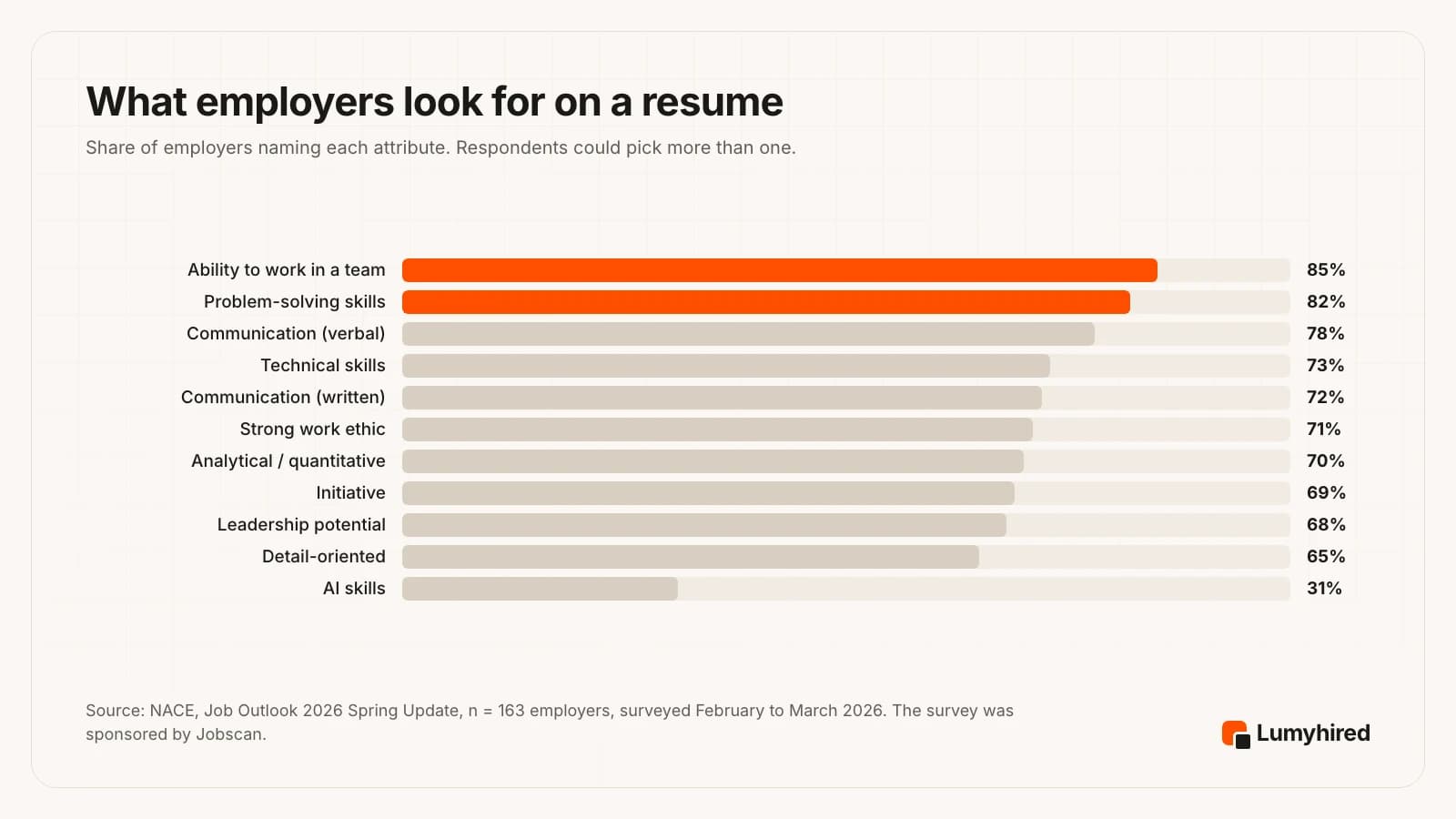
Of 163 employers, 85% named the ability to work in a team, 82% problem-solving, 78% verbal communication, 73% technical skills and 72% written communication. Work ethic, analytical skills, initiative, leadership potential and attention to detail all sit between 65% and 71%. AI skills are on the list too, named by 31%.
Two things to keep in mind when reading it. First, NACE surveys US employers that hire graduates, so the ranking leans toward early career hiring; an experienced hire is judged more on domain skills the survey does not list. Second, the 2026 edition was sponsored by Jobscan, a resume optimisation company.
LinkedIn’s own read of the market points the same way from a different angle. Its Skills on the Rise 2026 report, published on 24 February 2026, stopped publishing a single top-15 list and instead grouped the fastest-growing skills into clusters, under headings such as AI technical skills, process optimisation, communication and stakeholder management, financial acumen and team management. The pattern across both sources is the same: one cluster of skills that are specific to the work, and one cluster about how you work with people. A good resume needs evidence of both.
Hard skills vs soft skills: what is the difference?
Hard skills are specific and checkable. Soft skills describe how you work. The line matters on a resume because the two are proven in different places.
O*NET, the occupational database sponsored by the US Department of Labor, separates what it calls essential skills (reading, writing, mathematics, learning) from transferable skills, which it describes as skills you can use across different jobs, such as communication, problem solving and teamwork. It also lists software skills as a category of their own.
| Hard skills | Soft skills | |
|---|---|---|
| Examples | SQL, Salesforce, IFRS, AutoCAD, Spanish, a nursing licence | Communication, teamwork, adaptability, problem-solving |
| Can be tested | Yes, directly | Only through what you did |
| Where it goes | Skills section, by name | Experience bullets, as evidence |
| How software sees it | Extracted and matched against the posting | Rarely searched for by name |
Which matter more, hard skills or soft skills?
Both, at different stages of the same process. The NACE ranking puts three soft skills at the top, which can read as an argument for filling the skills section with them. The recruiter data says the opposite about how candidates get found.
Jobscan’s 2025 survey of 384 recruiters found that 76.4% filter candidates by skills when they search their applicant database, ahead of education at 59.7% and job title at 55.3%. Nobody types “team player” into that search box. They type “Salesforce”, “IFRS 16” or “Python”. Hard skills are how you get found; soft skills are what the person who found you is looking for once they start reading.
That resolves the apparent contradiction. Let named hard skills carry the skills section, because that is where software and searches look. Let soft skills appear where a reader can believe them, attached to something you did.
How does an ATS read your skills section?
It extracts the skills as text, maps each one to an entry in a skills taxonomy, and makes them searchable and comparable with the posting. Each of those steps changes how you should write the section.
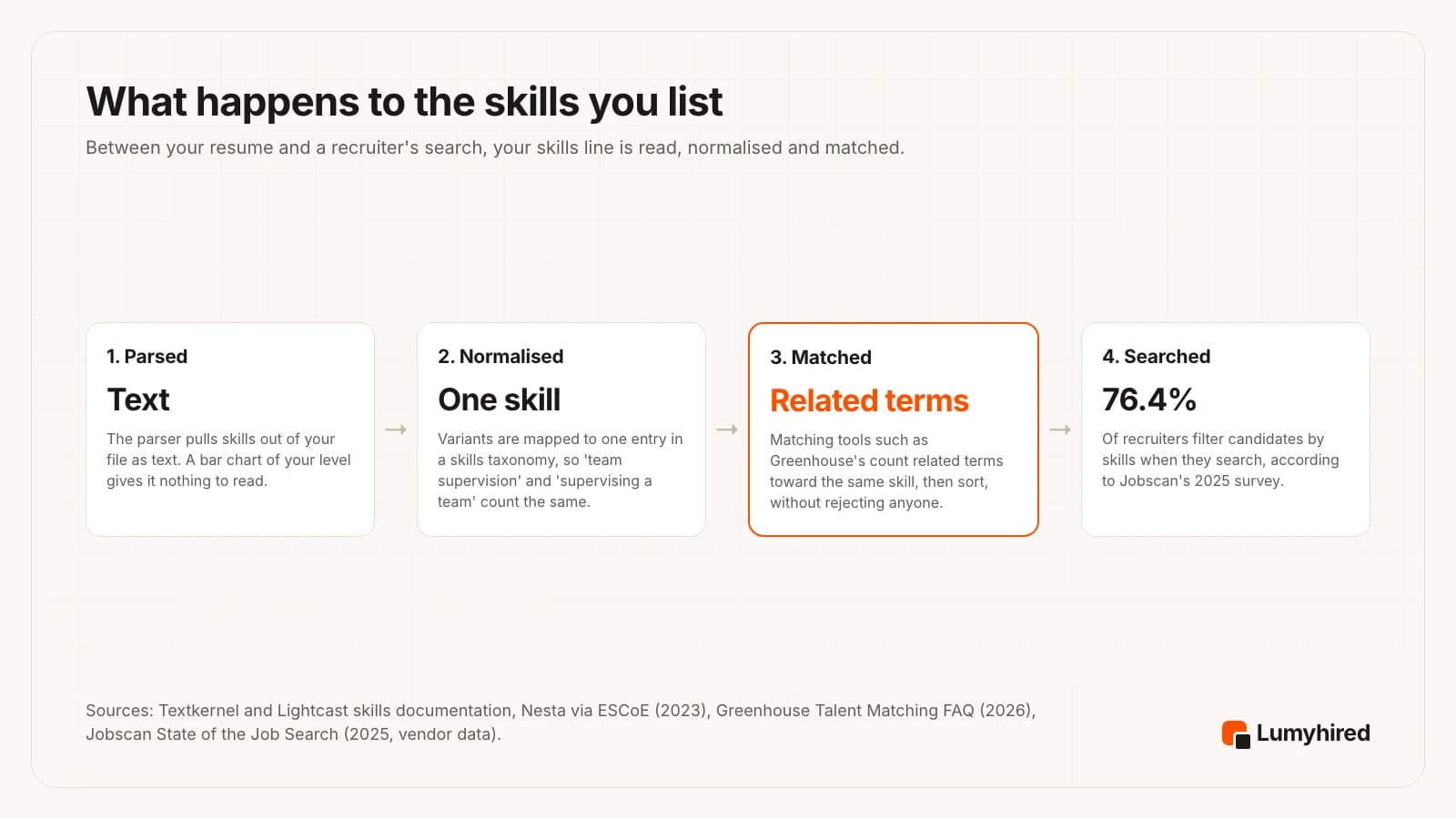
Parsing. The parser reads your file and pulls out anything that looks like a skill. It reads text. A skill shown as a bar, a set of stars, an icon or a word inside an image has nothing for it to extract, so that information never reaches the system a recruiter searches.
Normalisation. The extracted skill is mapped to a standard entry. Textkernel’s documentation describes a skills taxonomy with three layers: categories, skills, and the synonyms and variations that name the same skill, updated four times a year. Lightcast’s open taxonomy holds more than 34,000 skills drawn from job postings and profiles. Researchers at Nesta gave the clearest example of what this does in practice: “team supervision” and “supervision of a team” both resolve to one skill, “supervise a team”.
Matching. Greenhouse’s Talent Matching FAQ, updated in September 2026, says its matching counts related terms toward the same skill and sorts candidates into bands from Strong to Limited against criteria the recruiter weights. It does not reject anyone. Automatic rejection, per its separate auto-reject page, only comes from answers to screening questions a recruiter set up as rules.
Search. Then a person searches, and three in four filter by skills. That is where exact naming still pays, because a recruiter types one specific word.
The practical rules that follow: write skills as plain text in a section headed “Skills”; use the standard name of each tool and method, and the posting’s own term where it differs; spell out an acronym once (“search engine optimisation (SEO)”) so either form is found; and drop graphical ratings. Whether your file survives the first step at all is something you can check: the free ATS preview shows exactly what a parser extracts from your resume, skills included. The wider mechanics of screening are in how ATS filters actually work.
How to list skills on a resume
One section, a plain heading, the most relevant skills first, and a short list of groups once you pass about ten. Here is the shape that works for most roles.
SKILLS
Analysis:   SQL (BigQuery, Postgres), Python (pandas), Excel modelling
Reporting:  Looker, Tableau, dbt
Methods:    A/B testing, cohort analysis, forecasting
Languages:  English (native), Spanish (professional working)
- Order by relevance to this posting. The first three skills are the ones a skimming recruiter reads. Put the ones the job ad mentions first.
- Group past ten. Categories such as “Analysis” or “Tools” make a long list readable and show breadth at a glance. Keep each group to one line.
- Add the detail that makes a skill specific. “Python (pandas, three years in production)” tells a reader far more than “Python”. This is exactly the “specific skills” NACE’s employers asked for.
- Repeat your top skills in the summary. Two or three of them, in a sentence, at the top of the page. It is the first thing a reader sees and costs nothing.
- Keep the heading standard. “Skills”, “Technical skills” or “Core skills”. A creative heading can stop a parser from recognising the section.
Choosing which skills to put first is the same exercise as tailoring the whole resume, covered step by step in how to tailor your resume to a job description, and the words to use are in resume keywords.
How many skills should you put on a resume?
Roughly 8 to 15, chosen for the job. No study establishes a right number, so any precise figure you read elsewhere is a convention presented as a rule. Each of the 17 role examples on this site lists between 10 and 14 skills, which is a reasonable middle.
The real limit is defensibility. Every skill on the page is something an interviewer is entitled to ask about. A list of 30 almost always includes several you used once, years ago, and the one question about those is the one you remember after the interview. Fewer skills, each one current and specific, beats a long list on both the software side and the human side.
How do you prove your skills on a resume?
You attach each one to something you did, with a result. This is the single most useful finding in the 2026 employer data.
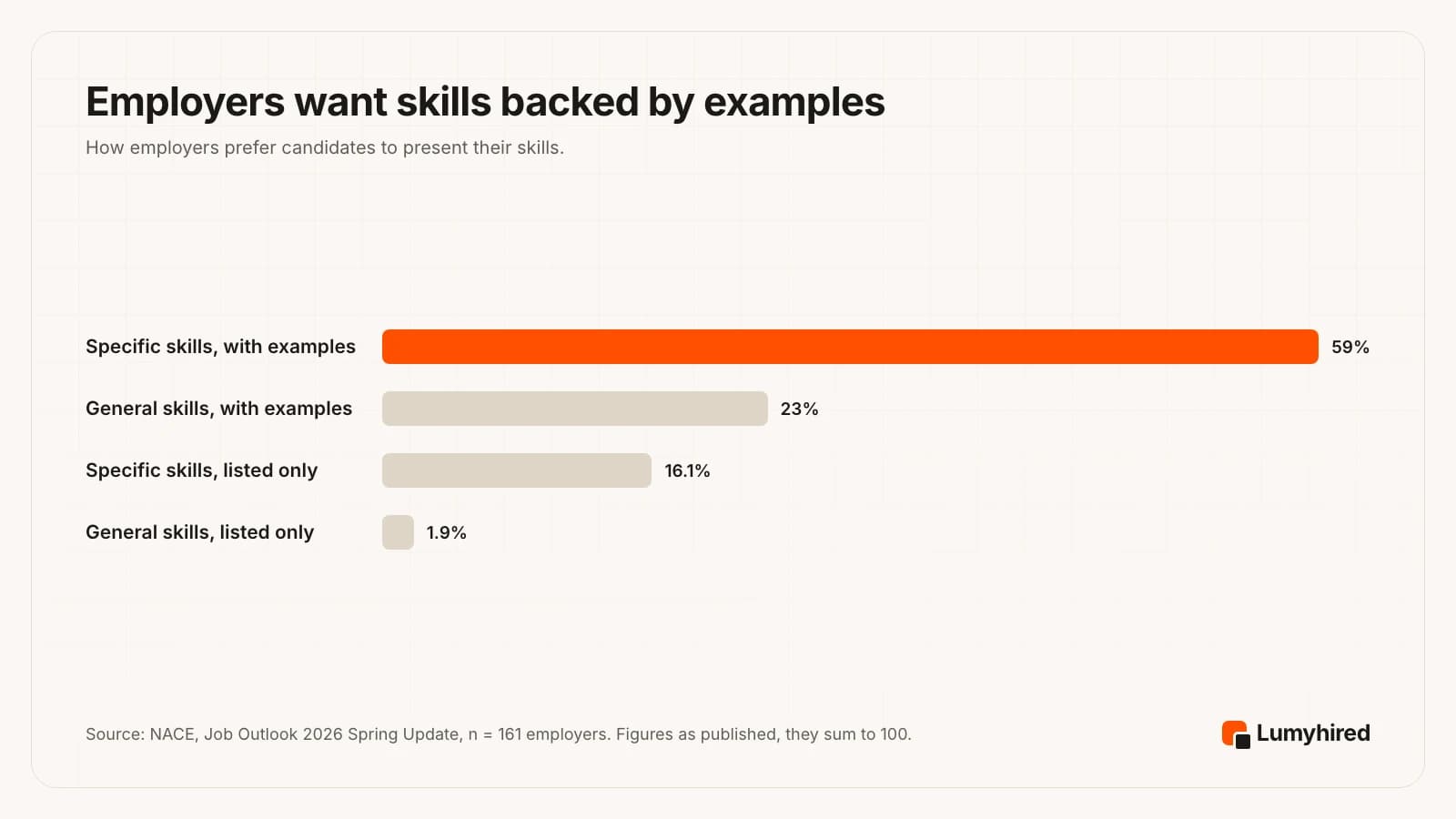
Asked how they want candidates to present skills, 59% of 161 employers chose specific skills with examples, 23% general skills with examples, 16.1% a list of specific skills, and 1.9% a list of general skills. Put the two “with examples” answers together and 82% of employers want proof. A bare list of general skills is what almost nobody asked for.
In practice, the skill goes into a bullet as an action and an outcome:
Listed
Strong communication and stakeholder management skills.
Proven
Presented the monthly close to the finance director and three regional heads, and rewrote the pack so it fit on two pages.
Listed
Problem-solving, analytical thinking.
Proven
Traced a recurring stock mismatch to a unit-of-measure error in two supplier feeds and fixed the mapping, ending a weekly manual correction.
The proven versions never use the word “communication” or “problem-solving”, and they demonstrate both. They also carry the hard skills a search will look for. Name the tool in the skills section, then show it working in a bullet.
Skills examples by job
The right skills depend on the role, so here are three from each of 17 complete resume examples on this site. Each link opens the full example, with every skill, a summary and sample bullets.
| Job | Three skills from the example |
|---|---|
| Software Engineer resume | JavaScript / TypeScript · Python · Go |
| Data Analyst resume | SQL (Postgres, BigQuery, Snowflake) · Python (pandas, NumPy, scikit-learn) · R |
| Project Manager resume | Scope, schedule and budget ownership · Risk and dependency management · Agile / Scrum, Kanban |
| Registered Nurse resume | Patient assessment and triage · Medication administration and titration · IV insertion and central line care |
| Accountant resume | Month-end and year-end close · Balance sheet reconciliations · Accounts payable / receivable |
| Marketing Manager resume | Campaign strategy and planning · Paid acquisition (Google Ads, Meta, LinkedIn) · SEO and content strategy |
| Sales Representative resume | New business development · Consultative and solution selling · Pipeline management and forecasting |
| Customer Service Representative resume | Zendesk, Freshdesk, Intercom, Salesforce Service Cloud · Omnichannel support (phone, email, live chat, social) · Ticket triage and queue management |
| Administrative Assistant resume | Calendar management across multiple time zones · Travel booking, itineraries and visa coordination · Expense processing (Concur, Expensify) |
| Financial Analyst resume | Three-statement financial modelling · DCF, NPV and valuation analysis · Budgeting, annual planning and rolling forecasts |
| Human Resources Manager resume | Employee relations casework (grievance, disciplinary, performance) · Employment law compliance and policy drafting · HRIS administration (Workday, SAP SuccessFactors, BambooHR, Personio) |
| Operations Manager resume | Cost centre and P&L ownership · Process improvement (Lean, Six Sigma, Kaizen, 5S) · KPI and SLA management |
| Mechanical Engineer resume | SolidWorks, Creo, CATIA, Inventor · AutoCAD and 2D detailing · FEA (ANSYS, Abaqus, SolidWorks Simulation) |
| Graphic Designer resume | Adobe Illustrator, Photoshop, InDesign · Adobe After Effects and Premiere Pro · Figma (design systems, components, prototyping) |
| Director of Finance resume | Financial strategy and long-range planning · Board and investor reporting · Group consolidation and statutory reporting (IFRS / US GAAP) |
| Teacher resume | State teaching certification (subject area and grade band) · Standards-aligned lesson and unit planning · Differentiated instruction and small-group intervention |
| Student resume | Microsoft Excel (pivot tables, XLOOKUP, charts) · SQL (SELECT, joins, aggregation) · Python (pandas, statsmodels, Matplotlib) |
Notice how specific the entries are: “SQL (Postgres, BigQuery, Snowflake)”, “Zendesk, Freshdesk, Intercom”, “FEA (ANSYS, Abaqus, SolidWorks Simulation)”. Specific names are what a recruiter searches for, and what NACE’s employers said they want to see.
What skills should you put on a resume with no experience?
The same ones, proven with different evidence. Without job titles to carry the page, the skills section and the bullets under projects, coursework, volunteering and part-time work do the selling, so put the skills section high, directly under the summary.
- Coursework and projects. Name the tool and the output. “Built a sales dashboard in Excel and Power BI from 12 months of store data for a marketing module” proves two hard skills and some analysis in one line.
- Part-time and volunteer work. Customer-facing jobs prove the skills at the top of the NACE ranking. “Ran the till and the closing cash count alone on weekend shifts” shows reliability and attention to detail without using either word.
- Certificates you can finish in weeks. A vendor certificate in a tool the posting names is a hard skill with a date attached.
This matters most for graduates, because the NACE survey is about them: these are employers hiring people at the start of a career, and 82% of them want skills shown with examples. A first resume that lists “teamwork, communication, problem-solving” with nothing behind them is the format 1.9% asked for. Where to look for that first job is covered in job search tools for new graduates.
Career changers have the opposite problem: plenty of experience, described in the vocabulary of the old job. Keep the facts and change the words. A teacher moving into training design already has curriculum design, needs analysis and assessment design, which are the terms a learning and development posting uses. O*NET’s transferable skills category describes exactly this kind of skill, one that carries across occupations, and it is the part of your skills section worth rewriting first.
Should you list AI skills on your resume?
Yes, if you can name what you used and what it produced. AI skills appear in NACE’s 2026 employer ranking, named by 31% of employers, and LinkedIn’s Skills on the Rise report now has two AI headings of its own, AI technical skills and AI leadership. The way it is usually written gives a recruiter nothing to search for.
“AI-savvy” or “proficient in AI tools” tells a reader nothing, for the same reason “good with computers” told them nothing in 2005. It cannot be searched, and it raises a question it does not answer. What works is the same rule as for every other hard skill: the specific tool, and what you did with it.
In the skills section
AI tools: ChatGPT and Claude (prompt templates, document drafting), Microsoft Copilot in Excel
In a bullet
Built a set of prompt templates for the weekly client report, reviewed every output against source data, and cut preparation from a day to two hours.
Note the middle of that bullet: reviewed every output against source data. A reader who sees AI on a resume will wonder whether the output was checked, and that half of the bullet answers the question before it is asked. If your AI use was writing your own resume, that is not a skill to list. How to use it well for that is covered in using ChatGPT on a resume.
What skills should you leave off your resume?
- Skills every applicant has. Email, web browsing, Microsoft Word for an office role. Listing them suggests you have little else to list, unless the posting names them explicitly.
- Adjectives. “Hard-working”, “detail-oriented”, “passionate”. They are claims about character, and they cannot be searched or checked.
- Technology nobody runs any more. It dates you and takes space from something current. Keep it only if the posting asks for legacy experience.
- Skills you could not discuss in an interview. If a question about it would expose that you used it once, it is costing you more than it earns.
- Self-ratings. Stars, bars and percentages. They vanish in parsing and mean nothing to a reader.
Does skills-based hiring change what you should list?
Less than the headlines suggest. Many employers say they hire on skills, and the hiring data shows most of them still hire much as before, so make both your skills and your credentials easy to find.
TestGorilla, which sells skills tests, reported in April 2025 that 85% of the 1,084 hiring decision-makers it surveyed use skills-based hiring and 53% have dropped degree requirements. A study by the Burning Glass Institute and Harvard Business School looked at 11,300 roles at large firms that removed a degree requirement from their postings. About 45% of those firms made no meaningful difference to who they hired, roughly one in five more made gains that did not last, and nearly all the change came from 37% of them. Across the market, the authors put the extra opportunity at fewer than one in 700 hires in the previous year.
The policy changed at every one of those firms, and hiring changed at just over a third of them. Keep your education section, keep your certifications, and make your skills specific enough to stand on their own for the employers who do read them.
Frequently asked questions
What are 10 good skills to put on a resume?
What skills are most valued by employers?
What is the difference between hard skills and soft skills?
How many skills should I put on a resume?
Is it good to put soft skills on a resume?
Should I rate my skills with stars or bars?
Where should the skills section go on a resume?
Do I need to match the skills in the job description exactly?
Check that your skills survive the parser
Run your resume through the ATS preview, which is free and needs no account, and read the skills a parser actually extracts. If one you rely on is missing, it is invisible to every recruiter search. Then match your skills to each posting with the ATS resume checker. Weekly plans start at €5 on the pricing page, with a 3-day money-back window and no free plan.
For a complete resume in your field, browse the resume examples by job.
Sources
Vendor data and sponsored surveys are marked as such. The World Economic Forum’s Future of Jobs report was not cited because its pages could not be opened for verification on the date this was written. Read 9 October 2026.
- NACE, The Key Skills Employers Seek on College Students' Resumes, Job Outlook 2026 Spring Update, 20 April 2026 (163 and 161 employer respondents; the survey was sponsored by Jobscan)
- NACE, press release, 23 April 2026
- NACE, Job Outlook 2026 Spring Update, survey slide deck (figures for the 161 and 163 respondent questions, including the skills-presentation chart and AI skills), copy hosted by the Association of Presbyterian Colleges and Universities
- Jobscan, The State of the Job Search in 2025, 25 February 2025 (384 recruiters; Jobscan sells resume optimisation)
- LinkedIn News, LinkedIn Skills on the Rise 2026, 24 February 2026
- Textkernel, Skills API overview, read 9 October 2026
- Lightcast, Open Skills and Skills Extractor FAQ, read 9 October 2026
- Nesta researchers on the ESCoE blog, mapping job advert skills to ESCO, 13 March 2023
- Greenhouse, Talent Matching FAQ, updated 3 September 2026
- Greenhouse, Auto-reject help page, updated 30 January 2026
- O*NET Resource Center, content model and descriptor definitions, read 9 October 2026
- Sigelman, Fuller and Martin, Skills-Based Hiring: The Long Road from Pronouncements to Practice, Burning Glass Institute and Harvard Business School, February 2024
- TestGorilla, The State of Skills-Based Hiring 2025, April 2025 (1,084 hiring decision-makers; TestGorilla sells skills tests)
Read next
- How Long Should a Resume Be? (2026 Evidence)
One page or two by career stage, the 2025 federal two-page rule, what the length studies and ATS documentation actually show, and how to cut a resume to one page.
- Resume Summary Examples by Career Stage (2026)
24 resume summary and objective examples by career stage, a four-part formula, three before and after rewrites, and what recruiters and ATS do with a summary.
- Resume Keywords in 2026
A worked extraction on a sample job posting, how recruiter Boolean search and related-term matching read your resume, and keyword lists by role from O*NET.
- How to Tailor Your Resume to a Job Description
A 15-minute method with three before and after bullets, an AI prompt that forbids invented facts, and Huntr's data: tailored resumes got interviews at 4.23% vs 2.07% in Q1 2026.
- How to Pass ATS Filters in 2026
What Greenhouse, Workday, Teamtailor, Lever and iCIMS say their software does to your resume, the one mechanism that rejects automatically, and where the 75% myth came from.
- Best Resume Format for AI Screening
Which format rules vendors actually document, a two-minute copy-paste parse test, and how to build and check an ATS-safe template in Word or Google Docs.
- ChatGPT Resume: What to Prompt, What to Fix
A four-prompt chain that does not produce a generic draft, the six things to fix in every output, and what the 2026 research says about AI detectors.