
Resume & ATS
Resume summary examples for 2026: a formula, 24 examples by career stage, and what recruiters do with them
The summary is the paragraph at the top of the page, under your name. This guide gives a four-part formula for writing one, a rule for when an objective fits better, 24 examples from graduate to executive, three weak summaries rewritten, and the eye-tracking, survey and vendor documentation on how people and software treat that paragraph.
What is a good resume summary?
A good resume summary is two to four sentences at the top of the page that name the job you do, your scope, one result with a number, and two or three skills the posting asks for. Use an objective only when your experience does not yet match the role: students, career changers and people returning to work. Put the job title in the first words: in the 2018 eye-tracking study by Ladders, a job site, the initial screen averaged 7.4 seconds.
Published 14 October 2026. Every figure in the text is sourced at the end, with its sample size and who ran the study when that matters. Numbers inside the example summaries are illustrative.
What is a resume summary, and how is it different from an objective?
A resume summary is a short paragraph under your name that says what you do, at what scale, and with what result. An objective says which role you want and why you can do it. A headline is the one line above both that names the job. They answer three different questions for the reader, and a resume needs at most two of them.
| Summary | Objective | Headline | |
|---|---|---|---|
| Answers | What have you done? | What are you aiming for? | What are you? |
| Length | 2 to 4 sentences | 1 or 2 sentences | One line |
| Best for | Anyone whose past jobs match the target job | Students, career changers, people returning to work | Everyone |
| Must contain | Title, scope, one result, matching skills | Target role, transferable proof, matching skills | The job title the posting uses |
The rule that decides between the first two is simple. If someone reading your last two job titles would already guess the job you are applying for, write a summary. If they would not, the objective tells the reader which role to read the rest of the page against. Textkernel’s parser keeps the two apart as well: its resume data model stores a professional summary and a written objective in separate fields, covered further down.
How do you write a resume summary?
Write four parts in this order: the title, the scope, one proof, and the match with the posting. Two to four sentences is the usual length; no study sets the number, so treat it as a convention that keeps the paragraph readable in a few seconds.
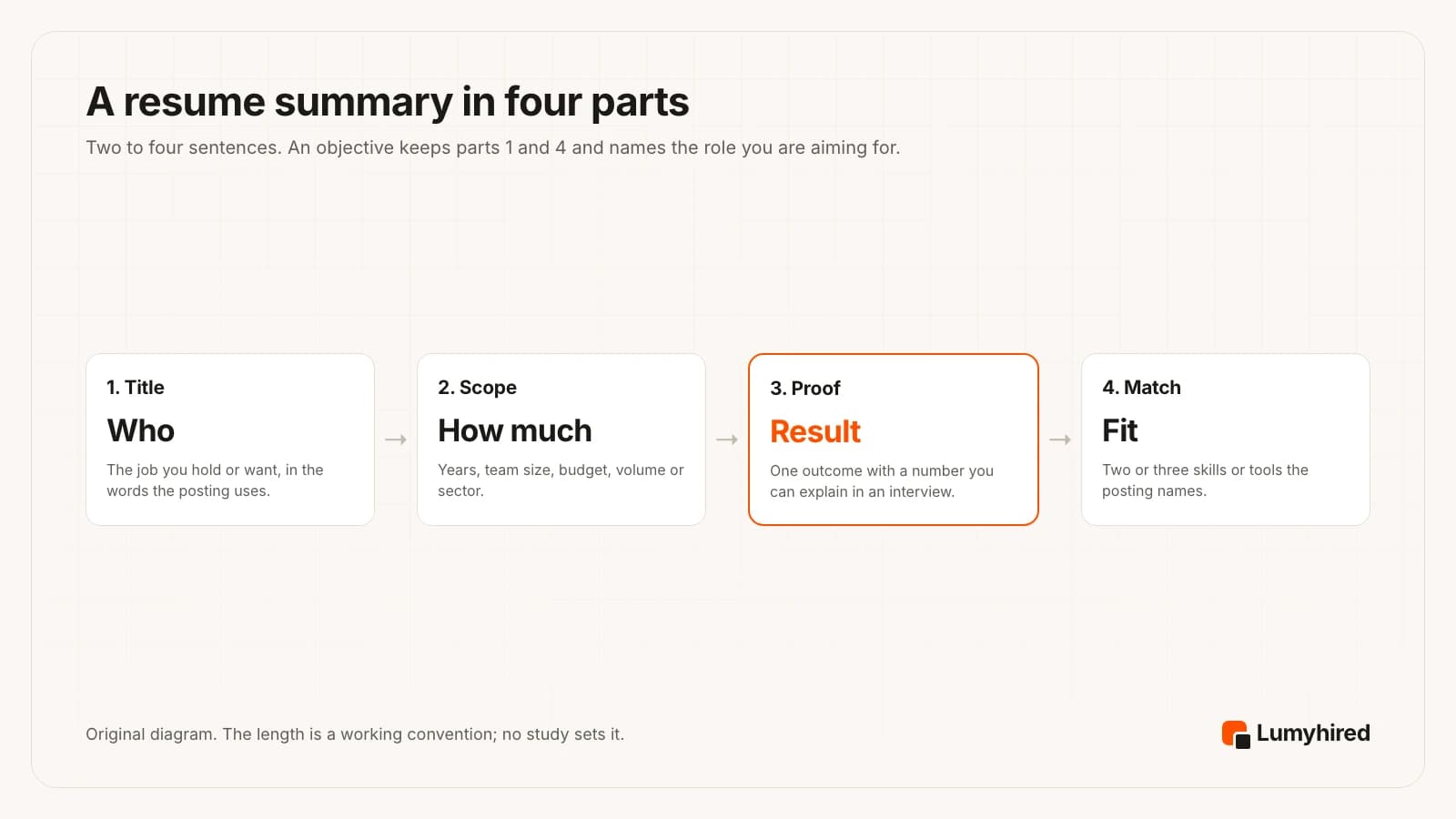
[Job title] with [years] in [sector or specialty],
[scope: team, budget, volume, clients].
[Verb] [what you did], [result with a number].
[Two or three tools or skills from the posting].
- Title. Open with the job title, worded the way the posting words it if that is honestly your job. Ladders found recruiters spent more time on job titles than on any other element; putting the title first in the summary applies that to the top of the page.
- Scope. Years, team size, budget, number of accounts, beds, sites or entities. Scope is what separates a junior from a senior version of the same title.
- Proof. One result with a number. Choose the one you could talk about for five minutes in an interview, because it is a likely first question.
- Match. Two or three skills or tools the posting names. In its 2026 employer survey, sponsored by Jobscan (which sells resume optimization), NACE wrote that it is “not enough” for candidates to list their skills and that employers “want to see examples”.
Leave out what the reader cannot check: “results-driven”, “passionate”, “team player”, “excellent communication skills”. Leave out salary expectations, reasons for leaving and personal details. Rewrite the summary for each application, because the match in part four changes with every posting; the method is the same one described in tailoring your resume to a job description.
Resume summary examples for students: what does a good one look like?
With little paid experience, the proof comes from projects, internships, clinical rotations, part-time jobs and certifications. Name the degree and graduation date, the role you are applying for, and one thing you built or ran with a number attached.
Computer science graduate, junior backend developer
Computer science graduate (BS, May 2026) applying for junior backend roles. Built a REST API in Python and FastAPI for a student housing project used by about 300 classmates, with Postgres and automated tests in GitHub Actions. Spent a 10-week internship on an e-commerce team writing integration tests for the returns service.
Accounting student, audit associate
Senior accounting major with a summer internship at a mid-sized audit firm: tested accounts payable cutoff for three clients and prepared lead schedules in Excel. Sitting for the first section of the CPA exam in early 2027. Looking for an audit associate role starting in September.
New graduate nurse, medical-surgical residency
Newly licensed registered nurse (BSN 2026, NCLEX passed in June) with clinical rotations in medical-surgical, pediatric and intensive care units, finishing with a 12-week ICU preceptorship. BLS and ACLS certified, charting in Epic. Applying for a new-graduate residency on a medical-surgical unit.
Marketing graduate, marketing coordinator
Marketing graduate who ran the social media accounts of a 2,000-member student association for two years, including a weekly short video series that became its most viewed content. Google Analytics 4 and Google Ads certified. Looking for a marketing coordinator role at a consumer brand.
Business student, operations internship
Sophomore business student working 20 hours a week as a front-end supervisor at a grocery store: opening and closing the registers, training new cashiers and reconciling the cash drawers. Comfortable with Excel pivot tables. Looking for a summer 2027 internship in retail operations.
Each of these ends with the target role, which makes them close to an objective. That is deliberate: at the start of a career the summary and the objective merge, and naming the role saves the reader from guessing. NACE’s survey of employers hiring graduates explains the choice of details: teamwork was the attribute most often sought on a resume, named by 85% of 163 employers, and the grocery store example shows it through a task, training new cashiers.
Career change resume summary examples: how do you frame the switch?
State the change in the first sentence, then show that the old job already contained parts of the new one. Translate the vocabulary: a teacher “wrote unit plans and assessments”, a store manager “ran hiring and employee relations”. Add the bridge you have built, a certificate, a course or a portfolio, with a date.
Teacher to instructional designer
High school science teacher of 8 years, now training as an instructional designer. Rewrote the 9th grade chemistry unit plans for a department of six teachers, built assessments in Canvas and coached colleagues on the new units. Completed an instructional design certificate in 2026 and built three e-learning modules in Articulate Rise for a portfolio.
Retail store manager to HR generalist
Retail store manager with 6 years leading teams of 25 to 40, applying for HR generalist roles. Ran hiring for every vacancy in the store, held attendance and disciplinary meetings under company policy, and onboarded around 60 new hires a year. Studying for the SHRM-CP, with the exam scheduled for spring 2027.
Army logistics to civilian supply chain
Army logistics sergeant leaving the service after 10 years, targeting civilian supply chain roles. Managed inventory and transportation for a 600-person unit, signed for several million dollars of equipment and closed every audit with no unexplained losses. Lean Six Sigma Yellow Belt; working in SAP since 2022.
Hotel front office manager to customer success
Hotel front office manager of 5 years making the switch to customer success for hospitality software. Led the property management system rollout at a 180-room hotel, trained 22 staff on it in three weeks and worked through about 40 support tickets with the vendor during go-live. Finished a customer success course in September 2026; used Zendesk daily throughout the rollout.
Each example names the old job and the new direction in the first sentence, then gives one dated bridge: a certificate completed in 2026, an exam scheduled for spring 2027, SAP use since 2022, a customer success course finished in September 2026.
Professional summary examples for mid-level roles: what should you lead with?
With three to ten years of experience, the summary stops explaining who you are and starts selecting. Pick the result that matters most for this posting and the tools it names, and leave the rest to the experience section.
Product designer, healthcare software
Redesigned an invoicing flow that cut support tickets about failed invoices by a third, as a product designer with 5 years in healthcare scheduling software. Run more than 40 usability sessions a year and maintain the team’s Figma design system; work in two-week sprints alongside engineers.
Supply chain planner, consumer goods
Demand and S&OP planning specialist in consumer goods, owning plans for 400 SKUs across two distribution centers. Raised forecast accuracy from 68% to 79% in two years by moving the team to statistical baselines in SAP IBP, and run the supply review in the monthly S&OP cycle.
Litigation paralegal
Commercial litigation paralegal (7 years) preparing trial binders, running e-discovery in Relativity and tracking court deadlines for four partners. Coordinated the review of more than 200,000 documents on a single matter and trained two junior paralegals on the firm’s exhibit process.
Physical therapist, outpatient orthopedics
Licensed physical therapist with 4 years in outpatient orthopedics, seeing 12 to 14 patients a day with a caseload weighted toward post-surgical knee and shoulder rehabilitation. Wrote the return-to-run protocol the clinic now uses for every ACL patient, about 60 a year. Documentation in WebPT.
Content and SEO specialist, B2B software
Grew monthly sign-ups from the blog from 400 to 1,100 in two years as the content and SEO specialist at a mid-sized B2B software company. Own the blog and product pages, from keyword research in Ahrefs to briefs, editing and technical fixes with developers.
Two of these open with the result and two with the specialty. When the result is the strongest thing you have, it can come before the title, as long as the title follows in the same sentence, as in the product designer and content examples.
For 17 more fields, each complete resume example on this site includes a full summary next to the headline, skills and bullet points it has to agree with. The opening line of each is below; the link opens the full example.
| Job | Opening line of the example summary |
|---|---|
| Software Engineer resume | Software engineer with 5+ years shipping production services in TypeScript and Go. |
| Data Analyst resume | Data analyst with 4 years partnering with product and growth teams. |
| Project Manager resume | Project manager with 7 years delivering cross-functional programmes in regulated environments. |
| Registered Nurse resume | Registered nurse with 6 years on medical-surgical and telemetry units, currently holding an active RN licence plus BLS and ACLS. |
| Accountant resume | Qualified accountant with 6 years in financial reporting and close across multi-entity groups. |
| Marketing Manager resume | Marketing manager with 6 years across B2B demand generation and lifecycle. |
| Sales Representative resume | B2B sales representative with 5 years selling into mid-market accounts, carrying a new-business quota and building pipeline largely through self-sourced outbound. |
| Customer Service Representative resume | Customer service representative with 4 years across phone, email and live chat in a high-volume consumer support team. |
| Administrative Assistant resume | Administrative assistant with 5 years supporting senior leaders and their teams in a 200-person organisation. |
| Financial Analyst resume | Financial analyst with 5 years in FP&A supporting commercial and operational teams. |
| Human Resources Manager resume | HR manager supporting a 450-person organisation across two sites, with 7 years in generalist roles and a strong employee relations bias. |
| Operations Manager resume | Operations manager running a 60-person function across two sites, accountable for a cost centre, a service level and a safety record. |
| Mechanical Engineer resume | Mechanical design engineer with 6 years taking assemblies from concept through detailed design to production release. |
| Graphic Designer resume | Graphic designer with 5 years across in-house and studio work, focused on brand identity and campaign design. |
| Director of Finance resume | Finance director and qualified accountant leading a 14-person function across 5 legal entities in 3 countries, reporting to the CEO and to a board with private equity representation. |
| Teacher resume | Texas-certified mathematics teacher (Mathematics 4-8) with 6 years in public middle schools, currently teaching four sections of 7th grade math and one section of 8th grade Algebra I. |
| Student resume | Economics senior with a data analytics minor, graduating May 2027 with a 3.6 GPA. |
What should a manager put in a resume summary?
Lead with the size of what you run (people, budget, sites, quota), then one outcome that only someone in charge could have produced: a hiring plan, a turnaround, an audit passed, a process rebuilt. At this level, scope often stands in for part of the proof: a team of 19 or a $6.5M quota already tells the reader what you were trusted with.
Engineering manager
Engineering manager leading three teams (19 engineers) on a route planning platform used by 1,500 delivery drivers a day. Hired 11 engineers in two years, introduced the on-call rotation and incident reviews that halved repeat incidents, and own a $2.4M annual budget. Still review design documents every week.
Nurse manager
Nurse manager for a 16-bed cardiac step-down unit with 34 staff, accountable for staffing, budget and quality measures. Cut agency spending by 40% in a year by building an internal float pool, and led the team through a Joint Commission survey with no findings. MSN, Certified Nurse Manager and Leader (CNML).
Regional sales manager
Regional sales manager leading 9 account executives who sell HR software to mid-market companies, against a team quota of $6.5M. Reached 104% and 109% of quota in the last two years, rebuilt the territory plan after a merger, and coach every rep through weekly deal reviews in Salesforce.
Warehouse operations manager
Warehouse operations manager running a 24/7 fulfillment site with 140 staff over three shifts and about 30,000 order lines a day. Brought pick accuracy to 99.7% and cut overtime by redesigning slotting and shift patterns. OSHA 30 and Lean Six Sigma Green Belt.
A manager applying for a hands-on role may want to copy the engineering manager’s last sentence, which says how close to the work they still are: design documents reviewed every week.
How should executives write the summary at the top of a resume?
An executive summary names the company context in a way a board member understands: ownership, revenue or headcount, geography, and reporting line. Then it lists two or three moves that changed the business. Leave the company name to the experience section; the summary describes the kind of business.
Chief financial officer
Chief financial officer of a family-owned manufacturer with $180M revenue across four countries, reporting to the CEO and the board. Led a $60M refinancing, two acquisitions and the move to monthly rolling forecasts, and cut days sales outstanding from 58 to 41. CPA, previously corporate controller.
Chief operating officer, home healthcare
Chief operating officer of a 1,200-person home healthcare provider operating in nine states. Merged three regional operating models into one, raised visit completion from 91% to 97%, reduced clinician turnover and led the licensing work for two new states. Previously regional vice president of operations at a national healthcare staffing company.
VP of engineering, insurance software
VP of engineering for a 140-person engineering organization at a 600-person Series C insurance software company, reporting to the CEO. Moved the product from a monolith to services with no customer-facing outage, built the platform and security teams from scratch, and led the company to SOC 2 Type II in the first year. Report on delivery and risk to the board each quarter.
All three give the size of the business in the first sentence (“$180M revenue across four countries”, “a 1,200-person home healthcare provider”, “a 600-person Series C insurance software company”), and two give the reporting line: “reporting to the CEO and the board”, “reporting to the CEO”.
Before and after: three weak summaries rewritten
Three common weak patterns. Each rewrite assumes facts a real candidate in that job would have and shows where they go.
The adjective pile: before
Results-driven, hard-working professional with excellent communication skills and a passion for success, seeking a challenging role where I can grow.
After
Customer support team lead with 5 years in e-commerce, running a team of 8 agents on phone, email and chat in Zendesk. Raised first-contact resolution from 61% to 74% by rewriting the macros and the escalation guide, and own the weekly quality reviews.
Every word of the original could sit on any resume in any field. The rewrite names the job, the team, the tool and one result.
The job description: before
Experienced accountant responsible for accounts payable, accounts receivable, reconciliations and month-end close. Familiar with various accounting software.
After
Staff accountant with 4 years in a multi-entity group, owning month-end close for two entities in NetSuite. Cut the close from 7 business days to 5 by booking accruals earlier and automating the intercompany reconciliation, and was the auditors’ main contact during fieldwork.
“Responsible for” lists duties, which describes the job. The rewrite says what this person did in it, and names NetSuite where the original said “various accounting software”.
The wish list: before
Looking for an opportunity in project management where I can use my skills and develop my career in a dynamic company.
After
Event manager of 6 years moving into project management. Delivered more than 30 corporate events a year with budgets up to $400,000, managing suppliers, timelines and on-the-day risk. PMP exam booked for January 2027; plan work in Asana and Smartsheet.
The original says what the candidate wants. The rewrite keeps the career change in the first sentence, then lists the project work inside the event job: budgets, suppliers, timelines, risk.
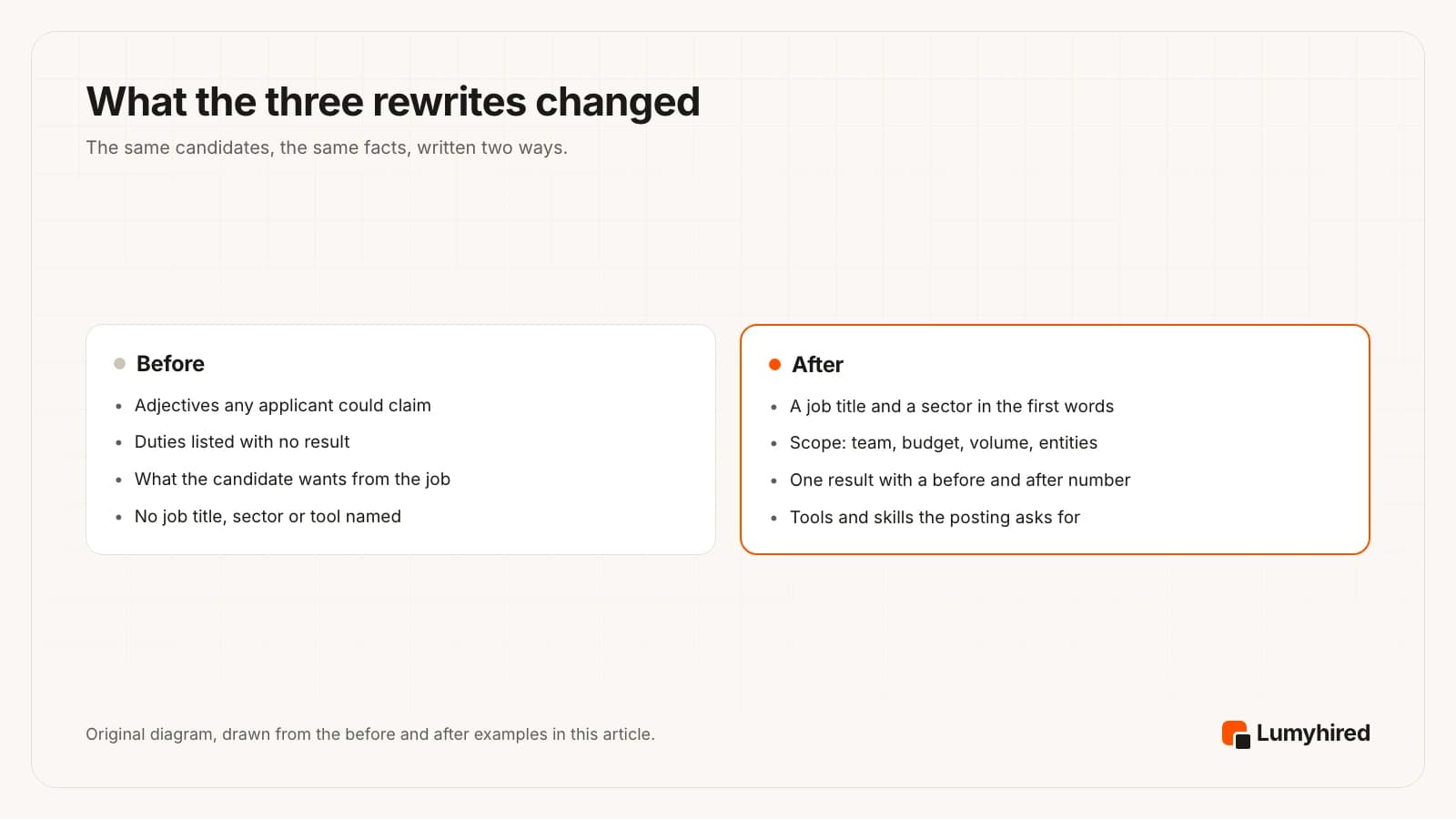
A quick test for your own summary: swap your name for a colleague’s and reread it. If it is still true, it belongs in the left-hand column and needs the four parts of the formula.
Do recruiters actually read the resume summary?
The available data says the first screen is short and most attention goes to experience. The evidence is thin and partly commercial, so here it is with its limits.
Ladders, 2018 (vendor data). Ladders, which runs a job site, timed recruiters sorting a stack of resumes and then followed their eyes in a lab. The average initial screen took 7.4 seconds, against about six seconds in its 2012 edition. The resumes that held attention had clear headings, bold job titles with bullet points, and “an overview or mission statement at the top of the first page”. Recruiters spent more time on job titles than on any other element. Neither the report nor the press release gives the number of recruiters, so treat the 7.4 seconds as an order of magnitude.
Pina and colleagues, 2023 (peer-reviewed). A team tracked the eyes of 221 recruiters who hire computer science graduates while each reviewed 30 resumes and decided whether to move them forward. The gaze measures that best predicted approval were time spent looking outside the content of the page, total viewing time, and time on the experience and education sections. The resume layout used in the study had no summary section: its top area of interest held the candidate’s name. So the study cannot show how recruiters read a summary. It shows that, for these graduate resumes, approval tracked attention to experience and education.
Novorésumé, 2025 survey (vendor data). In its HR survey of more than 200 HR professionals (survey date not published; page updated April 2026), Novorésumé, a resume builder that does not publish its method, reports that 79.4% named work experience as what they look at first; the summary or objective was the next most common answer.
Put together: the first screen is short, most recruiters say they look at experience first, and the summary or objective is the next most common answer. That gives the summary two jobs. It has to make the reader keep going, which the job title and one result are there to do. And it has to agree with the experience section, where Ladders and Novorésumé place the reader’s attention and where Pina and colleagues found the approval signal.
Should you use a resume objective in 2026?
Use one when your experience does not yet point at the job: as a student or graduate, as a career changer, or when returning after a break. With relevant experience, a summary carries the same keywords and adds the evidence behind them.
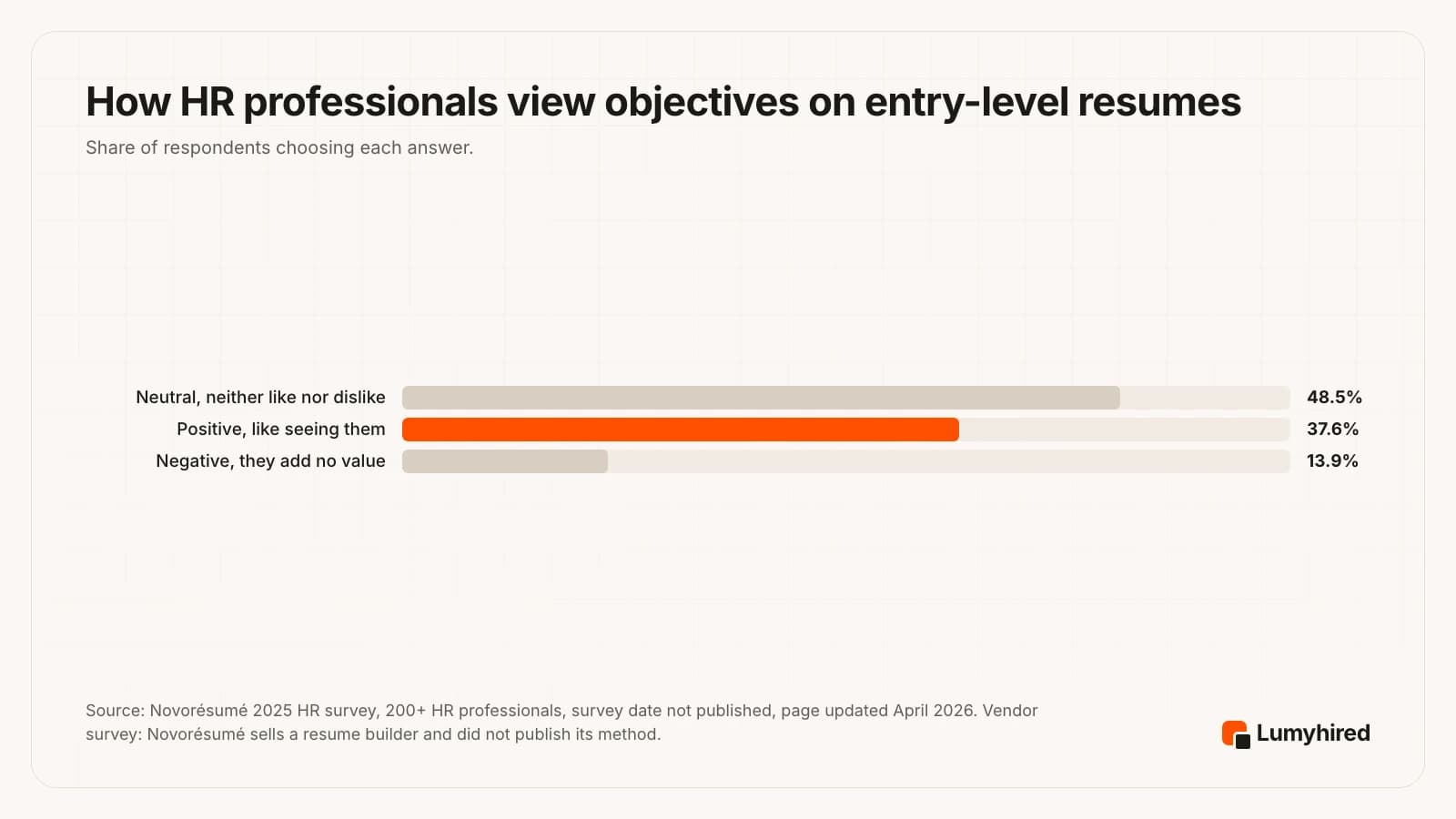
Asked about objectives on entry-level resumes, 48.5% of the HR professionals in Novorésumé’s survey were neutral, 37.6% liked seeing them and 13.9% thought they add no value. That is weak support, and it is the only published figure we found on the question. The survey asked about entry-level resumes only.
The old-style objective (“seeking a challenging position in a dynamic company”) is a claim with nothing behind it. NACE’s employers made the same point about skills: a claim needs an example. A modern objective names a specific role and gives the proof in the same sentence:
Student: entry-level data analyst
Objective: an entry-level data analyst role in a healthcare organization, bringing SQL and Python from a statistics degree and a capstone project that analyzed three years of hospital readmission data.
Career changer: junior UX researcher
Objective: a junior UX researcher role, applying 6 years of interviewing and field observation as a social worker, a Google UX Design certificate, and two usability studies published in my portfolio.
Returning to work: bookkeeper
Objective: a full-time bookkeeping role after a three-year career break for family care, bringing 7 years of full-cycle bookkeeping in QuickBooks and Xero and a payroll refresher course completed in 2026.
The returner example states the break and its reason in a few words: “after a three-year career break for family care”.
Do you need a headline above your resume summary?
Yes. A headline is a single line under your name that states the job, and it costs nothing. In Ladders’ 2018 study, recruiters spent more time on job titles than on any other element, and in Jobscan’s 2025 survey of 384 recruiters (vendor data: Jobscan sells resume optimization), 55.3% use job titles as search keywords in their candidate database.
FIRSTNAME LASTNAME
Supply Chain Planner, Demand and S&OP
city · email · phone · linkedin.com/in/...

SUMMARY
Demand and S&OP planning specialist in consumer goods...
- Use the posting’s title when it honestly describes your job. If your employer calls you “Planning Lead II” and the market calls it “Demand Planner”, the headline is the place to use the market’s word.
- Add one specialty after a comma. Every role example on this site does it: “Data Analyst, Product Analytics & Experimentation”, “Registered Nurse, Medical-Surgical / Telemetry”.
- Keep it as text. A headline inside a graphic or a text box may not come through a parser; the free ATS preview further down shows whether yours does.
How does an ATS read your resume summary?
In the parser data model documented below, the summary is recognized by its heading, stored in its own field, and searched for skills like any other part of the page. In systems that search parsed skills, matching and recruiter search then use those skills.
Separate fields. Textkernel publishes the data model of its resume parser in its official SDK. A parsed resume has a ProfessionalSummary field, an Objective field described as “the candidate’s written objective”, and a QualificationsSummary field for a standalone skills section. Its list of section types includes SUMMARY, OBJECTIVE and QUALIFICATIONS_SUMMARY, and each detected section records the exact text that marked its start. A plain heading such as “Summary”, “Professional Summary” or “Objective” gives the parser that marker.
Skills and dates. In Textkernel’s data model, a skill’s months of experience come from position dates, so a skill found only in the summary would have none. Other parsers may differ. Repeating each summary keyword in a dated experience bullet covers both cases.
The software may write its own summary of you. Textkernel’s parser generates a paragraph that summarizes the candidate’s experience from the other data it extracted. Zoho Recruit’s Profile Summary builds an overview from the attached resume, with sections for overview, skills, experience, qualifications and accomplishments, and shows it in candidate lists and quick views. A recruiter may read that generated paragraph next to yours, which is one more reason to keep your summary consistent with your experience section.
Matching sorts candidates into tiers. Greenhouse’s Talent Matching FAQ, updated on 5 October 2026, says AI analyzes the resume against criteria the hiring team calibrates, that several terms can map to the same skill, and that candidates are sorted into tiers such as Strong, Good, Partial and Limited. It “does not auto-reject or auto-advance any candidate”. Automatic rejection in Greenhouse comes from answers to custom application questions, per its auto-reject help page.
Then a person searches. In Jobscan’s recruiter survey, 76.4% filter by skills, which is why the two or three skills in part four of the formula should use the posting’s exact terms. To see whether a parser finds your summary at all, run your file through the free ATS preview, which shows the text and sections a parser extracts. The wider mechanics of screening software are in how ATS filters actually work, and how to choose and word the skills themselves is in skills to put on a resume.
Frequently asked questions
Should the summary or the skills section come first?
How long should a resume summary be?
Should I write my resume summary in the first person?
Should my LinkedIn About section match my resume summary?
Do I need a summary on a two-page resume?
Should I put keywords in my resume summary?
Can I use ChatGPT to write my resume summary?
Check what a parser makes of your summary
Upload your resume to the ATS preview, which is free and needs no account, and check that your summary comes out as its own section with the job title intact. Then compare your summary and skills with a specific posting in the ATS resume checker. Lumyhired adapts a master resume to each posting, ranks job listings by match and tracks your applications; weekly plans start at €5 on the pricing page, with a 3-day money-back window and no free plan.
For a summary in context with a full page, browse the resume examples by job.
Sources
Vendor data and sponsored surveys are marked as such. The Ladders report could not be opened on its own site from our region, so the archived copy is cited. The NACE page no longer shows the figures on how employers prefer skills presented, so only its skills chart and its written statements are used here. Two claims that circulate widely were left out because they could not be traced to a primary source: survey figures of the form “72% of hiring managers prefer a summary”, and the findings on objective statements attributed to a 1999 study in the Journal of Business and Psychology, whose full text was not accessible. Read 14 October 2026.
- Ladders, Eye-Tracking Study 2018 (archived copy of the report; Ladders runs a job site and publishes no sample size), read 14 October 2026
- Ladders, press release on the 2018 eye-tracking study, PR Newswire, 6 November 2018 (no sample size given)
- Pina, Petersheim, Cherian, Lahey, Alexander and Hammond, Using Machine Learning with Eye-Tracking Data to Predict if a Recruiter Will Approve a Resume, Machine Learning and Knowledge Extraction 5(3), 28 June 2023 (221 recruiters, 30 resumes each)
- Novorésumé, 2025 HR survey of 200+ HR professionals, survey date not published, page updated 1 April 2026 (Novorésumé sells a resume builder; method not published)
- Jobscan, The State of the Job Search in 2025, 25 February 2025 (384 recruiters; Jobscan sells resume optimization)
- NACE, The Key Skills Employers Seek on College Students' Resumes, Job Outlook 2026 Spring Update, 20 April 2026 (185 respondents, 163 on the skills question; the survey was sponsored by Jobscan)
- NACE, press release, 23 April 2026
- Textkernel, official Tx v10 SDK, ParsedResume data model (ProfessionalSummary, Objective, QualificationsSummary), read 14 October 2026
- Textkernel, official Tx v10 SDK, ResumeSection section types, read 14 October 2026
- Textkernel, official Tx v10 SDK, ResumeSkill data model (where a skill was found, months of experience, last used), read 14 October 2026
- Textkernel, official Tx v10 SDK, ExperienceSummary data model (generated experience paragraph), read 14 October 2026
- Greenhouse, Talent Matching FAQ, updated 5 October 2026
- Greenhouse, Auto-reject help page, updated 30 January 2026
- Zoho Recruit, Profile Summary help page, read 14 October 2026
Read next
- How to Tailor Your Resume to a Job Description
A 15-minute method with three before and after bullets, an AI prompt that forbids invented facts, and Huntr's data: tailored resumes got interviews at 4.23% vs 2.07% in Q1 2026.
- Resume Keywords in 2026
A worked extraction on a sample job posting, how recruiter Boolean search and related-term matching read your resume, and keyword lists by role from O*NET.
- Skills to Put on a Resume (2026 Employer Data)
What employers ranked in 2026, how an ATS extracts and matches your skills section, how many skills to list, and how to prove them, with examples for 15 jobs.
- ChatGPT Resume: What to Prompt, What to Fix
A four-prompt chain that does not produce a generic draft, the six things to fix in every output, and what the 2026 research says about AI detectors.
- Best Resume Builders for Career Changers in 2026
Seven builders ranked on translating the experience you already have into the target field's words, with what a parser really does to a functional layout.