
Resume & ATS
How to tailor your resume to a job description in 15 minutes
The step-by-step version: what to rewrite, what to leave alone, three before and after bullets from a sample candidate, a prompt for ChatGPT, Claude or Mistral that forbids invented facts, and what the 2025 and 2026 data says tailoring is worth.
How do you tailor a resume to a job description?
Start from a master resume that lists everything you have done, then change four things for each posting: the headline, the summary, which bullets you keep and in what order, and the order of your skills section. Leave job titles, employers, dates and numbers exactly as they are. Done by hand, that takes about 15 minutes. It is worth doing: in Huntr’s Q1 2026 data on 139,927 applications, tailored resumes got interviews at 4.23% against 2.07% for untailored ones, and in full-year 2025 at 5.8% against 3.73%. Huntr is a job-search tracker vendor and these are correlations, so read them with the limits explained below.
Does a tailored resume get more interviews than a generic one?
The best public numbers come from Huntr, which runs a job application tracker where users log whether they tailored each resume. In its Q1 2026 report, covering 139,927 applications from 25,635 job seekers, applications sent with a tailored resume turned into interviews 4.23% of the time. Untailored ones did so 2.07% of the time, about 2.04 times less often. Its 2025 annual report, built on 1.78 million applications from more than 57,000 seekers, found 5.8% against 3.73%.
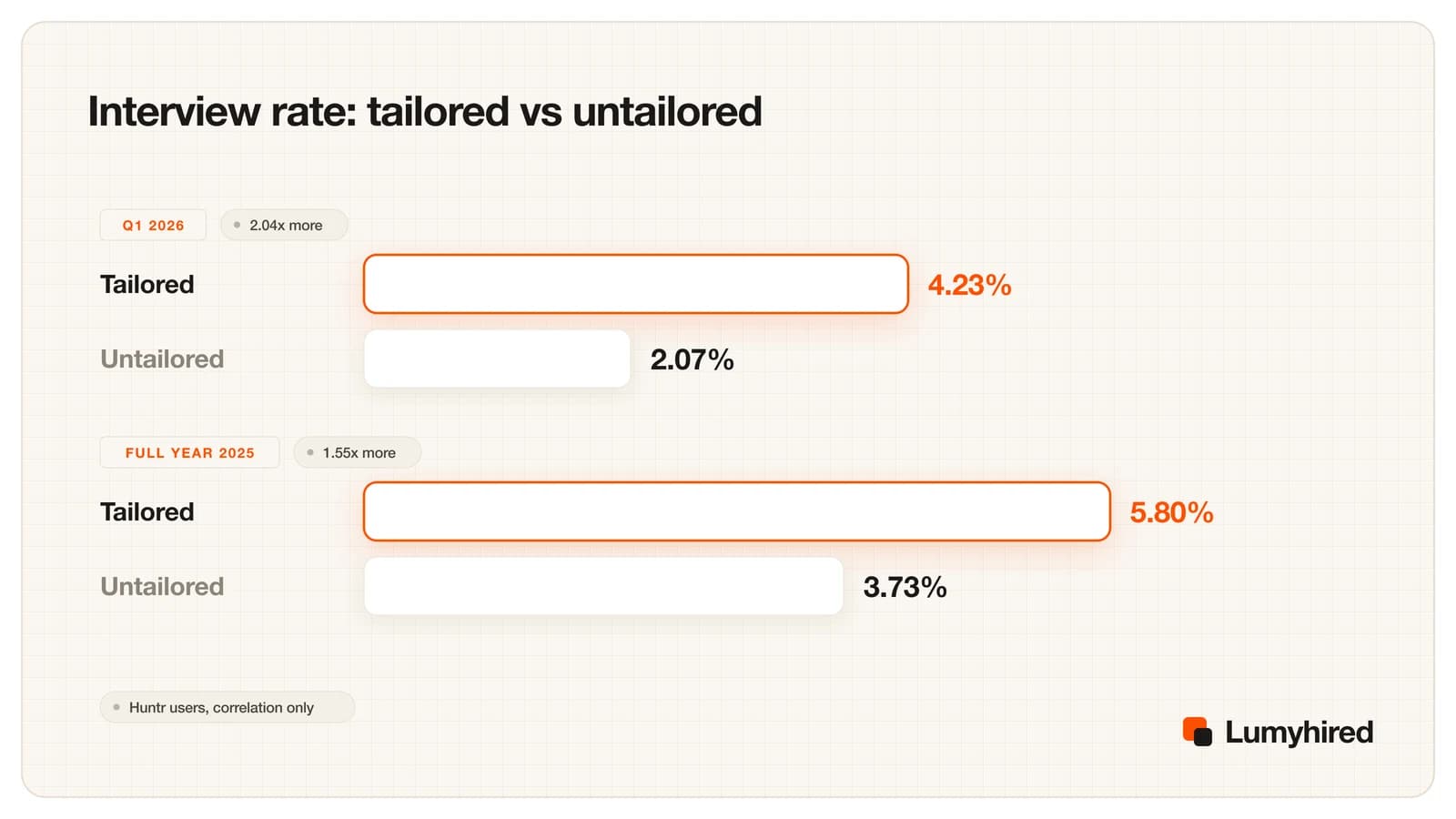
Read those figures with three limits in mind. Huntr users chose to install a tracker, so they are probably more organized than average. People who tailor may also be applying to roles that fit them better, which would lift their rate on its own. And the gap was smaller in 2025 (1.55 times) than in early 2026. What the data does support: in two separate periods, tailored applications came out ahead.
A second vendor points the same way on one specific element. Jobscan, which sells resume optimization, reported across 2.5 million applications that a resume title matching the job ad went with a 10.6 times higher interview rate. The headline step below exists because of that pattern, with the same caveat about correlation.
How long does it take to tailor a resume? The 15-minute table
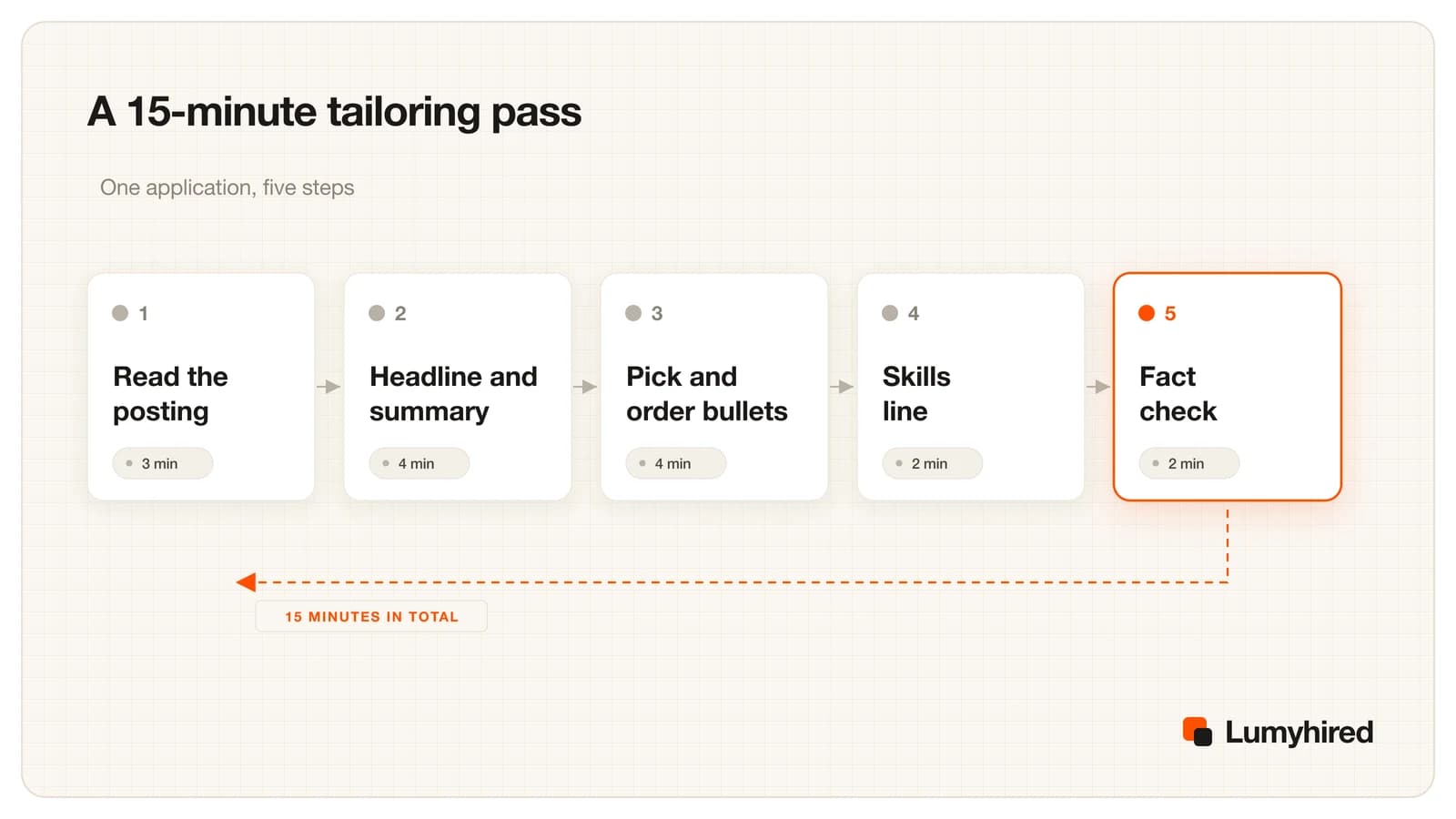
Tailoring gets abandoned when it means rewriting the whole document. The method below caps each step. It assumes you already have a master resume, a longer private document with every role, bullet, number and tool you could truthfully claim. Building that once takes an evening; after that, each application is an edit.
| Step | Minutes | What you touch | Done when |
|---|---|---|---|
| 1. Read the posting | 3 | Nothing yet. Mark the three requirements the posting repeats or puts first. | You can say in one sentence what this team needs solved. |
| 2. Headline and summary | 4 | The line under your name and the two or three sentences below it. | The summary names the role and proves the top two requirements. |
| 3. Choose and order bullets | 4 | Your two most recent roles: keep the four strongest bullets for this posting, reorder them, reword where the work is the same. | The first bullet of each role answers a requirement you marked. |
| 4. Skills section | 2 | Reorder so the tools and skills the posting asks for come first. Delete what is irrelevant here. | Every skill listed is one you could be tested on tomorrow. |
| 5. Fact check and save | 2 | Titles, employers, dates and every number, compared with your master resume. Then export and name the file. | Every line on the page also appears in your master resume. |
Time budget per step for the method described in this article. These are working targets for a one-page or two-page resume and a master resume that is already complete. They were not measured on real users.
Step 1 is reading for priorities. Pulling every keyword out of a posting and sorting it by type is a separate task, covered in the guide to finding and placing resume keywords. For tailoring, three marked requirements are enough: what appears first, what is repeated in different words, and what carries a number (years, team size, budget).
What to change: headline, summary, bullets and skills
Headline
The line under your name describes the role you are going for. Use the posting’s words where they are accurate for your work, and keep the official title on each experience line. A marketing manager at an accounting firm applying for a demand generation role can write B2B demand generation marketer | HubSpot, paid LinkedIn, webinars in the headline, while her experience line still reads Marketing Manager.
Summary
Two or three sentences that name the target role and prove the two requirements you marked first. A quick test: paste your summary next to a different posting. If it fits that one just as well, it is not tailored yet.
Before: Creative marketing professional with 8 years of experience in campaigns, events and digital communication.
After: B2B marketer with 8 years in professional services, running paid LinkedIn, webinars and HubSpot email for a 12,000-contact database. Cut cost per lead from $210 to $135 in 2024.
Sample candidate invented for this article. Every fact in the after version already appears elsewhere on her master resume.
Choice and order of bullets
This is where most of the effect sits, because recruiters read from the top down and often stop early. In a 2018 eye-tracking study by Ladders, a job site, about 30 recruiters spent 7.4 seconds on average on an initial resume screen. For your two most recent roles, keep the four bullets that best match the marked requirements, put the strongest first, and drop the rest from this version. Older roles can shrink to one or two lines.
Skills section
Reorder, then cut. The tools and skills the posting names go first, written the way the posting writes them if that is the standard name. Anything irrelevant to this job comes off this version. Matching software is less literal than it used to be: Greenhouse Talent Matching, in a help page updated on 3 September 2026, counts related terms toward the same skill, and it does not reject anyone on its own. Recruiters still type literal searches, which is why the exact name of a tool you really use is worth having. How those filters work end to end is covered in the hub guide on how ATS filters actually screen resumes.
Three before and after resume bullet examples
The candidate below is fictional. She is a marketing manager at an accounting firm group, applying to a Demand Generation Manager role at a B2B SaaS company that sells finance software. The posting, also invented, asks for pipeline generation, HubSpot, paid LinkedIn, close work with sales, and reporting on marketing-sourced revenue.
Example 1: move it up and use the posting’s words
Before: Launched LinkedIn Ads campaigns targeting CFOs at mid-size companies; cut cost per lead from $210 to $135 in 2024.
After: Ran paid LinkedIn campaigns aimed at CFOs of mid-size companies, cutting cost per lead from $210 to $135 in 2024.
It was her fourth bullet and is now her first, because paid LinkedIn is a stated requirement. Both numbers are unchanged. She did not add account-based marketing: targeting a job title on LinkedIn is not the same as working a named account list, and an interviewer would ask.
Example 2: merge two weak bullets into one that matches a requirement
Before: Planned and ran 18 client webinars a year from 2022 to 2024, averaging 140 registrants. / Managed the email newsletter and campaigns in HubSpot for 12,000 contacts.
After: Ran 18 webinars a year (2022 to 2024, 140 registrants on average) and the HubSpot follow-up emails to a 12,000-contact database.
The posting asks for HubSpot and pipeline generation. Two separate chores become one demand story. Every figure comes from the original two lines.
Example 3: make a vague bullet specific, from her own records
Before: Worked with the partners to track which campaigns brought in new clients.
After: Reported new clients to the partners each month, broken down by the campaign that sourced them.
The posting wants someone who reports on marketing-sourced revenue. The monthly cadence and the campaign breakdown are true details she had left out. She kept the word clients and did not write pipeline, because her firm had no pipeline stages she tracked.
The pattern across all three: position, wording and grouping changed, while the facts stayed put. The only new details in example 3 came from her own records. None came from the posting. For more finished bullets by role, see the resume examples.
How to tailor your resume without lying
Hiring managers say they see a lot of stretched resumes. In a survey run by The Harris Poll for Express Employment Professionals, a staffing company, and published on 11 February 2026, 80% of US hiring managers said resumes at least sometimes fail to match a candidate’s real skills, while only 22% of job seekers admitted listing skills they lack. 86% of the hiring managers said AI makes it too easy to exaggerate skills on a resume. It is a commissioned survey, and it still tells you what the person reading your resume is looking out for.
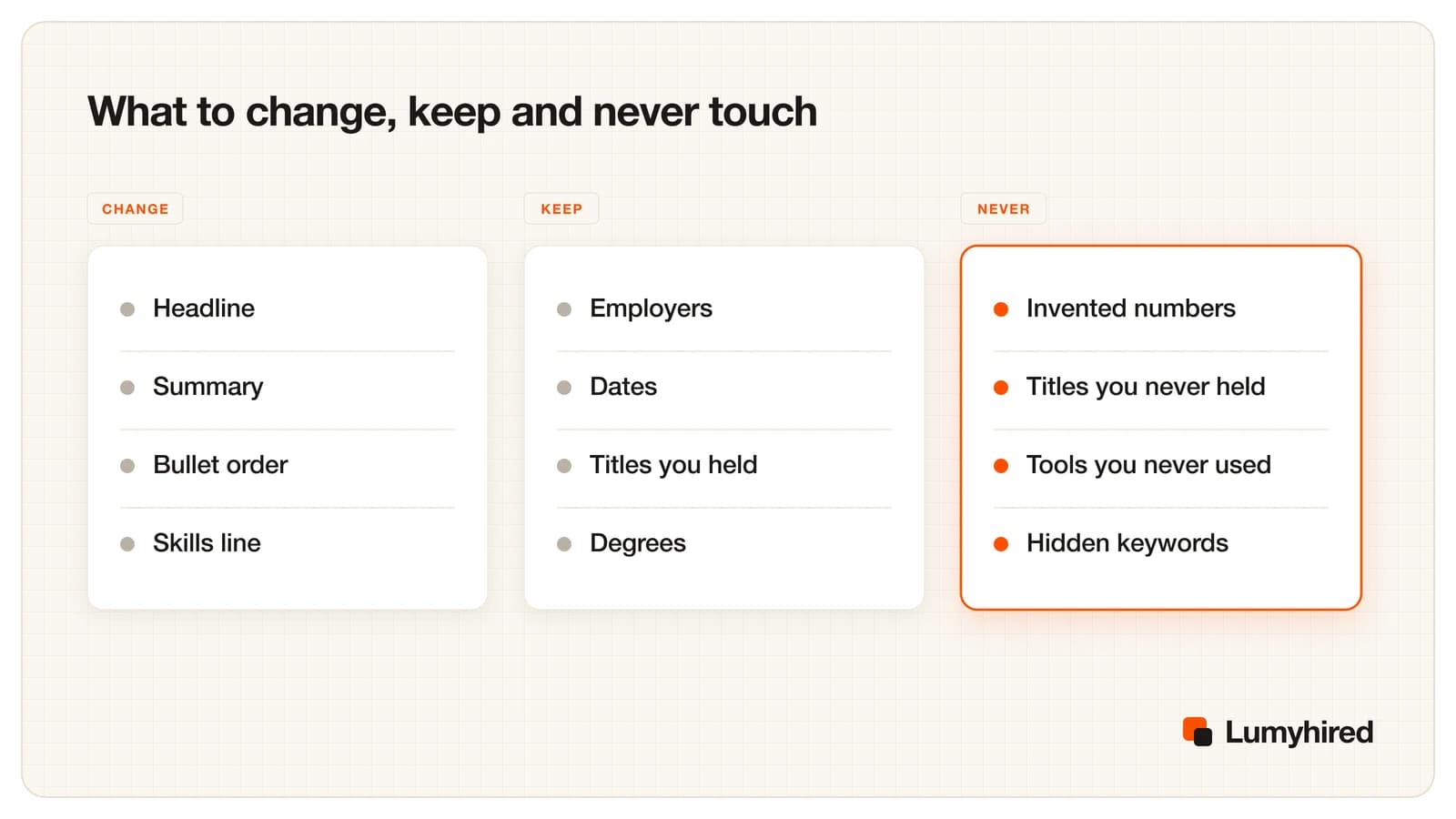
- Dates and employers can be checked in background checks and reference calls. Shifting a start date to hide a gap creates a bigger problem than the gap.
- Job titles you did not hold can be exposed by a single reference call. Put the posting’s wording in the headline if it fits your work, never on the experience line.
- Numbers can be moved, merged or rounded the way you would say them aloud, but a number that is not in your records does not go on the page.
- Scope verbs matter as much as numbers. Contributed to the budget and owned the budget are different jobs. Rewording one into the other is an invented fact.
- Hidden keywords in white text get caught, because parsers strip the color. Built In reported in October 2025, citing New York Times reporting, that Greenhouse found hidden text in about 1% of resumes in the first half of 2025, and that ManpowerGroup does not move forward the candidates it catches doing it.
How to tailor your resume with ChatGPT, Claude or Mistral
Most job seekers who use AI already use it here. In APEC’s May 2026 study of 2,000 French managers and professionals, 70% of those who had used AI in their job search used it for their CV, and 77% for a cover letter. The same study found 71% saying AI cannot fully replace professional advice on a CV or cover letter. A chatbot is fast at the rewording. Where it goes wrong is facts: it fills gaps with plausible tools and numbers unless you stop it.
The prompt below works in ChatGPT, Claude and Mistral’s Le Chat. Its rules forbid new facts, and rule 6 makes the model show where each bullet came from, which is what makes checking possible.
You are editing my resume for one job posting. Follow these rules.

1. Use only facts that appear in MY RESUME. Do not add tools, numbers, job titles, employers, dates, degrees or responsibilities.
2. Keep every job title, employer name and date exactly as written.
3. Rewrite the headline (12 words at most) and the summary (3 sentences at most) for this posting.
4. For my two most recent roles, keep the 4 bullets most relevant to the posting, put the most relevant first, and reword them with the posting's terms only where the work is the same.
5. Reorder my skills list so the skills the posting asks for come first. Do not add skills.
6. Under each rewritten bullet, quote the original bullet or bullets it came from.
7. At the end, list every requirement in the posting that my resume does not show. Do not fill those gaps.

JOB POSTING:
[paste the posting]

MY RESUME:
[paste your master resume, with phone number and home address removed]
The verification step (do not skip it)
- Put each rewritten bullet next to the original it quotes. Delete any number, tool, team size or result that is not in the original.
- Compare every job title, employer and date with your master resume, character by character.
- Watch the verbs. If led, owned or built replaced helped, supported or contributed, restore the original scope.
- Read the gap list. Do not add those items. Either apply anyway and address one gap in your cover letter, or skip the posting.
- Read each line aloud and ask whether you could talk about it for two minutes in an interview. If not, cut it.
The same rules apply to letters. The comparison of AI cover letter generators looks at which tools stay close to your real history.
How many resume versions to keep, and how to name them
Keep three layers. The master resume is private, long and complete, and it is the only file you edit freely. If you target two or three kinds of role, a base version for each saves the reordering time. Then each application gets its own exported file, which you never edit after sending, so you know exactly what the recruiter has in front of them when they call.
Name the files for two readers. The recruiter sees the file name, so start with your name: Firstname-Lastname-Resume-Demand-Generation-Manager.pdf. You need to find it again, so store it in a folder per company and date, or log it in an application tracker with the file name next to the application. When an interview invitation arrives three weeks later, open that exact file before the call.
Tailoring also changes how many applications you can send in a week. If each takes 15 to 20 minutes, a realistic number is lower than mass applying, and that is fine: the guide on how many jobs to apply to works through the numbers.
Where tailoring stops helping
Tailoring matters because it helps you stand out from other applicants. When everyone does it, the edge shrinks. A working paper by Cui, Dias and Ye (arXiv, September 2025, revised November 2025) studied a large online freelance platform after it launched an AI cover letter tool. Letters started matching job posts more closely. The link between how well a letter matched and whether it got a callback fell by 51%, and employers shifted their weight toward work history. The study covers one platform and freelance work, and it has not been peer reviewed. The mechanism is easy to follow: as AI makes fit-sounding text cheap, readers look for evidence that is harder to fake.
Two practical consequences. The substance of your bullets, meaning the results with numbers you can defend, is likely to count for more over time than their phrasing. And tailoring cannot replace channels that bypass the pile of applications: in Gem’s 2026 benchmarks, built on more than 165 million applications, referrals converted to hires at 11 times the rate of inbound applicants. Gem sells recruiting software and its data leans toward the US. The guide to getting a job in 2026 covers how tailoring fits with referrals and targeting.
Frequently asked questions
How long does it take to tailor a resume to a job description?
Does tailoring a resume actually get more interviews?
How do I tailor my resume without lying?
Can I use ChatGPT to tailor my resume?
Should my resume title match the job title in the posting?
How many versions of my resume should I keep?
Is a tailored resume worth it for every application?
Tailoring with Lumyhired
Lumyhired tailors your resume to one posting at a time and includes an application tracker, so each tailored version can sit next to the job it was sent to. You still do the verification step above. Before sending, the ATS preview shows the plain text a parser extracts from your file; it is free, runs in your browser and needs no account. Tailoring is part of the paid plans: Starter at €5 a week, Pro at €8 and Hunt at €13, with a 3-day money-back guarantee and cancel anytime. There is no free plan; details are on the pricing page.
Sources
- Huntr, Job Search Trends Q1 2026. 139,927 applications from 25,635 job seekers, plus a survey of 593. Vendor data, read 15 September 2026. huntr.co
- Huntr, 2025 Annual Job Search Trends Report, December 2025. 1.78 million applications from more than 57,000 job seekers. huntr.co
- Cui, Dias and Ye, working paper on an AI cover letter tool and hiring outcomes, arXiv 2509.25054, September 2025, revised November 2025. arxiv.org
- APEC, Les cadres et l’IA, 21 May 2026. Online survey of 2,000 managers and professionals in France, March 2026. corporate.apec.fr
- Express Employment Professionals and The Harris Poll, survey on AI and resume exaggeration, published 11 February 2026. Commissioned by a staffing company. prnewswire.com
- Jobscan, State of the Job Search, 2025. Analysis of 2.5 million applications by a resume optimization vendor. jobscan.co
- Greenhouse, Talent Matching FAQ, support page updated 3 September 2026. support.greenhouse.io
- HR Dive on the Ladders eye-tracking study, 2018. About 30 recruiters. hrdive.com
- Built In, hidden AI prompts in resumes, 15 October 2025, citing New York Times reporting. builtin.com
- Gem, key takeaways from the 2026 Recruiting Benchmarks report, December 2025. More than 165 million applications, June 2021 to May 2025. Vendor data. gem.com
Read next
- Resume Keywords in 2026
A worked extraction on a sample job posting, how recruiter Boolean search and related-term matching read your resume, and keyword lists by role from O*NET.
- How to Pass ATS Filters in 2026
What Greenhouse, Workday, Teamtailor, Lever and iCIMS say their software does to your resume, the one mechanism that rejects automatically, and where the 75% myth came from.
- How Many Jobs Should You Apply To?
The math behind the number: 0.5% of applications become offers, tailoring roughly doubles interview rates, and a weekly plan for each situation.
- Best AI Cover Letter Generator in 2026: 8 Tools Ranked
Eight generators ranked on reading the posting and your resume, keeping claims honest, and cost, with callback data and a prompt that checks every fact.