
Resume & ATS
ChatGPT resume: what to prompt, and what to fix afterwards
Most advice on this is a list of prompts. The prompts are the easy part. What decides whether the result helps you is the step after the output arrives, and almost nobody does it. Here is the chain that works, the six things to fix in every draft, and what the evidence actually says about getting caught.
Can you use ChatGPT to write your resume?
Yes, for a draft, and only if you supply the facts. ChatGPT is good at compressing a long bullet, at finding the posting’s words for work you already did, and at listing the requirements you do not meet. It is bad at anything it has to invent, which is every number, date and job title on the page. The practical rule is that it edits your history and never authors it, and the draft is not finished when the output appears.
Published 9 October 2026. Sources are listed at the end, with the date each was read.
What is ChatGPT actually good at on a resume?
It is good at the half of the job that has a verifiable answer, and unreliable at the half that does not. That is a more useful line than the usual one about trust.
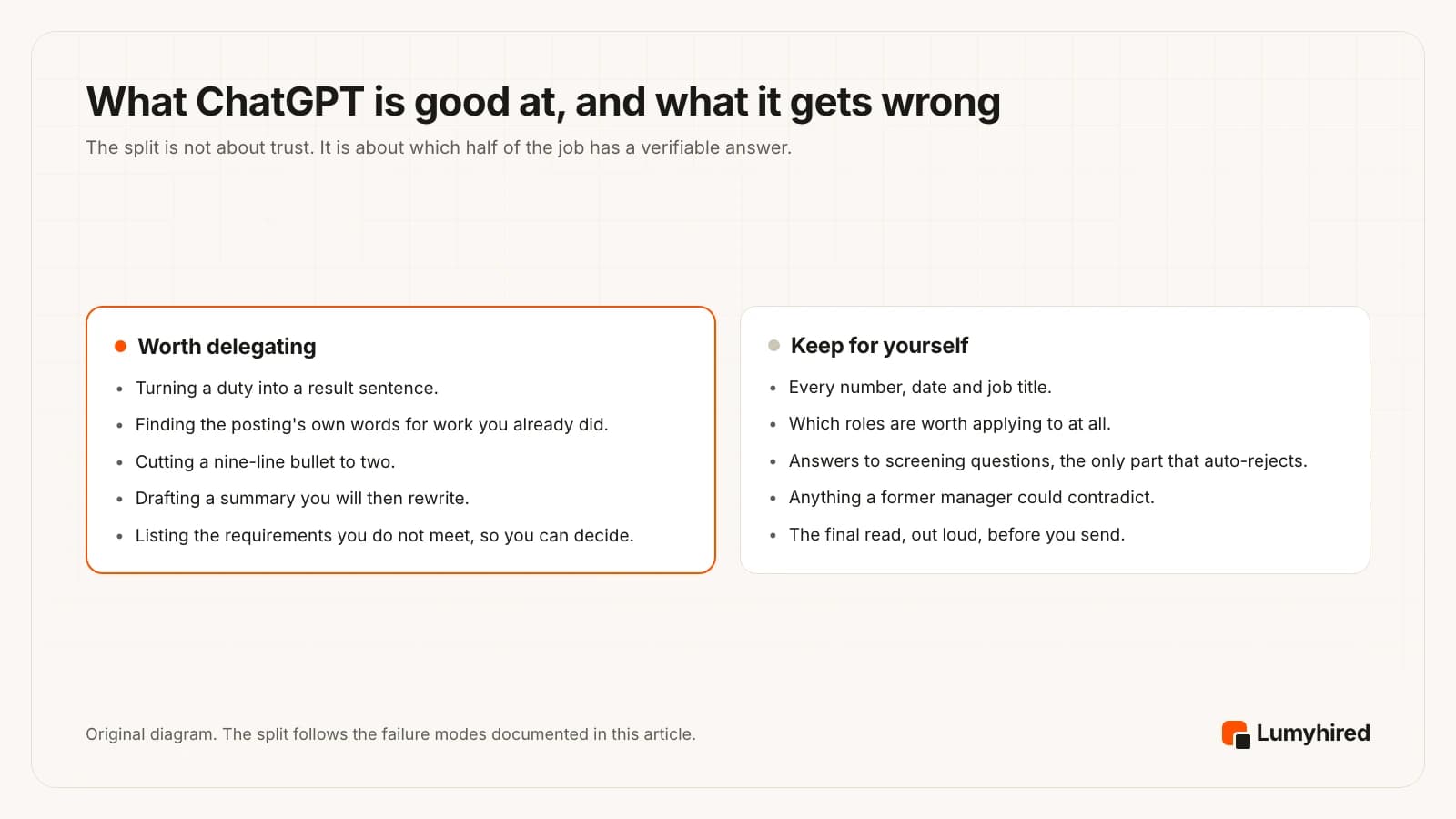
Take a bullet that reads “responsible for the management of the regional reporting process and associated stakeholder communication.” You know what it means. A model can compress it to “ran monthly reporting for six regional sites, used by the finance director to set quarterly targets,” and that is a real improvement it can make without knowing anything you did not tell it.
Now take “increased efficiency by 35%.” If you did not give it that number, it made it up, and it will do so fluently. This is the single most common failure in an AI-assisted resume, and it is the one with consequences that arrive late, in a reference call or an interview with somebody who was there.
Employers have noticed the pattern. In February 2026, Express Employment Professionals and The Harris Poll surveyed 1,002 US hiring managers and 86% said AI makes it too easy to exaggerate skills on a resume. That survey was commissioned by a staffing company and should be weighted accordingly, but it describes a suspicion that is now part of how your document gets read.
Will a recruiter know you used ChatGPT?
Not from a detector, and the research on this is clearer than the marketing. A detector will not reliably tell anybody anything about your resume.
A paper submitted in March 2026 and revised in April by Pudasaini, Miralles-Pechuán, Lillis and Llorens Salvador examined why AI-generated text detection fails. Their own classifier reached an F1 score of 0.9734 on the benchmark corpora, which is the kind of number vendors quote. The finding is what happens next: classifiers that excel in-domain degrade significantly under distribution shift, because the features they rely on differ markedly between datasets. In plain terms, they learn what one collection of texts looks like, not what machine writing is.
A resume is close to the worst case for such a tool. It is short, it is formatted unlike prose, and it is edited by a human after generation. None of that resembles the essays these systems were trained and benchmarked on.
So the risk is not detection. The risk is recognition, which is a different thing and does not need software. A recruiter reading their fortieth application of the morning recognises a document with no numbers in it, the same sentence shape in every bullet, three adjectives that describe a personality instead of a job, and a skills list that matches the posting more exactly than any real career matches a posting. None of that proves a model wrote it. All of it produces the same outcome.
One tactic worth naming so you do not try it: hidden text instructions. In October 2025, Built In reported, citing New York Times reporting, on candidates embedding invisible prompts in their resumes aimed at an AI screener. Parsers extract hidden text, humans then see it in the extracted view, and it reads as an attempt to manipulate the process. It is a fast way to be remembered for the wrong reason.
What actually gets your application rejected?
Not the writing style, and not the resume at all in most systems. The vendor documentation is specific about this, and it changes where you should spend your attention.
Greenhouse’s auto-reject help page, updated 30 January 2026, states that automatic rejection fires on a rule a recruiter attaches to a yes/no or multiple-choice application question. Not on your resume text. Its Talent Matching documentation, updated 3 September 2026, sorts candidates from Strong to Limited against recruiter-weighted criteria, counts related terms toward the same skill, and does not reject or advance anyone on its own.
Read together, those two pages invert the usual advice. The resume is graded by a person. The questions are graded by a rule. So the part of the application you should never delegate is the short-answer form at the end, which is exactly the part people rush after spending an hour on the document. Work authorisation, notice period, salary expectation, years of experience, location: a wrong answer there removes you before anybody reads a word you wrote.
The full mechanics, including which system each large employer runs, are in the guide to how ATS filters actually screen resumes.
Which ChatGPT prompts work for a resume?
One prompt produces a generic draft. The chain below produces something a person would believe, and the step that changes the outcome is the second one, which is not a writing step at all.
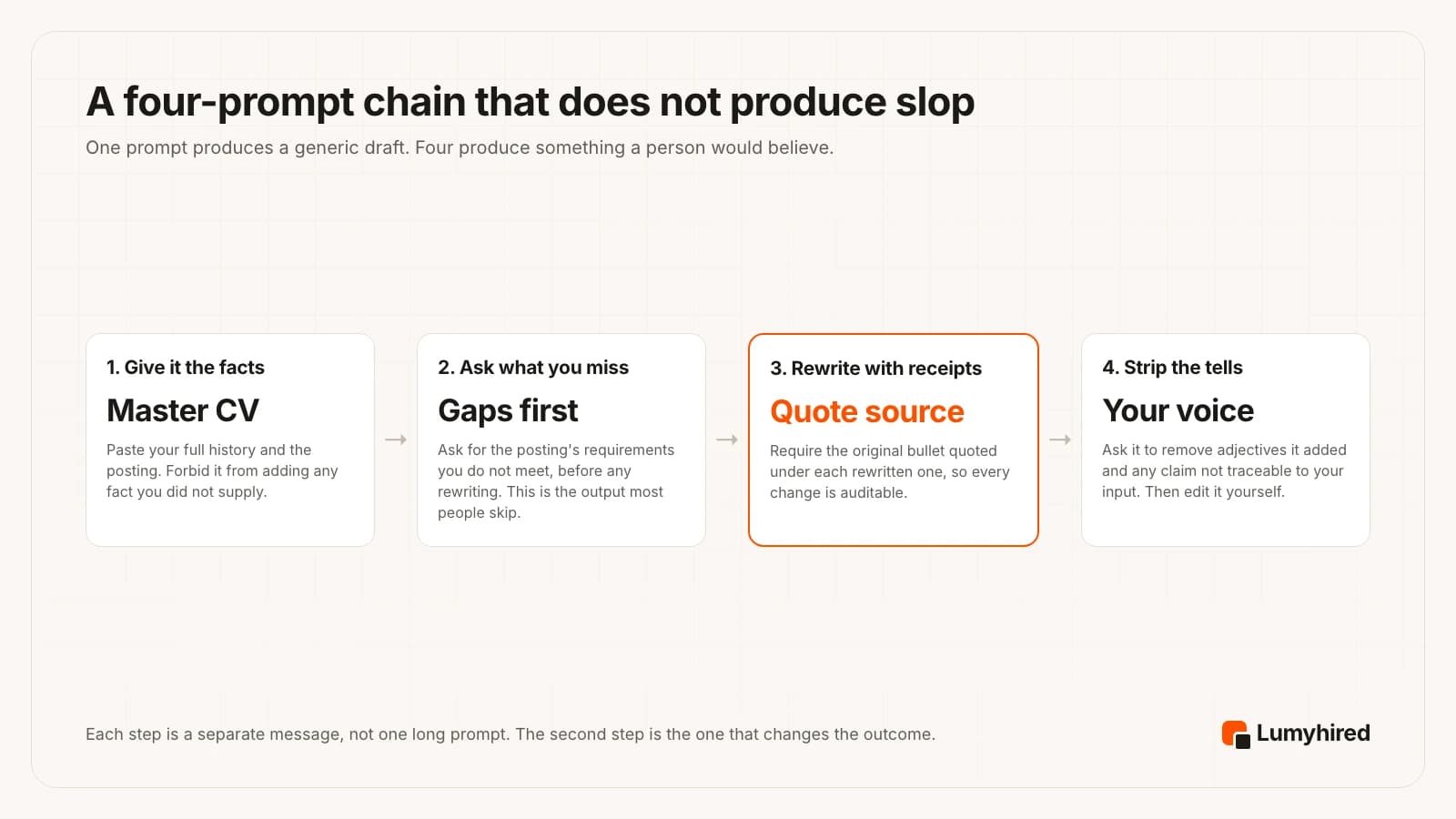
Step one, give it the facts. Paste your full master resume, everything you have ever done, and the full text of the job posting, not its title. Then set the constraint explicitly: it may reword what you supplied and may not add any fact, number, employer, date or tool that is not already there.
Step two, ask what you miss. Before any rewriting, ask it to list the requirements in the posting that your history does not cover. This is the output almost everyone skips and the one worth the most. It tells you whether to apply at all, it tells you what the interview will probe, and it stops the rewrite from quietly papering over a gap by borrowing the posting’s language for something you have never done.
Step three, rewrite with receipts. Ask for the rewritten bullets with your original quoted underneath each one. This single formatting requirement makes every change auditable in about ninety seconds, and it is where you will catch the invented percentages, because they appear in the new line with nothing underneath to support them.
Step four, strip the tells. Ask it to remove every adjective it introduced and every claim not traceable to your input. Models add warmth by default. A resume does not want warmth, it wants scope and outcomes. Then edit the result yourself, because the model cannot hear that one of those sentences does not sound like you.
Two prompts worth avoiding. “Make my resume ATS-friendly” produces formatting advice that is often wrong, including the two-column layouts and skills tables that parsers handle worst. “Make this sound more impressive” is a direct instruction to inflate, and it will be followed.
What should you fix in every ChatGPT draft?
Six checks, all of them fast. The draft is not finished until they are done, and this is the step that separates a useful tool from a liability.
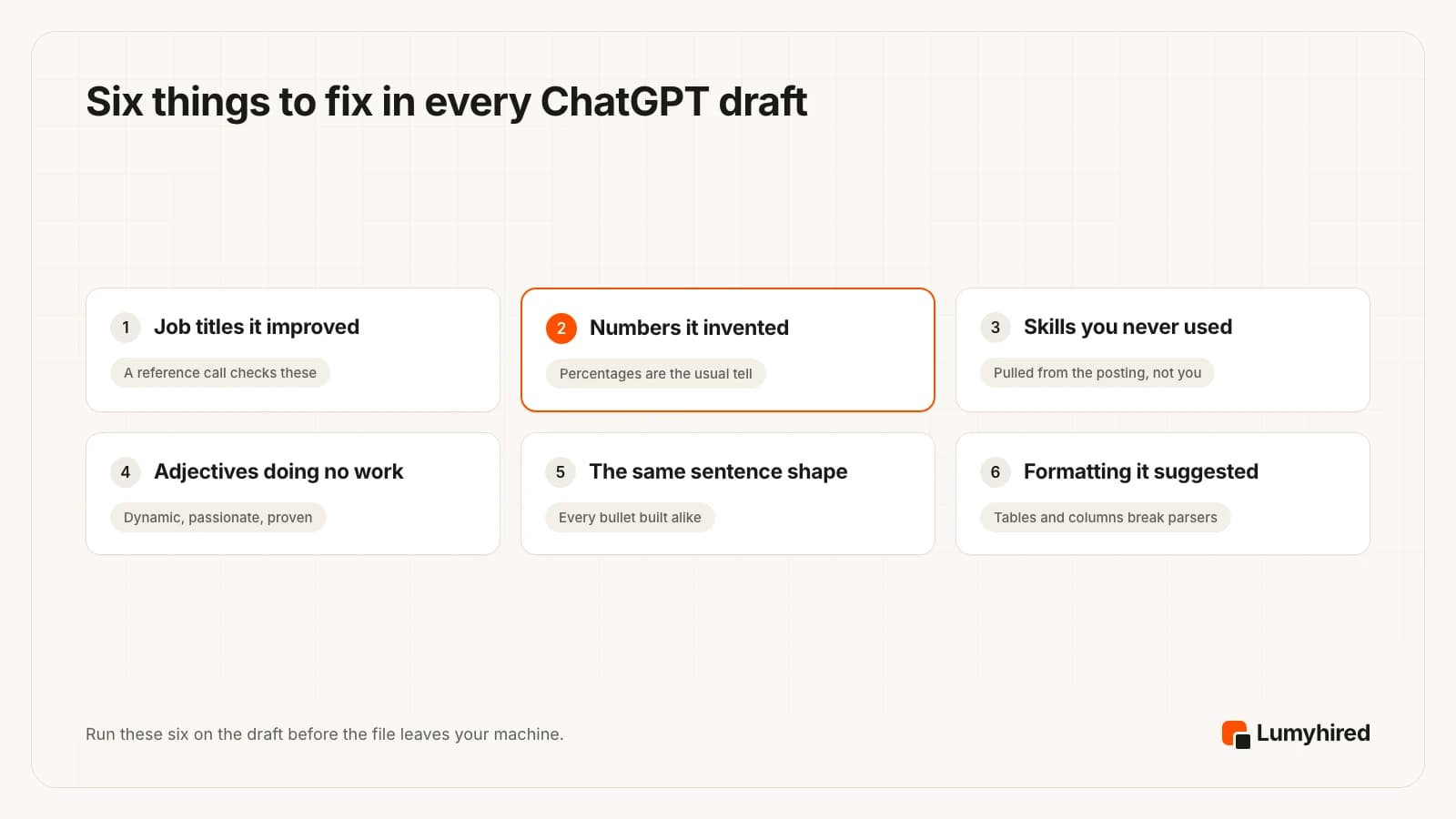
- Job titles it improved. “Coordinator” becomes “manager” with no prompting. The title on each experience line has to stay the title you actually held, because it is the field a reference call and a background check both verify.
- Numbers it invented. Any percentage you did not supply. These are the easiest to spot in the step-three output and the most expensive to leave in.
- Skills you never used. Models pull vocabulary from the posting. If the posting says Kubernetes and your history says Docker, you may find Kubernetes in your skills line.
- Adjectives doing no work. Dynamic, passionate, proven, results-driven. They occupy the space where a number belongs, and every other AI-assisted resume has them too.
- The same sentence shape. If all eleven bullets are verb, object, outcome, in the same rhythm, the page reads as generated even if every fact is true. Break the pattern by hand.
- Formatting it suggested. Ignore layout advice entirely and test the actual file instead.
Is it safe to paste your resume into ChatGPT?
It is a document carrying your full name, home address, phone number, email and complete employment history. That is worth two minutes of thought before it goes into any text box.
OpenAI’s data controls let you turn off “Improve the model for everyone” in Settings, under Data Controls. Conversations still appear in your history, and they are not used to improve the model. Temporary Chats are a stronger option for this specific task: they are deleted after 30 days, are not used for training, do not enter your history and do not create memories.
Whichever you choose, strip the contact block before pasting. Your address and phone number contribute nothing to a rewriting task, and they are the two fields you cannot withdraw once they have been sent. The same applies to a client name under NDA, an unannounced product, or anything else your employer would not want in a third party’s logs.
Does ChatGPT know what an ATS wants?
It knows what has been written about applicant tracking systems, which is a large body of advice containing a great deal that is false. That is not the same as knowing what a parser does to your file.
Ask it about ATS formatting and you will often get the 75% rejection figure that circulates without a traceable source, advice to stuff keywords, or a recommendation for a layout that looks organised to a human and scrambles in extraction. It also cannot tell you which system a given employer runs. Jobscan’s sixth ATS census, dated 20 August 2026, found a detectable system at 487 of the Fortune 500, with Workday above 40%. That is a market picture, and it is not an answer about the company you are applying to, and Jobscan sells resume optimisation, so the census is vendor data.
The decisive limitation is simpler. ChatGPT cannot see what came out the other side of a parser. You can: export the file, run it through a parser and read the extracted fields. If your three promotions at one employer arrive as one merged role with the wrong dates, no amount of prompting would have told you. The free ATS preview shows that extraction in the browser without an account, and the formatting rules that survive it are in the best resume format for AI screening.
Why does the generic draft work less well than it used to?
Because so many people are sending one. The arithmetic of a competent-but-anonymous application changed between 2022 and 2026, and the change is measured, not anecdotal.
Greenhouse analysed more than 640 million applications across over 6,000 companies for its March 2026 benchmark report. Applications per posting rose from roughly 115 in 2022 to 244 in 2025. Applications handled per recruiter went from 146 a year to 746, while recruiting teams were cut roughly in half. The number of jobs that ended in a hire rose 7.9%.
Its chief executive Daniel Chait told Fortune in July 2026 that AI-written applications “all start to look the same,” which is the operative problem for anybody sending a first-pass draft. The pile is deeper, it is more uniform, and the response has been to skim harder. In that environment a document whose only distinguishing feature is competent prose is indistinguishable from the two hundred next to it.
This cuts both ways, and it is worth being honest about the direction. A working paper by Cui, Dias and Ye, revised in November 2025, studied an AI writing tool in a real hiring setting and found improved outcomes for candidates who used it. The gain came from better-expressed applications, not from volume. That is the same conclusion from the other side: the tool helps when it makes a specific application clearer, and does nothing when it makes a generic one faster.
What if you have no numbers to give it?
This is the most common reason people let a model invent figures, and it deserves a straight answer: plenty of real work has no metric attached, and a resume without percentages is not a weak resume. What it needs instead is scope and specificity, and both are things you can supply without measuring anything.
Scope is a number you already know. How many people did you support, how many sites, how many accounts, what budget passed through your hands, how many tickets a week, how many languages, how many countries. None of that requires a performance report. A nurse does not know a conversion rate and does know the bed count on the ward. A teacher knows the class size. A support agent knows the queue.
Firsts and changes carry weight without a percentage. You were the first person in the role. You wrote the procedure that is still in use. You took over an account that was about to leave and it did not. You moved a process from a spreadsheet to a system. Each of those is checkable, memorable and impossible for a model to have invented, which is exactly what makes it useful.
Named things beat adjectives. The tool, the regulation, the system, the client type, the standard you worked to. “Audited against ISO 13485” says more than “strong attention to detail,” and it costs the same number of words.
Practically, feed those to the model in step one and tell it plainly that no percentage exists for this role, so it must write results using scope and named specifics only. Without that instruction it will fill the gap, because a results-shaped sentence is what it has learned a resume bullet looks like. With it, you get the same compression benefit and nothing you would have to defend later.
ChatGPT or a dedicated resume tool?
Use ChatGPT for the writing. Use something else for the parts writing cannot fix, which are extraction, versioning and keeping track. Those are different problems and one tool rarely covers both well.
ChatGPT gives you a text box and no memory of what you sent where. For one application that is fine. Across forty, over three months, it stops being fine: you lose which version went to which employer, you re-explain your history every session, and you have no record when a recruiter calls about a role you applied to in August. Nothing about that is a criticism of the model. It is a different job.
For what each dedicated tool does and what it costs, the comparison is in the best AI for resume writing, and the tailoring-specific tools are in AI resume tailoring tools. Both pages rank Lumyhired, which publishes them, so weigh the criteria before the order.
Frequently asked questions
Can ChatGPT write a resume?
Will recruiters know I used ChatGPT?
What are the best ChatGPT prompts for a resume?
Is it safe to paste my resume into ChatGPT?
Does ChatGPT know what an ATS wants?
Is a ChatGPT resume worse than one written by hand?
Should I tell an employer I used AI on my application?
How much does using ChatGPT for a resume cost?
Check the file, not the prose
The one thing no prompt can tell you is what a parser extracted from your document. Run the file you are about to send through the ATS preview, which is free and needs no account, and read the fields that come back. Then tailor per posting with the ATS resume checker. Weekly plans start at €5 on the pricing page, with a 3-day money-back window and no free plan.
For what a finished document looks like in your field, see the resume examples by role.
Sources
Vendor figures are marked as vendor figures, and survey work commissioned by a company with an interest in the result is marked too. Read 9 October 2026.
- Pudasaini, Miralles-Pechuán, Lillis and Llorens Salvador, Why AI-Generated Text Detection Fails, arXiv 2603.23146, submitted 24 March 2026, revised 22 April 2026
- Greenhouse, The Hire Standard benchmark report, March 2026, North America (6,000+ companies, 640M+ applications, 2022 to 2025)
- Greenhouse, Auto-reject help page, updated 30 January 2026
- Greenhouse, Talent Matching FAQ, updated 3 September 2026
- Express Employment Professionals and The Harris Poll, 11 February 2026 (1,002 US hiring managers; commissioned by a staffing company)
- Fortune, 27 July 2026: Greenhouse chief executive Daniel Chait on application volume and AI-written applications
- Built In, hidden AI prompts in resumes, 15 October 2025, citing New York Times reporting
- OpenAI Help Center, Data Controls FAQ
- OpenAI Help Center, chat and file retention policies in ChatGPT
- OpenAI, ChatGPT pricing, read 9 October 2026
- Jobscan, ATS usage census, sixth edition, 20 August 2026 (487 of the Fortune 500; vendor data, Jobscan sells resume optimisation)
- Cui, Dias and Ye, working paper on an AI writing tool and hiring outcomes, arXiv 2509.25054, revised November 2025
Read next
- Best AI for Resume Writing in 2026: 11 Tools Compared
ChatGPT, Claude, Gemini and eight resume tools compared on stated criteria, with most prices re-checked 15 October 2026, plus three prompts with a check step.
- Best AI for Resume Tailoring in 2026
Nine tailoring tools ranked on six criteria, from reading the full posting to keeping your facts, with prices read 18 September 2026 and a prompt that audits itself.
- How to Pass ATS Filters in 2026
What Greenhouse, Workday, Teamtailor, Lever and iCIMS say their software does to your resume, the one mechanism that rejects automatically, and where the 75% myth came from.
- Best Resume Format for AI Screening
Which format rules vendors actually document, a two-minute copy-paste parse test, and how to build and check an ATS-safe template in Word or Google Docs.
- How to Tailor Your Resume to a Job Description
A 15-minute method with three before and after bullets, an AI prompt that forbids invented facts, and Huntr's data: tailored resumes got interviews at 4.23% vs 2.07% in Q1 2026.