
Resume & ATS
Resume keywords in 2026: finding them and placing them
Most keyword advice stops at add relevant keywords. This is the longer version: where the words come from, how to sort them by type, how recruiters search for them, and which ones a 2026 matching system will credit you for even when you used a different word.
What keywords should be on my resume?
The terms in the posting you are answering, written the way the posting writes them, describing work you actually did. Sort them into five types: job titles, hard skills, tools, certifications and soft skills. Put the job title in your headline, two or three core skills in your summary, tools and certifications in the skills block, and every term you claim inside an experience bullet that proves it. Exact phrasing still matters because recruiters search quoted strings in LinkedIn Recruiter, where AND, OR and NOT have to be capitals and the + and - operators are not supported. Meaning now matters too: Greenhouse Talent Matching, in a help page updated on 3 September 2026, counts related terms toward the same skill instead of demanding the exact word.
A keyword is a matching signal. A term you cannot defend in an interview costs more than a term you leave out.
How to find keywords in a job description
Your source is the posting in front of you. Two companies hiring the same job describe it differently, and you are being compared against one description at a time. So the first step is mechanical: read the responsibilities and requirements blocks, ignore the culture paragraph, and pull out the nouns.
Here is a sample posting written for this article. It is an invented example and deliberately ordinary.
Example posting: Project Manager, Customer Onboarding
Permanent, hybrid, London
What you will do
- Run six to ten enterprise customer onboarding projects at a time in Jira, from kickoff to go live
- Own the risk register and the escalation path with the customer sponsor
- Coordinate engineers, solution architects and the customer side through Confluence
- Produce monthly stakeholder reporting on time to value
Requirements
- Four years or more in project management inside a B2B software company
- Jira and Confluence in daily use
- Risk register, budget forecasting and stakeholder reporting
- English at C1
Nice to have
- PMP or PRINCE2
- Power BI
Eleven terms come out of that. Sorting them by type is what tells you where each one belongs, and marking must have against nice to have is what stops you rewriting your whole resume around a bonus line.
| Term | Type | Weight | Where it goes |
|---|---|---|---|
| Project Manager | Job title | Must have | Headline, and the title line of the matching role if that is what you were called |
| customer onboarding | Domain | Must have | Summary, then one experience bullet |
| Jira | Tool | Must have | Skills list and one bullet that shows what you did in it |
| Confluence | Tool | Must have | Skills list |
| risk register | Hard skill | Must have | Experience bullet, with the size of the program |
| budget forecasting | Hard skill | Must have | Experience bullet, with the budget figure |
| stakeholder reporting | Hard skill | Must have | Summary and one bullet naming who received the report |
| English C1 | Language | Must have | Languages line, using the posting’s own scale |
| Power BI | Tool | Nice to have | Skills list, only if you have actually built reports in it |
| PMP | Certification | Nice to have | Certifications line, with the year |
| escalation path | Soft skill in disguise | Nice to have | Inside a bullet, never on its own |
Extraction from the example posting above. The posting is written for this article, so nothing here is a claim about a real employer.
Hard skills vs soft skills keywords, plus titles, tools and certifications
The five types behave differently, and treating them as one bag of words is what produces a skills block with forty entries and no evidence behind any of them.
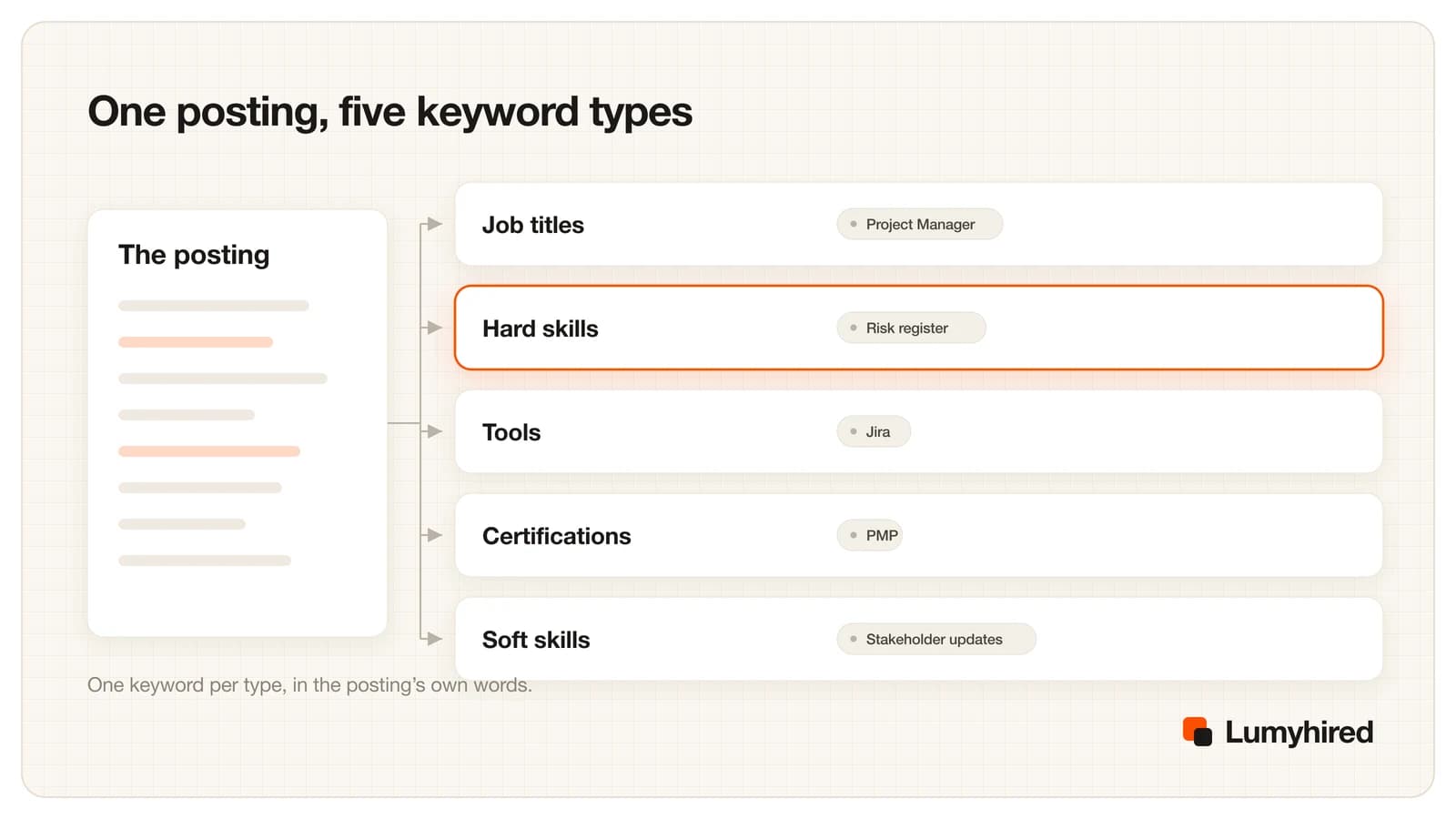
- Job titles are searched as quoted strings, so they are the one place exact wording pays off most. Jobscan, analysing 2.5 million applications for its State of the Job Search report, found a resume title matching the job ad went with a 10.6 times higher interview rate. Treat that as a correlation reported by a vendor that sells resume optimization: it does not show that renaming a role causes interviews.
- Hard skills are the filter terms: risk register, budget forecasting, revenue recognition. The same Jobscan report says recruiters filter on skills in 76.4% of cases, education in 59.7% and job title in 55.3%.
- Tools are the least ambiguous keyword of all. Jira is Jira. O*NET flags the tools that appear most often in employer job postings as Hot Technologies, which is a useful check that you named the standard product rather than your company’s internal nickname for it.
- Certifications are worth writing in both forms once, as in Project Management Professional (PMP), because some recruiters search the acronym and some search the full name.
- Soft skills are the weakest keywords when they stand alone and the strongest when they are evidenced. Everyone writes communication. Almost nobody writes ran the weekly steering committee for a fourteen-person program, which contains the same signal and cannot be copied from a list.
How recruiters search, and why exact titles matter
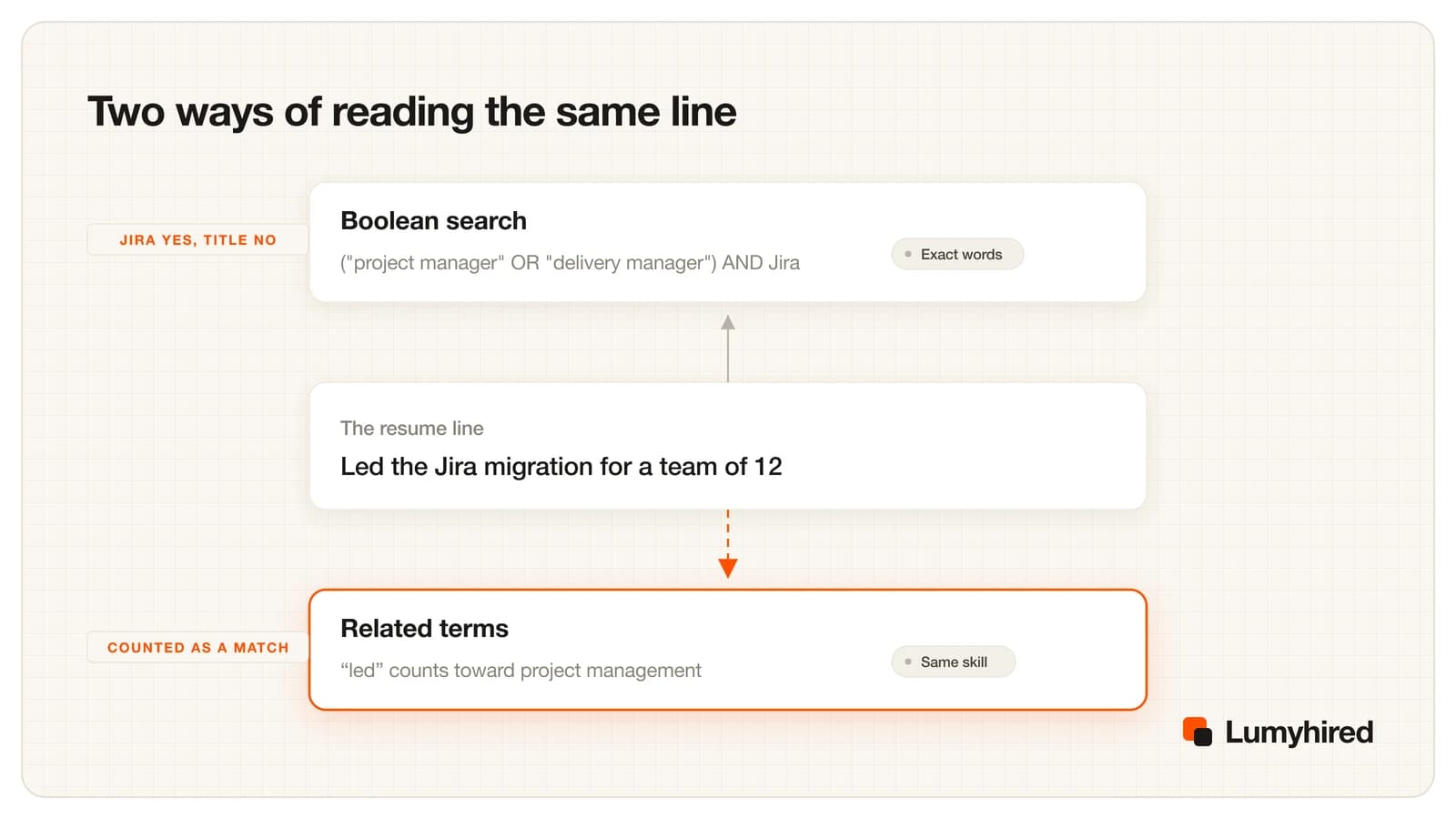
Long before any AI ranking happens, a recruiter types a search. LinkedIn Recruiter’s help page, read on 16 September 2026, is specific about how that search behaves: AND, OR and NOT work only in capital letters, quotation marks bind a phrase, parentheses group terms, and Boolean is honoured in the job title, company, keyword, skills, school, location, industry and spoken language filters. The plus and minus operators are not supported, and the Project filter does not take Boolean at all.
That is a literal search over your words. A recruiter looking for ("project manager" OR "delivery manager") AND Jira finds the resume that contains one of those exact titles. Delivery Lead is not in that string, so it does not surface, however similar the work was. Employers know this costs them people: in the Hidden Workers survey by Harvard Business School and Accenture (September 2021), 88% of employers agreed that qualified high-skills candidates get screened out because they do not match the job description exactly. The figure measures employer opinion rather than counted rejections, and it still tells you who carries the risk.
The practical rule: when the posting’s title is accurate for what you did, use it. Put it in the resume headline, which describes the role you are applying for, and keep your official title on the experience line. Both are true and both are searchable.
Do ATS recognize synonyms in 2026?
Increasingly, yes, and this is the part most keyword guides have not updated. Greenhouse Talent Matching, in a support page updated on 3 September 2026, places candidates in Strong, Good, Partial, Limited or Needs manual review against criteria the recruiter weights, and states that related terms count toward the same skill instead of requiring the identical word. The same page says the feature does not auto-reject or auto-advance anyone, and that a resume with formatting or technical problems is sent to Needs manual review rather than discarded.
Parsing vendors work the same way underneath. Textkernel says it normalizes skills and job titles to public taxonomies, naming O*NET and ISCO, which is the mechanism behind related-term matching: your words are mapped onto a standard concept before anything is compared. On the sourcing side, LinkedIn’s Hiring Assistant, an agent that takes instructions in plain language, became available globally in English in September 2025 according to HR Brew.
None of that makes exact phrasing obsolete, for one practical reason: you do not know which system you are facing, and the same recruiter who has semantic matching in the pipeline still types literal strings into the search box. Matching the posting costs nothing when the phrasing is true. For how the parsing step in front of all this behaves, and which file formats survive it, see the guide on how ATS filters actually work.
Where to put resume keywords
Placement changes what a term is worth. The same word in a skills block and in a results sentence reads as two different claims, to software and to the person skimming afterwards.
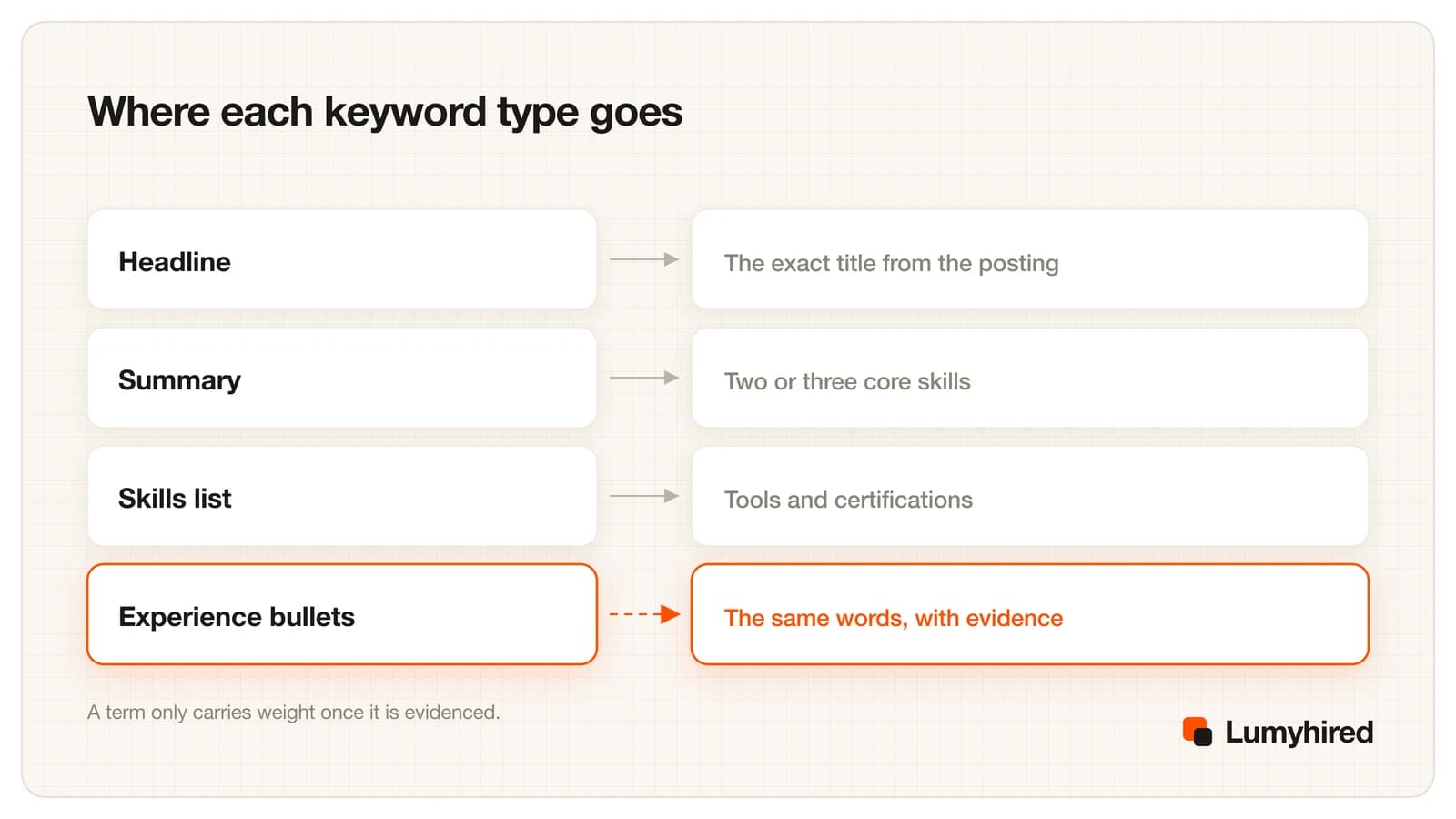
- Headline. The posting’s job title, where it is accurate. This is the line a recruiter sees first and the line a title search hits.
- Summary. Two or three hard skills from the must have column, written as a sentence about what you do.
- Skills list. Tools, systems, certifications and languages. Treat it as an index of terms you have already evidenced further down the page.
- Experience bullets. Every claimed keyword, inside work. Instead of a skills entry reading forecasting, a bullet reading built the quarterly demand forecast that set inventory targets for four regional warehouses. The term is present and it is proved in the same line.
Rewriting bullets this way, at speed, per posting, is its own job. The 15-minute method for it is in tailoring a resume to a job description, and if you want to see the finished shape first, the resume examples show terms sitting inside evidence rather than in a wall of nouns.
Resume keywords by job title: an ATS keywords list for 2026 from O*NET
A generic 500-word keyword list has one real use: checking that you have not missed the standard term for your own occupation. For that, use a public taxonomy rather than a blog. O*NET OnLine, run by the US Department of Labor, publishes, for every occupation, the titles employers report, the software it flags as Hot Technologies because it appears most often in employer job postings, and the skills that make up the work. The table below is taken straight from those pages.
| Occupation (O*NET code) | Reported job titles | Software named on the page | Skills O*NET lists |
|---|---|---|---|
| Software developers (15-1252.00) | Software Engineer, Software Architect, DevOps Engineer, Application Developer | GitLab, Atlassian Bitbucket, Red Hat OpenShift, Amazon DynamoDB, GraphQL, Selenium | Programming, Systems Analysis, Critical Thinking, Active Learning |
| Data scientists (15-2051.00) | No sample titles shown; O*NET points to Business Intelligence Analysts as related | Docker, Kubernetes, PostgreSQL, Apache Airflow, Apache Kafka, Amazon Redshift | Mathematics, Critical Thinking, Reading Comprehension, Writing |
| Project management specialists (13-1082.00) | Implementation Project Manager, Project Management Consultant, Fiber Project Manager | Asana, Atlassian Confluence, Oracle Primavera, Microsoft Visio, Procore | Coordination, Time Management, Judgment and Decision Making, Complex Problem Solving |
| Accountants and auditors (13-2011.00) | Accountant, Cost Accountant, Internal Auditor, Financial Reporting Accountant, CPA | SAP Concur, Workday, Structured query language SQL, Tableau, Oracle PeopleSoft | Mathematics, Reading Comprehension, Critical Thinking, Active Listening |
| Registered nurses (29-1141.00) | Staff Nurse, Charge Nurse, Oncology RN, School Nurse, Certified Operating Room Nurse | Epic Systems, MEDITECH, eClinicalWorks EHR, Microsoft Access | Active Listening, Social Perceptiveness, Service Orientation, Critical Thinking |
| Marketing managers (11-2021.00) | Brand Manager, Product Marketing Manager, Marketing Director, Marketing Communications Manager | HubSpot, Marketo Marketing Automation, Google Analytics, Tableau, Figma, Canva | Persuasion, Judgment and Decision Making, Speaking, Social Perceptiveness |
| Human resources specialists (13-1071.00) | Corporate Recruiter, HR Generalist, HR Analyst, HR Coordinator, Personnel Analyst | Oracle PeopleSoft, SAP, Kronos Workforce Timekeeper, Microsoft SharePoint | Speaking, Active Listening, Service Orientation, Negotiation |
| Sales representatives of services (41-3091.00) | Sales Representative, National Sales Executive | HubSpot, Microsoft Outlook, Microsoft PowerPoint, Microsoft Project | Negotiation, Persuasion, Social Perceptiveness, Time Management |
Source: O*NET OnLine (US Department of Labor, Employment and Training Administration), occupation summary pages read 16 September 2026; the site reports itself as updated 25 August 2026. Software entries are drawn from each occupation’s Software Skills section, skills from its Essential Skills and Transferable Skills sections.
Why keyword stuffing and white text backfire
Hiding the job description in white text, or burying instructions for an AI reader in a one-point font, is now common enough to be measured. Built In reported in October 2025, citing New York Times reporting, that Greenhouse found hidden text in about 1% of resumes in the first half of 2025, and that ManpowerGroup found it in around 10% of the resumes it scans with AI, roughly 100,000 a year, and does not move those candidates forward.
The mechanism is simple. A parser strips formatting to get at the text, so white on white becomes black on white in the reviewer’s window. The trick that was supposed to be invisible is the most visible thing on the page, and it arrives labelled as an attempt to game the process.
Ordinary stuffing fails more quietly. A skills block repeating forty terms reads as noise to a person who has a few seconds and a shortlist to build, and it dilutes the four terms that actually describe you. The honest test: read each keyword-bearing sentence aloud. If it describes something you did, keep it. If it exists only to hold the term, it is costing more than it returns. If you are sending many applications and hearing nothing, the diagnostic in why you are not getting interviews separates a keyword problem from a targeting problem.
Check your coverage in ten minutes
Put the posting and the resume side by side. Mark each requirement your document evidences, in the posting’s own words. Aim at the requirements you genuinely meet rather than all of them: a gap you cannot honestly fill is information, either that the role is a stretch or that the cover letter has one job to do.
Then confirm the terms survive extraction. Words inside a header, a text box or an image are often absent from the parsed text, which means the work was done and the filter never saw it. Comparison tools differ on scoring, which is worth knowing before you trust a number: see the ATS resume tools comparison. If you are changing field, the term mapping matters more than the layout, and the career changer tools review covers that case. For the search around the document, see the guide to getting a job in 2026.
Frequently asked questions
How many keywords should a resume have?
Do ATS recognize synonyms?
How do I find the keywords in a job description?
Should my job title match the posting exactly?
Are soft skill keywords worth including?
Is white text keyword stuffing detectable?
Do keyword lists for my industry work?
Check what a parser reads before you count keywords
Lumyhired does the two checks this article ends on. The ATS resume checker compares your resume against one posting and reports which of its terms are present, and ATS preview shows the plain text a parser pulls out, which is where keywords inside headers, tables and graphics disappear. Weekly plans start at €5 on the pricing page, with a 3-day money-back guarantee, cancel anytime, and no free plan.
Sources
- Greenhouse, Talent Matching FAQ, support page updated 3 September 2026. support.greenhouse.io
- LinkedIn, Boolean search in Recruiter, help page read 16 September 2026. linkedin.com/help/recruiter
- O*NET OnLine, US Department of Labor, occupation summary pages read 16 September 2026, site updated 25 August 2026. onetonline.org
- Textkernel, parsing FAQ on skill and job title normalization to O*NET and ISCO, undated. developer.textkernel.com
- Jobscan, State of the Job Search, 2025. Analysis of 2.5 million applications by a company that sells resume optimization. jobscan.co
- Built In, hidden AI prompts in resumes, 15 October 2025, citing New York Times reporting and figures from Greenhouse and ManpowerGroup. builtin.com
- HR Brew, LinkedIn Hiring Assistant expands globally, 3 September 2025. hr-brew.com
- Harvard Business School and Accenture, Hidden Workers: Untapped Talent, September 2021. 88% of employers agreed qualified high-skills candidates are screened out for not matching the job description exactly. hbs.edu
Read next
- How to Pass ATS Filters in 2026
What Greenhouse, Workday, Teamtailor, Lever and iCIMS say their software does to your resume, the one mechanism that rejects automatically, and where the 75% myth came from.
- How to Tailor Your Resume to a Job Description
A 15-minute method with three before and after bullets, an AI prompt that forbids invented facts, and Huntr's data: tailored resumes got interviews at 4.23% vs 2.07% in Q1 2026.
- Why You're Not Getting Interviews in 2026
Diagnose it by symptom: no replies, rejections within minutes, screens with no interviews, interviews with no offers, or silence. A 10-minute test for each.
- Best AI for Resume Writing in 2026: 11 Tools Compared
ChatGPT, Claude, Gemini and 8 resume tools compared on stated criteria, with prices checked 18 September 2026, a test you can repeat, and 3 prompts with a fact check.