
Resume & ATS
How long should a resume be in 2026? The evidence, and a length for every career stage
The one-page rule is repeated everywhere, and so is the claim that recruiters now prefer two pages. This guide reads the studies behind both, says who paid for them, sets out the one place where length is a hard rule, and ends with a table that gives a length for each career stage and a worked example of cutting a resume to one page.
How long should a resume be?
One page for students and early-career applicants, one or two pages from roughly five to ten years of relevant experience, and two pages for senior roles. Those boundaries are conventions: the research is thin, mostly published by companies that sell resume services, and it disagrees. One case has a hard rule (USAJOBS): Title 5 (competitive and excepted service) announcements on USAJOBS cap resumes at two pages since 27 September 2025. Academic CVs have no page limit, according to Harvard’s career guidance. Whatever the length, page one has to carry your strongest evidence.
Published 14 October 2026. Every figure is sourced at the end, with its sample size and who paid for the study when that matters.
What does the research on resume length actually show?
Less than the advice built on it. The studies found for this guide are few, all of them published by companies that sell resume or job search services, and they point in different directions depending on how the question is asked.
The most quoted is a hiring simulation run by ResumeGo between 15 October and 2 November 2018. It asked 482 people with direct hiring experience (recruiters, hiring managers, HR staff and senior executives) to screen resumes for several jobs and pick the candidates they would consider. Of the 7,712 resumes they picked, 5,375 were two pages long, about 69.7%. ResumeGo reported that reviewers were 2.3 times as likely to prefer the two-page version, 1.4 times at entry level, 2.6 times at mid level and 2.9 times for managerial roles. Two-page resumes also scored 8.6 out of 10 on average, against 7.1.
Read the design before using the result. Each one-page resume had a two-page counterpart with similar experience and credentials, but the one-page versions ran to 350 to 500 words and the two-page versions to 700 to 850. The two-page candidates therefore came with roughly twice as much detail about the same career. In this design, page count and amount of detail rose together, so the result measures the effect of both at once. ResumeGo also sells resume writing. The write-up we read does not mention that interest, and its only stated qualification is that the study is a simulation.
That is the pattern across the evidence below. Surveys measure what hiring professionals say they prefer, simulations measure what they pick in an artificial task, and the only data set found for this guide that looks at interviews comes from Jobscan. None of them is independent of the resume and job search industry, so this guide reports each with its sample and its publisher, and labels as a convention anything that rests on custom alone.
Do recruiters prefer one-page or two-page resumes?
The surveys split, and the split follows the wording of the question. Asked what length to advise, hiring professionals say one page. Asked about the resumes they actually receive, they say too short.
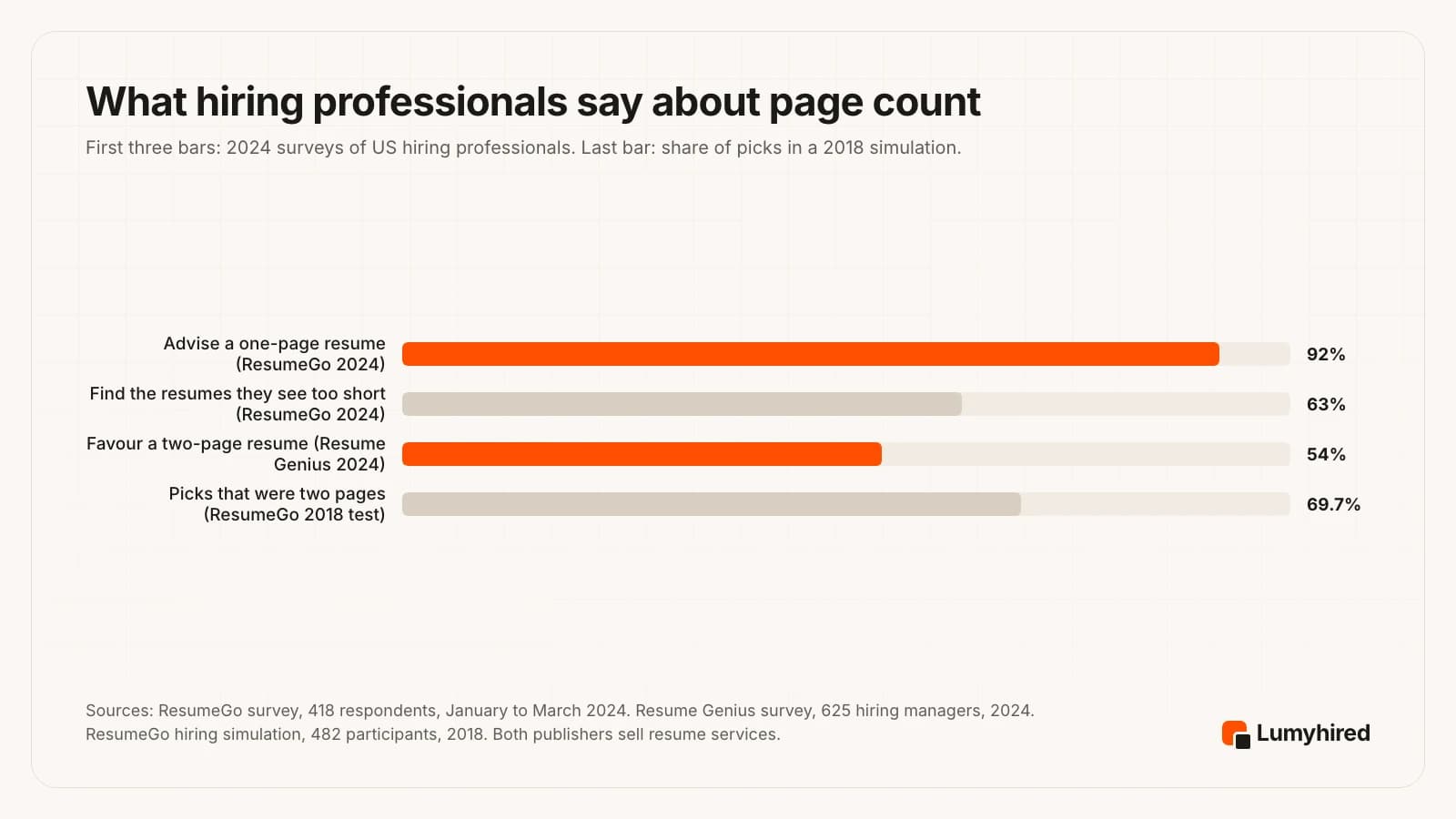
ResumeGo surveyed 418 US hiring professionals between 8 January and 1 March 2024. Asked which length they would recommend, 92% chose one page and 8% two. The same respondents then gave answers that pull the other way: 63% said the resumes they come across are too short for their liking, 89% said too little information is worse than too much, and 68% said a two-page resume is not unnecessarily long.
Resume Genius, which sells a resume builder, asked 625 US hiring managers in a survey that opened on 29 January 2024. Of those, 54% favoured a two-page resume. The share rose with company size, from 50% at small companies to 56% at medium-sized ones and 61% at large ones.
Asked at what point a resume becomes excessive whatever the candidate’s experience, 59% of ResumeGo’s respondents said past two pages and 22% said past one page.
Does a shorter resume get more interviews?
Among Jobscan users, the shortest entry-level resumes were associated with the highest interview rate. In mid career, a middle length had the highest rate and the shortest resumes the lowest. This is the only data set found for this guide that tracks interviews.
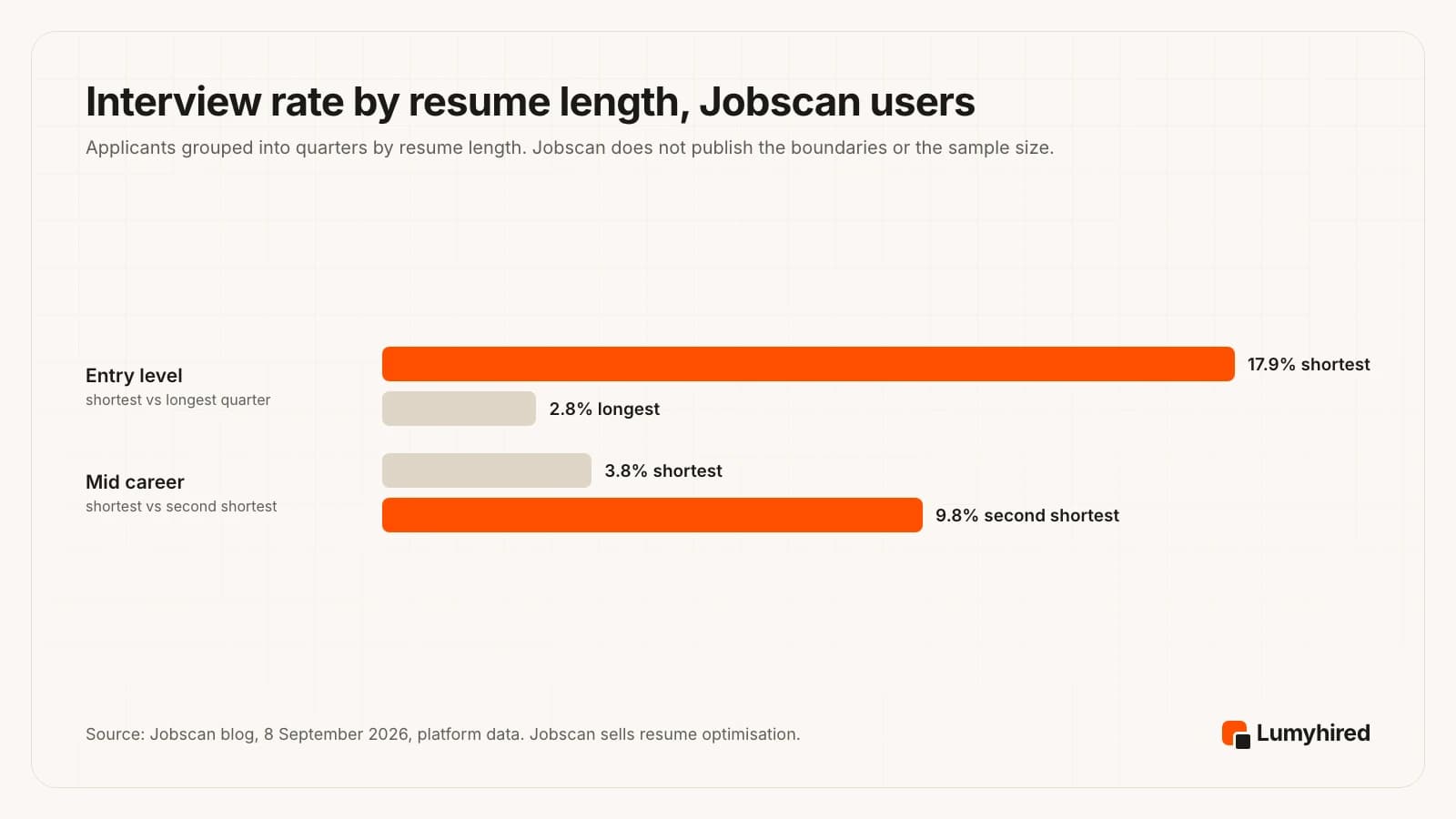
Jobscan published its own platform data on 8 September 2026. It grouped users into four quarters by resume length and compared Jobscan’s interview rate for each group. At entry level, the shortest quarter got interviews at a rate of 17.9%, the longest at 2.8%. In mid career, the shortest quarter had the lowest rate, 3.8%, and the second-shortest the highest, 9.8%. At senior level the shortest quarter reached 15.6%, but Jobscan calls that sample very small.
This is the closest thing to outcome data on resume length, and it has gaps. Jobscan does not give the number of users, the word or page boundaries of each quarter, or its definition of an interview. Its users chose to use a resume optimisation tool, which makes them a particular group. And length travels with other things: an entry-level applicant with a very long resume may also be applying to roles that do not fit, or padding a thin record. The figures describe an association between length and interviews, with the other causes left unmeasured.
Even so, it points the same way as the guidance for early career. Among Jobscan users, the shortest entry-level resumes were associated with the highest interview rate, and among mid-career users the second-shortest quarter had a higher rate than the shortest.
How long do recruiters spend reading a resume?
A few seconds for the first screen, minutes for the resumes that pass it. The length debate matters only after that first screen, which, by convention, should be won on the top of page one.
Ladders, a job site, reported in its 2018 eye-tracking study that recruiters spent an average of 7.4 seconds on the initial screen of a resume, up from about six seconds in its 2012 study, according to HR Dive’s report of 8 November 2018. The coverage gives no sample size. Resumes that held attention had simple layouts with clear sections and headings; cluttered layouts, little white space, multiple columns and long sentences fared badly. Ladders measured an initial screen, the first pass a recruiter makes over a resume.
Once reviewers do read, length changes the time spent. In ResumeGo’s 2018 simulation, where reviewers had to rate every candidate, they spent an average of 2 minutes 24 seconds on one-page resumes and 4 minutes 5 seconds on two-page ones. France Travail, the French public employment service, makes the same point from the other side: whatever the length, a recruiter spends very little time on a CV at the shortlisting stage, and on a two-page CV forms an opinion on the first page. Harvard’s career guide for graduate students warns that a CV may get no more than thirty seconds.
The practical consequence is the same at any length. Your current title, your strongest two or three results and the skills the posting names belong in the top third of page one, where the first screen happens.
How long should your resume be? A decision table by career stage
Find your row. The middle column is the length to aim for; the last column says what the advice rests on. A rule is enforced by the employer, guidance comes from a career service or public body, vendor data comes from a company that sells resume services, and a convention is common practice with no study behind it.
| Situation | Length | What it rests on |
|---|---|---|
| Student or new graduate | One page | Guidance: Purdue OWL, Onisep. Vendor data: Jobscan’s shortest entry-level quarter had a 17.9% interview rate, its longest 2.8%. |
| Early career (under 5 years) | One page; a second only if it is full of relevant work | Convention for the year boundaries. Guidance: Purdue OWL says under ten years of experience “may” fit on one page. |
| Mid career (5 to 10 years) | One or two pages | Guidance: Purdue OWL suggests considering two pages above entry level. Vendor data: ResumeGo’s 2018 test, 2.6 times as many two-page picks at mid level; Jobscan, the second-shortest mid-career quarter had the highest interview rate. |
| Senior or manager (more than 10 years) | Two pages | Vendor data: ResumeGo 2018, 2.9 times as many two-page picks at managerial level. Derived from ResumeGo’s 2024 answers: 53% set the threshold for two pages at ten years or less (any amount 6%, five years 2%, ten years 45%). Guidance: France Travail uses about ten years of varied experience. |
| Executive | Two pages, three if the record needs it | Guidance: Purdue OWL says senior managers and executives may need three or more pages. No outcome data found. |
| Academic (PhD, postdoc, faculty) | A CV with no page limit; graduate student CVs usually run 2 to 5 pages | Guidance: Harvard GSAS career guide, 2025. |
| US federal: Title 5 (competitive and excepted service) announcements on USAJOBS | Two pages maximum, enforced | Rule: OPM, in force since 27 September 2025. A longer resume makes the applicant ineligible. |
| France | One page; two from about ten years of varied experience | Guidance: Onisep (updated June 2026). Guidance: France Travail. |
One case has a hard rule (USAJOBS); academic CVs have no page limit, according to Harvard’s career guidance, and the other rows are judgement. The year boundaries in particular are conventions: no study sets the point at which a second page becomes worth it, and ResumeGo’s own 2024 respondents disagreed. Asked how many years of experience a job seeker should have before considering two pages, they set the threshold at ten years (45%), twenty (31%), fifteen (17%), five (2%) or any amount (6%). Count relevant experience, the years that match the job you are applying for. A career changer with twelve years in another field can have one page of relevant material.
When is a two-page resume the right choice?
When cutting to one page would remove evidence the employer would use to decide. Four tests help.
- Recent, relevant results fill more than a page. After you have cut everything below, if the last ten years still need more room, take it. OPM’s advice for its federal limit puts the priority the same way: most relevant and recent experience first, outdated or unrelated experience out.
- The role is above entry level. Purdue’s Online Writing Lab suggests considering two pages once you are above entry level and below executive level.
- The second page would be at least half full. ResumeGo’s 2024 survey asked about resumes of irregular length, such as 1.1 or 1.5 pages. Of the 418 respondents, 67% said they see them often and 84% recommend adjusting them. Only 13% said an odd length changes their view of the candidate significantly, 48% a little, 39% not at all. A few lines on page two can be fixed in either direction.
- Page two holds the secondary material. France Travail describes the split clearly: page one for what matters most to the job, page two for older experience, other skills and detail that supports page one.
Two practical details, both conventions. Repeat your name and a page number at the top of page two, in case the pages are separated or printed. And do not go below this guide’s formatting floor, set out in step 5 of the cutting method, to avoid a second page.
What changed for US federal resumes in 2025?
The long federal resume is gone. Since 27 September 2025, for Title 5 announcements, USAJOBS accepts resumes of two pages or fewer, and an applicant whose only resume is longer is ineligible.
The change comes from the Merit Hiring Plan of 29 May 2025, which, in the words of OPM’s guidance to agencies, prohibits the longform federal resume structure. OPM announced the date on 2 September 2025 and gave agencies a transition period ending on 27 September. From then, for Title 5 announcements, USAJOBS restricts all resumes to two pages: those stored in a profile, newly uploaded files, resumes built with the USAJOBS resume builder, and the searchable resumes agencies mine in the Agency Talent Portal. If an applicant submits a two-page resume and a longer one, agencies review only the two-page version. If the only resume is longer, the status notice reads that the application is not being considered for not meeting the resume page requirement.
The limit applies to competitive and excepted service announcements under Title 5. Non-Title 5 agencies and the judicial and legislative branches may accept longer resumes, but only if the announcement explains how to submit one under “other documents”. For positions that require a curriculum vitae, typically in medicine and research, agencies may ask for the CV the same way.
The content requirements did not shrink with the page count. For each relevant job, OPM still asks for the job title and employer (with series and grade for federal positions), start and end dates as month and year, and the hours worked per week. OPM’s guidance advises a PDF of 5MB or less to keep the page count, and quotes the values USAJOBS suggests: a sans-serif font such as Lato, Calibri or Arial, margins of 0.5 inches, 14-point titles and 10-point body text. If you have an old five-page federal resume, the cutting method below applies, with one addition: keep the hours, dates and grades on every role, because reviewers use them to check minimum qualifications.
How long should an academic CV be?
As long as the record requires. An academic CV has no page limit, and for graduate students it usually runs two to five pages.
Harvard’s 2025 career guide for its graduate school of arts and sciences says it directly: unlike a resume, there is no page limit, but most graduate student CVs are two to five pages long. The same guide warns that a CV may get no more than thirty seconds of the reader’s attention, so the most important categories belong on the first page, each listed in reverse chronological order. Purdue’s Online Writing Lab notes that academic and scientific job seekers will usually be asked for a CV, which it describes as a long resume with different information. In practice that means sections for publications, presentations, teaching, grants and service.
Length grows with the career because the lists grow, so a faculty CV can run far longer than a graduate student’s. The one discipline that applies at every stage is relevance on page one: your current position, your degree, and the research or teaching category the hiring committee reads first. When an academic applies for an industry job, the convention is to turn the CV into a one- or two-page resume built around skills and results, since the employer is reading for different evidence.
How long should a CV be in France and the rest of Europe?
One page in France for most applicants, two with about ten years of varied experience. In Europe more broadly, two pages is the usual ceiling (EURES, 2017). Outside academia, a European “CV” is what an American would call a resume.
Onisep, the French public body for education and career information, answers the question “should a CV fit on one page?” with a yes in its guide updated in June 2026: do not exceed two pages, especially without experience, and consider two pages only once you have a number of jobs behind you. It also recommends a plain font such as Arial, Calibri or Tahoma at 10 to 12 points. France Travail gives the same split: one page for young graduates and less experienced candidates, two pages printed front and back for candidates with at least ten or so years of experience in varied roles, with page one for what matters to the job and page two for secondary information.
According to EURES in 2017 (the European Commission’s job mobility portal), two pages is generally accepted as the ideal length. The advice is old, and national habits vary, but it matches the French guidance on the upper limit. If you apply across borders, the safe reading of these sources is one page early in a career and never more than two outside academia.
Does an ATS reject or cut off a long resume?
In the documentation of the two vendors checked, the stated risks concern parsing and file size. Neither describes cutting a resume off after a set number of pages.
Textkernel, a resume parsing vendor, lists under “Scalability” in its technical specifications that the service “has no document limits”; the sentence is about processing volume, and the page states no page or file-size limit for a single resume. Greenhouse’s help page on failed parses, updated in March 2026, lists three causes: a file that is too large, fake resumes, and formatting problems. Its size limit is stated in megabytes: Greenhouse cannot parse resumes larger than 2.5MB, which usually means a file loaded with high-resolution images.
Page limits do exist when an employer or portal sets them as a rule. USAJOBS is the clearest case: OPM’s guidance requires every Title 5 announcement to state the two-page cap in its How to Apply section, and advises a PDF of 5MB or less.
For both vendors, the risk documented for a long resume is the one documented for a short one: whether the parser can read it. You can check what a parser pulls from your file with the ATS preview, and the layout choices that parse cleanly are covered in the best resume format for AI screening.
How do you cut a resume to one page?
Content first, layout last. Cut in the order below, and stop as soon as the resume fits. Shrinking the font or the margins comes at the end, and only down to a floor.
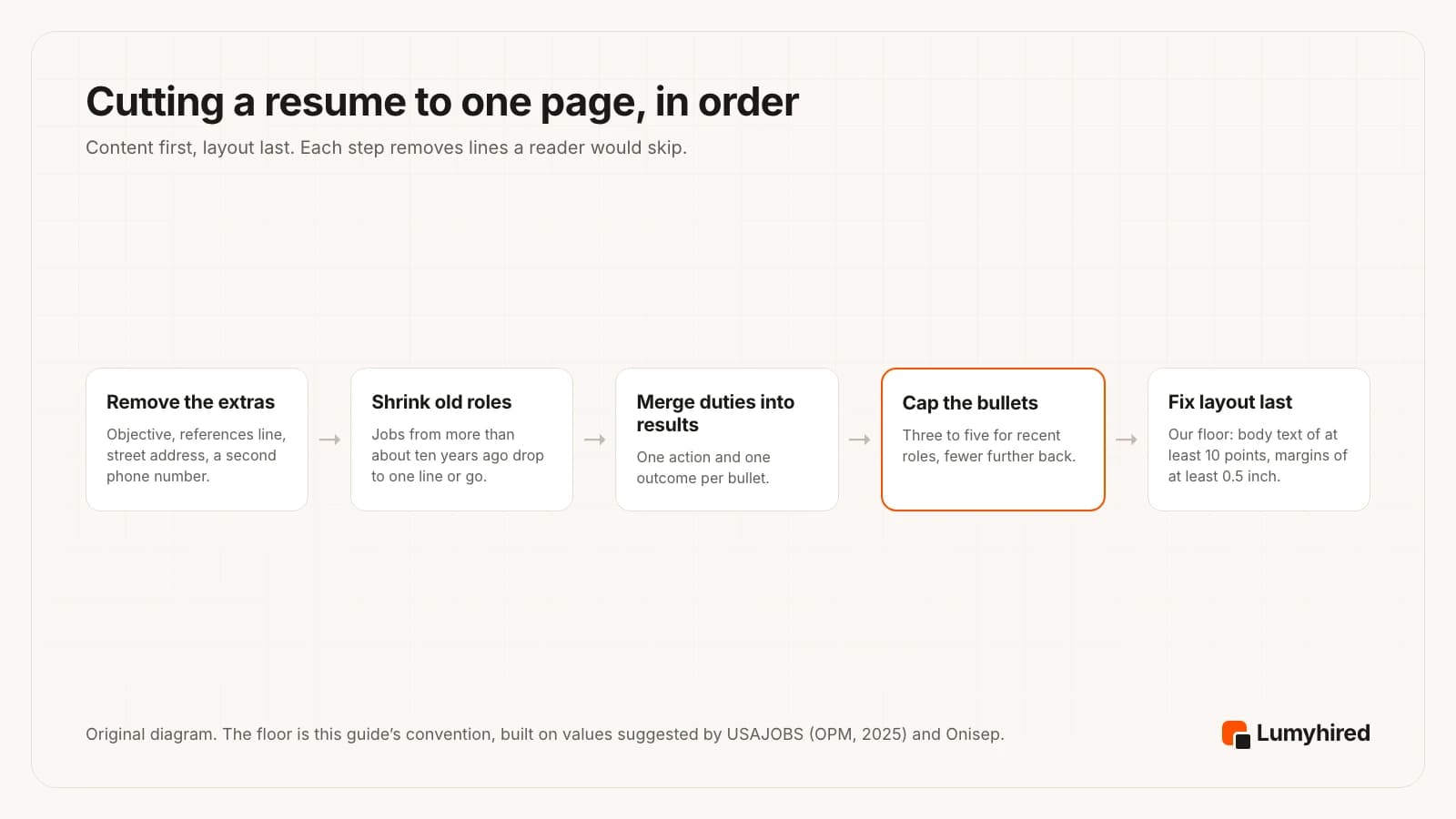
- Remove the extras. A career objective, the line “references available upon request”, a full street address, a second phone number, an interests list. None of them helps a reviewer decide. City and state, one phone number, one email address and a LinkedIn URL are enough.
- Shrink old roles. Jobs from more than about ten years ago, and early jobs unrelated to the target role, drop to one line each under an “Earlier” heading, or go. The ten years is a convention; the principle is OPM’s: remove outdated or unrelated experience.
- Merge duties into results. “Responsible for” bullets describe the job, and most jobs with the same title have the same duties. Rewrite each kept bullet as one action and one outcome, and delete the ones with no outcome to report.
- Cap the bullets. Three to five for recent roles, one or two for older ones (a convention). Order them by relevance to the posting, which is the same exercise as tailoring your resume to a job description.
- Fix layout last. Tighten spacing between sections and drop any sidebar. This guide’s floor is a convention built on the values USAJOBS suggests and on Onisep’s range: body text of at least 10 points, margins of at least 0.5 inches. If the resume still does not fit at that floor, it needs another content cut or a second page.
Here is the method applied to a fictional marketing coordinator with four years of experience. Names, employers and figures are invented for the example.
Before: 70 lines, 479 words, no measured result
JORDAN AVERY
42 Maple Street, Apt 3B, Columbus, OH 43215
Home: (614) 555-0142 · Mobile: (614) 555-0187
jordan.avery@example.com · Available: immediately

CAREER OBJECTIVE
Motivated, detail-oriented and creative marketing professional seeking
a challenging position in a dynamic, fast-paced company where I can
use my skills, contribute to the team and continue to grow.

PROFESSIONAL SUMMARY
Results-driven marketing coordinator with over 4 years of experience
in B2B and agency marketing. Excellent communication, teamwork and
problem-solving skills. Passionate about data, storytelling and
creativity. Proven ability to manage multiple projects at once and
work under pressure to meet tight deadlines. Quick learner who is
comfortable with new tools and enjoys working with people.

PROFESSIONAL EXPERIENCE
Marketing Coordinator, Northfield Software, Columbus, OH
March 2023 to present
- Responsible for managing the monthly company newsletter, including
  writing, design, scheduling and reporting on results
- Responsible for coordinating webinars together with the sales team
  and handling registrations, reminders and follow-up emails
- Worked on social media posts for LinkedIn and other channels
- Helped with the website redesign project alongside an agency
- Attended weekly marketing meetings, took notes and shared them
- In charge of updating the CRM with leads collected at events
- Created various reports in HubSpot for the marketing manager
- Liaised with the design team on brochures and event materials
- Helped organise the company stand at two industry trade shows
- Supported the team with ad hoc tasks as needed

Marketing Assistant, Brightline Agency, Columbus, OH
June 2021 to February 2023
- Assisted account managers with client campaigns across sectors
- Wrote blog posts and articles for clients on a range of topics
- Scheduled social media posts using a scheduling tool
- Answered client emails and phone calls in a timely manner
- Organised files and assets on the shared drive
- Took part in brainstorming sessions for new client pitches
- Compiled monthly reports for clients from several data sources
- Helped onboard two new clients to the agency’s processes

Marketing Intern, Brightline Agency, Columbus, OH
January 2021 to May 2021
- Supported the content team with research and proofreading
- Prepared slides for internal meetings
- Updated the agency’s own social media accounts

Sales Associate, Corner Books, Columbus, OH
September 2017 to May 2021 (part time during studies)
- Helped customers find books and recommended titles
- Operated the cash register and handled returns
- Stocked shelves, arranged displays and assisted with inventory
- Trained two new part-time staff members

EDUCATION
Bachelor of Arts in Communications, State University, 2021
GPA 3.4. Dean’s list, two semesters.
Relevant coursework: Marketing Principles, Consumer Behaviour,
Digital Media, Statistics, Public Speaking, Copywriting
High school diploma, Westland High School, 2017

CERTIFICATIONS
HubSpot Inbound Marketing (2022) · Google Analytics (2022)

SKILLS
Communication · Teamwork · Problem-solving · Creativity · Leadership
Time management · Attention to detail · Adaptability
Microsoft Word · Excel · PowerPoint · Outlook · Email · Internet
HubSpot · Canva · Google Analytics · Social media · WordPress

VOLUNTEERING
Volunteer, Columbus Food Pantry, 2019 to 2022
- Sorted donations and helped at weekend distributions

INTERESTS
Reading, hiking, photography, travel, cooking, podcasts

References available upon request
After: 41 lines, 291 words, a result in almost every bullet
JORDAN AVERY
Columbus, OH · (614) 555-0187 · jordan.avery@example.com

B2B marketing coordinator with four years in software and agency
marketing. Runs webinars, the customer newsletter and HubSpot
reporting for a 200-person software company, and writes most of
its long-form content.

EXPERIENCE
Marketing Coordinator, Northfield Software · 2023 to present
- Split the monthly newsletter into customer and prospect editions;
  the list grew from 3,200 to 5,100 subscribers in 18 months and
  the open rate rose from 31% to 38%
- Ran 14 webinars with the sales team, from registration to
  follow-up; 22% of registrants booked a demo
- Built the HubSpot dashboard the marketing manager uses in the
  weekly pipeline review, replacing three spreadsheets
- Logged event leads in the CRM within 48 hours of each event,
  down from about two weeks
- Wrote the brief and page copy for the 2024 website redesign
  with an outside agency; demo requests from the site doubled in
  the following quarter
- Organised the company stand at two industry trade shows,
  including booth staffing and lead capture

Marketing Assistant, Brightline Agency · 2021 to 2023
- Wrote 60 blog posts for four B2B software clients, two of which
  became the clients’ top organic landing pages
- Planned and scheduled social calendars for six client accounts
- Built monthly client reports from Google Analytics and LinkedIn
  data, cutting preparation from two days to one
- Drafted sections of three new-business pitches, two of them won

Earlier: Marketing Intern, Brightline Agency (2021);
Sales Associate, Corner Books (2017 to 2021, part time during
studies, trained two new staff members)

EDUCATION
BA Communications, State University, 2021

CERTIFICATIONS
HubSpot Inbound Marketing, 2022 · Google Analytics, 2022

SKILLS
Marketing tools: HubSpot (workflows, reports, lists), Google
Analytics 4, WordPress, Canva, Zoom Webinars
Data: Excel (pivot tables, lookups), Looker Studio
Content: SEO copywriting, email marketing, webinar production
What changed, step by step. The objective, street address, home phone, availability line, interests and references line went (step 1). The internship and the bookshop job became three lines under “Earlier”, keeping the one useful fact, training new staff, and the volunteering, which adds nothing for a B2B marketing role, went (step 2). Ten coordinator bullets became six, each with a result; “helped with the website redesign project” became the brief, the copy and what happened to demo requests (step 3). The skills list lost the soft skills and the tools every applicant has, and gained the specific ones; the reasoning is in which skills to put on a resume. The summary lost its adjectives and now says what the candidate runs, and for whom.
The after version is shorter by 29 lines and carries more information. It also sits below the 350 to 500 words that ResumeGo used for its one-page resumes, which leaves room to add a project or a certification that a particular posting asks for.
How many words should a resume be?
There is no standard, but word count is a steadier measure than pages, and the only published reference found puts a one-page resume at 350 to 500 words and a two-page resume at 700 to 850.
Those ranges are the material ResumeGo built for its 2018 simulation, so they describe the resumes it tested. They are still useful, because a page count depends on the template. The same 450 words fill one page in a compact single-column layout and spill onto a second in a design with a wide sidebar and large headings. Jobscan’s 2026 article makes the same point: in most cases, length is a matter of word count.
Three working limits, all conventions, keep a resume readable at any length: bullets of one or two lines, a summary of two to four lines, and no paragraph longer than three lines anywhere on the page. By our rule of thumb, a resume above about 600 words that still fits on one page is too dense, and the fix is either the cutting method above or a second page.
Once the length is right, check each page against the posting with the ATS resume checker.
Frequently asked questions
Is a two-page resume okay?
Should a resume be one page?
Can a resume be three pages?
How long should a resume be with 20 years of experience?
Do recruiters read the second page of a resume?
How many words should a resume be?
How long should a federal resume be?
Is a CV longer than a resume?
Check what survives on page one
Run your resume through the ATS preview, which is free and needs no account, and read what a parser extracts from each page. Then compare it with each posting in the ATS resume checker, which compares your resume with a specific job description and shows the requirements it does not yet cover. In Lumyhired you upload one master resume and it is adapted to each job, keywords and parser-friendly layout included. Weekly plans start at €5 on the pricing page, with a 3-day money-back window and no free plan.
Sources
Vendor data is marked as such: ResumeGo, Resume Genius, Jobscan and Ladders all sell resume or job search services. The ResumeGo study page carries no date, so its 2018 year is confirmed through ERE. Jobscan does not publish the sample size behind its interview rates. The original Ladders report could not be opened for this guide, so its figures come from HR Dive’s coverage. No independent, peer-reviewed study of resume length and hiring outcomes was found. Read 14 October 2026.
- US Office of Personnel Management, Agency Guidance on the Two-Page Limit on Resume Length, 2025 (Merit Hiring Plan; includes the USAJOBS formatting advice)
- US Office of Personnel Management, OPM Implements Two-Page Resume Standard to Streamline Federal Hiring, press release, 2 September 2025
- ResumeGo, Settling the Debate: One or Two Page Resumes, hiring simulation run 15 October to 2 November 2018 (482 participants; ResumeGo sells resume writing)
- ERE, coverage of the ResumeGo study confirming its 2018 dates, 4 January 2019
- ResumeGo, Survey: How Long Should a Resume Be?, 8 January to 1 March 2024 (418 US hiring professionals; ResumeGo sells resume writing)
- Resume Genius, hiring trends survey, fielded from 29 January 2024 (625 US hiring managers; Resume Genius sells a resume builder)
- Jobscan, We Checked What Actually Gets Interviews, And It’s Not What Recruiters Say They Prefer, 8 September 2026 (platform data, sample size not published; Jobscan sells resume optimisation)
- HR Dive, report on the Ladders 2018 eye-tracking study, 8 November 2018 (Ladders runs a job site)
- Purdue Online Writing Lab, Résumés: Using Two Pages or More, read 14 October 2026
- Harvard FAS career services, CVs and Cover Letters guide for GSAS students, August 2025
- Greenhouse, Unsuccessful resume parse, help page updated 2 March 2026
- Textkernel, Resume Parser technical specifications (Tx Platform v10), “Scalability” section, read 14 October 2026
- France Travail, Le CV sur 2 pages, bonne ou mauvaise idée ?, read 14 October 2026
- Onisep, Les 10 questions à se poser avant de rédiger son CV, published 16 December 2025, updated 19 June 2026
- EURES (European Commission job mobility portal), 5 tips for streamlining your CV, 26 September 2017
Read next
- Best Resume Format for AI Screening
Which format rules vendors actually document, a two-minute copy-paste parse test, and how to build and check an ATS-safe template in Word or Google Docs.
- How to Tailor Your Resume to a Job Description
A 15-minute method with three before and after bullets, an AI prompt that forbids invented facts, and Huntr's data: tailored resumes got interviews at 4.23% vs 2.07% in Q1 2026.
- Skills to Put on a Resume (2026 Employer Data)
What employers ranked in 2026, how an ATS extracts and matches your skills section, how many skills to list, and how to prove them, with examples for 15 jobs.
- How to Pass ATS Filters in 2026
What Greenhouse, Workday, Teamtailor, Lever and iCIMS say their software does to your resume, the one mechanism that rejects automatically, and where the 75% myth came from.
- Explaining a Career Gap
What field experiments show about gaps, the resume line and interview answer for each reason, what you never have to disclose, and the LinkedIn career break section.