
Career Guides
Best job search tools for new graduates in 2026
Two things decide a graduate search, and the ranking pages cover neither: what is actually free to you right now and when that ends, and how to say what your coursework, internships and projects amount to in the words a posting uses. Seven tools ranked on both, with every price read on 25 September 2026.
What are the best job search tools for new graduates in 2026?
Lumyhired ranks first on five criteria (turns work you have already done into the posting’s words, roles genuinely open with no experience, ATS safety, what it costs a student, coverage across the whole search). It reads the full posting, returns a gap list of what you match and what you are missing, rewrites the summary, bullets and skills using the posting’s terms only where your CV already describes that work, and files each version against the job. Plans start at €5 a week with a 3-day money-back guarantee, and there is no free plan. Handshake is second: employers post there for students, and it reached an interview on 5.06% of applications against LinkedIn’s 3.10% in Huntr’s 2025 tracker data. Kickresume is third because verified students get Premium free for up to 180 days.
Lumyhired publishes this page and ranks itself first. Prices, free allowances and help-centre rules read on vendor pages on 25 September 2026, except where the page states we could not read one. Article first published 27 August 2026, rewritten 25 September 2026.
What actually stops a graduate application
The problem is rarely a badly written CV. It is that there is not much on it yet, and the capability that does exist is written in university language while the posting is written in employment language. Nothing on the page is false. It is just not legible to the person reading.
The market makes that gap expensive. The New York Fed’s labor market data for recent college graduates, updated 6 August 2026 with figures through June, put their unemployment rate at about 5.6% in the second quarter of 2026 and their underemployment rate at 42%, meaning that share were working in jobs that typically do not require a degree. Underemployment at that level is a sorting problem as much as a demand problem: a lot of graduates are landing somewhere other than the roles their degree was for.
The second pressure is who else is in the queue. Indeed’s Hiring Lab looked at US applications in May 2026 and found that 30% of all applications to entry-level postings came from workers with ten or more years of experience, a larger share than any other group, and that almost half of everything those workers applied to was entry-level. That is Indeed’s own marketplace data, published 23 July 2026, and it changes the shape of the problem: an entry-level posting is not a queue of people like you.
The older claim that entry-level postings themselves demand experience rests on one analysis, and it is worth dating. LinkedIn looked at 3.8 million postings it classified as entry-level between December 2017 and August 2021 and found 35% asked for at least three years, rising to 60.3% in software. That was published in August 2021 and we found no refreshed version, so treat it as five-year-old evidence rather than a current measurement.
So the two questions worth answering are narrow ones. What can you actually use without paying, and for how long. And how do you get a dissertation, an unpaid internship or a society treasurer role to read as evidence for a requirement in a posting.
How we ranked them
We publish this page and we rank ourselves first, so here are the criteria before the list. They are weighted for someone leaving university, which is not how an experienced candidate would weight them, and one of them counts against us.
- Turns work you have already done into the posting’s words. Can it take a dissertation, an internship or a society role and make it read as evidence for a stated requirement, without adding anything that did not happen? This carries the most weight, because it is the step a thin CV fails on.
- Are the roles genuinely open with no experience? A board full of postings asking for three years is not a graduate tool, whatever its filters claim.
- ATS safety. Graduate schemes filter on structured fields more than experienced hiring does, so a parsing error costs more here.
- What it costs you, and when that changes. Free because your school pays, free for 180 days, free up to a usage cap and free with no account are four different promises. A tool priced for someone in work is priced wrong for someone leaving university.
- Coverage. Finding, writing, checking and tracking are four jobs. Tools that do one leave you assembling the rest.
On the fourth criterion we come last, and it is the one this reader feels most. There is no free plan here and no trial. Three of the nine pages currently ranking for this search also put their own product first, and only one of the three says so; we say so here.
The 7 best job search tools for new graduates in 2026
| Tool | Entry-level roles | Tailors to a posting | ATS check | Tracker | Free to you | Paid |
|---|---|---|---|---|---|---|
| Lumyhired | No entry-level filter | Full posting, gap list first | Yes, plus a free preview | Yes, version attached to the job | ATS preview only, no account | €5 to €13/week |
| Handshake | Yes, employers post for students | No | No | No | The whole student product | None charged to the student |
| Kickresume | No search | Paste the ad, it rewrites | Checker on Premium | No | Premium 180 days if you verify as a student | $4.50 to $19/month |
| Teal | No search | Keywords shown, you write | No | Yes, unlimited on free | Unlimited resumes and tracking, 10 keyword matches | Teal+ $13/7 days to $79/90 days |
| ChatGPT / Claude | No search | Yes, if you paste both | No | No | Free tiers with usage limits | Claude Pro or ChatGPT Plus $20/month |
| RippleMatch | Yes, early-career only | No | No | No | The whole candidate product | None shown |
| Filter reflects the employer's tag | No | No | Saved jobs only | Search, apply, alumni search | Premium Career, price not read |
1. Lumyhired
Best for: Putting the work you have already done into the posting's words, then checking the file parses and filing it against the job
Price: No free plan and no trial. Weekly plans €5 (6 tailored CVs a week), €8 (25) or €13 (80), cancel anytime, 3-day money-back guarantee.
What it does well
- Reads the whole posting and returns a gap list before rewriting anything: the skills and keywords you are missing, the ones you already match, and what reads as misaligned. On a graduate CV the second list is usually the surprise.
- Sorts every requirement into two piles. Where the posting asks for something your CV describes in other words, it renames it to the posting's term. Where the posting asks for something you do not have, the instruction is to leave it out, and the prompt states that a lower keyword match is the correct outcome. We read both rules in the source on 25 September 2026.
- On a CV with two roles or fewer it switches to 4 to 6 bullets per position at 20 to 30 words each, instead of the short uneven lines it writes for a long history. One internship gets the room to be described properly.
- Keeps your record fixed. Degree, school and dates pass through verbatim, and after generation the app copies employer names, dates, contact details and certifications back from your original file in code.
- Search, ATS audit and tracker sit in one account. The sources include Gradcracker, the UK graduate engineering and technology board, and France Travail. Each tailored version is stored against the job it was written for.
Worth knowing
- No free plan and no trial, and graduates are the readers least able to pay for anything. The 3-day money-back guarantee is the only way to see the output and change your mind.
- Smaller brand than Jobscan or Teal, and far smaller than LinkedIn or Handshake. If you want a name your careers adviser already recognises, this is not it.
- No student mode. The tailoring prompt has no rule for coursework, a dissertation or an unpaid internship, and nothing that maps academic work onto a posting's vocabulary by itself. You write that first sentence; the tool keeps it consistent with the posting and stops it drifting.
- Not built for firing off 200 applications a day. Tailored CVs are capped at 6, 25 and 80 a week by plan, and there is no auto-apply.
- No university careers-service integration, so roles your institution has exclusive access to will not show up here.
2. Handshake
Best for: Roles that are genuinely open to someone with no work history
Price: No student pricing page exists and there is no student checkout; the only pricing link on its student page goes to employer pricing. You register with a school email at an institution that has partnered with Handshake.
What it does well
- Employers post there to reach students, so the listings are open to people without years of experience rather than filtered down to them afterwards.
- Best interview rate of the large student-facing boards in the only public dataset: 5.06% of applications reached an interview, against 3.10% on LinkedIn, in Huntr's Q1 to Q4 2025 tracker data published by Boston University's Questrom School on 10 March 2026.
- Graduation does not end your access. Handshake's help centre says alumni keep using the same account rather than creating a new one.
Worth knowing
- The geography is narrower than its profile suggests. Its help centre says Handshake is currently available only in the United States, the United Kingdom, Germany and France, and that students at schools outside those four cannot create an account at this time.
- If your school is inside those countries but is not a partner, you can still register using the "Continue without a school" link, and the help centre says plainly that without a school instance you will not have access to all the features.
- Your school controls the alumni account. The help centre tells careers teams they can disable alumni logins after a set number of months through the student sync, and an archived account keeps working but is cut off from your school's postings and events.
- It finds roles and stops there. No tailoring to a posting, no ATS check, no version per application.
3. Kickresume
Best for: A first CV and an AI writer at no cost if you can verify you are a student
Price: Free plan: 4 resume templates, 4 cover letter templates, unlimited downloads. Premium $19/month, $27 every 3 months or $54 a year, 14-day money-back guarantee. Students get Premium free for up to 180 days by verifying through ISIC, ITIC or UNiDAYS. Read 25 September 2026.
What it does well
- The student offer is the largest amount of paid software a graduate can get for nothing on this page: up to 180 days of Premium, including the AI writer and its ATS checker, on an ISIC, ITIC or UNiDAYS verification.
- 40+ templates and a large example library, which matters when you have never seen a finished CV in your field and are guessing at the shape.
- Paste a job ad and it rewrites the summary, experience, skills and education against it, and its page says it uses only what is already in your resume.
Worth knowing
- The student window closes. After 180 days you are on the free plan or paying, and the free plan drops to 4 templates with no AI writer.
- Several of the best-looking templates are the ones a parser handles worst, and a graduate choosing on looks is the reader most likely to pick one.
- No job search and no application tracker, so it covers the document and nothing around it.
4. Teal
Best for: Keeping a first search organised without paying anything
Price: Free Forever plan: unlimited resumes, unlimited job tracking, 10 job-description keyword matches, top 5 analysis, and credits for 10 AI resume bullets, 2 professional summaries and 2 cover letters. Teal+ $13 every 7 days, $29 every 30 days or $79 every 90 days. Read 25 September 2026.
What it does well
- A first search falls apart on bookkeeping before it falls apart on writing, and this is the strongest free tracker in the category. Resumes and tracked jobs are both unlimited on the free plan.
- The Chrome extension saves a posting from LinkedIn in one click, so the record gets made at the moment you apply rather than from memory a week later.
- It shows the posting's keywords beside your CV, which is a usable second opinion on any other tool's output.
Worth knowing
- No job search of its own. It organises what you find elsewhere.
- The AI writing, which is what a thin CV most needs, is metered on the free plan: 10 bullet credits, 2 summaries, 2 cover letters, then Teal+.
- Teal publishes no fixed money-back window. Its FAQ says refunds are considered within your plan's eligibility timeframe without saying what that timeframe is.
5. ChatGPT or Claude, used directly
Best for: Drafting the first sentence that turns a project into a CV bullet
Price: Both have a free tier at $0. Claude Pro $20/month, or $17/month billed annually. ChatGPT Go $5.50/month (OpenAI's page notes this plan may include ads), Plus $20/month, Pro from $100/month. Read 25 September 2026. Neither offers an individual student discount.
What it does well
- Good at the exact thing graduates find hardest: saying what a dissertation, a lab rotation or a society role actually demonstrated, in employment terms.
- Reads everything you paste, including a long posting and a long list of modules, and will argue with you about whether a claim is fair.
- Free tiers, which matters more to this reader than to any other on this site.
Worth knowing
- It will inflate a student project into something it was not, and a first-time applicant is the least equipped person to catch it. The prompt further down forces it to list anything it cannot trace back to what you told it.
- Produces text. No document, no search, no export, no record of which version went where.
6. RippleMatch
Best for: Being matched to early-career roles instead of searching for them
Price: Free profile for candidates. No paid candidate tier shown on its site, read 25 September 2026.
What it does well
- Built for early-career hiring specifically, so you are not filtering a general board down to the roles that will take you.
- You fill in a profile and receive matches rather than running searches, which suits a reader who does not yet know which job titles to look for.
- Free to candidates, with no cap stated on its site.
Worth knowing
- Its headline claim about your odds of hearing back carries no published method or sample, so treat it as marketing rather than evidence.
- You see what it sends you. There is no way to widen the net yourself, and no tailoring, ATS check or tracker.
7. LinkedIn
Best for: Finding the alumni who can refer you past the pile altogether
Price: Free to search and apply. Premium Career is paid, and its price sits behind a sign-in on every public page we tried on 25 September 2026, so no figure is stated here.
What it does well
- Alumni search is the one thing here nothing else does: people who took your course and now work where you want to, with a shared reference point to open a message with.
- Largest single volume of postings, and free to search.
Worth knowing
- Lowest interview rate but one of the nine boards in the Huntr data published by BU Questrom on 10 March 2026: 3.10% of applications reached an interview, against 5.06% on Handshake.
- Easy Apply sends whatever CV is on file, which is the opposite of what a thin CV needs, and it is why one posting collects hundreds of applicants.
- Nothing filters for roles that will actually take a graduate. The experience-level filter reflects how the employer tagged the posting, not what it asks for in the body.
What is actually free for a new graduate
Every tool on this page uses the word free and it means five different things, each ending in a different way. Sorting them is worth ten minutes, because picking the wrong one means rebuilding your CV somewhere else halfway through a search.
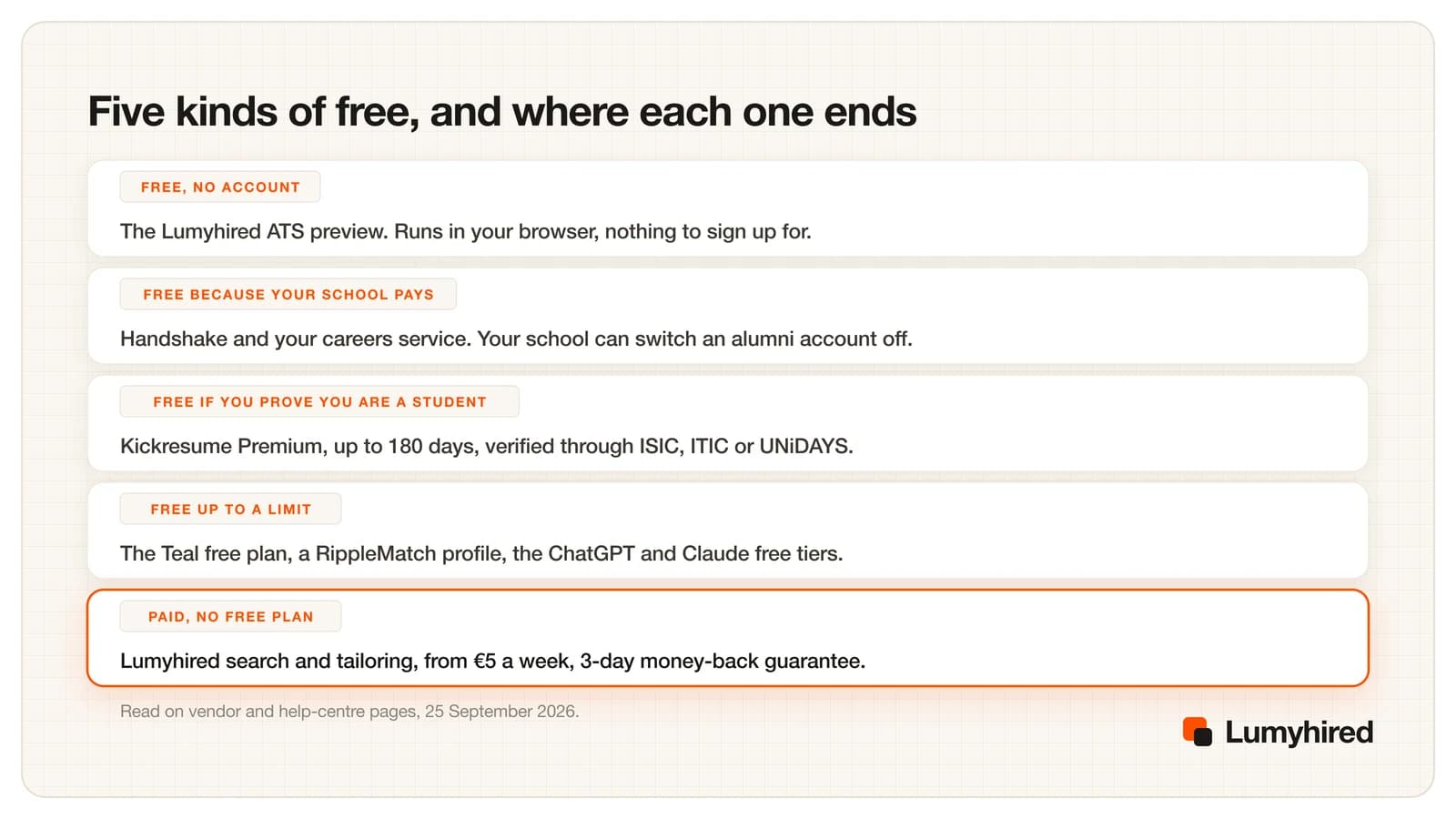
- Free because your school pays. Handshake has no student pricing page and no student checkout; the only pricing link on its student page points at employers. You register with a school email at a partner institution, in one of the four countries it serves.
- Free for 180 days if you verify. Kickresume gives students up to 180 days of Premium, including the AI writer and its ATS checker, on an ISIC, ITIC or UNiDAYS verification. This is the largest amount of paid software on this page available for nothing, and it beats us outright on cost.
- Free up to a usage cap. Teal’s free plan is unlimited for resumes and tracked jobs, and metered where the AI is: 10 job-description keyword matches, 10 resume bullet credits, 2 summaries, 2 cover letters. The ChatGPT and Claude free tiers are capped by usage too. The cap arrives in the middle of a task rather than on a date, which is the worst kind of surprise when you are mid-application.
- Free with nothing to sign up for. Lumyhired’s ATS preview runs in your browser, uploads nothing and needs no account. It shows you the text a parser pulls out of your file and flags what is missing. It deliberately does not hand over the wording of each fix, which is kept for signed-in users, so treat it as a diagnosis rather than a repair.
- Not free at all. Lumyhired’s search, tailoring and audit. Weekly plans of €5, €8 and €13, cancel anytime, with a 3-day money-back guarantee. There is no free plan and no trial, and the full ATS resume checker is part of those plans rather than a free tool.
When your free access expires, and the step to take first
Careers-service access is the cheapest thing a graduate has and the easiest to lose without noticing, because losing it is silent. The detail matters more than the folklore.
Handshake’s own help centre is clear that graduating does not end your access: alumni keep the same account rather than making a new one. What can end it is your institution. Careers teams are told they can disable alumni accounts after a set number of months by flagging them in the student data sync, and that archiving an account leaves it working but disconnected from the school, so you lose the postings and events that were the reason to be there.
The step to take while you still can costs nothing: add a personal email address to the account and set it as the primary one, which is what the help centre advises, so you can still log in and still get notifications after the school address stops working. Do the same on any other account you created with a school address, and export anything you would not want to re-enter. The same logic applies to Kickresume’s 180-day student window: note the date it started.
The free stack, and the one step it does not cover
It would be dishonest to rank seven tools for graduates without saying plainly that a free combination works for most of the job. Handshake or your university careers service for roles genuinely open to you, Teal’s free plan for an unlimited record of what you sent, and LinkedIn’s alumni search for the people who might refer you. That covers finding, organising and reaching.
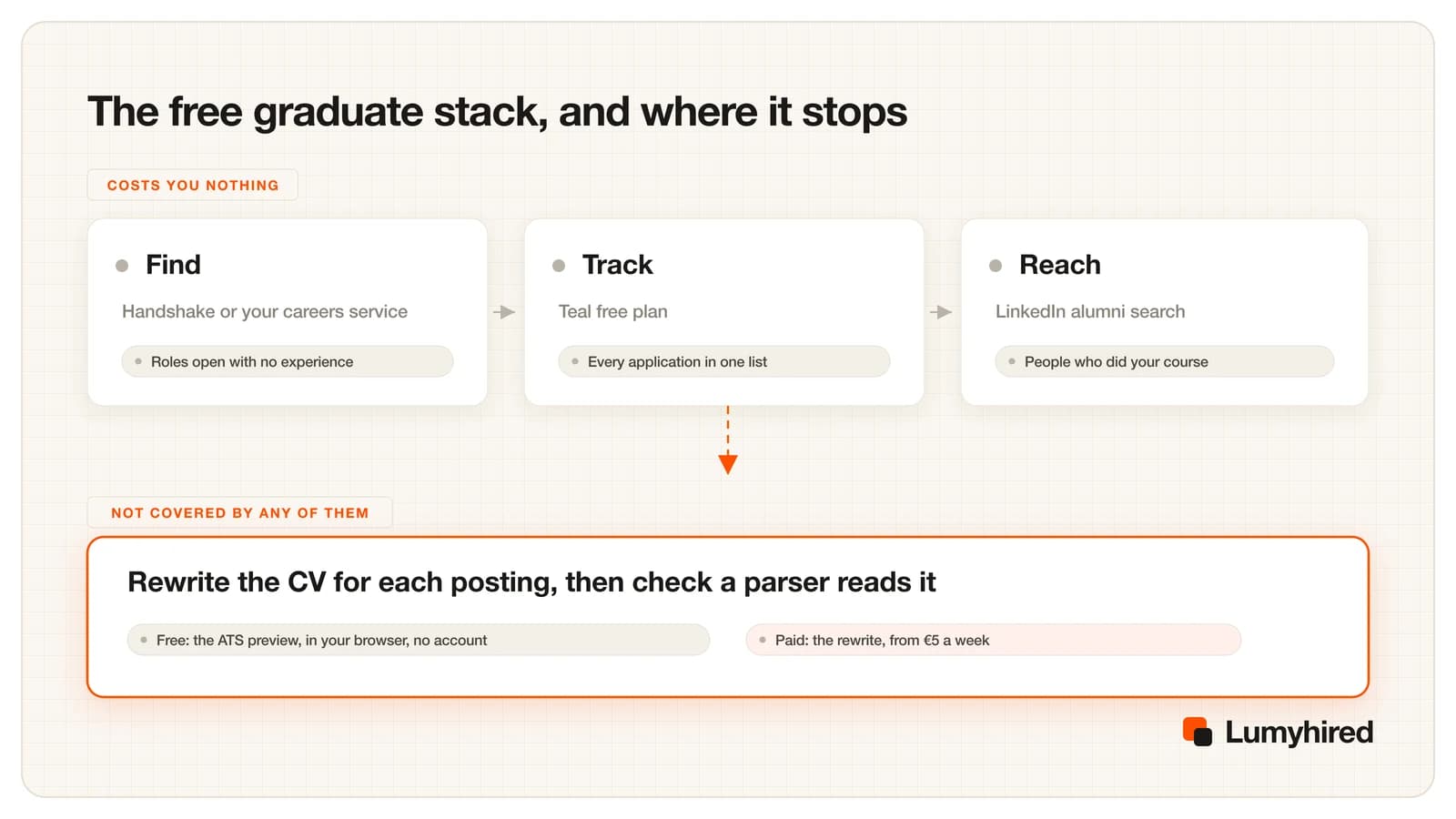
What it does not cover is rewriting the CV for each posting and confirming a parser reads the result. You can do the rewrite by hand or with a free chatbot and the prompt below, and you can check the parse with a free preview. What you are buying, if you buy anything, is the gap list, the rules that stop the rewrite drifting, and not having to remember which file went to which employer. Whether that is worth €5 a week depends on how many applications you are sending. The arithmetic behind a sensible weekly number is in how many jobs to apply to.
Does it matter which board you apply through?
On the only large public comparison, yes, and by more than most graduates expect. Boston University’s Questrom School published an analysis on 10 March 2026 of tracker data from Huntr covering more than 600,000 applications from over 60,000 candidates across 2025. A response counted when a user moved a job into the interview stage or beyond.
Handshake reached an interview on 5.06% of applications. Glassdoor was 5.46%, Indeed 4.46%, Welcome to the Jungle 4.52%, and LinkedIn 3.10%, the second lowest of the nine boards measured. Google Jobs topped the set at 11.29% and GovernmentJobs.com came second at 8.67%.
Three limits on reading too much into it. Huntr sells a paid job tracker and the data comes from its own users, so it has a stake in the conclusion. Those users chose to install a tracker and log their applications, which is not a random sample of job seekers. And the numbers mix experience levels, so a graduate’s figures would not be these ones. What survives all three is the direction: the boards with the least competition per posting did better than the ones everybody uses, which is an argument for the narrow board your school or your discipline points you at.
Huntr’s Q1 2026 report, on 139,927 applications from 25,635 job seekers, does break results down by experience, and the shape is not the one graduates expect. People with 0 to 1 years of experience reached an interview on 5.90% of applications, better than the 3.03% of people with 2 to 4 years, though below the 9.22% of people with 20 or more. Huntr does not publish the number of applications in each bucket or explain the dip in the middle, so read it as a reason not to assume the door is shut rather than as a measurement of your odds.
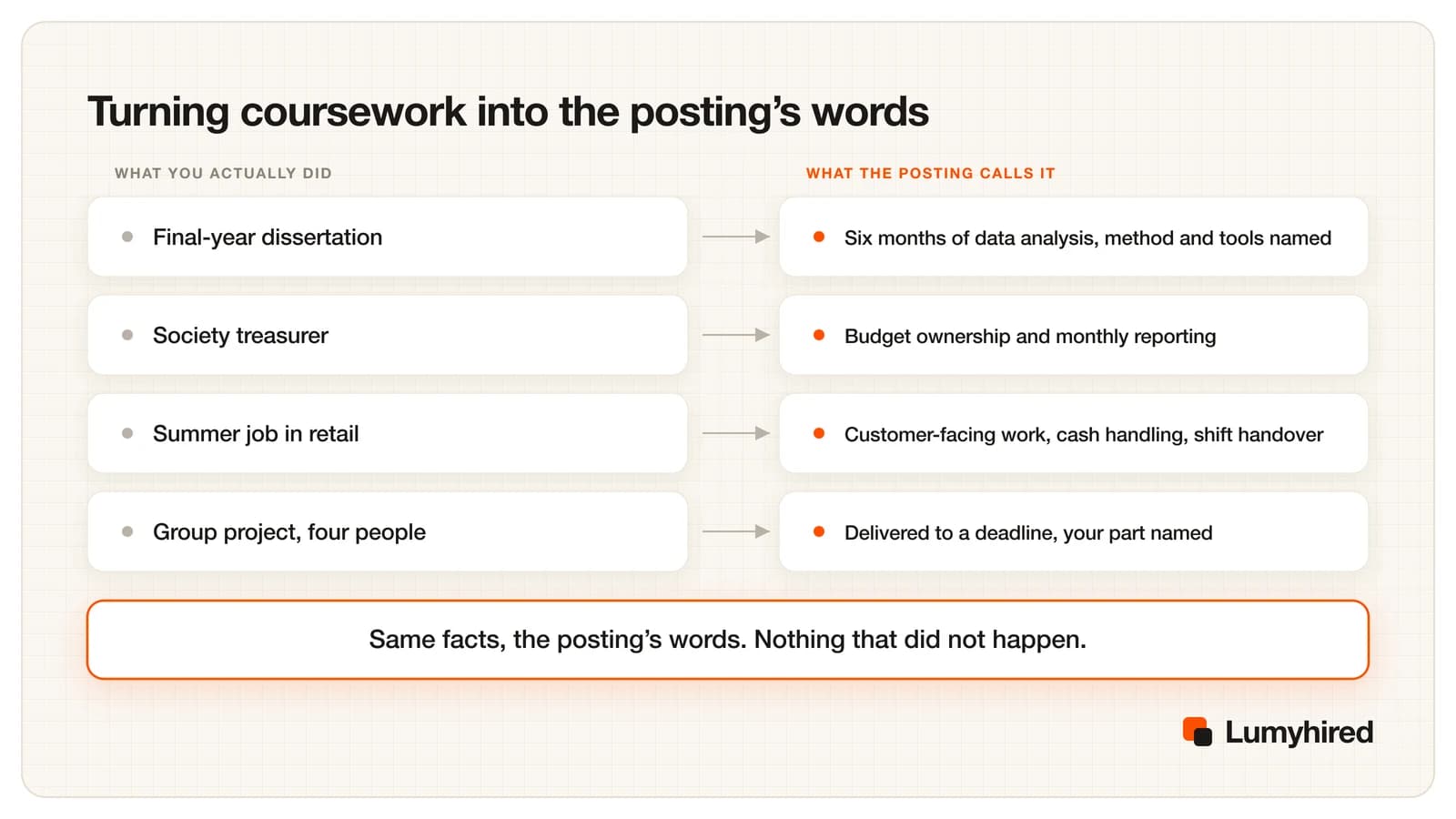
Turning coursework, internships and projects into the posting’s words
This is the step every ranking page names and none of them describes. It has three parts and they go in this order.
- Write the raw notes first, badly. Every module with a project, every dissertation or lab, every internship paid or unpaid, every society role, every part-time job. Three plain lines each: the situation, what you personally did, what came out of it. Do not make them sound good yet. Anything you skip here cannot come back later, and anything you invent here survives all the way to an interview.
- Match before you rewrite. Take each requirement in the posting and name the single closest real item from your notes. Some requirements will have nothing against them. Write "no evidence" and leave it, because those are the lines a tool with a match score will want to fill for you.
- Rewrite one bullet per match, in the posting’s term. Use the posting’s word only where your note describes the same work. "Six months of data analysis in Python on a 12,000-row dataset" answers a requirement for data analysis. "Data analysis" on its own does not.
The prompt below runs those three passes in ChatGPT, Claude, Gemini or Le Chat, and forces the model to show where every word came from. The third pass is the one that matters: it is what stops a project becoming a job and a group deliverable becoming yours.
Copyable prompt: match, rewrite, self-audit
You are helping me describe work I have actually done, for one job posting.
I am a recent graduate with little paid work history.

JOB POSTING:
[paste the full posting]

WHAT I HAVE DONE:
[list every module with a project, every dissertation or lab, every internship
paid or unpaid, every society or sports role, every part-time job. For each one
write three plain lines: what the situation was, what I personally did, what
came out of it. Do not tidy them up. Rough notes are fine.]

PASS 1: MATCH
For each requirement in the posting, name the one item above that is the closest
real evidence for it. If nothing I wrote is evidence for a requirement, say
"no evidence" and move on. Do not stretch.

PASS 2: REWRITE
For each match, write one CV bullet using the posting's term for the thing,
only where my note describes the same work. Keep every number, date, module
name and job title exactly as I wrote it.

PASS 3: SELF-AUDIT
List every tool, number, scale word and responsibility in your bullets. Next to
each, quote the line of my notes it came from. Mark anything with no source as
NOT IN MY NOTES.
Then list the requirements marked "no evidence". Leave them unanswered.
Then do the part the model cannot. Delete every line marked NOT IN MY NOTES. Check that no scale word grew: if "helped run" became "led", put it back. Read the requirements you left unanswered and decide whether to apply anyway, which for a graduate scheme is usually yes. The same discipline applied to the wording itself is in finding and placing resume keywords, and the longer method is in how to tailor a resume to a job description.
Which one fits your situation
Your university runs Handshake and you have no money. Handshake for the roles, Teal’s free plan for the record, LinkedIn for the alumni, and the prompt above in a free chatbot for the rewrite. Then run the result through a free ATS preview before you send it.
You still have a student ID you can verify. Kickresume, before the 180 days start running. It is the most paid software available here for nothing.
You have real capability your CV is not communicating, and you are sending applications every week. Lumyhired, from €5 a week, for the gap list, the rules that keep your record fixed, and one place where each version sits with the job it was written for.
You do not know what job titles to search for yet. RippleMatch, which sends you early-career matches rather than asking you to name what you want.
One person from your course works where you want to work. LinkedIn, for that conversation rather than for Easy Apply. A referral outperforms every tool on this page.
If you are further along and the problem is applications going quiet rather than a thin CV, the diagnosis is in why you are not getting interviews. The whole-search comparison, without the graduate weighting, is in the best AI tools to find a job in 2026.
Frequently asked questions
What is the best job search tool for a new graduate in 2026?
What job search tools are actually free for students?
Does Handshake stop working after you graduate?
How do I write a resume with no work experience?
Which job board gets new graduates the most interviews?
Do graduate employers use ATS systems?
Is a free job search stack enough for a new graduate?
Should I use Easy Apply on LinkedIn?
Where Lumyhired fits
Lumyhired works on one posting at a time. It lists the requirements you already meet and the ones you do not, rewrites the summary, bullets and skills under rules that keep titles, dates, employers, degrees and numbers fixed, and saves the version beside the job in its tracker. Search across boards including Gradcracker and France Travail sits in the same account, and tailored CVs export as text-based PDFs across five templates. There is no DOCX export, no auto-apply and no free plan: weekly plans are €5, €8 and €13 on the pricing page, cancel anytime, with a 3-day money-back guarantee. The one free thing is the ATS preview, which needs no account. If you are choosing between us and a single-purpose scanner, the side-by-side is in Lumyhired vs Jobscan.
For what a finished entry-level CV looks like in your field, see the resume examples by role.
Sources
- Federal Reserve Bank of New York, The Labor Market for Recent College Graduates, data for 2026 Q2, read 25 September 2026. newyorkfed.org
- Indeed Hiring Lab, Entry-level jobs aren't just for inexperienced workers, 23 July 2026. US application data for May 2026, from Indeed's own marketplace. hiringlab.indeed.com
- LinkedIn, George Anders, on experience requirements in entry-level postings, 18 August 2021. 3.8 million postings LinkedIn classified as entry-level, December 2017 to August 2021. LinkedIn owns the data and the taxonomy, and this is the most recent version we found. linkedin.com
- Boston University Questrom School of Business, 9 best job search sites of 2026, 10 March 2026. Data supplied by Huntr, a paid job tracker, from its own users: 600,000+ applications, 60,000+ candidates, Q1 to Q4 2025. questromfeld.bu.edu
- Huntr, Job Search Trends Q1 2026. 139,927 applications from 25,635 job seekers, 1 January to 31 March 2026. Vendor data; Huntr sells a tracker and a tailoring tool. huntr.co
- Handshake Help Center, Using Handshake After Graduation, and Encouraging Alumni Accounts and Maintaining Your Network, read 25 September 2026. support.joinhandshake.com
- Kickresume, pricing page and students page, read 25 September 2026. kickresume.com
- RippleMatch, candidate homepage, read 25 September 2026. ripplematch.com
- Teal, OpenAI and Anthropic pricing pages, read 25 September 2026. LinkedIn's Premium prices sit behind a sign-in on every public page we tried that day, so no LinkedIn figure is stated here. claude.com
- Lumyhired tailoring prompt, sanitizer and plan quotas, read in the source on 25 September 2026.
Read next
- Best Resume Builders for Career Changers in 2026
Seven builders ranked on translating the experience you already have into the target field's words, with what a parser really does to a functional layout.
- How to Tailor Your Resume to a Job Description
A 15-minute method with three before and after bullets, an AI prompt that forbids invented facts, and Huntr's data: tailored resumes got interviews at 4.23% vs 2.07% in Q1 2026.
- Best ATS Resume Tools in 2026: 7 Compared
Seven ATS resume tools ranked on what each one actually checks, with every price and free allowance read on 25 September 2026.