
Career Guides
How to get a job in 2026
The job market in 2026 has more applicants per opening, fewer recruiters reading them and longer searches than a year ago. This guide starts from the published numbers, then sets out the method that follows from them: eight steps, a 30-day plan you can copy, and a link to the detailed guide behind each step.
How do you get a job in 2026?
Pick a narrow target, keep two or three resume versions that parse cleanly, search several boards, tailor each application, ask for referrals, follow up after about a week, track everything and review the numbers every Friday. The data explains why: Greenhouse counted 244 applications per job in 2025, Gem found that 0.5% of applicants receive an offer, tailored resumes earned interviews at 4.23% against 2.07% in Huntr’s Q1 2026 data, and referred candidates are hired at 11 times the inbound rate (Gem). Budget time as well as effort: the US median unemployment spell was 11.4 weeks in August 2026 (Bureau of Labor Statistics), and Huntr measured 108 days to a first offer.
Figures read 15 to 17 September 2026. Greenhouse, Gem, Ashby and Huntr are hiring software vendors publishing data from their own products. Page updated 17 September 2026.
Job market 2026: the numbers behind your search
Six figures describe the market you are applying into. They come from different kinds of data (a government survey, employer-side applicant tracking data, and one tracker used by job seekers), so read each one for what it measures.
| Measure | Figure | Source and sample |
|---|---|---|
| Median length of unemployment, US | 11.4 weeks in August 2026, against 9.9 weeks in August 2025. 27.0% of unemployed people had been looking for 27 weeks or more. | US Bureau of Labor Statistics, Table A-12, released 4 September 2026 |
| Applications per job | 244 in 2025, up 111% since 2022, while recruiters per company fell 56%. | Greenhouse hiring benchmarks, 2026 edition, 6,000+ companies and 640M+ applications |
| Median time to a first offer | 108 days in Q1 2026, up from 83 days in Q4 2025. | Huntr, Q1 2026 report, 139,927 applications from 25,635 users of its tracker |
| Applicants who get past the first screen / get an offer | 8% / 0.5%, about one offer per 200 applications. | Gem 2026 Recruiting Benchmarks, 165M+ applications, June 2021 to May 2025 |
| Interview rate per application, tailored vs not | 4.23% with a tailored resume, 2.07% without. | Huntr, Q1 2026 |
| Referral conversion | Referred candidates are hired at 11 times the rate of inbound applicants. | Gem 2026 Recruiting Benchmarks |
The US unemployment rate was 4.1% in August 2026, which is low by historical standards. The strain shows in duration: the median spell grew by a week and a half in twelve months, and 1.9 million people had been unemployed for more than six months.
Why is it so hard to get a job in 2026?
Applying got cheaper while reading did not. Greenhouse found that 22% of candidates use bots to auto-apply, 31% among Gen Z (survey of 2,200 people in the US, UK and Ireland, July 2025). LinkedIn data reported by the New York Times in June 2025 put applications on the platform at about 11,000 a minute, up 45% in a year. On the other side, Greenhouse measured recruiters per company down 56% between 2022 and 2025, so each recruiter handles far more files.
The screening layer changed too. In a Greenhouse survey of 2,950 job seekers published 1 May 2026, 63% had faced an AI interview in the previous six months and 51% heard nothing afterwards. Silence is common at every stage: 63% of candidates in the 2025 Greenhouse survey were left without news after an interview.
One thing did not change as much as the blog posts claim. Resumes are not thrown out because a word fails to match letter for letter. In vendor documentation, the automatic rejection is a recruiter rule on an application question such as work authorization; AI grades reorder the list, and recruiters search with Boolean queries in which related terms can count toward the same skill. The mechanics, vendor by vendor, are in how to pass ATS filters in 2026.
How long does it take to get a job in 2026?
Three to four months is a fair planning horizon, and each source measures a different clock:
- 11.4 weeks: median length of unemployment in the US, August 2026 (BLS). It covers people without a job, and the mean is 26.3 weeks because long searches pull it up.
- 108 days: median time from starting a search to a first offer among Huntr users in Q1 2026, up from 83 days in Q4 2025.
- 52 to 71 days: time for employers to fill a first role, junior to senior (Ashby, 2026). The clock starts when the job opens, which may be weeks before you see it.
- 6 days and 21 days: how long Ashby customers take to archive a candidate who got no interview, and one who was interviewed.
The last line is the practical one. A silent application is usually decided within a week, so waiting a month before following up or adjusting wastes most of that month.
How to get a job in 2026, step by step
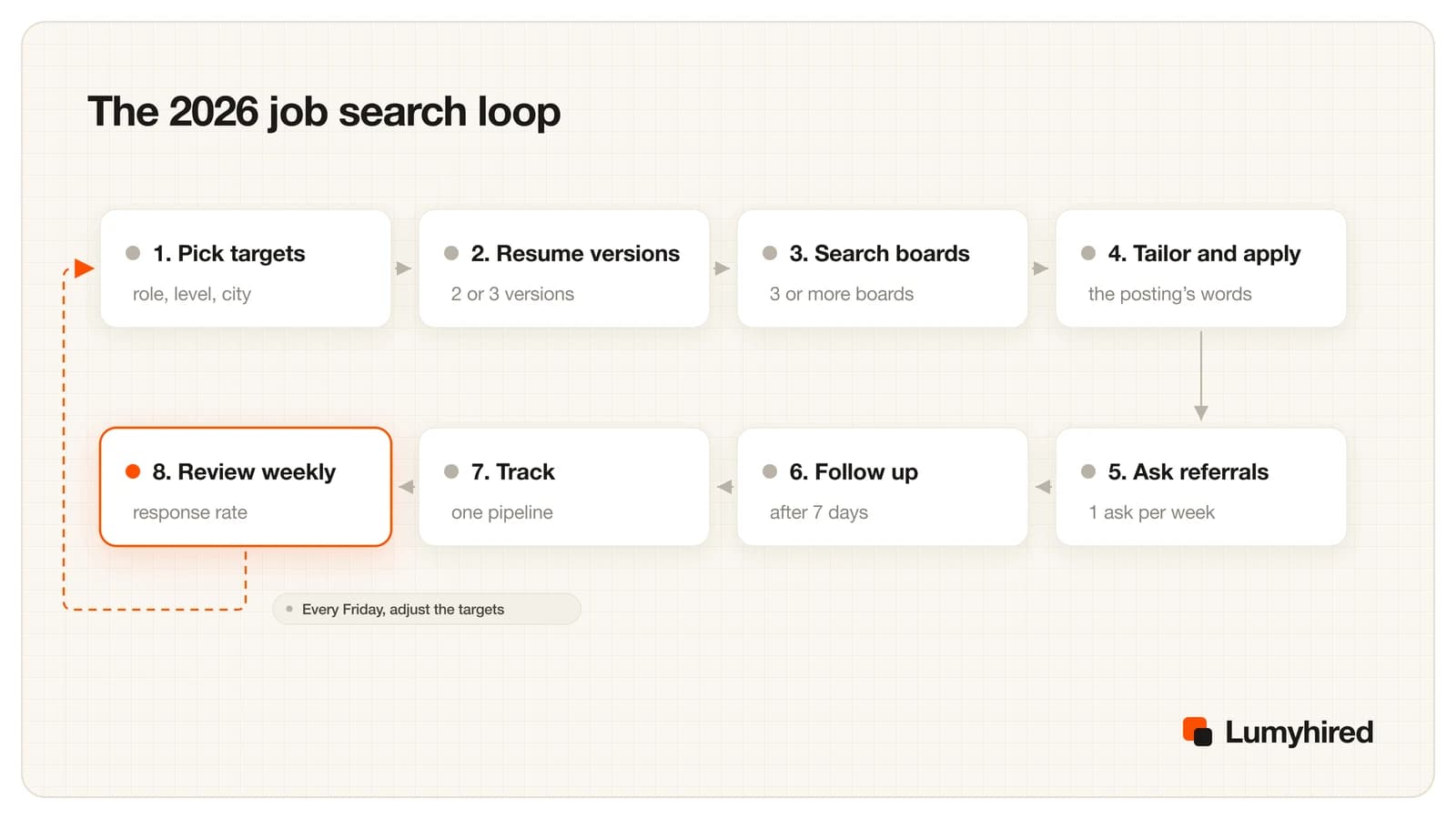
The method is a loop with eight steps. The weekly review feeds back into the target, so the second month runs on what the first one measured.
1. Pick a narrow target
Write one sentence: role, seniority, location or remote, and the salary floor. Then list 25 employers that hire for it. A narrow target makes every later step cheaper, because the same two resumes and the same keywords cover most postings. The filtering criteria, and how to drop stale listings, are in how to target the right job postings.
2. Prepare two or three resume versions
One version per job family you target, for example product analyst and data analyst. Each uses standard headings (Work Experience, Education, Skills), a single column, real selectable text and the usual job title for the role. Check what a parser extracts before you send anything: the free ATS extraction preview shows it in the browser without an account, and the resume examples by role show a structure that extracts cleanly.
3. Search several boards
Boards return very different response rates. In Huntr’s 2025 annual report (1.78 million applications), applications found through Google Jobs got a response 11.3% of the time, Indeed 4.5% and LinkedIn 3.1%. That is one tracker’s users, and the gap partly reflects which employers post where, but it is a reason to run the same search on at least three boards and to apply on the employer’s own site when you can.
4. Tailor each application
Tailoring means the first bullets of your most recent role answer the posting’s first requirements, in its words, when they are true. A quick example for a posting that asks for paid social and weekly reporting:
- Before: Responsible for the company’s social media accounts.
- After: Ran paid social campaigns on Meta Ads with a $4,000 monthly budget and sent the sales team a weekly cost per lead report.
The second line only works if it describes what you did. Huntr measured a 4.23% interview rate with a tailored resume against 2.07% without in Q1 2026. The full workflow is in tailoring your resume to a job description, and pulling the right terms out of a posting is covered in finding resume keywords.
5. Ask for referrals
Referrals convert best in both employer datasets we used. Gem measured referred candidates being hired at 11 times the rate of inbound applicants; Ashby found 52% of referred candidates pass the first screen against 35% overall, and referrals made up about 17 to 18% of hires between 2021 and mid-2025. A useful ask is specific: the posting link, two lines on why you fit, and a question about whether they would pass your resume to the hiring manager.
6. Follow up once, after about 7 days
Ashby’s customers archive candidates without an interview after about 6 days, so a short message to the recruiter or hiring manager around day 7 arrives while the decision is still open. One follow-up per application is enough. Restate the role, one result that matches the posting, and your availability.
7. Track every application
Log the date, board, resume version, contact and stage (saved, applied, screen, interview, offer, rejected). Past a dozen open applications, memory stops working, and without the version and board columns the weekly review has nothing to compare. A spreadsheet works; the tools are compared in the best job application trackers for 2026.
8. Review the numbers every week
On Friday, count applications, responses and interviews by resume version, board and job title. At Huntr’s 4.23% tailored rate, 25 applications should produce about one interview (our calculation), so zero interviews after 25 tailored applications is a signal worth acting on. Match the symptom to the stage that fails using the diagnostic for getting no interviews, then change one thing at a time.
A realistic 30-day job search plan
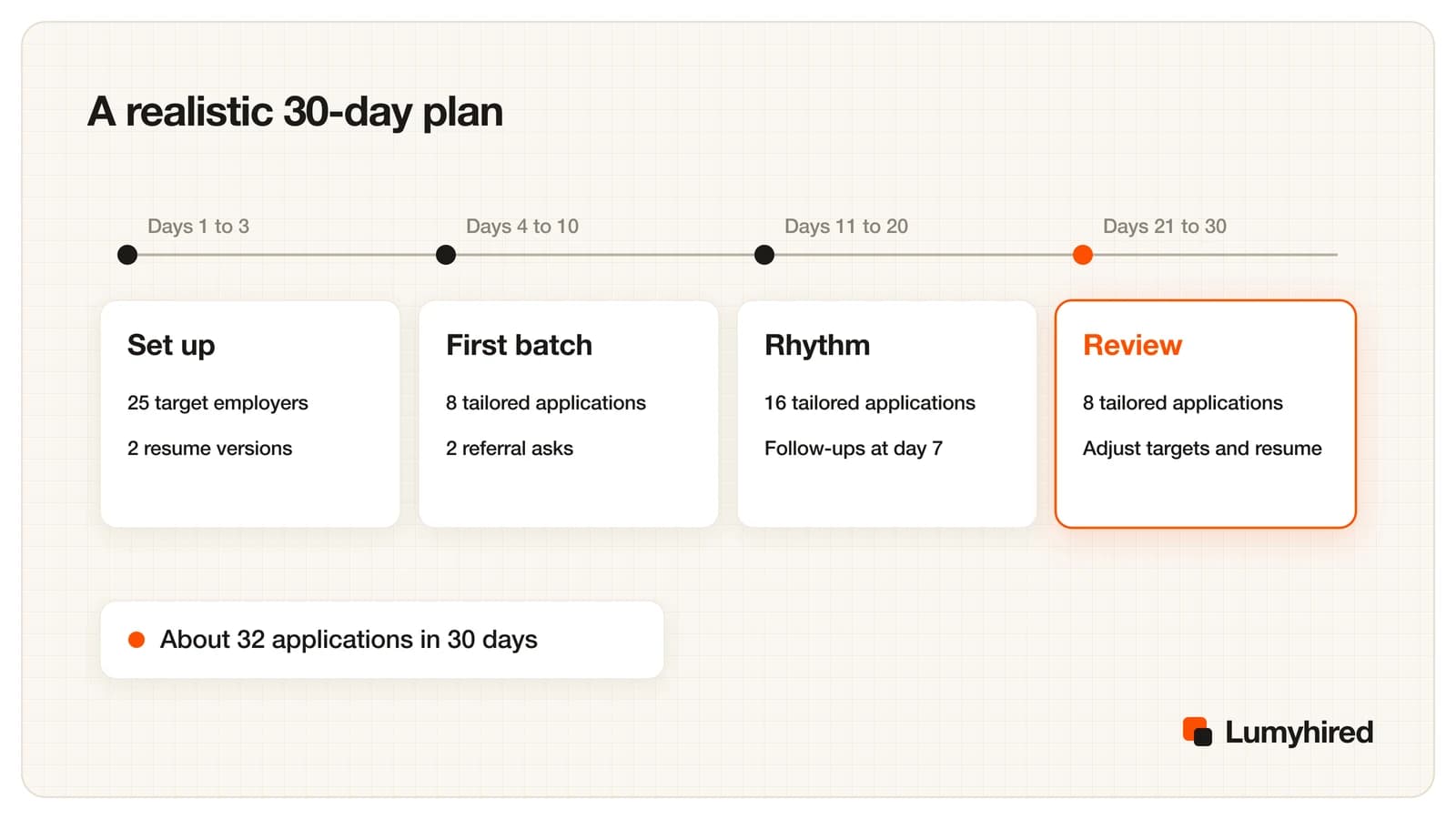
This plan sends about 32 tailored applications and 2 or more referral requests in a month, around 8 a week, which is a pace you can keep for the three to four months the data suggests. At a 4.23% interview rate it should produce one or two interviews from cold applications in the first month (our calculation), with referrals adding to that. Its main output is the data for your first real review.
| Days | Goal | What to do | Output |
|---|---|---|---|
| Days 1 to 3 | Set up | Write down one target role, seniority and location. List 25 employers. Build 2 resume versions and check that both parse. Set alerts on 3 boards. | Target list, 2 resumes, alerts |
| Days 4 to 10 | First batch | Send 8 tailored applications to the best matches. Ask 2 people in your network for a referral or an introduction. | 8 applications, 2 referral asks |
| Days 11 to 20 | Rhythm | Send 16 tailored applications (about 8 a week). Follow up once on every application that is 7 days old with no answer. | 16 applications, follow-ups sent |
| Days 21 to 30 | Review | Send 8 more. Count responses by resume version, board and job title. Drop the weakest target and adjust the resume that got nothing. | 8 applications, one change to the plan |
A daily version fits in about two hours: 30 minutes reading new postings from your alerts, one or two tailored applications, and one message (a referral ask or a follow-up). If you are working full time, halve the application count and keep the referral and follow-up messages, since those convert best.
Get a job fast: where effort goes vs what converts
Most extra effort in 2026 goes into volume. In a Greenhouse survey of 1,200 US job seekers published in November 2025, 49% said they were sending more applications than the year before. The measured returns point the other way.
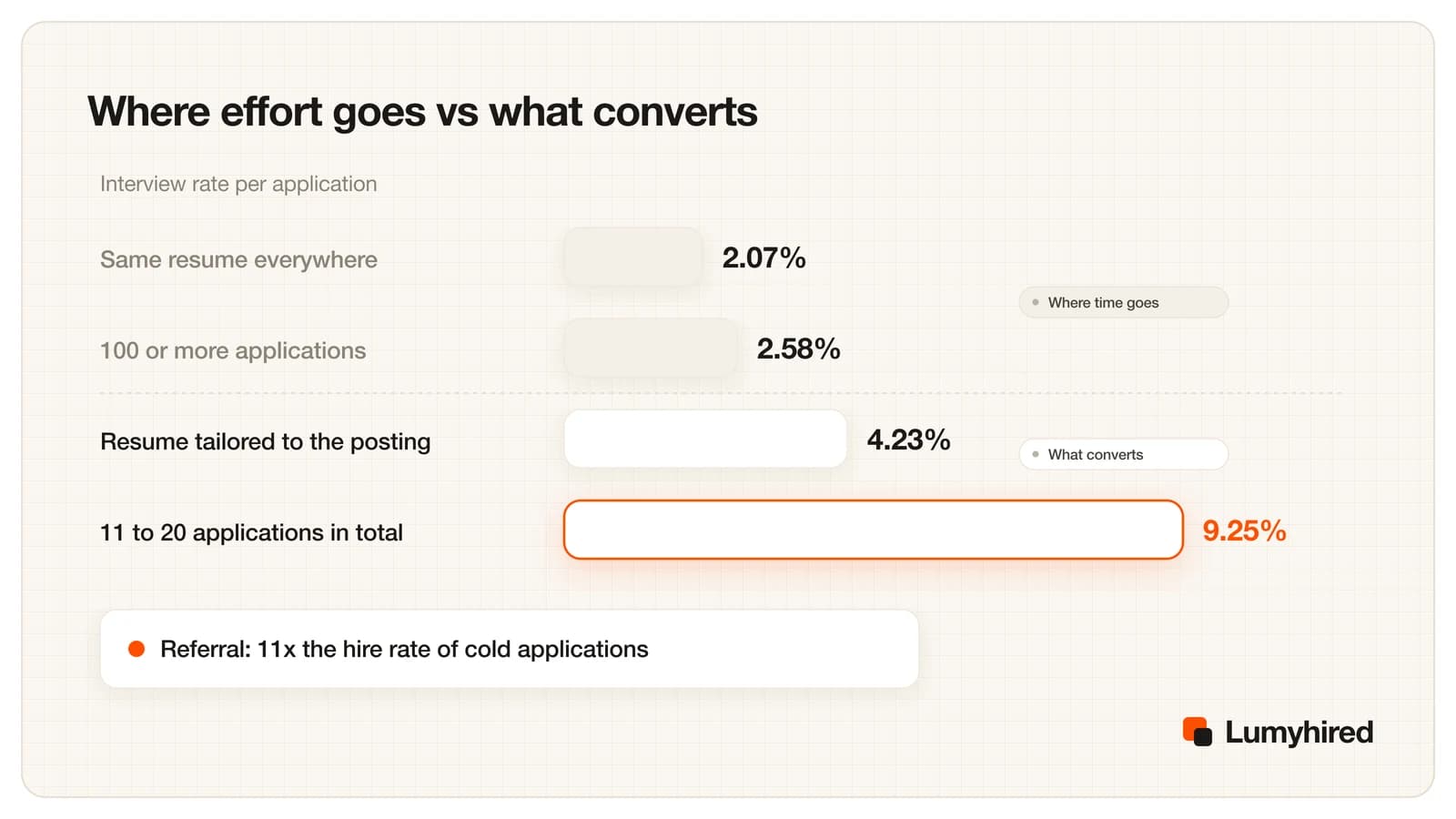
To speed up a search, put the hours into recent postings that match your target, a tailored resume, a referral where you can get one, and a follow-up at day 7. Auto-apply and AI tools can save time on search and drafting; which ones help and which ones add volume without results is reviewed in the best AI tools to find a job in 2026.
The detailed guides behind each step
This page is the overview. Each guide below goes deeper on one part of the search, with its own data.
Job search strategies: which channels get interviews
Interview rates by job board and by company career page, referral versus cold application with five message templates, and a 10-hour weekly plan built from 2026 data.
How to target the right job postings
Step 1 in detail. Selection criteria, posting freshness, and how to filter a list of openings before you spend time tailoring for any of them.
How many jobs should you apply to? The 2026 math
The arithmetic from about 200 cold applications per offer down to roughly 68 with tailoring and referrals, step by step, plus a weekly volume by situation.
Why you are not getting interviews: a 2026 diagnostic
Step 8 when the numbers are bad. Match your symptom (no replies, rejection within minutes, screens that go nowhere) to the stage that fails, run a 10-minute test and fix that stage.
How to pass ATS filters in 2026
The resume and ATS hub. What Greenhouse, Workday, Lever and others say their software does to your file, the one mechanism that rejects automatically, and a checklist to run before sending.
Best AI tools to find a job in 2026
The AI tools hub. Job discovery, resume tailoring, auto-apply and tracking tools compared on stated criteria, including what each one lacks.
If a gap in your work history is part of the picture, see how to explain a career gap in 2026, and for how candidates and recruiters use AI, the AI in job search statistics for 2026.
Frequently asked questions
Why is it so hard to get a job in 2026?
How long does it take to get a job in 2026?
How many jobs should I apply to per week?
How can I get a job fast?
Do ATS reject resumes automatically?
Is the job market getting better in 2026?
Should I use auto-apply tools to send more applications?
Where Lumyhired fits
Lumyhired covers steps 2, 3, 4 and 7 of the loop. The ATS preview is free and shows how a parser reads your resume. The paid plans add the full ATS check, one search across Indeed, LinkedIn, Glassdoor, Remotive, Adzuna, hiring.cafe and other boards, resume tailoring and cover letters against a specific posting, and an application tracker. It does not apply for you, and it cannot ask for referrals or follow up on your behalf. Weekly plans start at €5, with no free plan, cancel anytime and a 3-day money-back guarantee; details on the pricing page.
Sources
- US Bureau of Labor Statistics, Employment Situation Table A-12, released 4 September 2026. bls.gov
- US Bureau of Labor Statistics, Employment Situation summary, August 2026. bls.gov
- Greenhouse, hiring benchmarks, 2026 edition. greenhouse.com
- Huntr, Job Search Trends Q1 2026. huntr.co
- Huntr, 2025 Annual Job Search Trends Report, December 2025. huntr.co
- Gem, 2026 Recruiting Benchmarks key takeaways, December 2025. gem.com
- Ashby, Recruiting Operations Benchmarks, 2026. ashbyhq.com
- Ashby, inbound and referral hires report, 2025. ashbyhq.com
- Ashby, press release on applications per hire, 7 May 2026. prnewswire.com
- Greenhouse, 2025 Workforce and Hiring Report, 17 July 2025. prnewswire.com
- Greenhouse, AI interview survey, 1 May 2026. prnewswire.com
- Greenhouse, AI trust survey including US job seekers, 19 November 2025. greenhouse.com
- Greenhouse, Auto-reject, support article updated 30 January 2026. support.greenhouse.io
- eWeek, on LinkedIn application volume reported by the New York Times, June 2025. eweek.com
Read next
- Job Search Strategies 2026: Which Channels Get Interviews
Interview rates by job board and career page, referral vs cold application, five message templates and a 10-hour weekly plan built from 2026 data.
- How Many Jobs Should You Apply To?
The math behind the number: 0.5% of applications become offers, tailoring roughly doubles interview rates, and a weekly plan for each situation.
- Why You're Not Getting Interviews in 2026
Diagnose it by symptom: no replies, rejections within minutes, screens with no interviews, interviews with no offers, or silence. A 10-minute test for each.
- How to Negotiate Salary in 2026
EU pay transparency was due in national law by 7 June 2026. What is in force where you apply, what the research on first offers shows, and the stats we rejected.
- Best AI Cover Letter Generator in 2026: 8 Tools Ranked
Eight generators ranked on reading the posting and your resume, keeping claims honest, and cost, with callback data and a prompt that checks every fact.
- Best Job Search Tools for New Graduates in 2026
Seven tools ranked on turning coursework and internships into a posting's words, plus what each one really costs a student and when free access ends.