
Career Guides
Best remote job search tools in 2026: seven ranked
Seven tools ranked against the two problems a remote search has and a local one does not: postings tagged remote that carry a country, a state or a timezone requirement, and an applicant pool with no geographic limit. We counted the first problem ourselves on 248 postings, and every price here was read on the vendor’s own page on 25 September 2026.
What are the best remote job search tools in 2026?
Lumyhired ranks first on five criteria (acts on each posting, separates remote from hybrid, shows hiring region, coverage in one query, cost to the job seeker), because it is the only tool here that rewrites the application for the posting and labels every result Remote, Hybrid or On-site. Weekly plans start at €5 with a 3-day money-back guarantee; there is no free plan and no trial. We Work Remotely is the best source of postings an employer paid $299 to publish. Working Nomads and Remote OK are the only two that let you filter by hiring country before opening a posting. FlexJobs is the only one that charges the job seeker, and its own page says its listings are "entirely remote, hybrid, part-time, or flexible".
Lumyhired publishes this page and ranks itself first, so the criteria are stated before the list and two of them count against us. Prices read on each vendor’s own page on 25 September 2026. LinkedIn Premium pricing sits behind a sign-in and is left out rather than guessed.
Most "remote" postings are not the job you think
Four of the seven pages ranking for this search mention that remote listings are often hybrid or geographically restricted. None of them counts. The closest thing to a number in the search results is "around 20% of remote listings turn out to be hybrid", published with no source and no method.
So we counted. On 25 September 2026 we pulled every posting from We Work Remotely’s public RSS feed and its eight category feeds, 248 unique listings. The board gives each one a region tag, and 240 of the 248 carried the tag "Anywhere in the World". We then searched the text of those 240 postings for phrases that name a place or a timezone the candidate has to be in. 54 of them, 22.5%, had one.
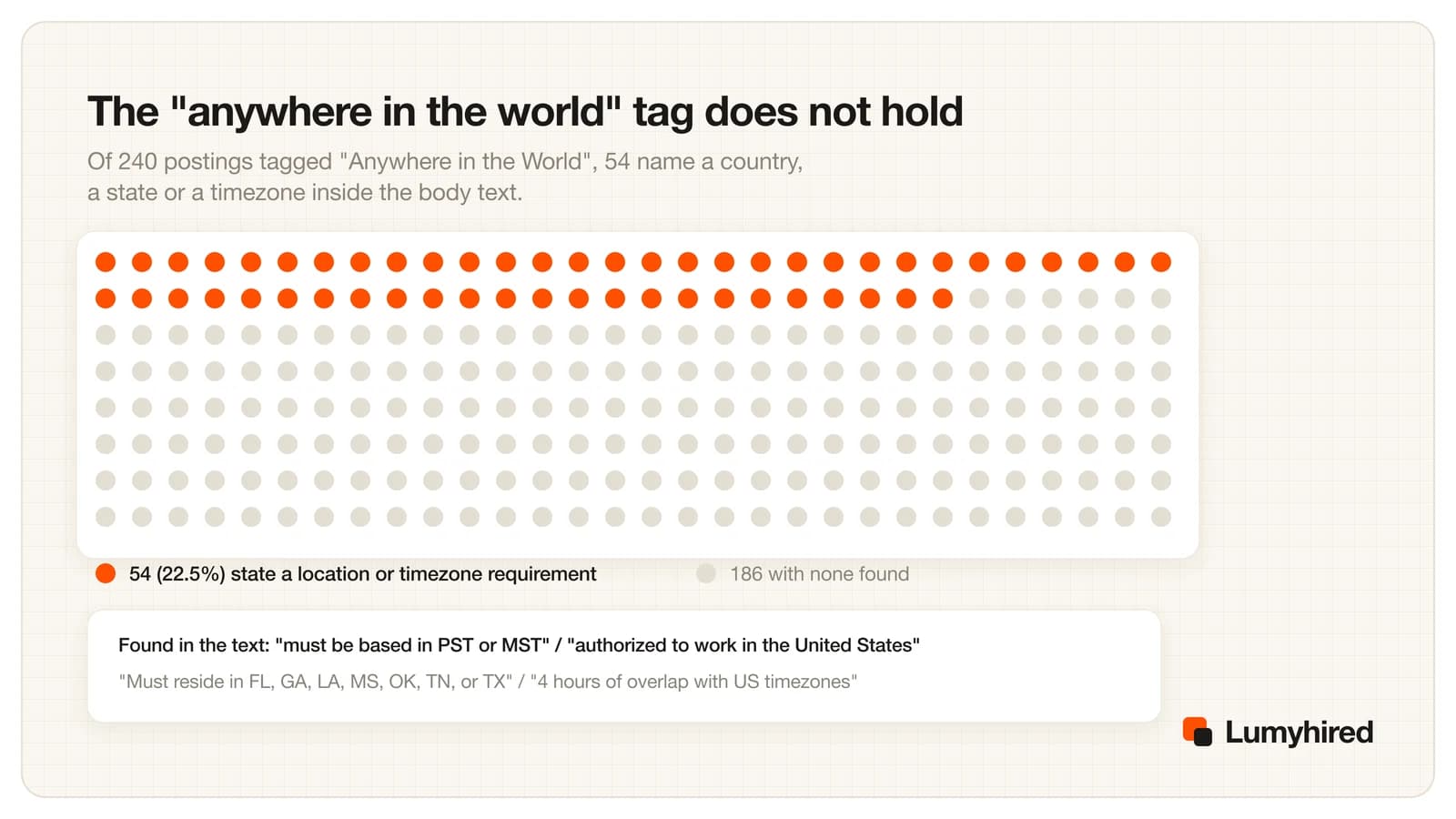
Four caveats, because the number only means something with them. This is phrase matching, so it is a floor rather than a ceiling: a posting that restricts hiring without using one of our phrases was counted as unrestricted. It is one board on one day. We Work Remotely’s own listing cards do show country flags on some of these roles, so the site often exposes the restriction even where the feed that aggregators and AI tools read does not. And a restriction is normal. An employer that can only run payroll in six US states is telling the truth in the body text while the tag above it says the opposite.
The phrases we matched are the ones worth searching for yourself: "must be based in PST or MST", "authorized to work in the United States", "Must reside in FL, GA, LA, MS, OK, TN, or TX", "Located in CET timezone (+/- 3 hours)", "4 hours of overlap with US timezones".
Remote OK shows the same pattern in a different shape. Of the 99 postings in its public API on 25 September 2026, 54 carried a location naming a country, city or region, 39 left the field blank, and 6 said Remote or Remoto. The structured field that should answer "can I hold this job" answers it on barely half the listings.
Why the published numbers disagree with each other
You will see remote work put at 3% of postings in one article and 17% in the next. Both can be right, because they count different things.
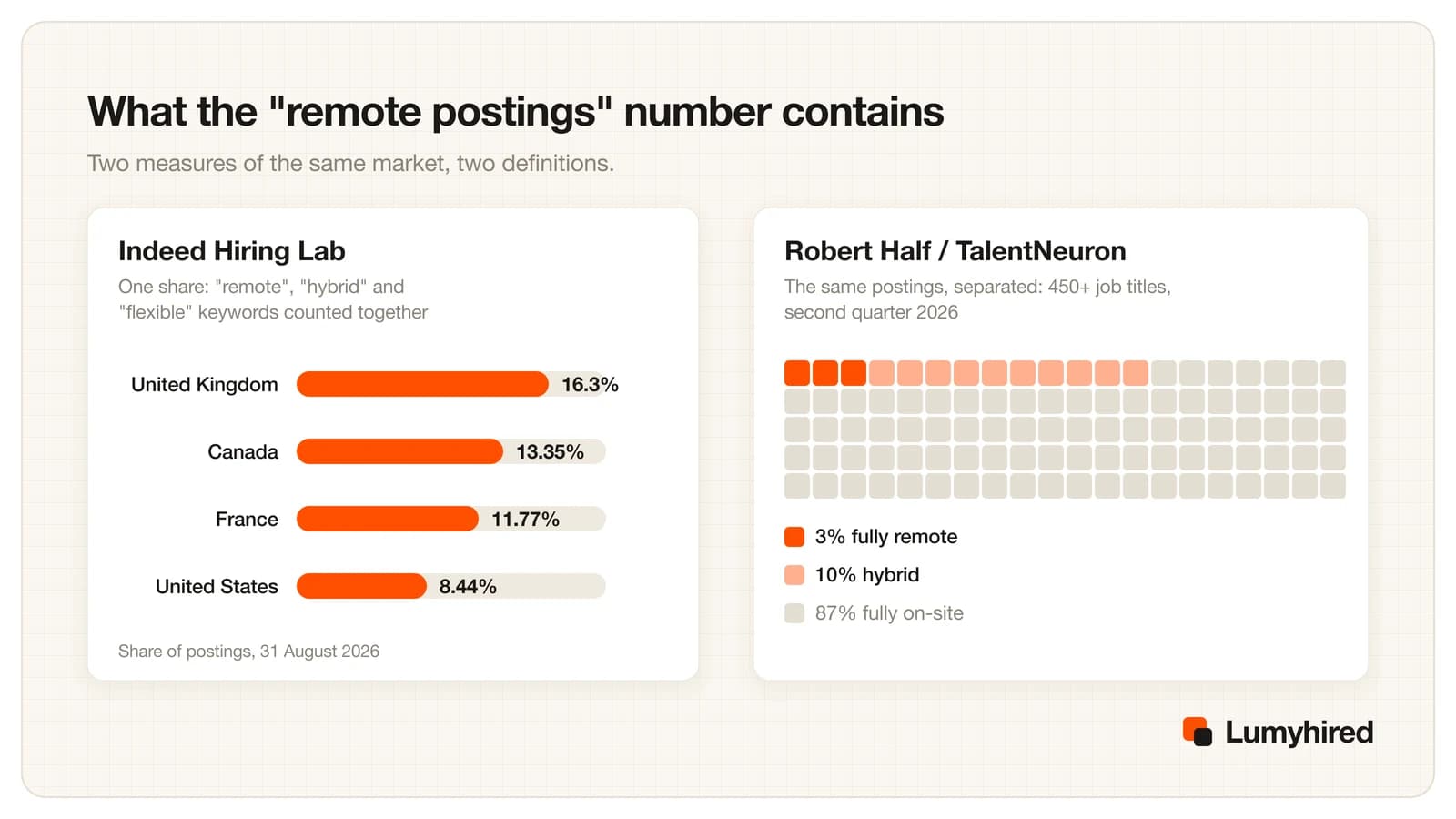
Indeed Hiring Lab publishes a daily remote tracker as an open dataset. Its methodology note says the share covers postings containing keywords "associated specifically with remote, hybrid and flexible work arrangements". One number, three arrangements. On 31 August 2026, the last observation in the dataset, that combined share was 8.44% in the United States, 11.77% in France, 13.35% in Canada and 16.30% in the United Kingdom.
Robert Half splits the same market apart. Using TalentNeuron data across more than 450 job titles from its 2026 Salary Guide, it found that in the second quarter of 2026, 87% of postings were fully on-site, 10% hybrid and 3% fully remote. Hybrid outnumbers fully remote by better than three to one, which is most of the reason a combined keyword share reads so much higher than a fully-remote count.
FlexJobs makes the blending explicit on its own pricing page: its jobs are "entirely remote, hybrid, part-time, or flexible across 50+ career categories". Its advertised 194,997 verified jobs is a count of that whole database, not of fully remote roles. FlexJobs states its definition openly, so the warning belongs to every article that quotes the number without it.
The second problem: a pool with no geographic limit
A local role competes within commuting distance. A remote one competes with everyone the employer is allowed to hire, which is the whole country at minimum and sometimes several continents. Two LinkedIn datasets size that.
LinkedIn’s Economic Graph Research Institute published "The Remote Work Gap" on 21 March 2025, covering 15 countries. In late 2024, 9% of newly listed US jobs were remote, but among jobs that were still active and still drawing applicants the share was 16%. Remote postings stay open and keep collecting applications, so they are over-represented among the roles you are actually competing for. On the demand side, more than 1 in 5 US job seekers apply exclusively to remote roles, down only slightly from a mid-2022 peak, while the supply of remote roles fell from 27% of jobs applied to in early 2022 to 16% by late 2024.
An older LinkedIn figure puts the crowding in one line. In February 2022, remote posts were 19.4% of all paid job postings on LinkedIn and attracted 50.1% of all applications. That data is now several years old, and the supply has fallen since while demand has not, so the crowding has no reason to have eased.
Filtering solves the first problem. Nothing filters your way out of the second one. What changes the odds there is what the employer reads, which is why the ranking below weights per-posting work above everything else. If you are deciding how many applications to send, the numbers are in how many jobs to apply to.
How we ranked the remote job search tools
We did not run a scored output test. The order rests on what each vendor documents on its own pages, read on 25 September 2026, on our own count of 248 postings described above, and for Lumyhired on its source code, checked the same day. Five criteria, in this order of weight:
- Does it act on the posting, or only list it? Weighted first because it is the only one of the five that touches the pool problem. Filters cannot make the pool smaller.
- Does it separate remote from hybrid? A remote-only policy, or a workplace classification you can filter on, rather than one merged bucket.
- Does it show the hiring region before you open the posting? A country or region facet, so a role you cannot legally hold never reaches your list. Lumyhired loses this one.
- Coverage in one query. Remote roles scatter across general boards, specialist boards and company pages.
- Cost to the job seeker, and who pays for the listing. An employer who pays per post filters noise. A seeker subscription has to earn its price.
Two of the five count against us. Lumyhired has no hiring-country or timezone facet, and it has no free plan while four of the boards below are free to search. The honest recommendation is to pair a specialist board with it rather than to replace one.
One thing worth knowing about the alternatives you will read elsewhere: every page ranking for this search today is published by a job board, an auto-apply vendor or a CV tool, and three of them rank their own product first. This page does the same. Weigh the criteria above against what you need.
The 7 best remote job search tools in 2026
| Tool | Remote only | Region filter | Timezone filter | Per-posting work | Job seeker pays | Employer pays |
|---|---|---|---|---|---|---|
| Lumyhired | No, but labels Remote / Hybrid / On-site and filters on it | No facet | No facet | Yes, rewrites per posting | €5 to €13/week, no free plan | Not a board |
| We Work Remotely | Yes | Flags on some cards, no facet | No | No | Free | $299 per post |
| Working Nomads | Yes, stated | Yes, 25+ countries | No | No | Free view; Premium $17.95/mo | $199 per post |
| Remote OK | Presented as remote | Yes, 150+ countries | Premium only | No | Free; Premium $14.95/mo | $447 for 30 days |
| FlexJobs | No, includes hybrid and part-time | Yes | Not found | No | $2.95 for 14 days, then $23.95/4 weeks | Not read |
| No, employer self-selects the tag | No | No | No | Free; Premium price behind sign-in | Paid posting | |
| Wellfound | No, city roles too | Location filter | No | No | Free | $0 |
1. Lumyhired
Best for: Acting on each posting rather than only listing it, which is the one lever left when the applicant pool has no geographic limit
Price: No free plan and no trial. Weekly plans €5 (Starter), €8 (Pro) or €13 (Hunt), cancel anytime, 3-day money-back guarantee.
What it does well
- Rewrites your resume for one posting at a time. Remote postings draw applicants from every country the employer can hire in, so the same file sent to twenty of them competes against the largest pools on any board.
- Labels every result Remote, Hybrid or On-site and lets you filter the board on those three values, instead of handing you one merged bucket. We checked the classifier and the filter in the source on 25 September 2026.
- Searches 10 sources in one query, including Remotive, a remote-only board, alongside Indeed, LinkedIn, Glassdoor, France Travail, Adzuna, hiring.cafe, startup.jobs, Gradcracker and UK Visa Jobs. Remote roles scatter across general boards, specialist boards and company pages, so one query beats eight tabs.
- Keeps each tailored version attached to the application it was made for, which is what you need when a recruiter in another timezone calls three weeks later.
- Weekly billing in euros from €5, cancel anytime, with a 3-day money-back guarantee, so a six-week search does not need an annual subscription.
Worth knowing
- The Remote, Hybrid and On-site label is only as good as the field each source publishes. Four of the connectors return no workplace value at all, so those results arrive unlabelled and you read the posting yourself.
- No hiring-country or timezone facet of its own. Working Nomads and Remote OK both let you filter by country before you open a posting; this does not.
- Smaller brand and a smaller install base than Jobscan or Teal, so there are fewer third-party reviews to read before you pay.
- Built for a small number of considered applications, not for firing off 200 a day. There is no auto-apply and no bulk send.
- No free plan and no trial. The one free tool is the ATS preview, which runs in the browser with no account.
2. We Work Remotely
Best for: Postings an employer paid $299 to publish
Price: Free to search, no job seeker subscription found. Employers pay $299 per post (read 25 September 2026).
What it does well
- Remote-only by construction, so nothing in the list is an office job with a remote tag on it.
- The $299 posting fee is the quality filter. Scraped duplicates and expired reposts do not survive a price per listing.
- The site states 42,103 jobs posted and 6 million monthly visitors, and browsing needs no account.
Worth knowing
- The public RSS feed is where the label breaks. Of 248 postings we pulled on 25 September 2026, 240 carried the region tag "Anywhere in the World", and 54 of those named a country, state or timezone in their own text.
- No hiring-region or timezone facet in the site navigation. Some listing cards show country flags; the rest give you the body text and nothing else.
- Volume is far below a general board, which is the same trait that keeps the quality up.
3. Working Nomads
Best for: Filtering by hiring country before you open a posting
Price: Free to browse. Premium $17.95 a month, $39.95 every 3 months or $79.95 a year. Employers pay $199 per post, or $169 each in a 10-job bundle (read 25 September 2026).
What it does well
- Country and region filters covering more than 25 countries plus North America, LATAM, Europe, the Middle East, Africa and APAC, which answers the eligibility question before you read anything.
- States plainly that it lists "100% fully remote jobs worldwide", so hybrid is out by policy rather than by your filtering.
- Employers pay $199 for 30 days, which does the same noise filtering as We Work Remotely at a lower entry price.
Worth knowing
- The free view is a restricted one. Premium is advertised as "10x more job postings", so the free list is a sample of the database.
- No timezone filter. Overlap requirements still sit in the body text.
- Its "50K+ Remote Jobs" figure is a headline claim on the site, not a live count we could verify.
4. Remote OK
Best for: Reading the region and the salary off the card
Price: Free to search. Remote OK Premium $14.95 a month, billed monthly on a 12-month commitment. Employers pay $447 for 30 days, a rate the page says adjusts with weekly posting volume (read 25 September 2026).
What it does well
- Region filter (Worldwide, North America, LATAM, Europe, Africa, Middle East, Asia, Oceania) plus more than 150 countries, all on the free tier.
- Salary ranges appear on a large share of listings, which is rare in this category and saves an evening on roles that pay half what you need.
- A public API means the listings are machine readable, and fast browsing needs no account.
Worth knowing
- The location field is inconsistent. Of the 99 postings in its public API on 25 September 2026, 54 named a country, city or region, 39 were blank and only 6 said Remote or its Spanish equivalent.
- The timezone filter is a Premium feature at $14.95 a month, and Premium is sold on a 12-month commitment.
- Coverage skews technical. Operations, finance, HR and clinical roles are thin.
5. FlexJobs
Best for: A screened list, if you accept that its remote category includes hybrid and part-time
Price: Job seekers pay: $2.95 for 14 days, then $23.95 every 4 weeks; or $29.85 up front for 3 months; or $71.40 up front for a year. 14-day money-back guarantee (read 25 September 2026).
What it does well
- Every listing is human screened, and the site states the database is free of ads, scams, commission-only and multi-level marketing jobs.
- The 14-day money-back guarantee and the $2.95 entry price make it cheap to test whether the screening is worth it for your field.
- Claims 194,997 verified jobs across 12,849 companies, with saved searches and alerts included.
Worth knowing
- Its own pricing page states the jobs are "entirely remote, hybrid, part-time, or flexible". Remote is one of four categories in the same database, so the count is not a count of remote roles.
- It is the only board here that charges the job seeker rather than the employer, and the $2.95 trial auto-renews at $23.95 every 4 weeks.
- You cannot read a single listing before paying, so the screening claim has to be taken on trust at the point of purchase.
6. LinkedIn
Best for: Volume, and the person who can refer you past the pile
Price: Free to search. Premium Career pricing sits behind a sign-in and we could not read it.
What it does well
- The largest single volume of remote postings, free to search, with company pages that show whether the workforce is genuinely distributed.
- People search is the part worth the time. One person already working remotely at the target company beats fifty applications.
- Its own research is the best public evidence on the size of the pool, which is quoted later on this page.
Worth knowing
- The remote filter is employer self-selection, so hybrid and occasionally on-site roles carry the tag. Nothing on the platform verifies it.
- Easy Apply sends the same file everywhere, which is the weakest possible move in the most crowded pool on any board.
- No hiring-region or timezone facet, so eligibility is a question you answer by reading each posting.
7. Wellfound
Best for: Remote startup roles with salary and equity shown upfront
Price: Always free for candidates, per the site. Employers post free: unlimited jobs, unlimited applicants and an ATS at $0 (read 25 September 2026).
What it does well
- Salary and equity ranges appear on most listings before you apply.
- Applications often reach a founder or hiring manager instead of a queue.
- Startups were disproportionately remote-first and many stayed that way.
Worth knowing
- Posting is free for employers, so the price filter that keeps We Work Remotely and Working Nomads clean does not exist here. Listings sit open for months.
- Not a remote board. City-based roles in San Francisco, New York, Los Angeles, Boston, Seattle, Austin, Chicago and Denver share the same database.
- Startup-weighted, so there is little here for large-company or public-sector work.
Four checks before you apply to a remote posting
Run these on the posting text, not on the filters. In the 248 postings we read, the answer was in the body on almost every listing that had one.
- Can they employ me where I live? Search for "authorized to work in", "eligible to work in" and "must reside in". An employer can normally only hire where it holds a legal entity or uses an employer-of-record service, so "remote worldwide" usually means worldwide within a supported list.
- Which countries or states exactly? Search for "eligible location" and for two-letter state codes in a row. One posting in our sample restricted hiring to seven US states while the board tag above it said Anywhere in the World.
- How much timezone overlap? Search for "overlap", "PST", "CET" and "business hours". A role needing four hours of overlap with a timezone eight hours away is not a job you can hold, whatever the tag says.
- How many days in the office? Search for "from the office", "hybrid" and "on-site". This is where a hybrid role with a remote tag gives itself away.
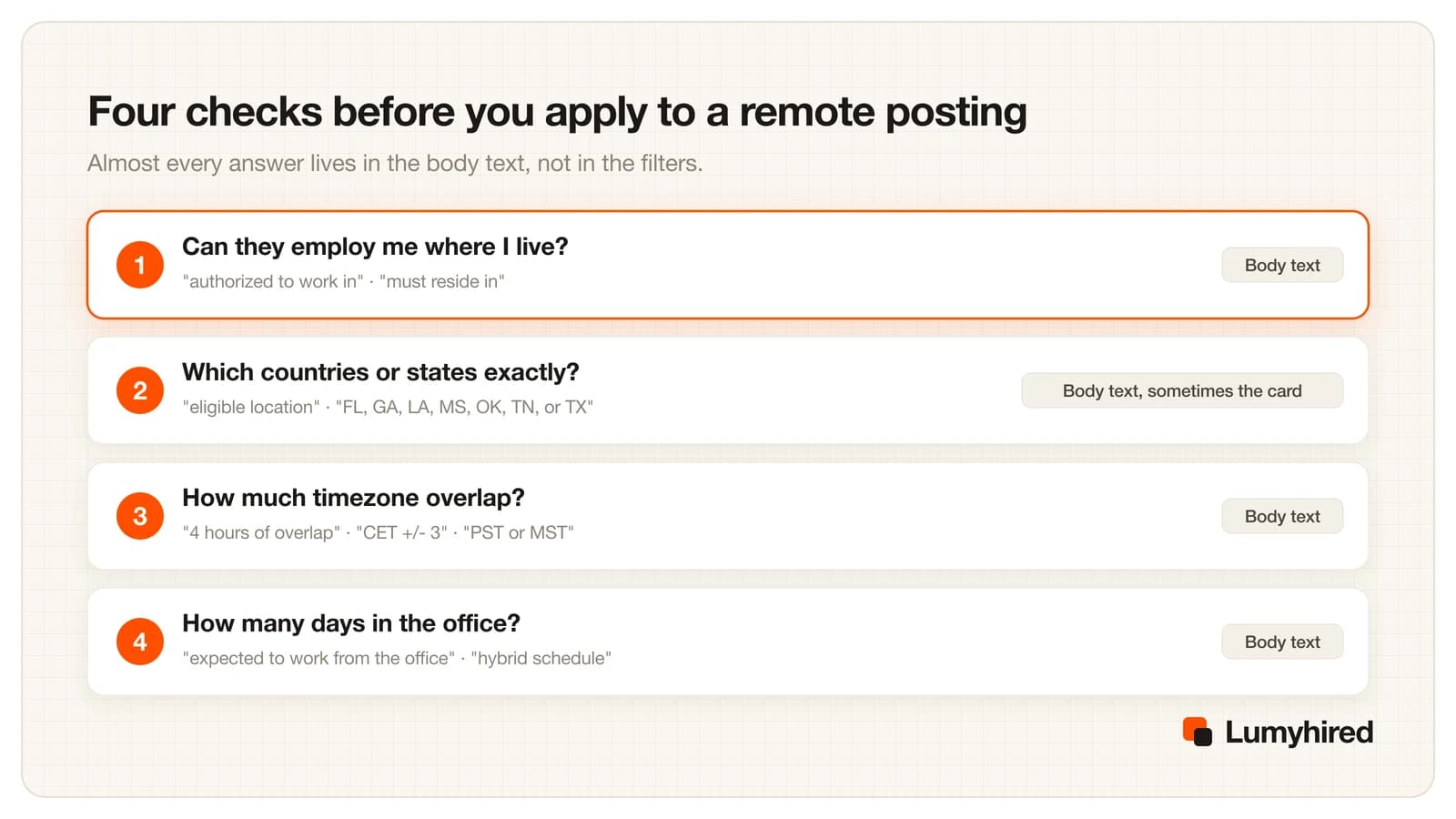
Two of the four have a filter on some boards. Working Nomads and Remote OK both filter by hiring country, and Remote OK puts its timezone filter behind Premium. The other two are yours to read.
Which remote job search tool fits your situation
You are finding remote roles but not hearing back. Lumyhired. This is the usual failure mode once the search itself works, and per-posting rewriting is the part nothing else here does, from €5 a week in English or French.
You are applying from outside the employer’s home country. Working Nomads or Remote OK, for the country filter, so a role you cannot legally hold never reaches your list.
You want postings someone paid to publish. We Work Remotely at $299 per post, or Working Nomads at $199.
You want to know the pay before you spend an evening on it. Remote OK, then Wellfound for startup roles with equity shown too.
You want a human-screened list and will pay for it. FlexJobs, at $2.95 for 14 days, reading its definition of remote first.
You want a referral rather than a listing. LinkedIn, searching people at distributed companies instead of jobs.
If you are weighing automation against targeting, the auto apply tools comparison covers that trade-off directly, and the broader comparison of search, resume and application tools is in the best AI tools to find a job in 2026.
Frequently asked questions
What are the best remote job search tools in 2026?
How many remote job postings are actually remote?
How do I find jobs that are actually remote and not hybrid?
Why is it harder to get a remote job?
Do I need to live in a specific country for a remote job?
Is there a free way to search for remote jobs?
Should I use auto apply for remote roles?
Is FlexJobs worth paying for?
Where Lumyhired fits
Lumyhired is not a remote job board and does not try to be one. It searches 10 sources in one query, including the remote-only board Remotive, labels each result Remote, Hybrid or On-site, rewrites your resume for one posting at a time without changing your titles, dates, employers or numbers, and keeps each version next to the application it went with. Weekly plans start at €5 on the pricing page, cancel anytime, with a 3-day money-back guarantee. There is no free plan and no trial.
Before any of that, the ATS preview is free, runs in your browser and needs no account. It shows the text a parser pulls out of your file, which matters more in a remote search than a local one because distributed employers receive more applications per posting and lean harder on automated screening. The mechanics are in the guide to how ATS filters actually screen resumes, and the rewrite itself is covered in how to tailor a resume to a job description.
Sources
- Our own count: 248 unique postings from We Work Remotely’s site RSS feed and its eight category feeds, pulled 25 September 2026. 240 tagged "Anywhere in the World"; 54 of those matched a location or timezone requirement in the posting text. Phrase matching, so a floor rather than a ceiling. weworkremotely.com
- Our own count: 99 postings from Remote OK’s public API, pulled 25 September 2026. 54 named a country, city or region in the location field, 39 blank, 6 Remote or Remoto. Data from Remote OK.
- Indeed Hiring Lab, Remote Tracker open dataset and its hybrid and remote methodology note. Observation of 31 August 2026: United States 8.44%, France 11.77%, Canada 13.35%, United Kingdom 16.30%. The share counts remote, hybrid and flexible keywords together. github.com/hiring-lab
- Robert Half, remote work statistics and trends, using TalentNeuron data across more than 450 job titles from its 2026 Salary Guide. Second quarter 2026: 87% fully on-site, 10% hybrid, 3% fully remote. Published by a staffing company. roberthalf.com
- Peter McCrory, "The Remote Work Gap: Steady Demand, Fewer Opportunities", LinkedIn Economic Graph Research Institute, 21 March 2025, 15 countries. Vendor data. economicgraph.linkedin.com
- Greg Lewis, "In a First, Remote Jobs Attract a Majority of Applications on LinkedIn", LinkedIn Talent Blog, 7 April 2022, on February 2022 data. Vendor data. linkedin.com
- We Work Remotely, home and job posting pages, read 25 September 2026 in a browser after its HTML returned 403 to our fetcher. "Post a job for $299", 42,103 jobs posted. weworkremotely.com
- Working Nomads, premium subscription and post-job options pages, read 25 September 2026. workingnomads.com
- Remote OK, premium and hire-remotely pages, read 25 September 2026. Employer rate stated as adjusting with weekly posting volume. remoteok.com
- FlexJobs, pricing page, read 25 September 2026. Jobs described as "entirely remote, hybrid, part-time, or flexible". flexjobs.com
- Wellfound, home page, read 25 September 2026. Free for candidates; $0 for employers to post. wellfound.com
- LinkedIn Premium pricing sits behind a sign-in and is eligibility-based. We did not state a price for it. premium.linkedin.com
Read next
- Best Auto Apply Tools in 2026
Six auto apply tools compared, including the trade-off vendors avoid: what mass applying costs in reply rate now that so many candidates do it.
- How Many Jobs Should You Apply To?
The math behind the number: 0.5% of applications become offers, tailoring roughly doubles interview rates, and a weekly plan for each situation.
- Best ATS Resume Tools in 2026: 7 Compared
Seven ATS resume tools ranked on what each one actually checks, with every price and free allowance read on 25 September 2026.