
Career Guides
How to target the right job postings in 2026
Updated 25 September 2026. A tailored application costs about an hour once you have read the posting, rewritten the title line and filled in the form. You will always find more postings than you have hours. This page is a method for deciding which ones earn one, and two of the rules you have probably been following turn out to have no evidence behind them.
Which job postings are worth a tailored application?
A posting earns the hour when three things hold: you can pass every field on its application form, you can evidence most of its required block with facts already on your resume, and it is a live opening rather than a pipeline. The wishlist decides nothing. The Harvard Business School and Accenture Hidden Workers research found more than 90% of employers filter or rank candidates with software at the first screen, on the exact criteria the posting names. Greenhouse classified 18 to 22% of the postings on its own platform as ghost jobs in any given quarter. And tailoring only pays where it lands: Huntr recorded a 5.71% interview rate per application on tailored resumes against 3.09% on untailored ones.
Figures read on 25 September 2026 from Harvard Business School and Accenture (September 2021), Greenhouse (December 2024) and Huntr (Q2 2026). Greenhouse and Huntr both report on their own products, and Huntr sells the tailoring feature its figure measures.
Start from the hours you have
Most advice on this question argues that quality beats quantity and stops there. That answers a question nobody is asking. The real problem is allocation: you have a fixed number of hours a week, a tailored application consumes one of them, and postings arrive faster than the hours do. Every posting you tailor for is a posting you did not tailor for.
The base rates make that allocation matter more than it used to. Greenhouse counted 244 applications per job in 2025, up from about 115 in 2022, across more than 6,000 companies. Gem’s 2026 benchmarks, drawn from over 165 million applications and 1.2 million hires, have 8% of applicants getting past the first screen and 0.5% receiving an offer. At those rates an untargeted application costs the employer almost nothing to discard and costs you an evening.
Huntr’s Q2 2026 data points the same way from the candidate side: 5.71% interviews per application on tailored resumes against 3.09% on untailored ones, from 101,501 tailored and 1,893,054 untailored applications logged since October 2024. That is roughly a 1.8 times lift, and it was 2.0 times in the previous quarter, so treat it as a range rather than a constant. It is also observational and it comes from a company that sells tailoring, which is a reason to read it as evidence about where the hour goes rather than as a guaranteed multiplier. The arithmetic of how many applications a search needs is in how many jobs to apply to.
Read the posting in three blocks
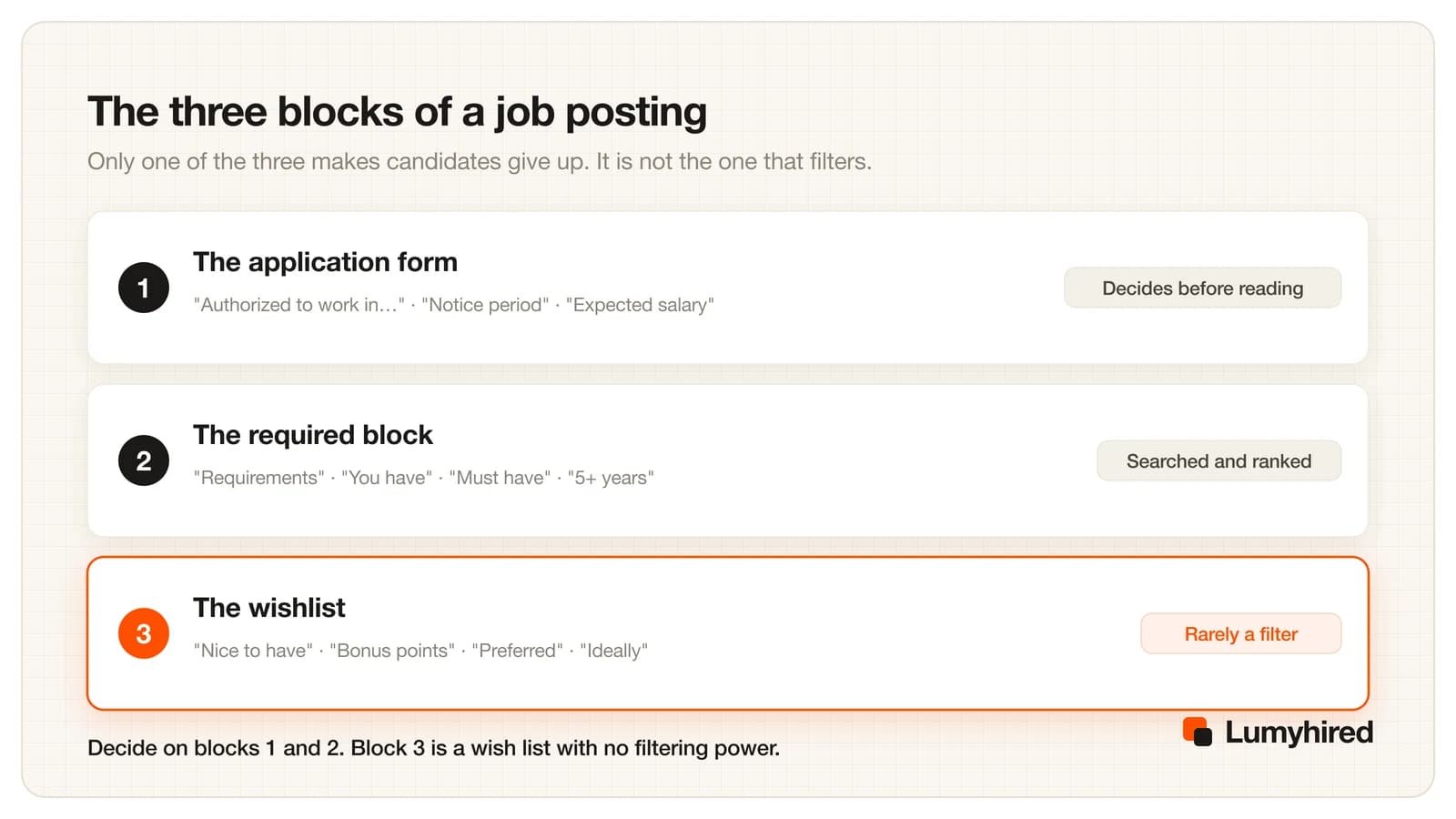
A job posting is three documents in one, written by different people for different reasons, and they do completely different things to your application. Reading it as one wall of text is why candidates skip postings they would have passed and tailor for postings that ruled them out on the form.
| Block | Where it appears | What it does | What to do with it |
|---|---|---|---|
| The application form | Before the job description, on the form itself: work authorisation, location, notice period, expected salary, licences. | An answer here can end the application the moment it lands. In the Harvard Business School and Accenture Hidden Workers survey, more than 90% of employers said they use their recruiting software to filter or rank candidates at first screening. | Read the form before the job description. One field you cannot pass makes the rest of the posting irrelevant, however well you match it. |
| The required block | "Requirements", "You have", "Must have", "5+ years", a named tool, a named certification, a degree. | This is the text a recruiter searches against and the text an ATS ranks on. In the same survey, 88% of employers agreed that qualified high-skills candidates get screened out for not matching the exact criteria in the job description, rising to 94% for middle-skills roles. | Count the lines you can evidence with a fact already on your resume. That count is the decision, rather than a feeling about the role. |
| The wishlist | "Nice to have", "Bonus points", "Preferred", "Ideally", "A plus". | Almost never a filter, and almost always the block that stops people applying. It exists because somebody asked the hiring manager what a perfect candidate would look like. | Keep it out of the decision. Use it in a cover note only on the lines you happen to match. |
The order matters as much as the content. Open the application form first, before you read a word of the description. A posting that asks for work authorisation you do not hold, a location you cannot take or a licence you do not have is closed to you whatever the rest of it says, and finding that out after an hour of tailoring is the most avoidable way to lose an evening. What those fields do once you submit them is covered in why you are not getting interviews.
One line inside the required block has moved recently, and most articles on this subject have not caught up. Degree requirements were widely reported as falling, and they did fall between 2017 and 2019. Indeed Hiring Lab reported in January 2026 that the trend reversed: holding the mix of job titles constant, the share of US postings requiring a bachelor’s degree or higher has been rising since March 2024, reaching 19.3% in November 2025 against 16.6% in November 2023. If a posting names a degree, treat it in 2026 as a line that is likelier to be enforced than the skills-first coverage of a few years ago implies.
Do you have to meet every requirement? The number everyone quotes has no source
You have read the rule: men apply when they meet 60% of the qualifications, women only at 100%. It appears in books, in conference talks and in almost every article on this subject. It traces to one place, Tara Sophia Mohr’s August 2014 piece in the Harvard Business Review, which says in its second paragraph that the finding comes from a Hewlett Packard internal report. That report has never been published. No sample, no method, no date, no way for anyone to check it.
Someone did check the claim itself. Mona Salwender and Dagmar Stahlberg ran four experiments, published in the European Journal of Social Psychology in 2024, showing participants a posting and a CV set to 60% or 100% qualification fit and asking whether they would apply. In the first study, of 289 participants, no gender difference appeared at either threshold, and a Bayesian test returned substantial evidence for that null. Their introduction is blunter than most rebuttals: journalists had already found the original statistic was based on a speculative comment rather than on quantitative data.
The same experiment found something far more useful, and it applies to everyone. Qualification fit itself drove application intention hard: participants shown the 100% fit version were much more willing to apply than those shown the 60% version, a large effect in a study designed to look for a difference between men and women and finding one between well-matched and poorly-matched instead. The instinct to weigh your fit against the posting is correct. It is the calibration that is wrong.
So drop the percentage and count. Take the required block line by line and mark each line you can support with something already written on your resume: a number, a project, a title, a tool you have used. One or two unsupported lines is an ordinary application. When most of the block is unsupported, the posting was written around someone else’s history, and the Hidden Workers finding says what that costs: 88% of employers agreed that qualified high-skills candidates get screened out for not matching the exact criteria in the job description, rising to 94% for middle-skills roles. Where you draw the line is a working rule. Nobody has measured it.
The wishlist stays out of the count. A line under “nice to have” that you do not match costs you nothing, and treating it as a requirement is how a winnable posting gets skipped. Turning the lines you can support into wording the posting will match is a separate job, covered in tailoring a resume to a job description and where resume keywords come from.
What a posting’s age actually changes
The second rule with nothing behind it is the ten-minute window: apply within ten minutes of a posting going live and you are supposedly four times likelier to hear back. It traces to a remark by a LinkedIn product manager quoted in a newsletter. There is no dataset, no sample and no method, and LinkedIn has never published anything of the sort. Speed is not the variable it is sold as.
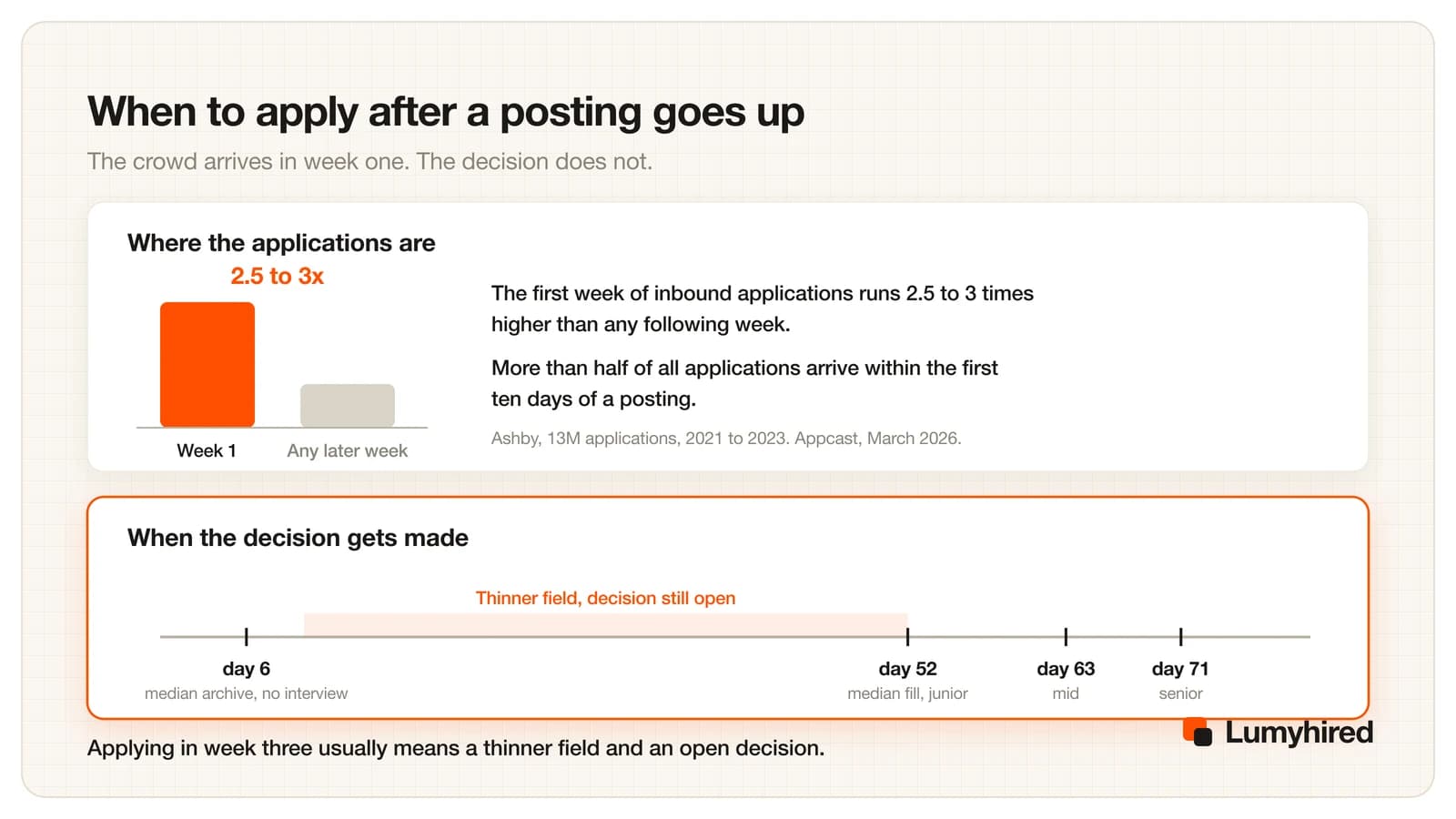
What is measured is where the crowd sits. Ashby, across more than 13 million applications, found the first week of inbound applications runs 2.5 to 3 times higher than any following week. Appcast reported in March 2026 that more than half of all applications arrive within a posting’s first ten days, with nearly 20% landing on a Monday. Applying early puts you in front of more people at the same moment. It does not beat a hidden deadline.
The decision runs on a much slower clock. Ashby’s 2026 operations benchmarks put the median time to fill at 52 days for junior roles, 63 for mid-level and 71 for senior, and 75 days for technical roles. So a posting three weeks old is usually still open, with most of its applicants already submitted and sorted. The field is thinner and the decision is still live. The sharper signal is your own clock: the median time to archive a candidate who never interviews is six days, so a fortnight of silence is more likely a slow process than a rejection nobody sent.
Practically: sort your shortlist newest first and work down it, rather than deleting everything past a date. An old posting whose required block you match completely is a better use of the hour than this morning’s posting that you half match.
Is the posting a live opening?
Not every posting is a vacancy with a start date attached. Some are pipelines, kept open so a company can collect resumes for roles it expects to open later. Some are evergreen requisitions for high-turnover jobs. Some are scraped copies an aggregator never took down after the employer filled the role. Seen from the outside the differences are small, and guessing wrong costs the whole hour.
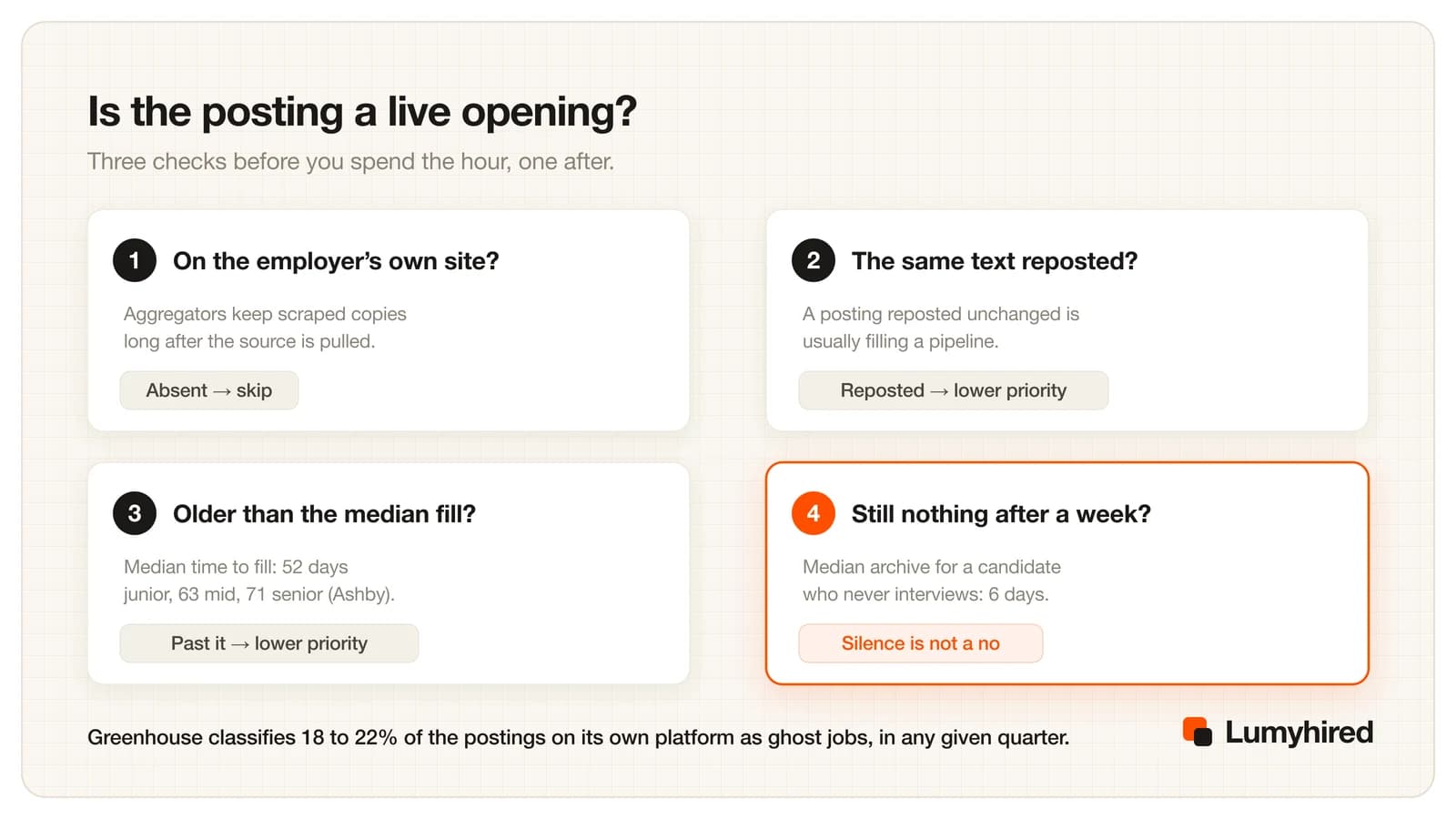
Three measurements are worth knowing here, and they say different things. Greenhouse, from the employer side, classifies 18 to 22% of the jobs on its own platform as ghost jobs in any given quarter. Revelio Labs, matching postings to positions actually filled, found hires per posting falling from about 0.75 in 2018 to below 0.5 by 2023, so roughly every other posting now ends in a hire. And Hunter Ng, analysing about 270,000 Glassdoor interview reviews in a 2024 preprint, estimated that up to 21% of job ads may be ghost jobs. Three methods, three datasets, a broadly consistent answer of around one posting in five.
Watch what happens to that number as it travels. Search the subject today and you will find pages announcing that one in three listings is fake, or 47%, with no method attached to either. The measured figures cluster near 20%, which is high enough to justify a two-minute check and low enough that treating every posting as fake would cost you far more than it saves.
Candidate perception runs higher still, and the gap is the point. Three in five candidates in Greenhouse’s survey of 2,500 workers said they suspected they had met a ghost job, and in Huntr’s Q1 2026 survey 520 of 559 respondents, 93%, said they had applied to a posting they believed was never meant to be filled, or suspected as much. Those measure how the market feels. Silence after an application is the normal outcome at 2026 rates, and it is not evidence the posting was fake.
The two-minute screen, in order
Four steps, run before you open a document. The order is the point: each step costs more than the one before it, so the cheapest test should be able to end the decision.
- 1. Open the application form. Work authorisation, location, notice period, salary, licences. One answer that disqualifies you closes the posting. Twenty seconds, and it saves the most.
- 2. Find the posting on the employer’s own careers page. If the role lives only on an aggregator, it may have been filled and never pulled. If the employer’s page carries it, take the date shown there rather than the aggregator’s.
- 3. Read the required block and count. Mark each required line you can already evidence. Skip the wishlist. About a minute, and it is the step that decides whether the hour is worth spending.
- 4. Rank what survives, newest first. Postings where you can evidence everything go to the top whatever their age. Then work down until the week’s hours are gone, one application per company.
Anything that fails step one or step three does not get a light-touch application either. Sending an untailored resume to a posting you cannot pass adds a rejection to your record at that employer and nothing else.
Where the freed hours should go
Screening postings out only helps if the recovered time lands somewhere with a better return. Three places have measurements behind them.
One application per company. Huntr recorded a 6.14% interview rate per application among job seekers who applied once at a given employer in Q2 2026, against 1.85% among those who sent eight or more, across 82,625 and 2,266 applications respectively. Pick the posting whose required block you match best and leave the rest of that company’s list alone.
Referrals. Ashby measured 52% of referred candidates passing initial screens against about 35% overall, and Gem put referral conversion at eleven times the inbound rate. One referral attempt is worth more than several extra cold applications and takes less than an hour.
Deeper tailoring on fewer postings. The gap between 5.71% and 3.09% in Huntr’s data is the return on the hour you are protecting. One thing that gap does not say: Huntr’s figures also show interview rates falling as total application counts rise, from 8.12% per application in the 11 to 20 bracket to 2.86% past 100, and the obvious reading of that is backwards. People who get interviews early stop applying, which loads the low-volume bracket with successes. The defensible conclusion is narrower: high-volume applying is not rescuing anyone. For the standing routine rather than the one-off method, the guide to getting a job in 2026 covers tracking and weekly pacing.
Frequently asked questions
Do you have to meet 100% of the requirements to apply?
How many requirements should I meet before applying?
How can I tell whether a posting is still a live opening?
Does the age of a job posting affect my chances?
Is it true you should apply within ten minutes of a posting going live?
Is it better to send ten tailored applications or fifty generic ones?
Should I apply to several roles at the same company?
How do I target postings when I am changing industry?
Should I still tailor when the posting looks like a perfect match?
Sources
- Tara Sophia Mohr, Why Women Don’t Apply for Jobs Unless They’re 100% Qualified, Harvard Business Review, 25 August 2014. Survey of more than 1,000 respondents, predominantly American professionals. The 60% figure is attributed there to an unpublished Hewlett Packard internal report.
- Mona Salwender and Dagmar Stahlberg, Do women only apply when they are 100% qualified, whereas men already apply when they are 60% qualified?, European Journal of Social Psychology, 2024, DOI 10.1002/ejsp.3109. Four experiments, 289 participants in Study 1, 807 across Studies 2 to 4. Open access.
- Harvard Business School Project on Managing the Future of Work and Accenture, Hidden Workers: Untapped Talent, September 2021. More than 8,000 workers and more than 2,250 executives in the US, UK and Germany, surveyed in 2020.
- Indeed Hiring Lab, Where do college degrees still matter in a skills-first job market?, 28 January 2026. US Indeed postings, adjusted for job title mix.
- Ashby, Applications Per Job, 2023 trends report. More than 13 million applications, January 2021 to April 2023, predominantly US tech companies of 1 to 1,500 employees.
- Ashby, Recruiting Operations Benchmarks, 7 May 2026. 54M+ applications, 93K jobs, January 2021 to March 2026.
- Appcast, job ad content best practices, 6 March 2026.
- Greenhouse, 2024 State of Job Hunting report, 10 December 2024. Survey of 2,500 workers in the US, UK and Germany, plus Greenhouse platform data on ghost jobs.
- Revelio Labs, ghost job postings, 31 October 2023, updated 2026. Postings matched to new positions within six months.
- Hunter Ng, Why is it so hard to find a job now? Enter Ghost Jobs, arXiv preprint, 29 October 2024. About 270,000 Glassdoor interview reviews.
- Huntr, Job Search Trends Q2 2026 and Q1 2026. 102,777 applications in Q2; the tailoring comparison covers 101,501 tailored and 1,893,054 untailored applications since October 2024.
- Gem, 2026 Recruiting Benchmarks, December 2025, and Greenhouse, Hiring Benchmarks, May 2026.
Running this screen with Lumyhired
Lumyhired is built around the same order. The job search scans more than ten boards in one query, so the shortlist you screen is the full list rather than whichever site you opened today, and each result carries its posting date where the source publishes one. The ATS extraction preview runs in your browser with no account and shows the text a parser pulls out of your file, which is the check to run before any of this matters. The ATS resume checker then scores that text against one posting’s required block, so step three takes seconds instead of a minute, and the tracker keeps applications per company visible. Weekly plans start at €5 on the pricing page, with a 3-day money-back window and cancellation at any time. Every plan is paid.
Read next
- How Many Jobs Should You Apply To?
The math behind the number: 0.5% of applications become offers, tailoring roughly doubles interview rates, and a weekly plan for each situation.
- How to Tailor Your Resume to a Job Description
A 15-minute method with three before and after bullets, an AI prompt that forbids invented facts, and Huntr's data: tailored resumes got interviews at 4.23% vs 2.07% in Q1 2026.
- Why You're Not Getting Interviews in 2026
Diagnose it by symptom: no replies, rejections within minutes, screens with no interviews, interviews with no offers, or silence. A 10-minute test for each.