
Strategy
Job search strategies for 2026: which channels get interviews
Most job search advice lists tactics without saying which ones work. This guide compares the channels themselves (job boards, company career pages, referrals, recruiters, outreach, alumni and alerts) with the published conversion data, then turns the numbers into a weekly plan, message templates and a way to measure your own results.
Which job search strategies work best in 2026?
Use job boards to find roles, then apply on the employer's own site: in Huntr's data on 1.24 million applications (October 2024 to July 2026), company career pages converted to interviews at 6.87%, Google Jobs at 6.60% and LinkedIn at 1.95%. Add at least one referral request a week, since Gem found referred candidates are hired at 11 times the rate of inbound applicants and Ashby found 52% of them pass the first screen against 35% overall. Put about 40% of your search hours into tailored applications and 25% into people, then log the channel of every application and compare interview rates each Friday.
Figures read 17 September 2026. Huntr, Gem and Ashby are software vendors publishing data from their own products. Page updated 17 September 2026.
Job search strategies by channel: why the route matters
A channel is the route an application takes to a recruiter: a board form, the employer's own site, a referral, a recruiter who found you. The same resume sent to the same job can get very different results depending on that route, and the difference is large enough to plan your week around.
This page goes deep on channels. For the full method (targeting, resume versions, tailoring, follow-ups and a 30-day plan), start with the guide on how to get a job in 2026. For the volume question, see how many jobs to apply to each week.
Two kinds of data are used below, and they measure different things. Huntr, a job application tracker, reports the share of its users' applications that reached an interview. Gem and Ashby, two applicant tracking systems, report what happens to candidates on the employer side. Neither is a controlled experiment.
Best job boards by response rate in 2026
Huntr published its ranking in July 2026 from 1,244,654 applications logged between 1 October 2024 and 1 July 2026, counting only sites with at least 1,000 applications. GovernmentJobs came first at 7.28%, then Google Jobs (6.60%), Seek (5.16%), Magneto (4.09%) and Welcome to the Jungle (3.78%). The big general boards sat lower: Indeed 2.92%, Glassdoor 2.89%, LinkedIn 1.95%, ZipRecruiter 1.12%.
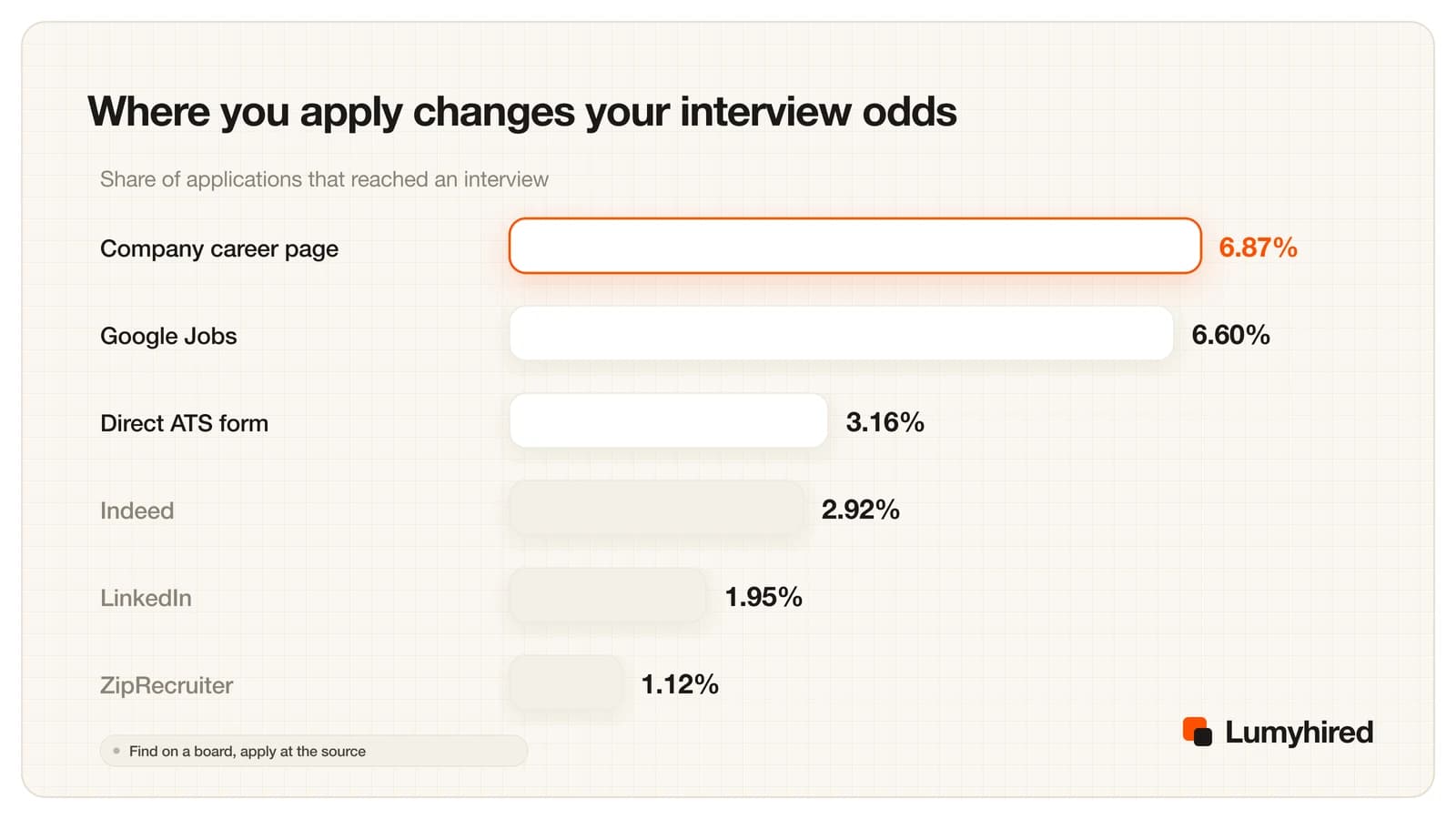
The more useful cut is where the application finally went. Huntr grouped applications by destination: through job boards and aggregators, 1.95% reached an interview; straight into an applicant tracking system such as Workday or iCIMS, 3.16%; through the company's own career page, 6.87%. Google Jobs ranks high for the same reason: it sends you to the employer's form instead of hosting the application.
Huntr's earlier reports point the same way with different windows and definitions. Over April 2025 to March 2026, Google converted at 7.12% and LinkedIn at 2.94%. In the 2025 annual report (598,627 applications, where a response means the job moved to the interview stage or beyond), Google Jobs was at 11.3%, Indeed 4.5% and LinkedIn 3.1%.
Read these rates as board plus behavior. Huntr says it directly: a site built for one-click bulk applying converts worse than one where each application takes work. LinkedIn carried about 78% of all applications in the dataset (970,190 of 1,244,654, our calculation), so most effort goes to the channel with one of the lowest returns. The practical rule is to keep LinkedIn and Indeed as discovery tools and move the application to the source.
| Channel | What is measured | Figure | Source |
|---|---|---|---|
| Company career page | Applications that reached an interview | 6.87% | Huntr, Oct 2024 to Jul 2026 |
| Google Jobs (routes you to the employer's form) | Applications that reached an interview | 6.60% (7.12% over Apr 2025 to Mar 2026) | Huntr best job boards; Huntr Q1 2026 |
| Direct ATS form (Workday, iCIMS and similar) | Applications that reached an interview | 3.16% | Huntr, Oct 2024 to Jul 2026 |
| Indeed / Glassdoor | Applications that reached an interview | 2.92% / 2.89% | Huntr, Oct 2024 to Jul 2026 |
| Applications that reached an interview | 1.95% (2.94% over Apr 2025 to Mar 2026) | Huntr best job boards; Huntr Q1 2026 | |
| All job boards and aggregators | Applications that reached an interview | 1.95% | Huntr, Oct 2024 to Jul 2026 |
| Employee referral | Hire rate compared with inbound applicants | 11 times higher | Gem 2026 Recruiting Benchmarks |
| Employee referral | Candidates who pass the first screen | 52%, against 35% overall | Ashby Recruiting Operations Benchmarks, 2026 |
| Recruiter outreach (you were sourced) | Hire rate compared with inbound applicants | About 8 times higher | Gem 2026 Recruiting Benchmarks |
Referral vs cold application: what the data shows
Every employer-side dataset we found gives referrals a large edge. Gem's 2026 benchmarks (more than 165 million applications, June 2021 to May 2025) put the hire rate of referred candidates at 11 times that of inbound applicants. Ashby's 2026 benchmarks show 52% of referred candidates passing the first recruiter screen, against 35% for all candidates.
Referrals are still a minority of hires. In Ashby's data on nearly 250,000 hires from January 2021 to June 2025, referrals held at about 17 to 18% whatever the inbound volume, while inbound applicants made up between 43% and 52%. So the better plan is to do both: applications for coverage, referrals for the roles you want most.
Job seekers under-invest in people. Huntr's Q1 2026 survey asked 555 users how they spend their search time: 85% said mostly on online applications, 15% mostly on networking. Among the 503 who landed an interview, 14% got it through an employee referral, 13% through a recruiter who reached out, 12% through networking and 62% through an online application.
The hidden job market in 2026: what is measured and what is myth
The claim that 85% of jobs are filled through networking traces back to a LinkedIn article by recruiting consultant Lou Adler, published 29 February 2016. He had asked people how they found their most recent job and collected about 3,000 answers, mostly from staff and management roles, and the result was about "critical jobs" filled via networking of some sort. That is an informal poll of one author's audience, ten years old, and it does not describe all jobs.
What current data shows is narrower. At Ashby customers, most hires come from people who applied to a posted job (52% in Q2 2025), with referrals at about 18% and sourced candidates at about 16%. In France, APEC's survey of companies that hired managers and professionals in 2024 (published May 2025) found that 41% of those hires were already known to the company or recommended, across all channels.
Roles that are never posted leave no trace in applicant tracking data, so the true size of the hidden market is unknown. What you can act on is the part that is measurable: a posted job is easier to win with a referral, and recruiters fill some roles by searching profiles before candidates ever apply. Both reward being known to people at your target companies before the posting appears.
The other channels: recruiters, outreach, alumni and job alerts
Recruiters and agencies
Being found is a channel in its own right. Gem reports sourced candidates are about 8 times more likely to be hired than inbound applicants, and 13% of Huntr's surveyed seekers who landed an interview got it from a recruiter who reached out. You cannot schedule that, but you can make it likely: use your target job title in your profile headline, list the skills postings ask for, and answer recruiter messages within a day. With agencies, ask which clients they will submit you to before they do, so the same employer does not get you twice.
LinkedIn outreach to hiring managers
We found no public dataset with reply rates for candidate messages to hiring managers, so treat any number you see quoted with care. Outreach works best as a complement to an application you already sent: it gives the manager a reason to look for your file. Keep it to a few lines, name the posting and one result that matches its first requirement.
Alumni and professional communities
No dataset isolates alumni networks, so they fall under the networking share above (12% of interviews in Huntr's survey). They matter because they turn strangers into weak ties with a reason to answer. Search your school or former employer on LinkedIn filtered by your target company, and join the Slack or Discord groups of your field, where members often share openings from their own teams.
Job alerts
Alerts help you find roles early; the application itself belongs elsewhere. Set them for your target title on two or three boards and on Google Jobs, and follow the career pages of the companies on your list. When an alert fires, apply on the employer's site. One caution from Huntr's Q1 2026 data: seekers who applied to the same company once interviewed at 6.07%, against 1.91% for those who applied 8 times or more, so pick the best-fitting role at each company. Choosing which postings deserve an application is covered in how to target the right jobs.
How to ask for a referral: flow and message templates
A referral ask works when it costs the other person almost nothing. Close contacts can get a direct ask. Weak ties (someone from your school, a former employer, a community) should get a short conversation first, then the ask.
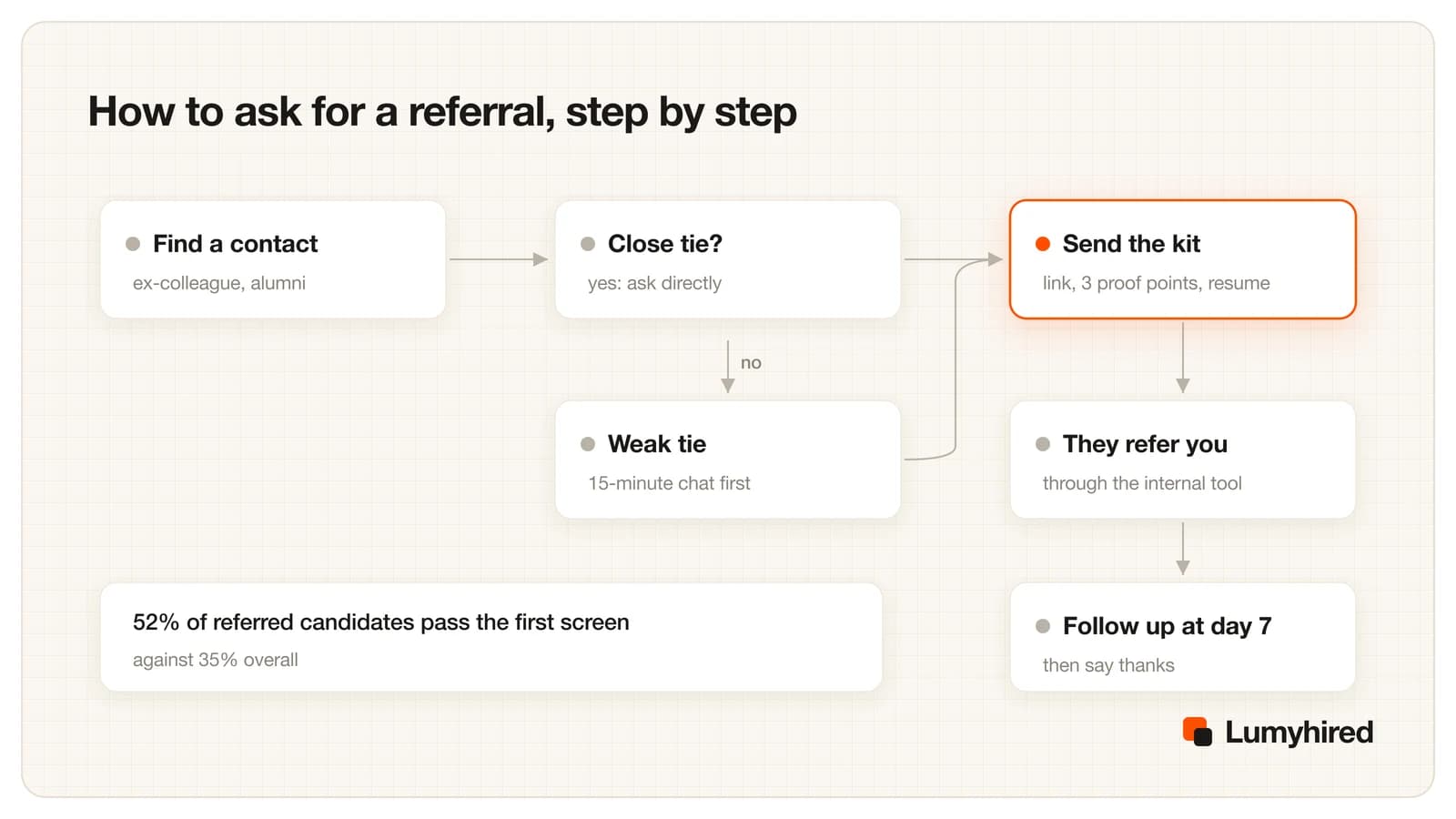
The templates below are short on purpose. Replace every bracket, and only claim results you can back up in an interview.
Template 1: referral ask to a former colleague
Hi [name], I saw [company] is hiring a [job title]: [link]. It lines up with the [project or result] we worked on at [employer]. Would you be comfortable referring me? I can send a two-line summary and my resume so it takes you a minute.
Template 2: first message to an alumnus or weak tie
Hi [name], we both studied at [school] / worked at [employer]. I am looking at the [job title] role on your team and would value 15 minutes on how the team works. Would [two time options] suit you?
Template 3: the referral kit, after a good conversation
Thanks again for the time. If you are happy to refer me, here is everything in one place. Posting: [link]. Why I fit: [result 1 with a number]; [result 2]; [tool or skill the posting names first]. Resume attached. No pressure either way.
Template 4: note to a hiring manager after applying
Hi [name], I applied for the [job title] role on [date]. The posting leads with [requirement]; at [employer] I [result that matches it]. Happy to share details if useful.
Template 5: reply to a recruiter who reached out
Thanks, [name]. I am open to [job title] roles in [location or remote], at [salary range]. Could you share the company name and the posting before you submit my profile? I am free for a call [two time options].
A weekly job search plan built from the conversion data
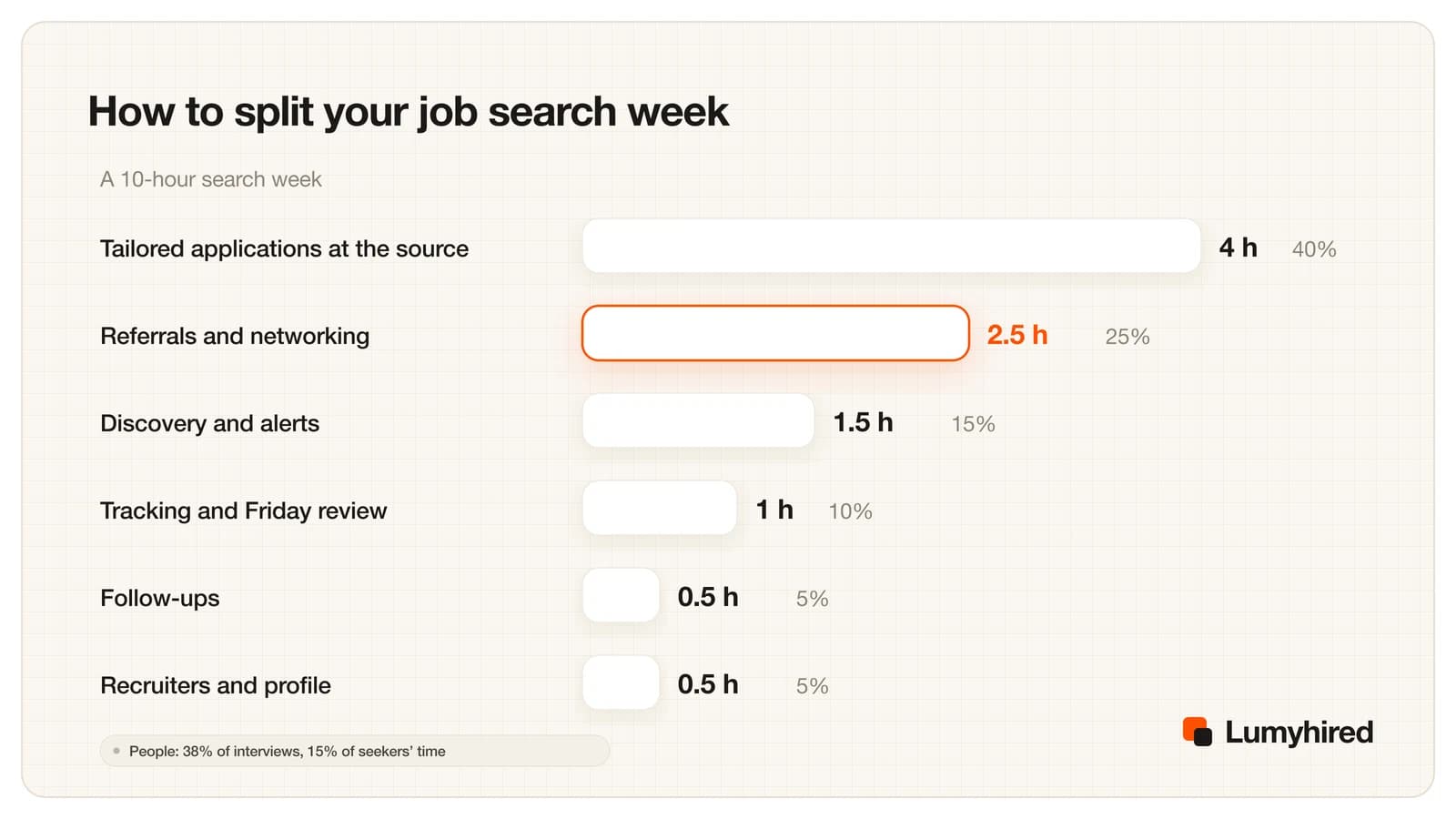
The plan below assumes 10 hours a week, a pace someone with a job can keep. For a full-time search, double every block. The split is our recommendation; the reasoning for each block cites the measured figure it rests on.
| Block | Hours | Share | Why this much |
|---|---|---|---|
| Tailored applications on the employer's own site | 4 h | 40% | Online applications still produced 62% of interviews in Huntr's survey, so they keep the biggest block. Sending them through career pages (6.87%) rather than board forms (1.95%) is the single largest gain in the data. |
| Referral asks, alumni and former colleagues | 2.5 h | 25% | Referrals and networking produced 26% of interviews (14% plus 12%) while only 15% of seekers spent most of their time on people. Referred candidates pass the first screen at 52% against 35% (Ashby). |
| Discovery: alerts, Google Jobs, target company pages | 1.5 h | 15% | Boards are where you find roles. The time goes into reading and shortlisting, then the application moves to the source. |
| Tracking and the Friday channel review | 1 h | 10% | Without a source column in your tracker you cannot tell which of the blocks above works for you. |
| Follow-ups | 0.5 h | 5% | Ashby customers archive candidates who get no interview after about 6 days, so one message around day 7 lands while the file is still open. |
| Recruiter replies and profile upkeep | 0.5 h | 5% | 13% of interviews came from a recruiter who reached out (Huntr survey). You cannot schedule that, but you can keep your profile searchable and answer fast. |
In practice, the 4 hours of applications cover about five tailored applications, and the 2.5 hours of people time cover two referral asks, one or two alumni messages and one conversation. The shift from typical behavior is deliberate: Huntr's surveyed seekers put most of their time into online applications, while people-based channels produced 38% of their interviews. If a block produces nothing after three or four weeks, your tracker will show it, and the time moves.
How to measure your own channel mix in a tracker
Published rates are averages over other people. Your own numbers decide where the next month goes. Add one column to your tracker, Channel, with a fixed list: board name, company career page, referral, recruiter inbound, outreach. Keep the usual columns too: date, company, role, resume version and stage (saved, applied, screen, interview, offer, rejected).
Every Friday, divide interviews by applications for each channel. Wait for about 20 applications in a channel before you judge it: at that size, a single interview moves the rate by 5 points. The example below is invented to show the calculation.
| Channel | Sent | Interviews | Interview rate |
|---|---|---|---|
| LinkedIn Easy Apply | 30 | 0 | 0.0% |
| Company career pages | 18 | 2 | 11.1% |
| Referrals | 4 | 2 | 50.0% |
| Recruiter inbound | 2 | 1 | 50.0% |
Read it in this order. Zero interviews from 30 Easy Apply submissions says to drop that route and send applications to those companies through their own sites instead. Two interviews from 18 career-page applications (11.1%) sits above Huntr's 6.87% average, so that block keeps its hours. The referral and recruiter rows are too small to judge alone, but they already produced 3 interviews from 6 asks, more than the other two routes combined from 48 applications. If every channel stays at zero after about 25 tailored applications, the problem is likely upstream of the channel; the diagnostic for getting no interviews helps find the stage that fails.
A spreadsheet is enough for this. If you prefer a tool, the options are compared in the best job application trackers for 2026; check that the one you pick lets you record the source of each application.
Where AI tools fit in these channels
Software speeds up the discovery block and the drafting part of applications. It does not create referrals or conversations, and auto-apply tools push volume into exactly the one-click board forms that convert worst in Huntr's data. Huntr's Q1 2026 report also found that seekers who sent 11 to 20 applications in total interviewed at 9.25% per application, against 2.58% for those who sent 100 or more (a correlation that does not prove cause). Which tools help with which channel is reviewed in the best AI tools to find a job in 2026.
Before sending applications to career pages, where the employer's applicant tracking system reads your file directly, check what it extracts. Tailoring each application to the posting is covered in how to tailor your resume to a job description.
Frequently asked questions
What are the best job search strategies in 2026?
What is the hidden job market, and how big is it in 2026?
Is a referral better than a cold application?
Which job boards have the best response rate?
How do I ask for a referral from someone I don't know well?
How many hours a week should I spend on job searching?
Should I apply on LinkedIn or on the company website?
Do recruiters still find candidates on LinkedIn in 2026?
Where Lumyhired fits
Lumyhired covers the discovery, application and tracking blocks of the week. One search runs across Indeed, LinkedIn, Glassdoor, France Travail, Remotive, Adzuna, hiring.cafe, startup.jobs, Gradcracker and UK Visa Jobs; the paid plans add resume tailoring and cover letters against a specific posting, the full ATS check and an application tracker. It does not apply for you and cannot ask for referrals, message recruiters or run your networking. The ATS preview is free and shows how a parser reads your resume, without an account. Weekly plans start at €5, with no free plan, cancel anytime and a 3-day money-back guarantee; details on the pricing page.
Sources
- Huntr, The Best Job Boards of 2026, Ranked by Interview Rate, 19 July 2026. huntr.co
- Huntr, The Q1 2026 Job Search Trends Report (applications data and survey of 555 users). huntr.co
- Huntr, 2025 Annual Job Search Trends Report, December 2025. huntr.co
- Gem, 2026 Recruiting Benchmarks key takeaways, December 2025. gem.com
- Ashby, Recruiting Operations Benchmarks, 2026. ashbyhq.com
- Ashby, inbound and referral hires report, data to June 2025. ashbyhq.com
- APEC, Pratiques de recrutement 2025, May 2025. corporate.apec.fr
- Lou Adler, New Survey Reveals 85% of All Jobs are Filled Via Networking, LinkedIn, 29 February 2016. linkedin.com
Read next
- How to Get a Job in 2026: A Data-Backed Guide
The 2026 job market in numbers (11.4 weeks median unemployment, 244 applications per job, 108 days to an offer), an 8-step method and a realistic 30-day plan.
- How Many Jobs Should You Apply To?
The math behind the number: 0.5% of applications become offers, tailoring roughly doubles interview rates, and a weekly plan for each situation.
- How to Target the Right Job Postings in 2026
A tailored application costs an hour. The three blocks of a posting, the 60% rule that has no source, and what a posting's age actually changes.
- How to Negotiate Salary in 2026
EU pay transparency was due in national law by 7 June 2026. What is in force where you apply, what the research on first offers shows, and the stats we rejected.
- AI Adoption in Job Search: What Actually Changed in 2026
The 2026 numbers on AI in hiring: how many candidates and recruiters use it, for what, AI interviews, bias evidence, and the rules arriving through December 2027.