
Resume & ATS
References on a resume in 2026: where they go, who to ask, and what employers may do with them
This guide covers where references belong, the reference page format, who to choose, the email to ask them, and the rules on what an employer may collect and what a former employer may say in the US, the UK and France.
Should you put references on your resume?
In most cases, no. Put them on a separate reference page and send it when an employer asks. If you apply in France, the employer must tell you before it collects references (L1221-9). In the UK, Acas advises employers to ask at the final stage. List about three people who have agreed in advance, each with name, job title, company, phone, email and one line on how you worked together. Leave out “references available upon request”. In a 2012 CareerBuilder survey (CareerBuilder sells hiring services), 80% of 2,494 US employers said they contact references.
Published 14 October 2026. Every figure is sourced at the end, with its sample size and who ran the survey. Legal points are general information: for a specific case, ask an employment lawyer.
Should you put references on your resume?
Keep them off the resume and on a separate page, unless the posting or the application form asks for referees at the moment you apply. Three reasons make the separate page the better default.
- Timing. Acas, the UK’s employment advisory body, advises employers to ask for references at the final stage, and to have a conditional offer and the applicant’s permission before approaching a current employer. In the 2012 CareerBuilder survey, 16% of employers who check references called them before the interview. Either way, names on a resume reach the employer at the first stage.
- Your referees’ privacy. A resume travels: to job boards, recruiters and applicant tracking systems you will never see. Every copy would carry someone else’s phone number and email.
- Choice. A separate page lets you pick the two or three people who fit each job. A sales role and an operations role call for different voices, and you can only choose once you know which job is asking.
The exception is practical. When a posting or an application form asks for referees at the point of application, with fields for names and contact details, fill them in and follow the posting.
If your resume already lists referees, take them out before your next application. You can see what a parser pulls out of your file, contact details included, with the free ATS preview, which needs no account.
Should you write “references available upon request”?
No. The line states something every employer already assumes, and it takes a line at the bottom of the page where a last achievement or a certification could go.
An employer who wants references asks for them, by email, by phone or through a form in its applicant tracking system. When you must be told, in France and the UK, is covered below.
What to put in its place: nothing on the resume, and a finished reference page on your computer, ready to send the day you are asked. The template is further down.
Do employers actually check references?
In the surveys available, most say they do, and what references say changes decisions. The published numbers are old and come from companies that sell hiring services, so read them as orders of magnitude.
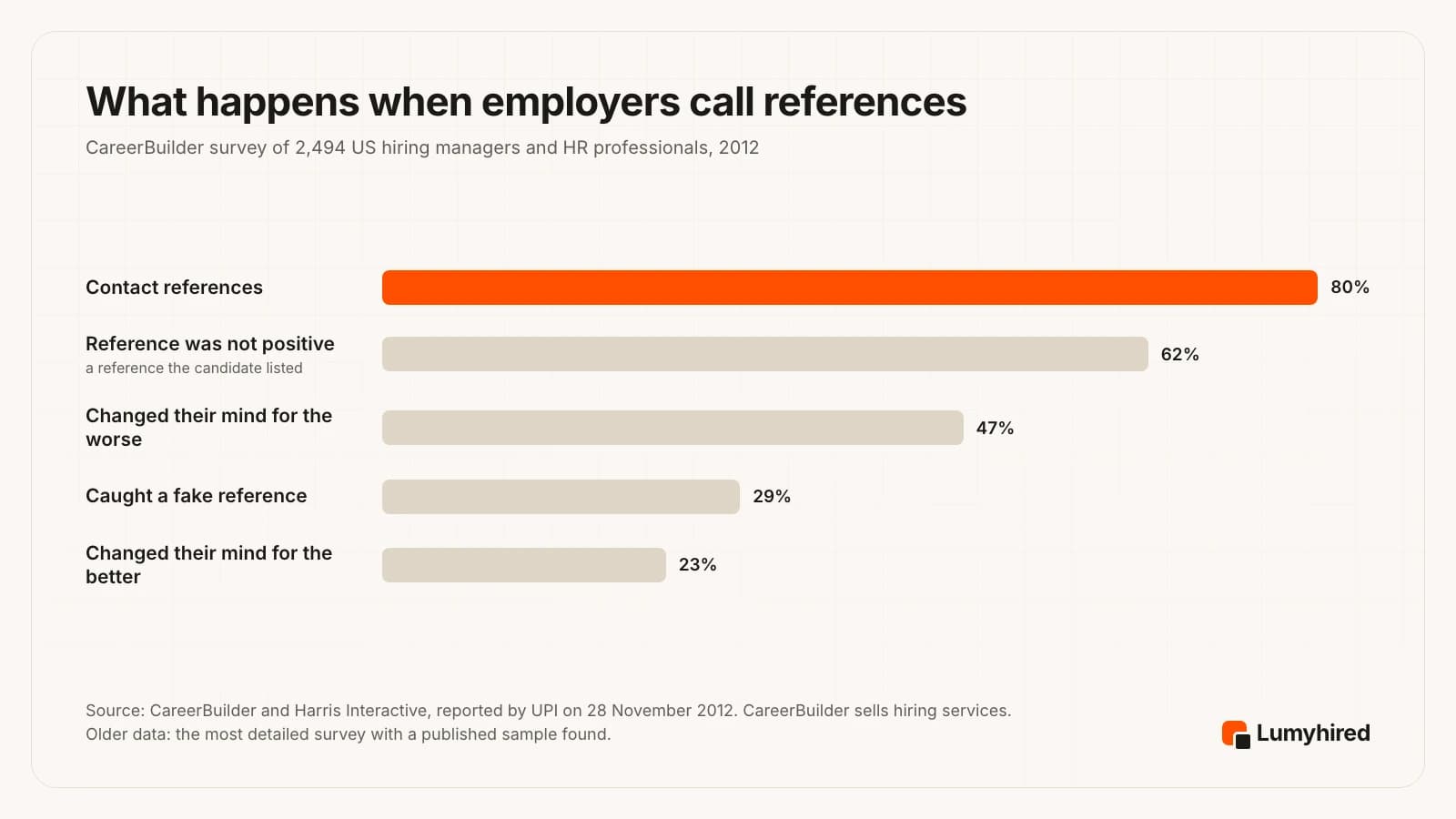
The most detailed survey with a published sample is CareerBuilder’s (2012), run by Harris Interactive with 2,494 hiring managers and HR professionals and 3,976 workers. Of the employers, 80% said they contact references, and 16% of those said they call references before inviting the candidate to an interview. 62% said a reference the candidate listed did not give a positive review. 47% said a reference had made their opinion of a candidate worse, 23% said better, and 29% had caught a fake reference on an application.
The worker side of the same survey has a related number: 15% of workers admitted listing someone as a reference without telling them. A referee who is surprised by the call, or does not remember the details of your work, is more likely to give a vague answer.
A later survey points the same way. In an Accountemps survey of more than 2,800 US senior managers, reported by HR Dive in March 2019 and cited by Robert Half, senior managers say they remove about 34% of candidates from consideration after a reference check. Accountemps is a Robert Half staffing business.
You will also see “87% of employers check references” attributed to SHRM. We could not find the SHRM study behind it, so it is left out here.
Who should you use as a reference?
People who saw your work recently and closely, can give examples, will pick up the phone, and have said yes. A former direct manager is the strongest default. The table shows where each type of referee helps and where it can backfire.
| Referee | Best for | What they can speak to | Watch out for |
|---|---|---|---|
| Former direct manager | Almost any application | Scope, results, strengths and weaknesses | Their employer may route all references through HR |
| Current manager | After an offer, if at all | Your most recent work | Alerting them to your search |
| Senior colleague or peer | Team-heavy roles | How you work day to day | Less weight on performance |
| Client or partner | Sales, consulting, account roles | Delivery, reliability, the relationship | Their own confidentiality rules |
| Someone you managed | Management roles | How you lead, delegate and give feedback | Use alongside a manager, never alone |
| Professor or internship supervisor | Graduates, first jobs | Quality of work, reliability, learning | Pick one who knows your work by name |
| Family or friends | Nothing | Nothing an employer will accept | Leave them off |
Two filters matter more than seniority. First, recency: a manager from three years ago who supervised you daily beats a director from last year who met you twice. Second, the job you are applying for: if the role is about managing clients, a client who will vouch for you is worth more than a third manager.
Be realistic about what a former employer will say. Employment lawyers quoted by SHRM advise employers to let one trained person, usually in HR, handle reference requests, give only factual information and get the former employee’s written permission. Acas notes that an employer’s reference policy can restrict how much is said and who may say it. So a call to the company switchboard may only confirm your title and dates. That is one more reason to name a person, with their direct contact details, who has agreed to talk.
How do you ask someone to be a reference?
By email or message, before you need them, with an easy way to say no. Then a second, short note when an employer actually asks for names. Here are both, ready to adapt.
Email 1: asking someone to be a reference
Subject: Would you be a reference for me?

Hi Karen,

I’m looking for my next role in operations planning, and I’d like to
list you as a reference. You managed me at Northwind Logistics from
2022 to 2025, and you saw the warehouse slotting project from start
to finish, so you’re the person who can speak to my planning work best.

If you agree, an employer might email or call you in the next two
months, usually near the end of their process. I’ll tell you before
I give out your details, with the company, the role and who will
contact you.

Could you confirm the best phone number and email to share? And if
the timing doesn’t work for you, just say so. No problem at all.

Thank you,
Daniel Ortiz
(555) 010-4421
Email 2: the heads-up when an employer asks for references
Subject: Reference call from Harbor Foods this week

Hi Karen,

Good news: I’m in the final round for Supply Planning Lead at Harbor
Foods, and I’ve given them your details. Their recruiter, Ms. Lee,
will contact you by email this week.

The role is mostly demand forecasting and running a team of four.
Two things from our time together that are relevant:
- the slotting project that cut pick times on the main site
- taking over the weekly S&OP meeting when the team grew

The job description is attached. Thank you again for doing this.

Daniel
The second email changes the call. It tells your referee who will contact them, what the job needs, and which of your projects to bring up. You are reminding them of facts they already know. The 15% of workers in the CareerBuilder survey who listed someone without telling them gave up exactly this advantage.
After the decision, send a third, shorter note: the outcome, and thanks.
How do you format a reference page?
One page, the same header as your resume, a title that says “References”, and three entries in order of relevance to the job. Each entry has six lines: name, job title, company, phone, email, and one sentence on how you worked together.
Reference page template
[YOUR NAME]
[City, State] · [Phone] · [Email] · [LinkedIn URL]

REFERENCES

[Reference name]
[Job title], [Company]
[Phone] · [Email]
Relationship: [How you know them, when, and on what work]

[Reference name]
[Job title], [Company]
[Phone] · [Email]
Relationship: [How you know them, when, and on what work]

[Reference name]
[Job title], [Company]
[Phone] · [Email]
Relationship: [How you know them, when, and on what work]
Filled example
DANIEL ORTIZ
Columbus, OH · (555) 010-4421 · daniel.ortiz@example.com

REFERENCES

Karen Holt
Director of Operations, Northwind Logistics
(555) 010-2290 · k.holt@example.com
Relationship: My direct manager, 2022 to 2025. Oversaw the warehouse
slotting project I led.

Marcus Bell
Senior Demand Planner, Northwind Logistics
(555) 010-7715 · marcus.bell@example.com
Relationship: Peer on the planning team for three years. We ran the
weekly S&OP meeting together.

Aisha Grant
Category Manager, Fairway Grocers (client)
(555) 010-3368 · agrant@example.com
Relationship: My main client contact for two years on replenishment
forecasts.
- Match the resume header. Same name line, same font, same contact block. The page is read next to your resume and should look like part of the same file.
- Put the most relevant person first. If the job is client-facing, a client can go first. A recruiter with limited time may call one name only.
- Use the contact details they gave you. A direct line or mobile and a work or personal email they check. A company switchboard sends the call to HR, which may only confirm dates.
- Write the relationship line. It tells the employer why this person’s view counts before the call starts, and it reminds the referee which work to talk about.
- Save it as a PDF named after you. “Daniel-Ortiz-References.pdf” is easy to find in an inbox and in an applicant tracking system.
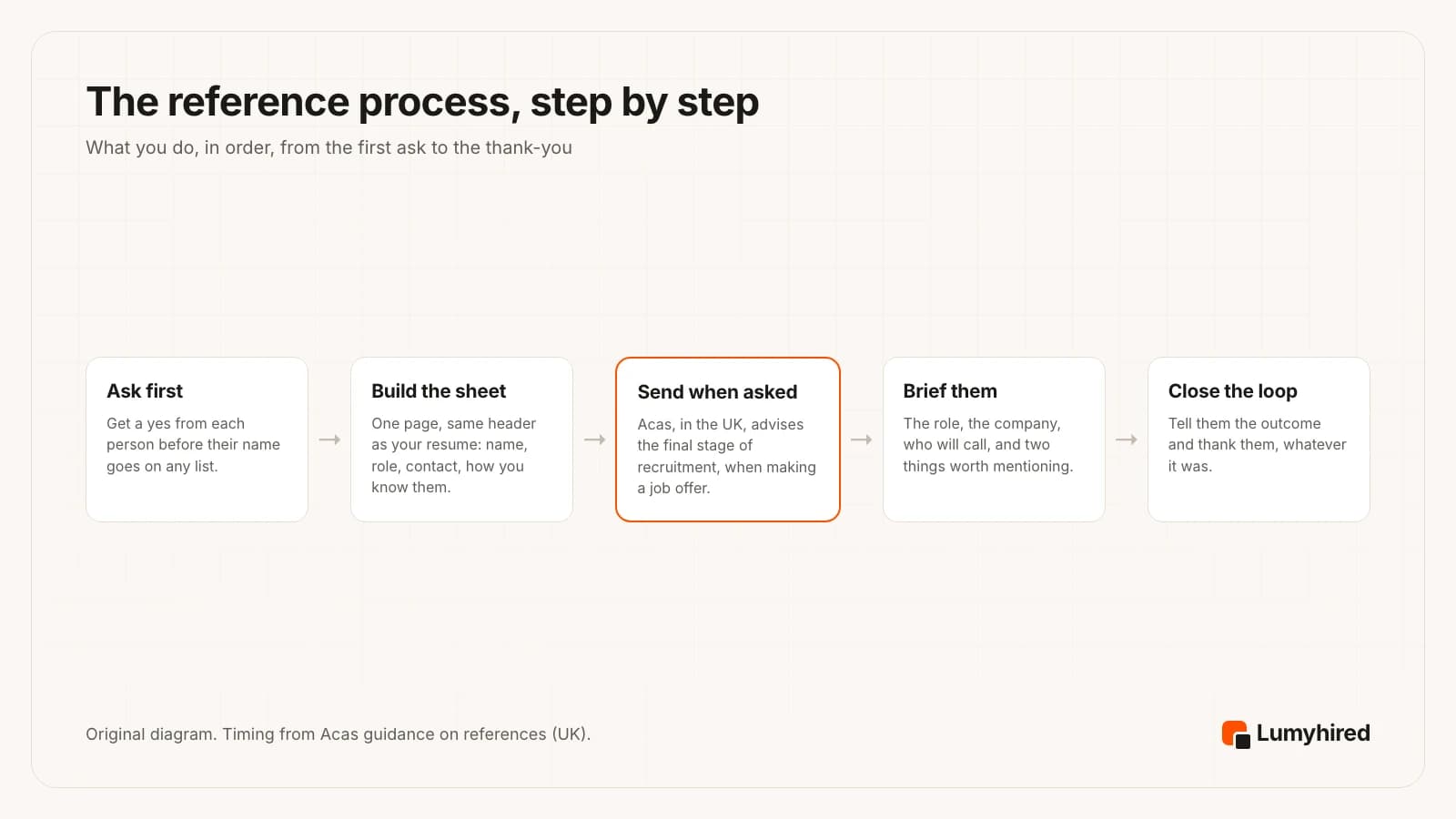
The page is one of five steps. The other four are the asking, sending it when asked, the briefing and the thank-you.
What do employers ask your references?
Mostly your strengths and weaknesses, then what you actually did. Confirming titles and dates comes third.
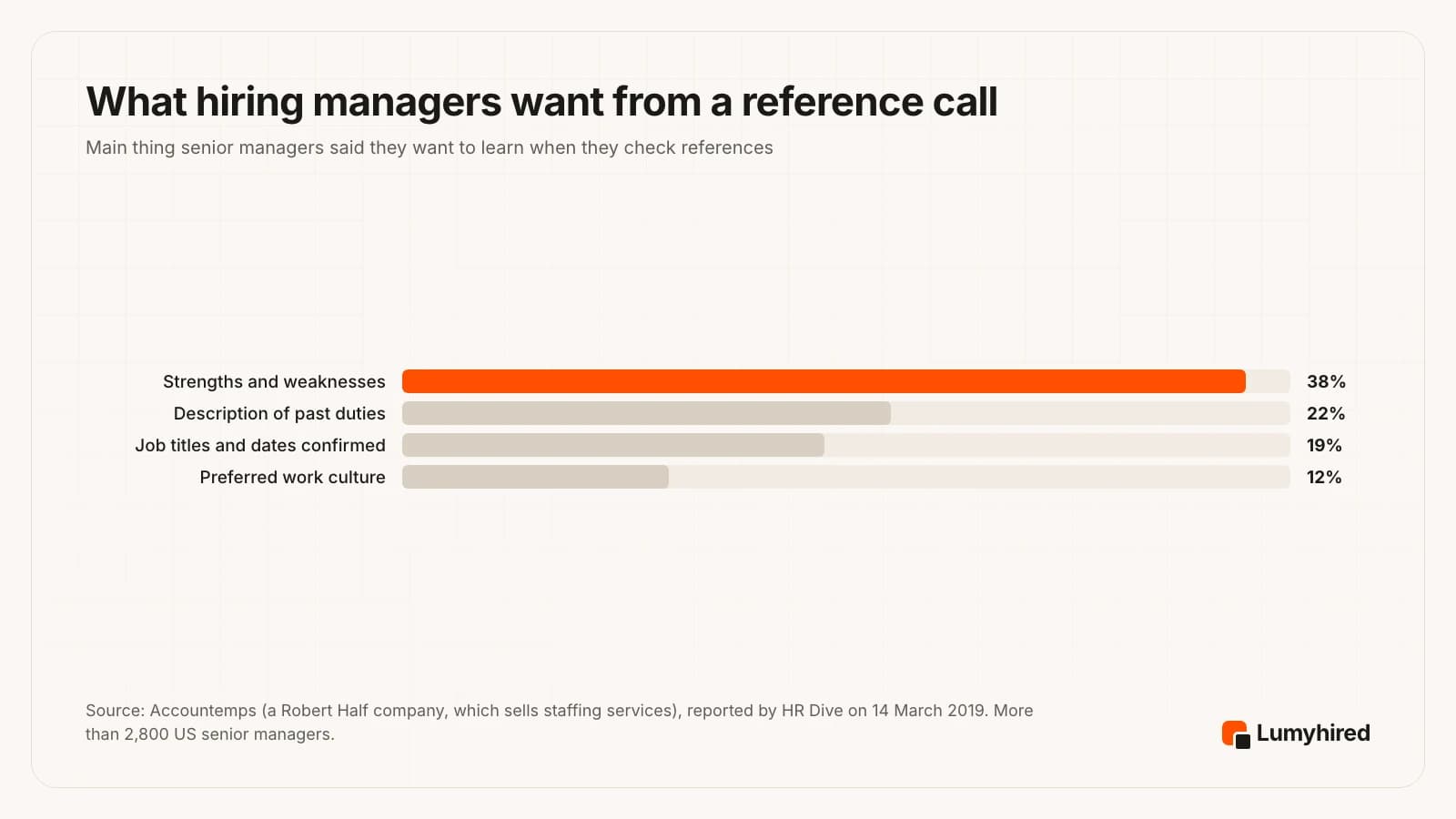
In the Accountemps survey reported by HR Dive, 38% of senior managers said what they most want from a reference is a view of the applicant’s strengths and weaknesses, 22% a description of past duties, 19% confirmation of job titles and dates of employment, and 12% insight into the work culture the applicant prefers.
Robert Half’s own guide for hiring managers lists the questions it recommends asking. Expect your referees to hear some version of these:
- What were the candidate’s main responsibilities?
- What are their strongest skills or qualities?
- What was their most significant accomplishment?
- What training could they benefit from?
- How do they handle constructive criticism?
- What are their weaknesses?
- Would you rehire them, and why?
- Is there anyone else I should speak to?
Two of these deserve preparation. Prepare the weakness question together: agree on a true and minor answer you have already worked on, the same one you would give in an interview. The rehire question is contested on the employer side: an HR consultant quoted by SHRM in 2018 advises employers not to ask or answer whether someone is eligible for rehire, because the answer may only reflect the referee’s personal feelings. Some referees will decline it.
The last question, “anyone else I should speak to?”, is how an employer reaches people you did not list. In France, the employer must tell you beforehand (see below).
What can a former employer say about you in the US?
Usually anything true, within limits set by each state. No federal law sets what an employer may say in a reference, though federal anti-discrimination law bars retaliatory references. The details depend on where you, your old employer and your new one are located. What follows is general information; for a specific case, ask an employment lawyer.
A 2018 SHRM article for employers, quoting employment lawyers, sets out the main points. Employers can usually be truthful, including about poor performance. Many states give employers qualified immunity for information provided in good faith, and that protection is lost when an employer knowingly or recklessly gives false or misleading information or acts with malice. The states differ in the details:
- Hawaii presumes good faith and protects job-related information, opinions included, unless the employer knew it was false.
- Arkansas requires the employee’s written consent and protects a defined list of information, such as dates of employment, pay, duties, the last performance evaluation and the reason for separation.
- Missouri applies its protection only to written answers to written requests, with a copy sent to the employee.
- New York and Massachusetts have no immunity statute, which a lawyer quoted by SHRM says makes giving references there harder.
Employers who say too much, or say it to the wrong person, can face defamation claims from the former employee or negligent referral claims from the new employer. That risk is why the lawyers quoted by SHRM recommend that one trained person handle all reference requests, in writing, with the former employee’s written permission.
Federal law also bars retaliation. The Equal Employment Opportunity Commission’s 2016 guidance on retaliation, citing the Supreme Court’s 1997 decision in Robinson v. Shell Oil, says Title VII protects former employees. Protected activity covers participating in an EEO process (a charge, testimony, an investigation) and opposing conduct made unlawful by EEO law. The guidance’s examples of retaliation against a former employee include giving an “unjustified, untruthful negative job reference”, refusing to provide a job reference, and telling a prospective employer about a prior EEO complaint. In one of its examples, a negative reference that gave honest assessments of the former employee’s job performance, in line with the employer’s usual practice, is not retaliation unless it is given because of the discrimination claim.
A second set of rules applies when the employer hires a screening company. Under the Fair Credit Reporting Act, as the Federal Trade Commission explains, a background report from a third party is a consumer report. The employer must give you a written notice in a stand-alone document and get your written permission before ordering it. If the report is an investigative consumer report, built from personal interviews about your character or reputation, the employer must also tell you so and give you the right to ask about its nature and scope. And before rejecting you because of a report, the employer must send you a copy along with a summary of your rights, so you can dispute errors.
How do references work in the UK?
An employer usually has no legal duty to give one, and any reference it gives must be fair and accurate. Acas, the public body that advises on employment in England, Scotland and Wales, sets out the rules. It also advises employers to ask for references at the final stage of the recruitment process, when making a job offer, to have a conditional offer and the applicant’s permission before approaching a current employer, and warns that the current employer might otherwise find out the applicant is applying for other jobs.
A reference is required only in a few cases: when the employer has promised one in writing, for example in the contract; for certain financial services jobs regulated by the Financial Conduct Authority or the Prudential Regulation Authority; and where one has been agreed, for example in a settlement agreement. Outside those cases, an employer can decline, and its policy can limit what is said and who says it.
Acas distinguishes three kinds. A basic work reference gives your job title and dates. A detailed one can add your skills, ability and experience, reasons for leaving, sickness or absence records, and disciplinary records when they are current. A character reference comes from someone who knows you and covers how long they have known you and your strengths. Whatever the kind, the reference must not be misleading, opinions should be supported by evidence, and Acas says a reference should not include details of reasonable adjustments for a disability, absences linked to disability, adoption, maternity or paternity leave, or disciplinary records unless recent and relevant.
Can you read what was written about you? Not if it was given in confidence. The Information Commissioner’s Office says confidential references given for employment are exempt from the right of access, whether you ask the employer who wrote the reference or the one who received it. The exemption covers only references given in confidence, and the ICO tells employers to say clearly, in a privacy notice or staff handbook, whether they treat references as confidential. In one of its examples, a purely factual HR reference that the worker already knew about could reasonably be disclosed.
If you apply in France, what does the law say about reference checks?
An employer in France may contact your references, but only after telling you it will, and only to assess your ability to do the job. Three articles of the Labour Code, all quoted in the CNIL’s recruitment guide, set the frame.
- Article L1221-6: information requested from a candidate, in any form, can only serve to assess their ability to do the job or their professional skills, and must have a direct and necessary link with the job.
- Article L1221-8: the candidate must be expressly informed, before they are used, of the recruitment methods and techniques applied to them. The results are confidential, and the methods must be relevant to their purpose.
- Article L1221-9: no personal information about a candidate may be collected through a method the candidate was not told about beforehand.
The CNIL’s recruitment guide, published on 30 January 2023, applies this to references directly. Collecting references from your professional circle (managers, colleagues, internship supervisors, clients, suppliers) is allowed once you have been informed beforehand. Because references are collected from a third party, the guide says the recruiter must inform you as soon as possible, at the latest within one month of collecting them. Your right of access covers data gathered from former employers, with the referees’ own rights protected; the guide gives removing the names of the people who made the comments as good practice. If you are not hired, the employer may keep your file for up to three months after the process ends. Beyond that it needs your consent, or must tell you and let you object easily, and the guide recommends no more than two years after the last contact.
France also has a document worth knowing about. At the end of any employment contract, the employer must give the employee a certificat de travail (article L1234-19). Its content is limited to factual mentions: article D1234-6 lists the start and end dates and the jobs held with their periods, and article L911-8 of the Social Security Code adds the continuation of health and provident cover. It carries no assessment of your work. The CNIL notes that this certificate is in principle enough to prove your experience, so a recruiter may ask for it, and that payslips, which hold salary, absence and bank details, should not be requested. Anything about the quality of your work therefore comes from a reference or a lettre de recommandation, a letter a former manager writes on request.
| United States | United Kingdom | France | |
|---|---|---|---|
| Main rules | State law on references; FCRA when a screening company is used | Acas guidance; UK GDPR and ICO guidance | Labour Code L1221-6 to L1221-9; GDPR and CNIL guide |
| Must a former employer give one? | No federal duty to give one; no federal law sets what it may say, beyond the ban on retaliation; protection varies by state | Usually not, except by contract, FCA or PRA roles, or agreement | Certificat de travail is mandatory, factual mentions only |
| Are you told before checks? | Yes, in writing, when a screening company is used | Acas advises asking at the final stage, with your permission | Yes, the law requires prior notice (L1221-9) |
| Can you see what was said? | You get a copy of a screening report before a rejection based on it | Not if it was given in confidence | Yes, through the right of access; referees’ names may be removed |
In practice, for a job in France, give your references when asked, say which people the recruiter may contact, and keep your certificats de travail and any recommendation letters in one folder so you can send them the same day.
What if you have no references, or fear a bad one?
Most people who have worked, studied or volunteered have someone who saw them do it. Start there, and plan around the person you would rather the employer did not call.
- No work experience. A professor whose course you did well in, an internship supervisor, the manager of a part-time job, a volunteer coordinator, a coach. What matters is that they saw you deliver something and can say so. If you are at that stage, the job search tools for new graduates guide covers where to look for that first role.
- A former employer that only confirms dates. That is usually company policy: lawyers quoted by SHRM advise employers to route every request through one person in HR. Add a former colleague or client who can talk about the work itself.
- A gap in your work history. A reference from the period before the gap, plus one from whatever you did during it (a course, freelance work, caring), covers both sides. How to talk about the gap itself is in explaining a career gap.
- A manager you parted badly with. Do not list them, and have two strong names ready. If the employer insists on that company, offer the HR contact for a factual confirmation and a senior colleague from the same team for the substance.
Do not invent one: 29% of employers in the CareerBuilder survey had caught a fake reference on an application.
If a reference was unfair, your options depend on where you are. In the UK, Acas says a reference must be fair and accurate, with opinions backed by evidence. In France, your right of access covers what referees said about you. In the US, the remedies depend on the state.
How do you keep track of references during a job search?
Write down, for each application, who you gave and when you warned them. Over a long search, the same three people can be called by several employers, and each call goes better when the referee knew it was coming.
Add three columns to whatever you use to follow your applications: referees given, date of the heads-up email, date of the thank-you. The job application tracker template has the columns for stage and follow-up dates already, and the three reference columns fit next to them. Rotate referees when you can, using the one who best fits each job.
For the pay conversation that follows an offer, see how to negotiate salary.
Frequently asked questions
Should I put references on my resume?
Should I write “references available upon request” on my resume?
How many references should I have?
Who should not be a reference?
Can a coworker be a reference?
Do employers actually call references?
Can a recruiter call my former employer?
What can a former employer legally say about me?
What is the difference between a reference and a letter of recommendation?
Get to the reference stage first
Before anyone calls your references, your resume has to get you through screening. Run yours through the ATS preview, free and with no account, to see what a parser extracts. Lumyhired then tailors your master resume to each posting, ranks jobs by match score and tracks every application on a kanban board, with interview reminders and AI interview preparation. Compare a resume to a specific posting with the ATS resume checker. Weekly plans start at €5 on the pricing page, with a 3-day money-back window and no free plan.
Sources
Surveys run by companies that sell hiring services are marked as such. The widely repeated claim that 87% of employers check references, attributed to SHRM, was left out because no SHRM study behind it could be found; SHRM’s reference checking toolkit is reserved for members and could not be read. Legal sources are summarised for general information. Read 14 October 2026.
- CareerBuilder survey conducted by Harris Interactive, reported by UPI, 28 November 2012 (2,494 hiring managers and HR professionals, 3,976 workers; CareerBuilder sells hiring services)
- Robert Half, Here’s How to Check References, undated, read 14 October 2026 (survey of 2,800 US senior managers; Robert Half sells staffing and recruitment services)
- HR Dive, Managers rule out a third of candidates after reference checks, 14 March 2019 (Accountemps survey, more than 2,800 US senior managers; Accountemps is a Robert Half company)
- SHRM, Lisa Nagele-Piazza, Can Employers Give a Bad Reference for a Former Employee?, 28 February 2018
- US Equal Employment Opportunity Commission, Enforcement Guidance on Retaliation and Related Issues, 25 August 2016 (cites Robinson v. Shell Oil, 1997)
- US Federal Trade Commission, Using Consumer Reports: What Employers Need to Know, October 2016
- Acas, Job references: when an employer must give a reference, including “When to ask for a reference”, updated 1 October 2026
- Acas, What employers can say in a reference, updated 1 October 2026
- UK Information Commissioner’s Office, Subject access request Q&As for employers, read 14 October 2026
- Légifrance, French Labour Code, article L1221-6, in force since 1 May 2008
- Légifrance, French Labour Code, article L1221-8, in force since 1 May 2008
- Légifrance, French Labour Code, article L1221-9, in force since 1 May 2008
- Légifrance, French Labour Code, article L1234-19 (duty to issue a certificat de travail), in force since 1 May 2008
- Légifrance, French Labour Code, article D1234-6 (content of the certificat de travail), in force since 1 January 2015
- Légifrance, French Social Security Code, article L911-8 (continued cover noted on the certificat de travail), in force since 17 June 2013
- CNIL, Guide Recrutement, 30 January 2023 (fiches 5, 7, 8 and 9; quotes Labour Code articles L1221-6 to L1221-9)
Read next
- How to Get a Job in 2026: A Data-Backed Guide
The 2026 job market in numbers (11.4 weeks median unemployment, 244 applications per job, 108 days to an offer), an 8-step method and a realistic 30-day plan.
- How to Negotiate Salary in 2026
EU pay transparency was due in national law by 7 June 2026. What is in force where you apply, what the research on first offers shows, and the stats we rejected.
- Explaining a Career Gap
What field experiments show about gaps, the resume line and interview answer for each reason, what you never have to disclose, and the LinkedIn career break section.
- Why You're Not Getting Interviews in 2026
Diagnose it by symptom: no replies, rejections within minutes, screens with no interviews, interviews with no offers, or silence. A 10-minute test for each.