
Career Guides
Why am I not getting interviews? Diagnose it by symptom
Updated 15 September 2026. Most advice on this question is a list of fourteen reasons with no way to tell which one is yours. This page works the other way round: name the symptom, find the stage that fails, run a test that takes ten minutes, then fix that stage and nothing else.
Why am I not getting interviews?
Because one specific stage is failing, and the symptom tells you which. No reply at all usually means the resume does not extract cleanly or the roles were picked badly. Rejection within minutes means a knockout question or a hard filter on the form. Recruiter screens that stop there point at the pitch and the pay range, since Ashby measured about 35% passing that stage in 2026. The market is harder than it was: Greenhouse counted 244 applications per job in 2025 against about 115 in 2022, Gem found 8% of applicants get past the first screen and 0.5% receive an offer, and Huntr put the median time to a first offer at 108 days in Q1 2026.
Figures read on 15 September 2026 from Greenhouse (May 2026), Gem (December 2025), Ashby (2026) and Huntr (Q1 2026). Gem and Greenhouse measure employer-side data, Huntr measures its own users.
Start with the symptom
Five symptoms cover almost every case, and each one points at a different stage. Getting no answer at all is a different failure from being rejected in four minutes, and both are different from screens that never become interviews. Advice aimed at the wrong stage costs weeks.
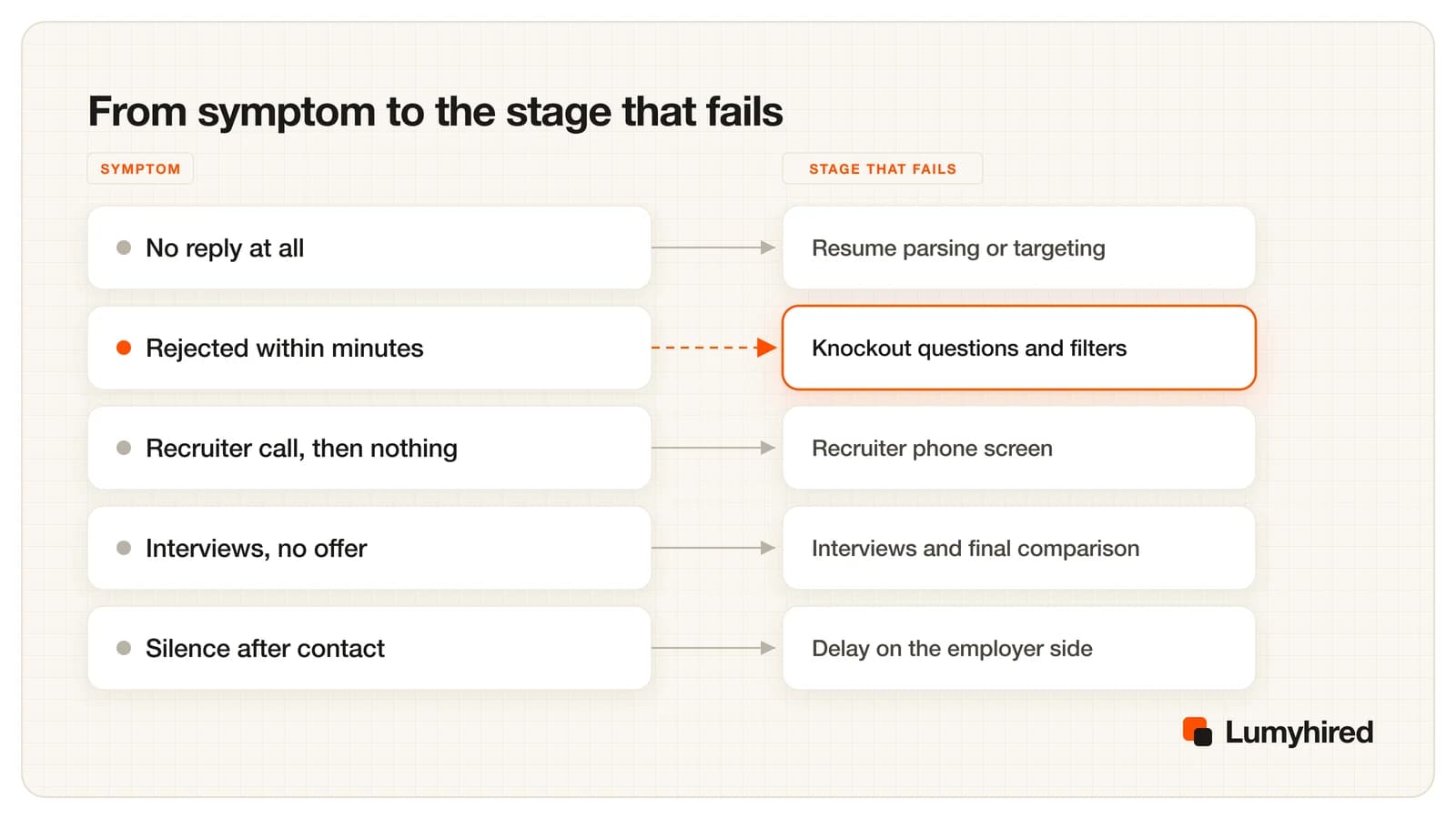
| Symptom | Stage that fails | 10-minute test | Fix |
|---|---|---|---|
| No reply at all, dozens of applications in | Resume parsing, or the roles you picked | Paste the file into an extraction preview and read what comes back. Then compare your resume title line with the title on five recent postings. | Repair the layout until contact details, section headings and dates all survive extraction, then tailor the title and summary per posting. |
| Rejection lands within minutes or hours | Knockout questions and hard filters on the application form | Reopen the form for a role you were rejected for and reread your own answers on work authorisation, location, notice period, years of experience and pay. | Answer the form fields the way your situation actually qualifies, and drop postings where a field rules you out before anyone reads a word. |
| Recruiter screens happen, interviews do not follow | The recruiter screen, where about 35% move on (Ashby, 2026) | Record your 60-second answer to the opening question and check it against the three requirements at the top of the posting. | Rebuild the pitch around those three requirements, and settle your pay range and notice period before the call rather than during it. |
| Interviews happen, offers do not | Later rounds and the final comparison | After each round, write down the question you answered worst while it is fresh, and the one fact the interviewer kept returning to. | Prepare two or three worked examples with numbers in them, and ask the recruiter directly what the panel wanted more of. |
| Silence after a real conversation | The employer pipeline, or a posting that was never live | Check the posting age and whether it has been reposted, and look at your own tracker for how long silence has lasted. | Follow up once, then treat it as open rather than closed and keep the weekly application count steady. |
How much of this is the 2026 market?
Some of it is, and knowing how much keeps you from rewriting a resume that was already fine. Greenhouse counted 244 applications per job in 2025, up 111% from about 115 in 2022, across 6,000+ companies and more than 640 million applications. Ashby reported more than 300 applications per hire in May 2026, three times the 2021 level, and estimated candidates are about 50% less likely to reach an interview than five years ago. The base rate moved, so a reply rate that would have been poor in 2021 can be ordinary now.
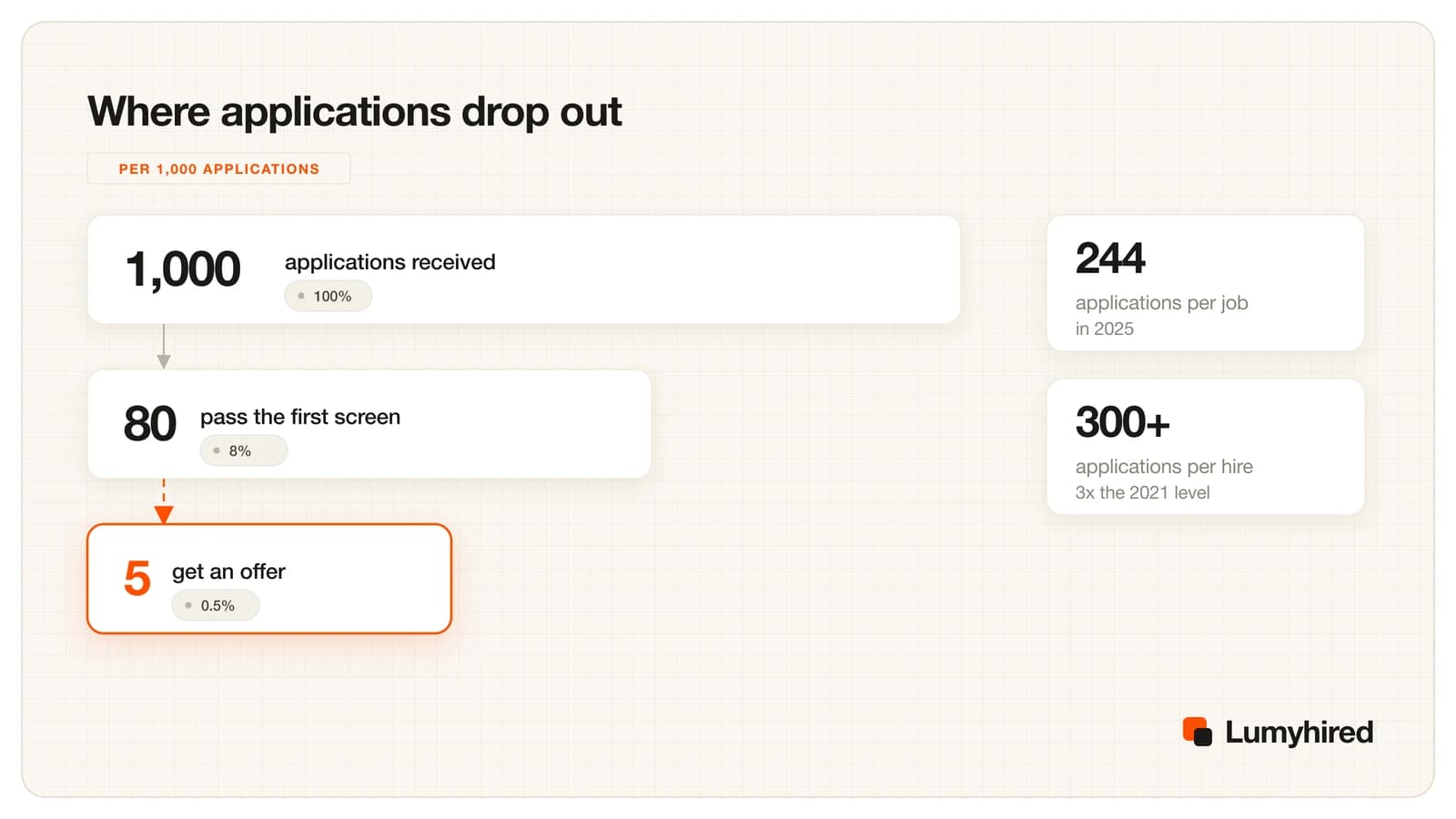
What the market does not explain is a reply rate of zero. Gem’s 8% first-screen pass rate is an average across a very large pool, so a run of fifty applications with no first conversation is unusual enough to investigate rather than absorb. The rest of this page is the investigation.
| Figure | Source and date | Sample |
|---|---|---|
| 244 applications per job in 2025, up 111% from about 115 in 2022 | Greenhouse Hiring Benchmarks, May 2026 | 6,000+ companies, 640M+ applications |
| More than 300 applications per hire, three times the 2021 level, and candidates about 50% less likely to reach an interview than five years ago | Ashby, press release, 7 May 2026 | 100M+ applications, 200K+ jobs |
| 8% of applicants get past the first screen, 0.5% receive an offer, about one hire per 200 applications | Gem 2026 Recruiting Benchmarks, December 2025 | 165M+ applications, 1.2M hires, June 2021 to May 2025 |
| 9.25% interview rate per application for job seekers who sent 11 to 20 applications, against 2.58% for those who sent 100 or more | Huntr Q1 2026 report | 139,927 applications from 25,635 job seekers |
| Median time from starting a search to a first offer: 108 days, up from 83 days in Q4 2025 | Huntr Q1 2026 report | same dataset, plus a 593-person survey |
Symptom 1: applied to 100 jobs, no responses at all
Zero is the one number that is almost never a market effect. Two causes produce it. The first is extraction: an applicant tracking system reads text out of your file before a person sees anything, and two-column layouts, headers, text boxes and tables can scramble or drop what they hold. Your record then looks empty when a recruiter searches, and nothing tells you it happened. The second is targeting: you are applying to roles whose title, level or location does not match what your resume evidences.
The 10-minute test. Paste your resume into the ATS extraction preview and read the text it returns. Check four things: your email and phone survived, the section headings are recognisable, the dates sit next to the right employers, and your job titles are not interleaved with your skills. Then open five postings you applied to and write your resume title line beside each posting title. If your line says Customer Success Lead, APAC and every posting says Account Manager, the search that a recruiter runs will not return you.
The fix. Repair the layout first, because everything else depends on it, then tailor the title and the summary per posting. Huntr recorded 4.23% interviews per application on tailored resumes in Q1 2026 against 2.07% on untailored ones, from 139,927 applications. The mechanics of both steps are covered in how to pass ATS filters and where resume keywords come from.
Volume belongs at the end of the list. Huntr’s Q1 2026 data has job seekers who sent 11 to 20 applications interviewing at 9.25% per application, and those past 100 at 2.58%. That is a correlation, since the two groups differ in more ways than volume, but it does say that sending more untested applications is a weak answer. The arithmetic of how many to send is in how many jobs to apply to.
Symptom 2: rejected within minutes of applying
A rejection that arrives in four minutes was decided by the form. Employers can attach knockout questions to an application (work authorisation, willingness to relocate, minimum years of experience, a pay figure, a required licence) and set an answer to end the application on the spot. Hard filters do the same job more quietly: a location radius, a salary ceiling, a degree requirement. In the Harvard Business School and Accenture Hidden Workers research, more than 90% of employers said they use their recruiting software to filter or rank candidates at first screening, and 88% agreed that qualified high-skills candidates are screened out because they do not match the exact criteria in the job description. For middle-skills roles the figure was 94%.
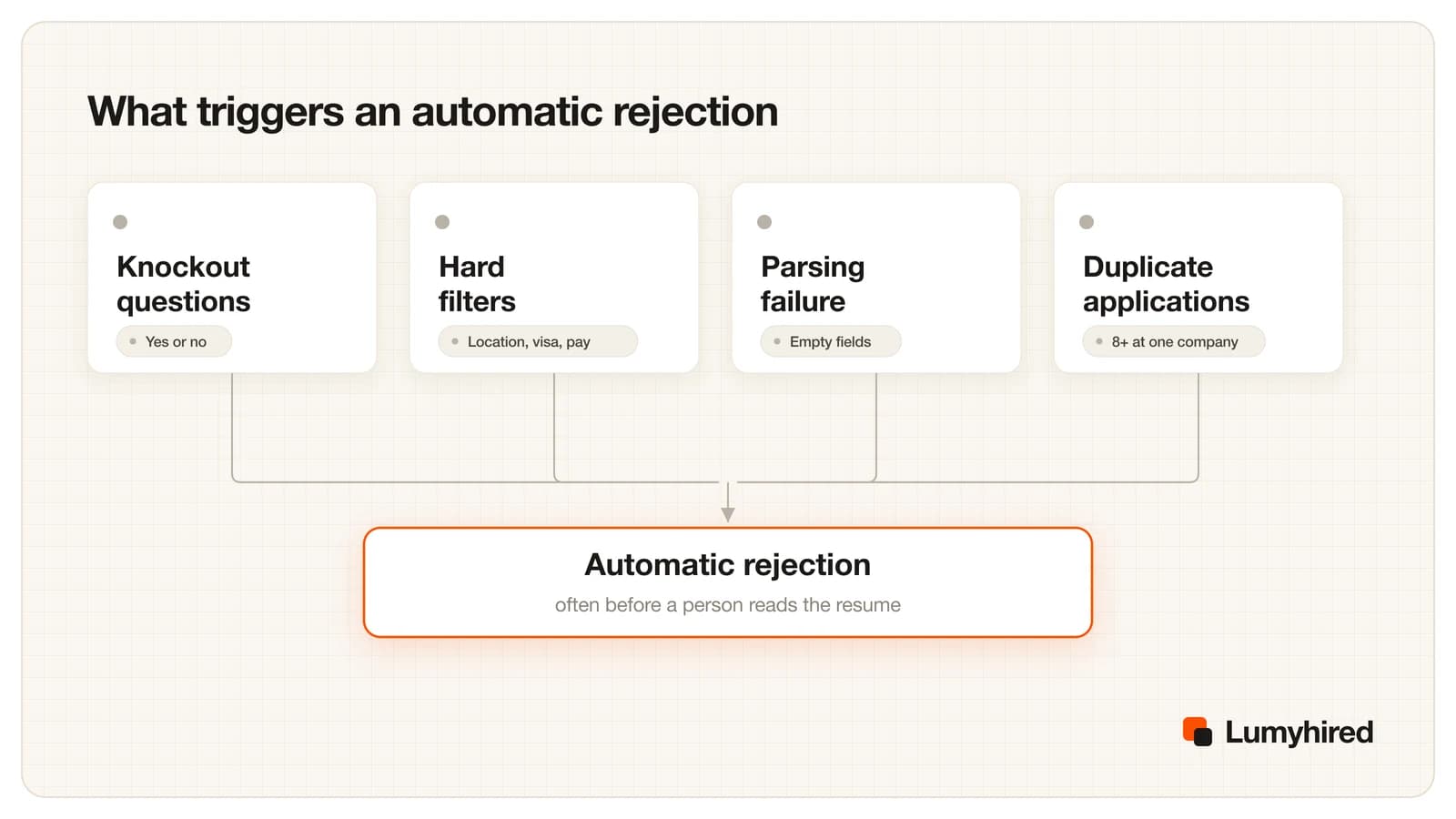
The 10-minute test. Reopen the application form for a role that rejected you quickly and reread your own answers. People fail these fields by being careless rather than unqualified: a notice period entered in weeks where the form wanted a date, a salary box filled with a stretch number, a relocation question answered no because the role looked remote. Then look at your tracker and count applications per company. Huntr measured 6.07% interviews per application for people who applied once at a company in Q1 2026, and 1.91% for those who sent eight or more.
The fix. Answer the fields as your situation actually qualifies, and stop applying where a field rules you out: a role requiring authorisation you do not hold is a no before anyone reads a word. Choosing postings you can pass is the subject of targeting the right jobs. If the filter you keep failing is a gap in your history, HBS found 48% of employers filtering out middle-skills candidates and 43% filtering out high-skills candidates for a resume gap, which is worth pre-empting the way explaining an employment gap sets out.
Does the ATS reject most resumes automatically?
The claim that applicant tracking systems reject 75% of resumes, or that 80% never reach a human, has been repeated for years without a study behind it. We could not trace either number to a published method or sample, so neither belongs in a diagnosis. The evidence that does hold up is the HBS Hidden Workers survey above: filtering is real, it is configured by employers, and it works on exact criteria rather than on an overall score.
The practical difference matters. If software scored your resume, you would need a better score. Since an employer set a filter, you need to match the criterion, or to stop applying to postings where you cannot. And the failure that costs most is not a filter at all: it is text that never made it out of your file, which is why the extraction check comes before everything else.
Symptom 3: recruiter screens, then nothing
Getting the call means your resume worked. The screen is a different test, and it is the narrowest stage of the process: Ashby’s 2026 operations benchmarks put pass-through at early stages such as recruiter screens at about 35%, from 54 million applications and 93,000 jobs. Three things end screens. Your pitch answers a question the posting did not ask. Your pay expectation lands outside the band. Your availability or location turns out to be more complicated than the form suggested.
The 10-minute test. Record your answer to the opening question on your phone, keep it to 60 seconds, and play it back against the top three requirements in the posting. Count how many of the three you actually touched. Most recordings cover a career history and none of the three.
The fix. Rewrite the pitch as three claims, one per requirement, each with a number or a named outcome attached, and decide your pay range and notice period before the call. The same requirement-by-requirement reading is how tailoring works on paper, covered in tailoring a resume to a job description. One more lever at this stage: Ashby found 52% of referred candidates pass the first screen against 35% overall, and Gem put referral conversion at 11 times the inbound rate.
Symptom 4: interviews but no offers
At this stage you are being compared, no longer screened. Gem’s benchmarks have 8% of applicants passing the first screen and 0.5% receiving an offer, with interviews per hire up 33% since 2021, so later rounds now involve more people and more of them are close on paper. Losing at this stage means someone answered the same questions with more specific evidence.
The 10-minute test. Within an hour of each round, write two lines: the question you answered worst, and the topic the interviewer returned to twice. After three interviews the pattern is usually obvious, and it is usually the same missing example.
The fix. Build two or three worked examples that carry numbers, dates and your own decisions, and reuse them. Then ask the recruiter what the panel wanted more of, once, in one sentence. A rejection is the cheapest feedback available in a process where most candidates get none.
Symptom 5: silence, ghosting and postings that were never real
Silence is a stage of its own in 2026, and some of it has nothing to do with you. Greenhouse surveyed 2,950 job seekers in the US, UK, Germany, Australia and Ireland in May 2026: among candidates who completed an AI interview, 28% moved forward, 13% were formally rejected, and 51% never heard back. In Greenhouse’s July 2025 workforce survey of 2,200 people, 63% said they had been left without news after interviews. And in Huntr’s Q1 2026 survey, 520 of 559 respondents (93%) said they had applied to a posting they believed was fake or never meant to be filled, or suspected it.
The 10-minute test. Before tailoring anything, check the posting: how old it is, whether the same text has been reposted every few weeks, whether the company careers page carries it at all. Then check your own clock. Ashby found candidates who never get an interview are archived in a median of about six days, while interviewed candidates average 21 days, so two weeks of silence after an application is usually a decision that nobody sent.
The fix. Follow up once, a week after applying and a week after an interview, then let it sit and keep your weekly count steady. Spending the freed time on referrals pays better than spending it on follow-ups, given the referral numbers above.
A two-week plan to test the diagnosis
Diagnosis only helps if you change one variable at a time. Two weeks is enough to see whether the first conversation rate moves, and it is short enough to keep.
- Day 1. Run the extraction check and fix whatever did not survive it. Nothing else matters until contact details, headings and dates come back intact.
- Days 2 to 5. Send 8 to 10 applications, one per company, each with the title line and summary rewritten against the posting. Log the date, the company, the title you used and the form fields that gave you pause.
- Days 6 to 10. Add two referral attempts. A referred application passes the first screen at 52% against 35% overall in Ashby’s data, which is worth more than ten extra cold applications.
- Days 11 to 14. Count first responses instead of applications. One or two first conversations from ten targeted applications is a working pipeline at 2026 rates. Zero, with clean extraction and honest targeting, points at the roles you are choosing rather than the documents.
If you would rather run this as a standing system than as a fortnight of effort, the guide to getting a job in 2026 covers the tracking side.
Frequently asked questions
I applied to 100 jobs and got no interviews. What now?
Why do I get rejected within minutes of applying?
Does an ATS really reject 75% of resumes?
Why am I not getting interviews with plenty of experience?
How long should I wait before assuming it is a no?
Could the postings themselves be fake?
Does applying several times to the same company help?
Did an AI interview end my application?
Sources
- Huntr, Job Search Trends Q1 2026. 139,927 applications from 25,635 job seekers, plus a 593-person survey.
- Gem, key takeaways from the 2026 Recruiting Benchmarks report, December 2025. 165M+ applications, 1.2M hires.
- Greenhouse, Hiring Benchmarks, May 2026, with coverage by RecTech Media, 9 May 2026.
- Ashby, Recruiting Operations Benchmarks, 2026. 54M+ applications, 93K jobs, January 2021 to March 2026.
- Ashby, press release on application volume, 7 May 2026.
- Greenhouse, AI interview survey, 1 May 2026. 2,950 job seekers in the US, UK, Germany, Australia and Ireland.
- Greenhouse, 2025 Workforce and Hiring Report, 17 July 2025. 2,200 respondents.
- Harvard Business School and Accenture, Hidden Workers: Untapped Talent, September 2021. 8,720 workers and 2,275 executives in the US, UK and Germany.
Running the diagnosis with Lumyhired
The first two tests on this page are what Lumyhired was built for. The ATS extraction preview shows the text a parser pulls out of your file, so a silent extraction failure takes two minutes to rule out rather than fifty applications. The ATS resume checker scores that extraction against a specific posting, per-job tailoring rewrites the title line and summary against the posting you picked, and the tracker keeps applications per company visible so you notice the eighth one at the same employer. Weekly plans start at €5 on the pricing page, with a 3-day money-back window and cancellation at any time.
Read next
- How to Pass ATS Filters in 2026
What Greenhouse, Workday, Teamtailor, Lever and iCIMS say their software does to your resume, the one mechanism that rejects automatically, and where the 75% myth came from.
- How Many Jobs Should You Apply To?
The math behind the number: 0.5% of applications become offers, tailoring roughly doubles interview rates, and a weekly plan for each situation.
- How to Target the Right Job Postings in 2026
A tailored application costs an hour. The three blocks of a posting, the 60% rule that has no source, and what a posting's age actually changes.
- How to Negotiate Salary in 2026
EU pay transparency was due in national law by 7 June 2026. What is in force where you apply, what the research on first offers shows, and the stats we rejected.
- AI Adoption in Job Search: What Actually Changed in 2026
The 2026 numbers on AI in hiring: how many candidates and recruiters use it, for what, AI interviews, bias evidence, and the rules arriving through December 2027.