
AI Tools
Best AI cover letter generator in 2026: eight tools ranked
Eight generators ranked on five criteria stated up front, with every price and free allowance read on the vendor's own page on 17 September 2026. Before the ranking: what the data says about whether a letter still changes callbacks, what an AI-assisted letter needs to contain, and a prompt you can use with any of them that ends with a fact check.
What is the best AI cover letter generator in 2026?
Our pick is Lumyhired. It writes each letter from your resume and the specific posting, in English or French, uses only metrics already on your resume, and saves the letter with the tailored resume for that job in your application tracker, next to jobs found across 10 boards. Weekly plans start at €5 with a 3-day money-back guarantee; there is no free plan. For a free route, Claude or ChatGPT used directly with a strict prompt reads the full posting and resume you paste. Teal gives 2 free AI letters, and Kickresume is free for verified students. A letter still matters: in ResumeGo's 2019-20 field experiment, tailored letters drew a 16.4% callback rate against 10.7% for no letter.
Lumyhired publishes this page.
Prices and plans read on vendor pages on 17 September 2026. Page updated 17 September 2026.
Do cover letters still matter in 2026?
Fewer employers ask for one, and the ones that read them read them differently than before AI. Both halves of that sentence have data behind them.
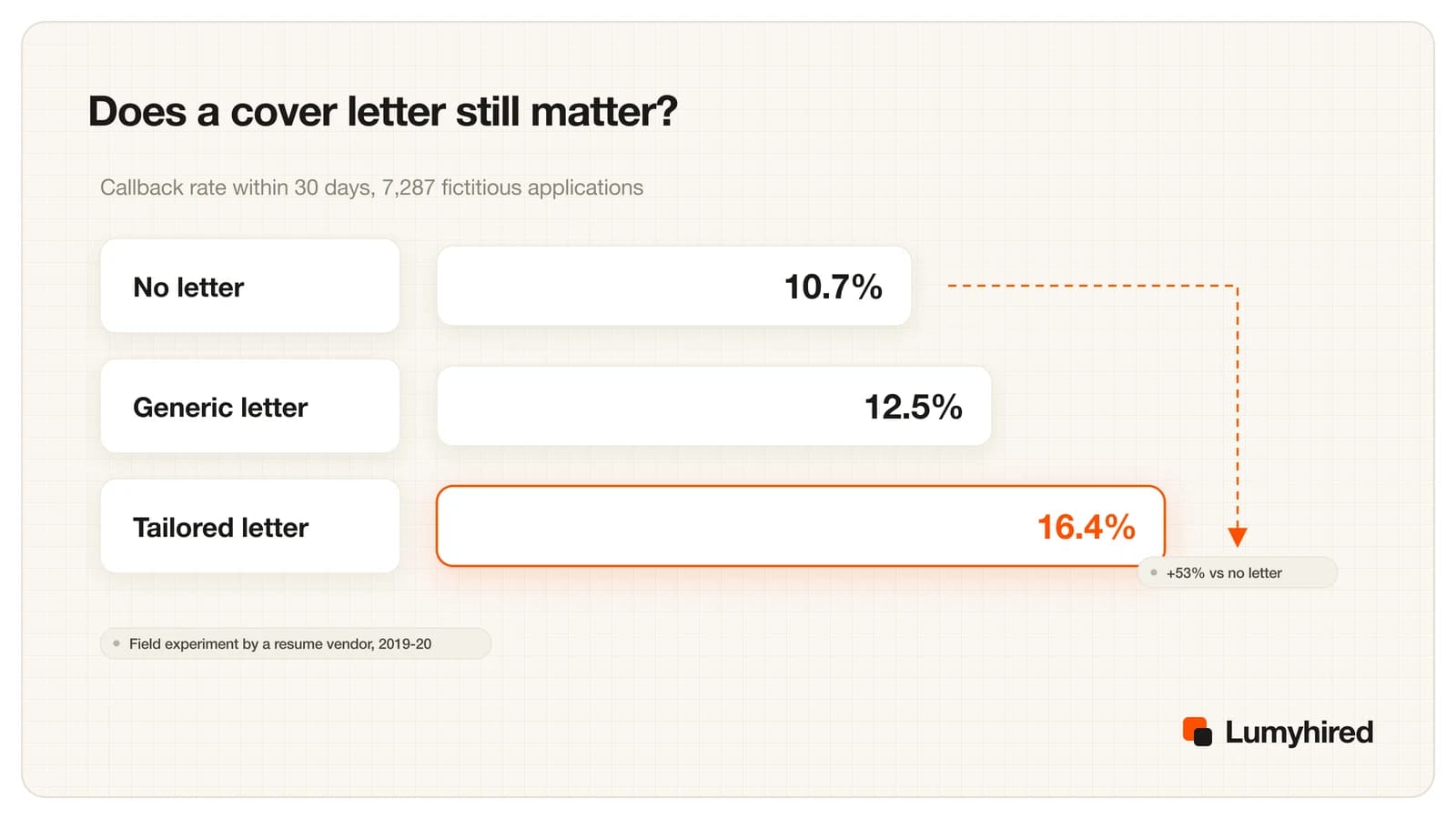
The most cited controlled test is old and comes from a vendor. ResumeGo, a resume writing company, sent 7,287 fictitious applications through ZipRecruiter, Glassdoor and Indeed between July 2019 and January 2020 and counted callbacks within 30 days. Applications with a letter tailored to the job got called back 16.4% of the time, generic letters 12.5%, and no letter 10.7%. That is 53% more callbacks for a tailored letter than for none. The study was not peer reviewed and predates generative AI, when a tailored letter still took real effort to write.
On the employer side, the best recent count comes from France. APEC surveyed 1,150 companies that hired at least one manager or professional in 2025: half asked candidates for a cover letter at least once, against nearly 70% up to 2021, and the share has held at 50% for three years. It varies by sector, from 40% in retail and trade to 62% in services and 79% in health, social work and training. Phone pre-screens are now more common than letters, at 71%.
So a letter is optional more often than it used to be, and still requested by half of employers in that survey. When a posting asks for one, skipping it is a choice the recruiter sees. When it does not, a short, specific letter built with the method below is still cheap to add. If your applications get no replies at all, the letter is rarely the first thing to fix; the diagnosis in why you are not getting interviews separates targeting, resume and volume problems.
Can employers tell if a cover letter is AI?
Nobody has published a measure of how often recruiters correctly spot an AI-written letter. The better evidence is about what employers do once most letters are machine-polished.
Jingyi Cui, Gabriel Dias and Justin Ye studied a large online labor platform that added an AI cover letter tool (working paper, first posted September 2025, revised November 2025). Access to the tool made letters match job posts more closely and raised callback rates. But after launch, the correlation between how well a letter matched the post and whether it got a callback fell by 51%, and employers shifted weight toward candidates' prior work history. Time spent editing the AI draft was positively correlated with getting hired. The platform hires freelancers, so the result may not transfer exactly to salaried hiring.
Candidates have moved faster than any detector. In APEC's March 2026 survey of 2,000 French professionals, 31% of those who had recently job hunted had used generative AI, up from 15% in December 2024, and 77% of those users used it for cover letters, ahead of the CV at 70%. On the hiring side, 86% of US hiring managers in an Express Employment Professionals and Harris Poll survey (1,002 respondents, November 2025) said AI makes it too easy to exaggerate skills on a resume.
The practical read: a recruiter does not need a detector to discount a letter that could be sent to any company. What still carries signal is what the Cui study says employers turned to, which is verifiable history. A letter that names one real result from your resume points the reader at exactly that. Our roundup of AI adoption on both sides of hiring covers the wider numbers.
What a good AI-assisted cover letter needs
Three things, and a generator can only supply the wording around them. The raw material has to come from you and from the posting.
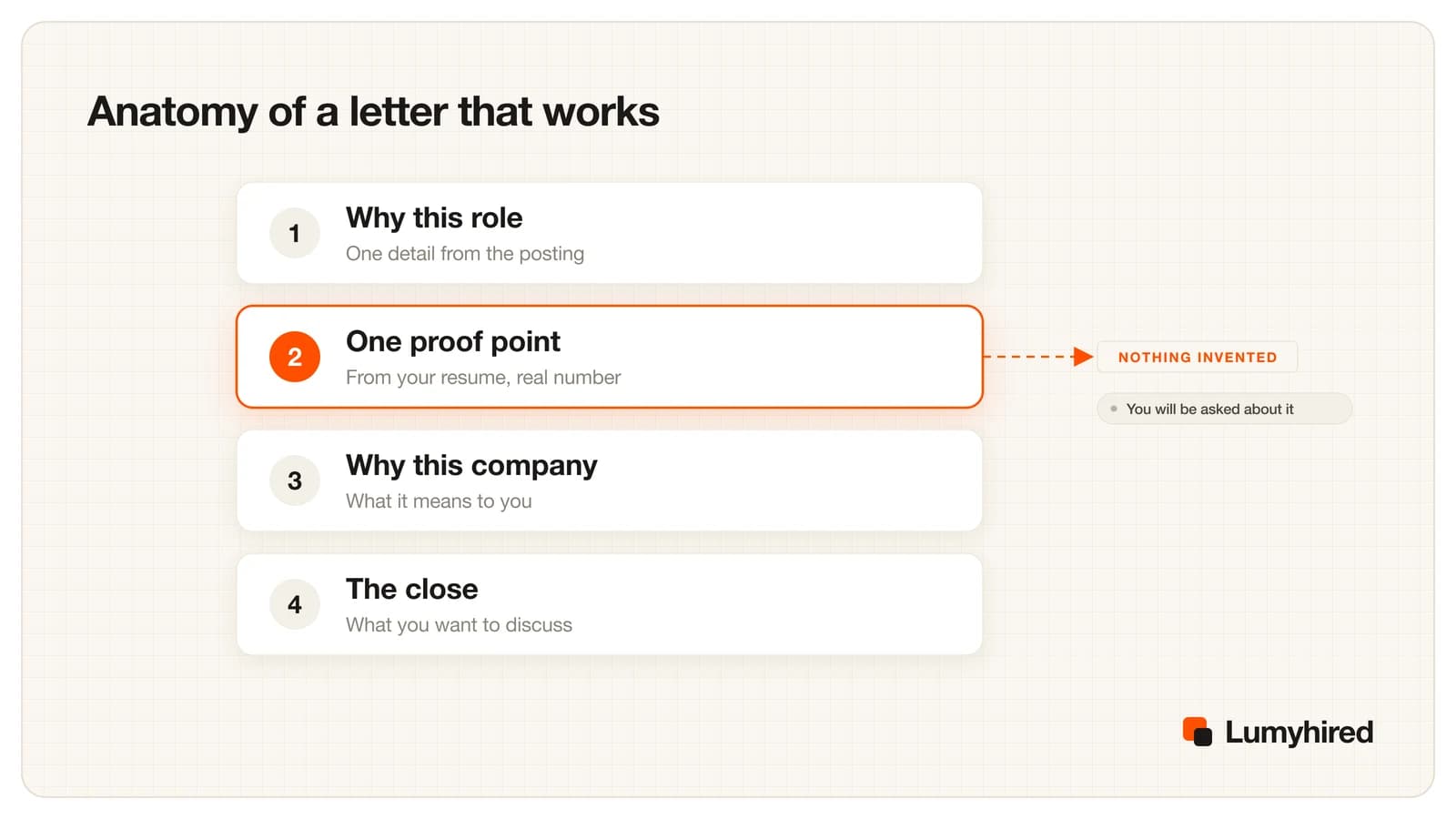
- A reason tied to this posting. One detail from the job ad, such as a problem it names, a product or a team, and why it matters to you. If the sentence would still be true with another company's name in it, replace it.
- One proof point from your resume. A single result with its real number, or its real scope if there is no number, that answers the posting's main requirement. The same terms you pull out for resume keywords tell you which requirement to answer.
- No invented numbers. An AI will happily write "increased retention by 30%". If it is not on your resume, it becomes an interview question you cannot answer, and the reader can check your history against it.
Before and after: one paragraph
Fictional example. The candidate, companies, posting and numbers are invented for illustration.
Before: generic AI draft
I am excited to apply for the Customer Success Manager position at your innovative company. With my strong communication skills and passion for customer satisfaction, I am confident I would be a valuable asset to your team, and I have a proven record of increasing retention by 30%.
After: posting plus resume, checked
Your posting says most churn happens in a customer's first 60 days. At Northwind Freight I ran onboarding for 40 mid-size accounts and rebuilt the kickoff call around the three reports those clients asked for most. The next year, 36 of the 40 renewed, up from 31. I would like to hear how onboarding is split between your product and your success team.
The first version has no detail from the posting and a 30% figure that appears nowhere on the resume. The second uses one line of the ad, one result that is on the resume (31 to 36 renewals out of 40), and a closing question that only makes sense for this company. The same discipline applies to the resume itself, covered with worked examples in how to tailor your resume to a job description.
An AI cover letter prompt with a verification step
This works in Claude, ChatGPT, Mistral's Le Chat or any tool that accepts free text. The last rule is the one most prompts leave out: it makes the model show where each claim came from, so checking takes a minute.
Draft a cover letter using only the material below.

JOB POSTING:
[paste the full posting]

MY RESUME:
[paste your resume as plain text]

RULES
1. Open with one specific detail from the posting and why it matters to me.
2. Use one proof point from my resume that answers the posting's main requirement.
   Keep its number exactly as written. If there is no number, describe scope instead.
3. Do not add employers, tools, job titles, dates or results that are not in my resume.
4. At most four short paragraphs. Do not open with "I am writing to express my interest".
5. After the letter, list every factual claim you made and quote the resume line it
   came from. Mark any claim without a source line as UNSUPPORTED.
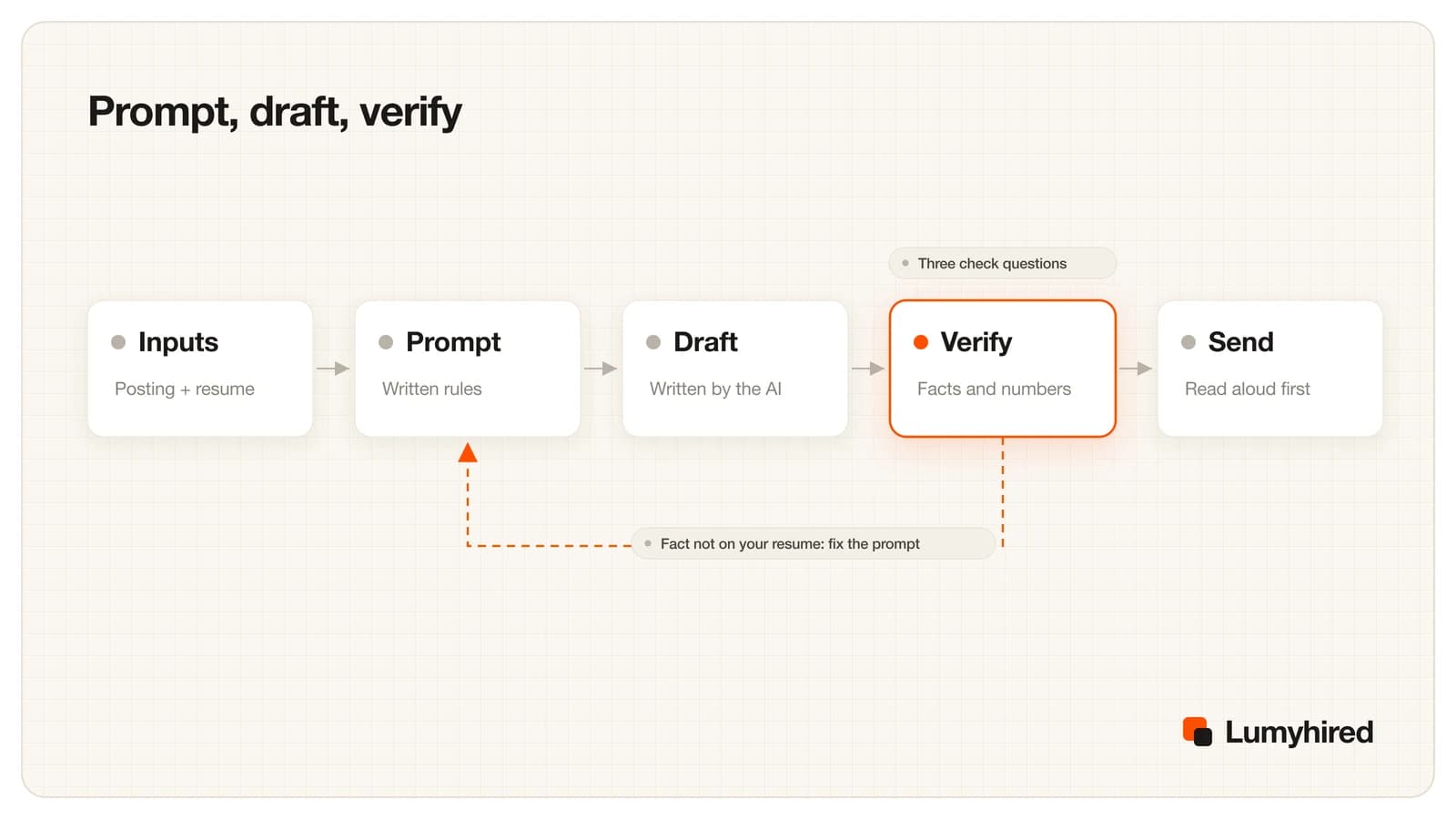
Then run three checks:
- Does every item on the claims list quote a real line of your resume? Delete or fix anything marked UNSUPPORTED, then fix the prompt input that caused it.
- Could you talk for two minutes about every number in the letter if an interviewer asked?
- Swap the company name for a competitor's. If the letter still reads correctly, the first paragraph is not specific enough.
Finish by reading it aloud and changing any phrase you would never say. That edit is the part employers in the Cui study appear to reward.
How we ranked the AI cover letter generators
We did not run a scored test of output quality, so the order rests on what each vendor documents, checked on 17 September 2026, against five criteria in this order of weight:
- Handles the whole application in one place. A letter is one step among several: finding the job, tailoring the resume, checking how an ATS reads it and tracking what you sent. A tool that writes the letter from the same tailored resume and keeps both with the posting saves re-pasting and records which letter went where.
- Keeps claims tied to your real material. A written rule against invented facts, or full control over the instructions.
- Reads the posting and your resume together. Without both, a letter has nothing specific to say.
- Writes in English and French. For anyone applying in both languages, or to employers in France.
- Cost of one usable letter. Free generations, whether downloading is paid, the entry price and the refund terms.
The 8 best AI cover letter generators in 2026
| Tool | Reads the posting | Reads your resume | Free option | Paid |
|---|---|---|---|---|
| Lumyhired | Yes | Yes (the tailored version) | None; 3-day money-back | €5 to €13/week |
| Claude / ChatGPT | Yes (pasted) | Yes (pasted) | Free tiers | $8 to $20/month |
| Teal | Yes | Yes | 2 AI letters | $13/week or $29/30 days |
| Kickresume | Yes | Optional | First AI letter; students free | $4.50 to $19/month |
| Grammarly | Yes | Yes (no PDF upload) | 100 AI prompts/month | See plans page |
| Jobright | Yes | Yes | Advertised, limits not stated | Not stated on tool page |
| Rezi | Target job | Yes | Unclear for AI letters | $29/month or $149 lifetime |
| Zety | Not shown | Zety builder | Create only | Download from $1.95 |
1. Lumyhired
Best for: Anyone applying to several jobs who wants each letter written from the resume tailored for that posting, and kept with it
Inputs: Your resume and the job posting, with tone and situation settings. Price: No free plan. Weekly plans €5, €8 or €13, cancel anytime, 3-day money-back guarantee.
What it does well
- Writes each letter from your resume and the specific posting, in English or French, and saves it with the tailored resume for that job in your application tracker.
- Its instructions allow only metrics that are already on your resume, and forbid adding tools, employers or seniority you do not have.
- Settings for a career change, an employment gap, or being over or under the posting's level, plus five tones from startup to public sector.
- The same account finds jobs across 10 boards (Indeed, LinkedIn, Glassdoor, France Travail and six more), tailors the resume to each posting and checks how an ATS parses it.
Worth knowing
- Cover letters come with the paid weekly plans and an account; there is no free plan and no standalone letter page.
- Each letter is tied to a saved job, so for a one-off letter with no application behind it a chatbot is quicker.
2. Claude or ChatGPT, used directly
Best for: Anyone willing to paste the posting and resume and check the output
Inputs: Whatever you paste: the full posting and your resume text. Price: Free tiers. ChatGPT Go $8/month, Plus $20/month. Claude Pro $20/month, or $17/month billed yearly.
What it does well
- Reads both documents in full, with no form fields cutting the posting down to a job title.
- You write the rules, so you can forbid invented numbers and ask for a list of every claim with its source line.
- Handles unusual cases a template product struggles with: a career change, a gap, a move between countries.
What it lacks
- Nothing stops it inventing a result unless your prompt forbids it and you check.
- You repeat the setup for every application, and nothing records which letter went where.
3. Teal
Best for: Trying a posting-aware generator for free next to a job tracker
Inputs: Your resume (upload, LinkedIn import or manual) and the job description. Price: Free plan with 2 AI cover letter generations. Teal+ $13/week, $29 every 30 days or $79 every 90 days.
What it does well
- Pulls in both the resume and the job description, which is what a specific letter needs.
- Two free generations are enough to judge the output on a real posting before paying.
- Letters sit next to Teal's job tracker, so the posting is already saved.
What it lacks
- Two free generations run out after two applications.
- Unlimited letters need Teal+, and the weekly price is the most expensive way to pay for it.
4. Kickresume
Best for: Students, and people who want the letter to match a designed resume
Inputs: Job title and pasted job ad, with one of your Kickresume resumes as an option. Price: Premium $19/month, $9/month billed quarterly, $4.50/month billed yearly. Free for verified students.
What it does well
- Takes the pasted job ad and can tailor to a resume you already built there.
- The tool page says your first AI cover letter is free, and verified students (ISIC, ITIC or UNiDAYS) get Premium free.
- Letter and resume share matching templates.
What it lacks
- The pricing page lists the AI cover letter writer under Premium, so expect to pay after the first letter.
- The resume input is optional, and a letter written without it has less real material to draw on.
5. Grammarly
Best for: A quick draft you then edit with Grammarly's tone and clarity suggestions
Inputs: Resume upload (DOC, DOCX or TXT) or pasted text, job title, and pasted responsibilities and requirements. Price: Free plan includes 100 AI prompts a month. Paid plans on the Grammarly plans page.
What it does well
- Asks for the posting's responsibilities and requirements as well as your resume.
- Editing tools for formality, tone and length are part of the same product.
What it lacks
- The upload form lists DOC, DOCX and TXT, so a PDF resume has to be pasted as text.
- The sample letters on its own page open with a stock line about expressing interest, so plan to rewrite the opening.
6. Jobright
Best for: US job seekers already using Jobright's job matching
Inputs: Your uploaded resume and a job description, through its Orion chat assistant. Price: Advertised as free to create; no prices or limits on the tool page.
What it does well
- Uses both the resume and the job description.
- Works inside a job-matching product, so the posting can come from its recommendations.
What it lacks
- The tool page states no limits or prices, and we could not verify paid plan prices on Jobright's own site.
- Account required, and the product is built around the US job market.
7. Rezi
Best for: People who already keep their resume in Rezi
Inputs: Your Rezi resume content and the job you are targeting. Price: Free plan (1 resume, 3 PDF downloads). Pro $29/month with unlimited AI. Lifetime $149.
What it does well
- Writes the letter from the resume content already in Rezi, aimed at a target job.
- Pro includes unlimited AI use, and the pricing page advertises a 30-day money-back guarantee.
What it lacks
- The pricing page does not make clear how much AI letter writing the free plan allows.
- $29 a month is the highest monthly subscription among the dedicated letter tools here.
8. Zety
Best for: A formatted letter that matches a Zety resume template
Inputs: Target job and your details, with a built-in resume builder. Price: Free to create; PDF or Word download needs a paid plan, from $1.95 with a 14-day money-back guarantee.
What it does well
- Generate as many letters as you like before paying, according to its FAQ.
- Templates match its resume designs.
What it lacks
- You pay to download a PDF or Word file, and the builder page does not state the price after the first period.
- The page does not show that it reads the full posting text.
Which AI cover letter generator fits your situation
You are applying to several jobs and want each letter to match the resume you sent. Lumyhired. The letter is written from the posting and the resume tailored for it, in English or French, and both stay with the application in your tracker. Weekly plans start at €5, cancel anytime, with a 3-day money-back guarantee.
You send a few letters a month and want to pay nothing. Use Claude or ChatGPT on a free tier with the prompt above.
You want to try a dedicated tool before paying. Teal, with its 2 free AI letters. If you keep going, $29 every 30 days costs less than paying weekly for four weeks.
You are a student. Kickresume, since verified students get Premium free.
Your situation needs explaining, such as a gap or a career change. Lumyhired has settings for a career change, a gap and being over or under the posting's level; a chatbot where you write the instructions also works. Our guide to explaining a career gap has wording that holds up.
Cover letters are one of several AI jobs in a search. The wider comparison of resume, search and application tools is in the best AI tools to find a job in 2026, and the overall plan is in how to get a job in 2026.
Frequently asked questions
What is the best AI cover letter generator in 2026?
Do cover letters still matter in 2026?
Can employers tell if a cover letter is AI?
Is it OK to use ChatGPT to write a cover letter?
Will an AI cover letter generator make things up?
Is there a free AI cover letter generator that reads the job description?
How long should a cover letter be?
Where Lumyhired fits
In Lumyhired, a cover letter is written for a specific saved job, from your resume and that posting, in English or French, with only the metrics your resume already contains. It sits next to per-job resume tailoring, an ATS parsing check, job search across 10 boards including Indeed, LinkedIn and France Travail, and an application tracker that keeps the tailored resume and letter with each job. Cover letters are part of the paid weekly plans, from €5 a week on the pricing page, cancel anytime, with a 3-day money-back guarantee. There is no free plan. The free ATS preview shows how a parser reads your resume before you apply.
Sources
- ResumeGo, cover letter field experiment, 7,287 applications, July 2019 to January 2020. resumego.net
- Cui, Dias and Ye, Signaling in the Age of AI: Evidence from Cover Letters, arXiv 2509.25054, revised 12 November 2025. arxiv.org
- APEC, Pratiques de recrutement de cadres 2026, survey of 1,150 companies, May 2026. corporate.apec.fr
- APEC, Les cadres et l'IA, survey of 2,000 professionals, 21 May 2026. corporate.apec.fr
- Express Employment Professionals and Harris Poll, hiring managers survey, 11 February 2026. prnewswire.com
- Teal, cover letter generator and pricing pages, read 17 September 2026. tealhq.com
- Kickresume, AI cover letter writer and pricing pages, read 17 September 2026. kickresume.com
- Grammarly, cover letter generator and plans pages, read 17 September 2026. grammarly.com
- Jobright, cover letter generator page, read 17 September 2026. jobright.ai
- Rezi, AI cover letter builder and pricing pages, read 17 September 2026. rezi.ai
- Zety, cover letter builder page and FAQ, read 17 September 2026. zety.com
- OpenAI, ChatGPT pricing, and Anthropic, Claude pricing, read 17 September 2026. openai.com, claude.com
Read next
- How to Tailor Your Resume to a Job Description
A 15-minute method with three before and after bullets, an AI prompt that forbids invented facts, and Huntr's data: tailored resumes got interviews at 4.23% vs 2.07% in Q1 2026.
- Resume Keywords in 2026
A worked extraction on a sample job posting, how recruiter Boolean search and related-term matching read your resume, and keyword lists by role from O*NET.
- Why You're Not Getting Interviews in 2026
Diagnose it by symptom: no replies, rejections within minutes, screens with no interviews, interviews with no offers, or silence. A 10-minute test for each.