
Career Guides
How to explain a gap in your resume in 2026
Most advice on employment gaps is written from intuition. There is actual evidence: four field experiments, one employer survey covering 2,275 executives, and one recruiter experiment published in November 2025. They agree on where the penalty sits, how long it lasts, and which format reduces it. Updated 15 September 2026.
How do you explain a gap in your resume?
Put the gap in the chronology as a dated line with a plain label, for example “Family caregiver, 2023 to 2025”, add one line of anything relevant you did, and prepare a two-sentence interview answer that ends on why you are available now. The size of the problem is measurable. In a field experiment with 12,054 fictitious resumes (Kroft, Lange and Notowidigdo, Quarterly Journal of Economics, 2013), callbacks fell from about 7% at one month out of work to about 4% at eight months and then stayed flat. Harvard Business School and Accenture found in 2021 that 48% of employers filter out middle-skills candidates over a resume gap. A 2022 Nature Human Behaviour audit found that writing roles as years worked rather than exact dates raised callbacks by 15% against resumes with a visible gap.
Sources read on 15 September 2026. Figures that move over time carry their date in the text below.
What the research says about an employment gap on a resume
The best-known number comes from a correspondence study run across 100 US metro areas in 2011 and 2012. Kroft, Lange and Notowidigdo sent 12,054 fictitious resumes to 3,040 job ads and varied one thing: how long the applicant had been out of work. Callbacks ran at about 7% for applicants one month out and about 4% for those eight months out, a drop of 45%. Almost all of the decline happened inside those first eight months, and the curve was close to flat afterwards.
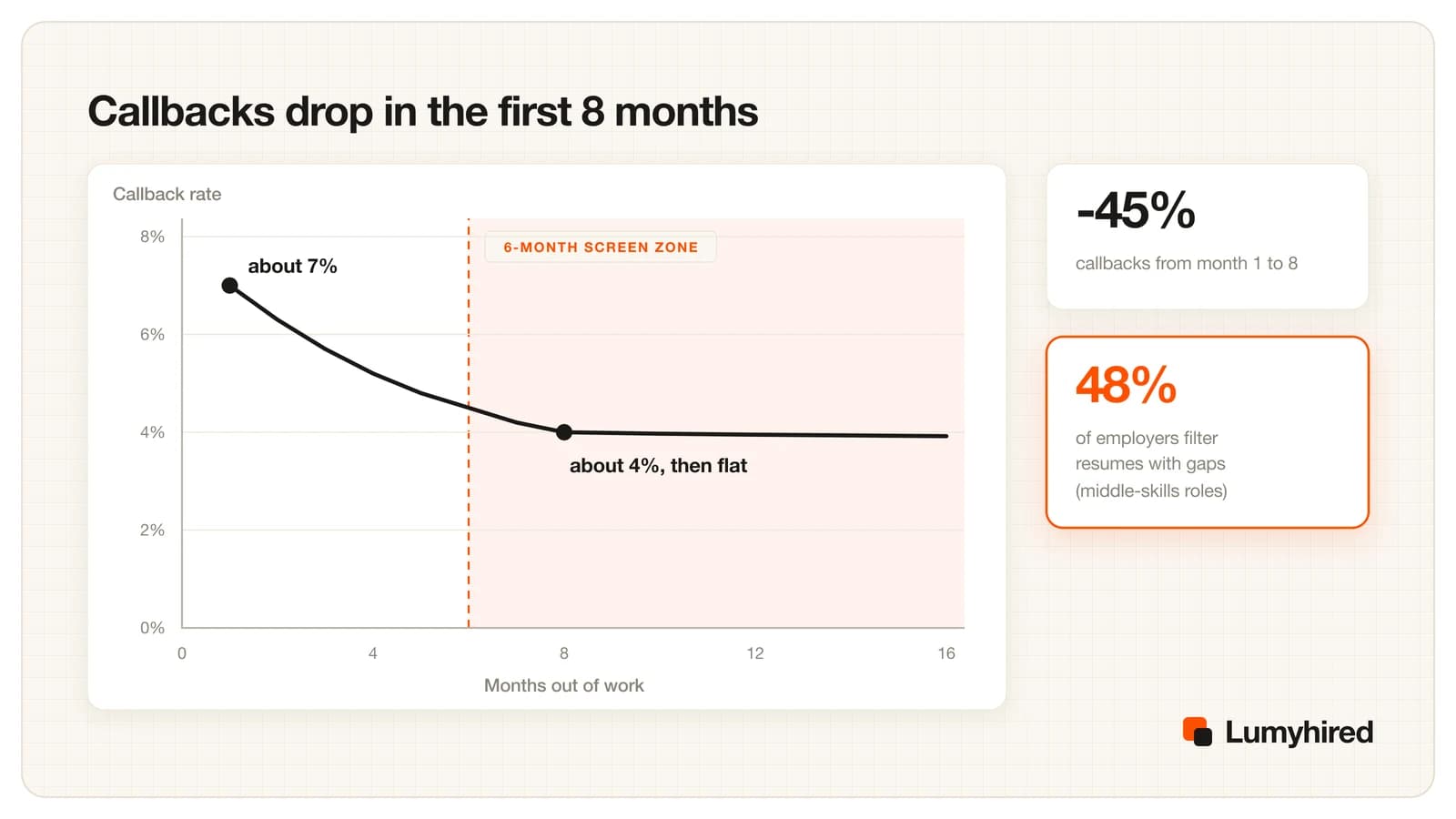
Two caveats matter before you apply that to your own search. The applicants in the study were young, average age 27, and the penalty was larger in tighter local labor markets. What it does establish is the shape: the cost of a gap accumulates early and then stops accumulating, which is the opposite of the fear that every extra month makes things worse.
The Swedish experiment by Eriksson and Rooth adds the finding that changes what you should do about it. Long-term unemployment in the past carried no penalty once the applicant had worked again since. Current gaps of nine months or more did draw one; short current gaps did not. Read together with the US curve, the practical conclusion is that taking contract, temporary or part-time work during a long search is worth more than any amount of rewording, because it moves the gap from current to past.
The most recent evidence is a November 2025 IZA discussion paper by D’hert, El Haj and Baert, which put the scenarios to professional recruiters. Care-related breaks were judged less harshly than long-term unemployment, though still harshly. What recruiters said they worried about was lost skills, commitment and availability, strongest after a childcare break. Mentioning flexibility and adaptability improved ratings for caregivers and did nothing for long-term unemployed candidates. That tells you what your two sentences have to answer.
| Study | Design | What it found |
|---|---|---|
| Kroft, Lange and Notowidigdo, Quarterly Journal of Economics, August 2013 | 12,054 fictitious resumes sent to 3,040 US job ads in 100 metro areas, 2011 to 2012, average applicant age 27 | Callbacks fell from about 7% at one month out of work to about 4% at eight months, a drop of 45%, with little further decline after that. The penalty was larger in tighter local labor markets. |
| Eriksson and Rooth, American Economic Review, March 2014 | Field experiment on the Swedish labor market | Past long-term unemployment stopped mattering once the applicant had worked again. Short current gaps drew no penalty; current gaps of nine months or more did. |
| Fuller and Raman et al., Hidden Workers, Harvard Business School and Accenture, September 2021 | 8,720 workers and 2,275 executives surveyed in the US, UK and Germany; employer survey ran January to February 2020 | 48% of employers said they filter out middle-skills candidates over a resume gap, and 43% do the same for high-skills candidates. The report puts more than 27 million people in the US in the hidden-worker group. |
| Kristal, Nicks, Gloor and Hauser, Nature Human Behaviour, published online 5 December 2022 | UK field audit of real applications | Writing each job as years worked rather than start and end dates raised callbacks by 15% against resumes showing a gap, and by 8% against resumes with no gap at all. The effect held for women and men. |
| D’hert, El Haj and Baert, IZA discussion paper 18292, November 2025 | Survey experiment with professional recruiters | Care-related breaks were penalized less than long-term unemployment but still substantially. Recruiters worried about lost skills, commitment and availability, most of all after a childcare break. Mentioning flexibility helped caregivers and did nothing for the long-term unemployed. |
Sources: QJE (2013), AER (2014), Hidden Workers (HBS and Accenture, September 2021), Nature Human Behaviour (December 2022), IZA DP 18292 (November 2025). Read 15 September 2026.
Two vendor datasets point the same way and should be weighed as vendor research. ResumeGo, a resume-writing company, sent 36,510 applications between January and July 2019 and reported 45% fewer interviews for applicants with gaps, with callbacks falling from 9.8% to 4.6% between a two-year and a three-year gap. Huntr, an application-tracker vendor, analyzed 139,927 applications from 25,635 mostly US job seekers using its own tool in Q1 2026 and put the start of the interview-rate penalty at the six to twelve month band, where applications converted at 4.51%. Both samples are self-selected. If your applications are disappearing without replies for reasons you have not isolated yet, the diagnosis order in why you are not getting interviews is the cheaper place to start.
Does an ATS reject employment gaps?
The honest answer is narrower than either side of the usual argument. No applicant tracking vendor documents a built-in rule that rejects resumes with gaps. What is documented is employers choosing to screen that way. In the Hidden Workers survey of 2,275 executives, 48% said they filter out middle-skills candidates when the resume shows a gap, and 43% said the same for high-skills candidates. The report works through a seven-month gap as its example and describes a gap longer than six months being, in its words, “automatically screened out”.
Context from the same report: 63% of employers use a recruitment management system (75% in the US), over 90% use it to filter or rank candidates at first screening, and 88% agree that qualified high-skills candidates get screened out for failing to match the exact criteria. The gap rule is one filter among several, and the others are usually the ones costing you more. The mechanics of those filters are covered in how to pass ATS filters, and you can see how your own dates and section headings come out of a parser with the ATS preview.
One practical consequence: a gap entry that a parser cannot read as a dated experience row can produce a second, invisible gap. If you write the break inside a text box, a header or a two-column sidebar, the extracted text may show your 2022 job sitting next to your 2025 job with nothing in between and no explanation anywhere. Keep the break in the same experience section, in the same format as your jobs.
Career break on a resume: the line to write for each reason
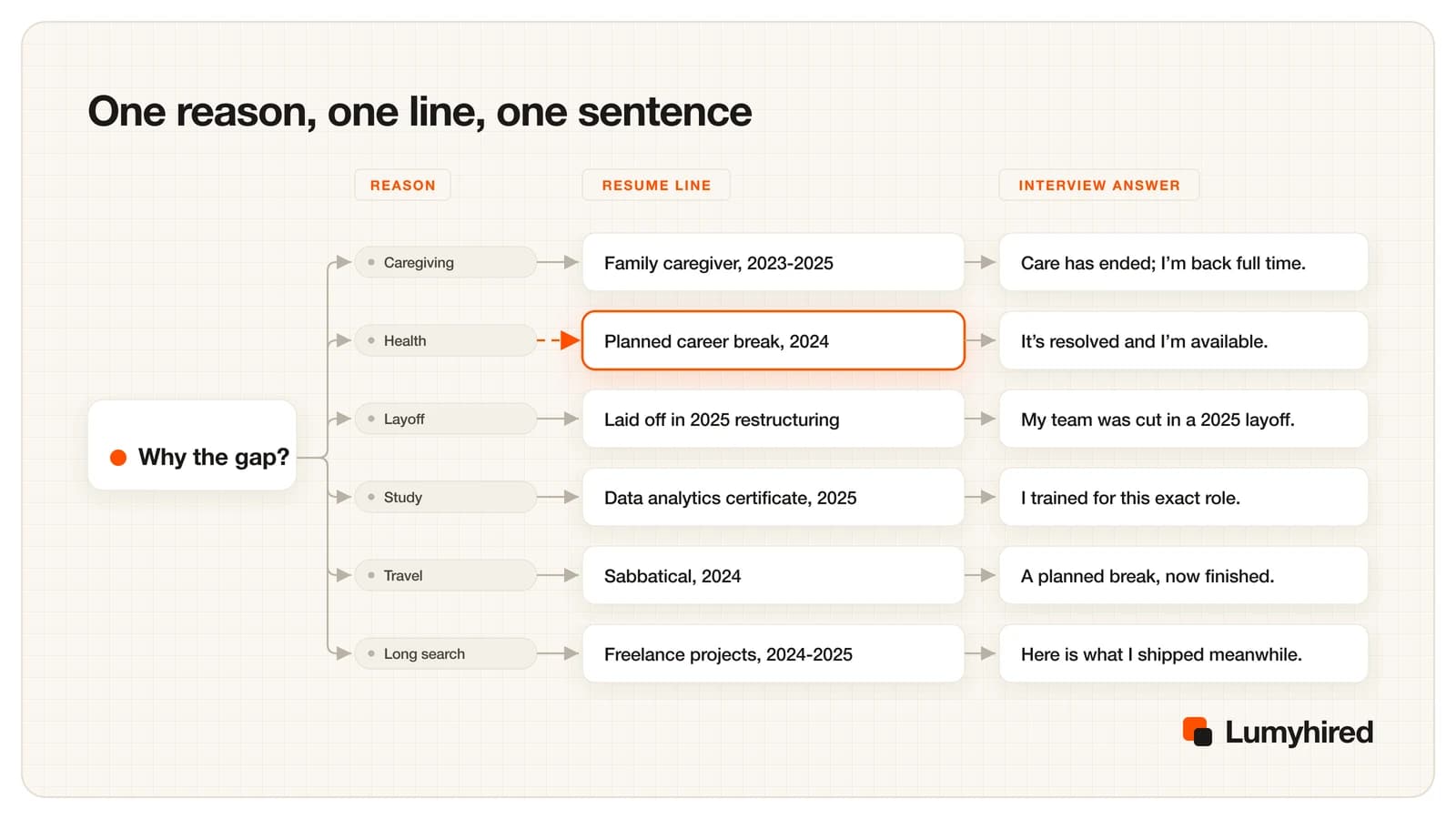
The line belongs in the experience section, in the same visual format as a job: label, dates, one supporting line if you have something true to put there. Vague wording is what creates questions, because a reader who cannot tell what happened fills the space with a guess. Here are the lines, ready to copy and adjust.
| Reason | Resume line | Add underneath, if true | LinkedIn break type |
|---|---|---|---|
| Caring for a child | Full-time parent, 2021 to 2024 | Anything organized or budgeted that maps to the job, if it is true | Full-time parenting |
| Caring for a relative | Family caregiver, 2023 to 2025 | Care schedule, insurance claims, coordination with providers | Caregiving |
| Health | Planned career break, 2024 | A course or certificate if you took one. No medical detail | Other life needs, or leave the type blank |
| Layoff | Career break after 2025 restructuring | Contract work, open-source, volunteering with dates and output | Layoff |
| Study or retraining | Full-time study: data analytics certificate, 2025 | The capstone project and the tools it used | List it under Education instead |
| Travel or sabbatical | Sabbatical, 2024 | Language level reached, remote work done on the road | Gap year |
| Bereavement | Career break, 2024 | Nothing is required here | Bereavement |
Break types are the ones LinkedIn documents in its help page on adding career breaks (read 15 September 2026). The resume lines are ours.
Three rules hold across all of them. Do not invent the supporting line: a course you did not take is checkable and a single small project described as two years of consulting falls apart at the first follow-up question. Do not name a medical condition. And keep the label consistent with what the application form and your LinkedIn profile say, since a recruiter comparing the three is the most common way a mismatch surfaces. If you want models for the surrounding sections, the resume examples show the format the break line has to sit inside.
Should you write years worked instead of exact dates?
This is the one formatting change with a randomized trial behind it. In a UK field audit published in Nature Human Behaviour in December 2022, Kristal, Nicks, Gloor and Hauser sent applications where each role was written as a duration (“3 years”) rather than start and end dates. Callbacks rose 15% against resumes that showed a gap through dates, and 8% against resumes with no gap at all. The effect held for women and for men.
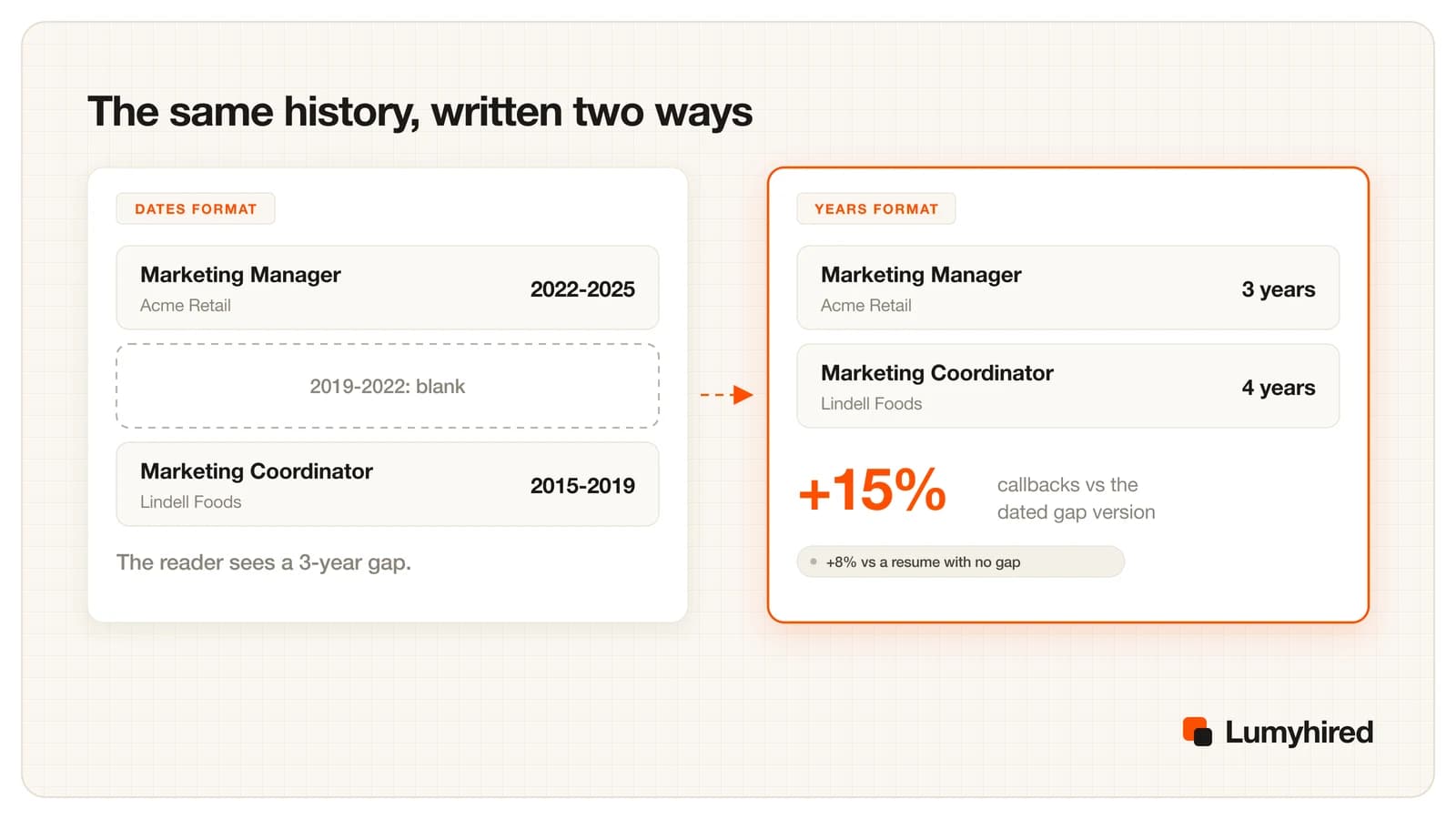
Two limits on using it. The format works on the resume and it does not follow you into the application form, where date fields are usually mandatory and have to be answered accurately, or into a background check. And some recruiters read duration-only resumes as deliberately unclear, which is a cost you are trading against the measured gain. A reasonable middle path is years worked on the resume, exact dates wherever a form asks for them, and a labelled break line if the gap is longer than a year.
Whichever format you pick, apply it to every role on the page. A history that mixes dates for some jobs and durations for others reads as though the durations are hiding something specific. The same consistency logic applies to phrasing across versions of your document, which is the point of tailoring the resume to each posting rather than keeping one file for everything.
How to explain an employment gap in an interview
The IZA recruiter experiment is the best guide to what the answer has to contain. Recruiters reported three worries: skills gone stale, commitment, and availability. So the answer runs reason, what kept you current, availability now. Two or three sentences, then stop. Here are worked versions for the common cases.
- Caregiving. “From 2023 to 2025 I cared for my father full time. That ended in March, and I have care arranged so my availability is not an issue. I kept my reporting work current by handling the billing and insurance side, and I took a refresher course in Excel modeling in the spring.”
- Health. “I took a planned break in 2024 for personal health reasons. It is resolved, and there is nothing that affects my ability to do this job. Since June I have been back to full-time work on a contract basis.”
- Layoff. “My team was cut when the company restructured in March 2025. I have spent the time since on two freelance projects and a certification, and I have been selective about the next role rather than taking the first offer.”
- Study or retraining. “I left to complete a data analytics certificate full time because I wanted to move from marketing into analytics. The capstone was a churn dashboard built in SQL and Power BI, which is close to what this team does.”
- Travel or sabbatical. “I had planned a year off for a long time and took it in 2024. It is finished, and I am looking for a role I can stay in for several years. I did remote contract work for two months of it.”
- A long job search. “The search has taken longer than I expected. I have been doing contract work for a local retailer in the meantime, which kept my campaign and analytics work in use, and I have focused on roles like this one rather than applying everywhere.”
One note from the same study: mentioning flexibility and adaptability improved how recruiters rated caregivers and made no difference for candidates coming out of long-term unemployment. If your gap is a long search, the sentence that works is a piece of evidence about recent work rather than a statement about your attitude. And if a long search is the underlying problem, the volume question is worth checking against how many jobs to apply to.
What you do not have to disclose
Under the Americans with Disabilities Act, an employer may not ask disability-related questions or require a medical examination before making a job offer, even when the question would be job-related. They may ask whether you can perform the functions of the job. That is why “a planned personal break, now resolved” is a complete answer, and why an interviewer pressing for the diagnosis is asking for something they are not entitled to.
For pregnancy, the Pregnant Workers Fairness Act has applied since 27 June 2023 to employers with at least 15 employees, and it covers applicants as well as employees. The EEOC final rule implementing it took effect on 18 June 2024.
Caregiving is the case people get wrong. The EEOC guidance published on 23 May 2007 is explicit that caregivers are not a protected class in themselves under federal law. Treating them worse becomes unlawful when it rests on sex stereotyping, such as assuming a mother will be less committed, on pregnancy, or on association with a person who has a disability. So a caregiving break is worth stating plainly, and the protection you have runs through those other grounds rather than through caregiver status itself.
Outside the US the position can be stronger. In France, article L1132-1 of the Code du travail bars exclusion from a recruitment process on grounds including family situation, pregnancy, health, disability and age, and article L1221-6 limits what a recruiter may ask to what has a direct and necessary link to the job, while requiring the candidate to answer in good faith. The practical French reading is the same as the American one: you may decline to give the reason, and you may not lie about it.
How to add a LinkedIn career break
LinkedIn added the career break entry on 1 March 2022, and it sits in the same part of the profile as a job rather than in a side section. The path is: open your profile, click Add profile section, open Core, then choose Add career break. Set the dates, pick a type, and write a short description of what you did.
- Documented types: full-time parenting, bereavement, caregiving, gap year, layoff, and other life needs.
- The type is optional. You can leave it blank and write your own description, which is the route to take for a health break.
- The entry is visible to signed-in members only, and adding it does not notify your network.
- Keep the dates identical to the break line on your resume, since the two documents get compared.
LinkedIn published survey figures alongside the launch on 1 March 2022: across roughly 23,000 workers and more than 7,000 hiring managers, 62% said they had taken a career break, 56% said they learned or improved skills during it, and 51% of employers said they were more likely to call back a candidate whose break came with a stated reason. The same survey reported that 20% of hiring managers reject career-break candidates outright. Countries and fieldwork dates were not published, and LinkedIn was launching a feature, so treat these as vendor numbers that point in a direction rather than measurements you can lean on.
Layoffs in 2026, and why your gap is less unusual than it feels
Tech layoff tracking gives some sense of the volume of people carrying a recent involuntary gap. Reporting on the Layoffs.fyi tracker put 2026 at 122,796 people by 23 July 2026, already marginally above the 122,606 the same snapshot showed for all of 2025 (Yahoo Finance, 23 July 2026). TechCrunch counted 123,941 across 269 companies for 2025 in its 22 December 2025 wrap. Both trail the 2023 record of 265,660. The tracker updates continuously, so check it for the number on the day you read this.
The useful inference is narrow. A 2025 or 2026 layoff line on a resume is a common sight for anyone hiring in these sectors, and the interviewer is likely to have colleagues in the same position. It does not repeal the callback curve at the top of this page. It does mean the expected reaction is a short question rather than a rejection, and that preparing for a short question is a small task. If your search has run long enough that the structure needs rethinking rather than the wording, the guide to getting a job in 2026 sets out the order of operations, and the tools for experienced professionals covers what to use at senior level.
Frequently asked questions
How long can an employment gap be before it hurts?
Does an ATS reject employment gaps automatically?
Should I explain the gap in my cover letter?
Do I have to say my gap was for health reasons?
Is a gap from five years ago still a problem?
Should I use a functional resume to hide the gap?
What do I say if I was fired?
Does a gap spent studying hurt less?
Check what the filter sees
A break line only works if it survives parsing as a dated experience row. Lumyhired runs your file through the ATS resume checker and shows you the extracted text, so you can confirm that the break entry, its dates and the roles around it come out in the right order before you send anything. It also rewrites the document against each posting, searches 10+ job boards, and tracks which version went where. Plans run at €5 a week for Starter, €8 for Pro and €13 for Hunt on the pricing page, with a 3-day money-back guarantee, cancel anytime, and no free plan.
Sources
- Kroft, Lange and Notowidigdo, “Duration Dependence and Labor Market Conditions”, Quarterly Journal of Economics 128(3), August 2013. academic.oup.com
- NBER Digest summary of the same study, March 2013. nber.org
- Eriksson and Rooth, “Do Employers Use Unemployment as a Sorting Criterion When Hiring?”, American Economic Review 104(3), March 2014. aeaweb.org
- Hidden Workers: Untapped Talent, Harvard Business School and Accenture, September 2021 (employer survey fielded January to February 2020). hbs.edu (PDF)
- Kristal, Nicks, Gloor and Hauser, “Reducing discrimination against job seekers with and without employment gaps”, Nature Human Behaviour, online 5 December 2022. pubmed.ncbi.nlm.nih.gov
- Behavioural Insights Team, note on the same trial. bi.team
- D’hert, El Haj and Baert, IZA discussion paper 18292, November 2025. docs.iza.org (PDF)
- ResumeGo, employment gaps study, 36,510 applications, January to July 2019. Vendor research without peer review. resumego.net
- Huntr, job search trends Q1 2026, 139,927 applications from 25,635 job seekers using its tracker. Vendor research, self-selected sample. huntr.co
- LinkedIn Talent Blog, career breaks survey and feature launch, 1 March 2022. Vendor survey. linkedin.com
- LinkedIn Help, adding career breaks to your profile. linkedin.com/help
- EEOC, enforcement guidance on pre-employment disability-related questions and medical examinations. eeoc.gov
- EEOC, what you should know about the Pregnant Workers Fairness Act. eeoc.gov
- EEOC, questions and answers on unlawful disparate treatment of workers with caregiving responsibilities, 23 May 2007. eeoc.gov
- Code du travail, articles L1132-1 and L1221-6, Code du travail numérique. code.travail.gouv.fr
- Yahoo Finance on Layoffs.fyi totals, 23 July 2026, and TechCrunch tech layoffs wrap, 22 December 2025. techcrunch.com
All sources read on 15 September 2026. This page describes what published research and public guidance say. It is not legal advice.
Read next
- Why You're Not Getting Interviews in 2026
Diagnose it by symptom: no replies, rejections within minutes, screens with no interviews, interviews with no offers, or silence. A 10-minute test for each.
- How to Tailor Your Resume to a Job Description
A 15-minute method with three before and after bullets, an AI prompt that forbids invented facts, and Huntr's data: tailored resumes got interviews at 4.23% vs 2.07% in Q1 2026.
- Best Resume Builders for Career Changers in 2026
Seven builders ranked on translating the experience you already have into the target field's words, with what a parser really does to a functional layout.