
Strategy
AI in job search and hiring statistics 2026: what the data shows
Most pages ranking for these queries are stat roundups that copy each other, so the same number appears in ten places and its sample size appears in none. This report groups every figure under the organization that actually collected it, gives the sample and the fieldwork date, and says plainly which numbers come from vendors selling hiring software.
How much of job search and hiring runs on AI in 2026?
Candidate use sits between 31% and 74% depending on who asks: Gartner measured 39% of candidates using AI during the application process (n=3,290), APEC measured 31% of French cadres who had recently searched (n=2,000, March 2026), and Greenhouse, a hiring software vendor, reported 74% of 1,200 US job seekers. Employer use is lower and rising fast: 43% of organizations used AI for HR tasks in 2025 against 26% a year earlier (SHRM, n=2,040), and in France 13% of large firms used it to recruit cadres against 6% in 2024 (APEC, n=1,150 firms). Where employers apply it matters more than whether they use it: 81% of AI-using French firms write job ads with it and 38% use it to match applications to required skills. AI interviews have spread fastest of all, with 63% of 2,950 job seekers surveyed by Greenhouse reporting one in the six months to May 2026. EU obligations for recruitment systems apply from 2 December 2027.
Updated 15 September 2026. All sources were read on that date.
Key findings
- 1
63% of job seekers had faced an interview run by AI in the previous six months, up 13 points in six months. 70% were not told beforehand and 51% heard nothing afterwards. Greenhouse, an applicant tracking vendor, survey of 2,950 job seekers in the US, UK, Germany, Australia and Ireland, published 1 May 2026.
- 2
39% of candidates said they used AI during the application process. Gartner candidate survey, n=3,290, fielded in the fourth quarter of 2024, reported 31 July 2025.
- 3
26% of candidates trust AI to evaluate them fairly. Gartner survey of 2,918 candidates, first quarter of 2025, reported 31 July 2025.
- 4
43% of organizations use AI for HR tasks, up from 26% a year earlier. SHRM 2025 Talent Trends, 2,040 HR professionals surveyed 3 to 12 February 2025.
- 5
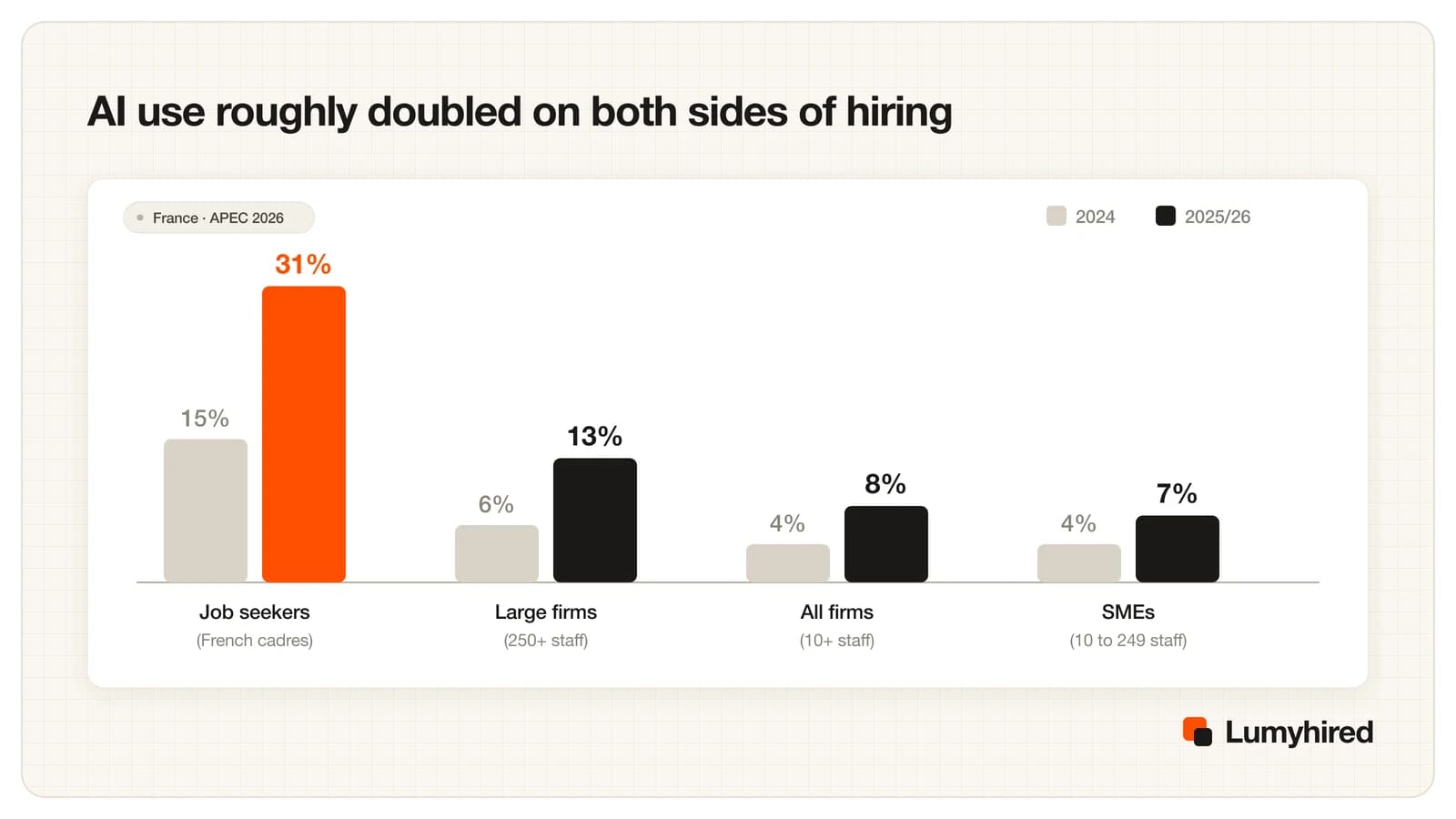
31% vs 13% in France: 31% of cadres who had taken a job-search step in the past three months had used generative AI for it (15% in December 2024), while 13% of large firms used AI to recruit cadres (6% in 2024). APEC, two studies published May 2026, n=2,000 cadres and n=1,150 firms.
- 6
11,000 applications submitted per minute on LinkedIn, up 45% year on year. LinkedIn platform data reported by the New York Times in June 2025. The Times reported that AI tools contribute to the rise, and nobody has measured by how much.
- 7
+12% more job offers for applicants interviewed by an AI voice interviewer than by a human recruiter (9.73% vs 8.70%), across 70,884 applications in a randomized field experiment in the Philippines. Working paper by Jabarian and Henkel, arXiv version 10 September 2026, with the conflict of interest noted below.
- 8
2 Dec 2027 the date EU AI Act obligations for high-risk systems, which include recruitment and candidate selection tools, start to apply after Regulation (EU) 2026/1744 pushed the deadline back. Emotion recognition at work has already been banned since 2 February 2025.
How many job seekers use AI, and for what
Four surveys give four answers. Gartner: 39% of candidates used AI during the application process (n=3,290, fourth quarter of 2024). APEC: 31% of cadres who had taken a job-search step in the past three months had tried generative AI for it, up from 15% in December 2024, and 66% would use it in a future search (n=2,000, March 2026). Greenhouse: 74% of 1,200 US job seekers (November 2025). Gdoc, a document vendor polling 500 US job seekers through Pollfish: 36% (August 2026). The gap between 31% and 74% is mostly question wording, country and sample quality, and any page quoting one of these as the number is hiding the other three.
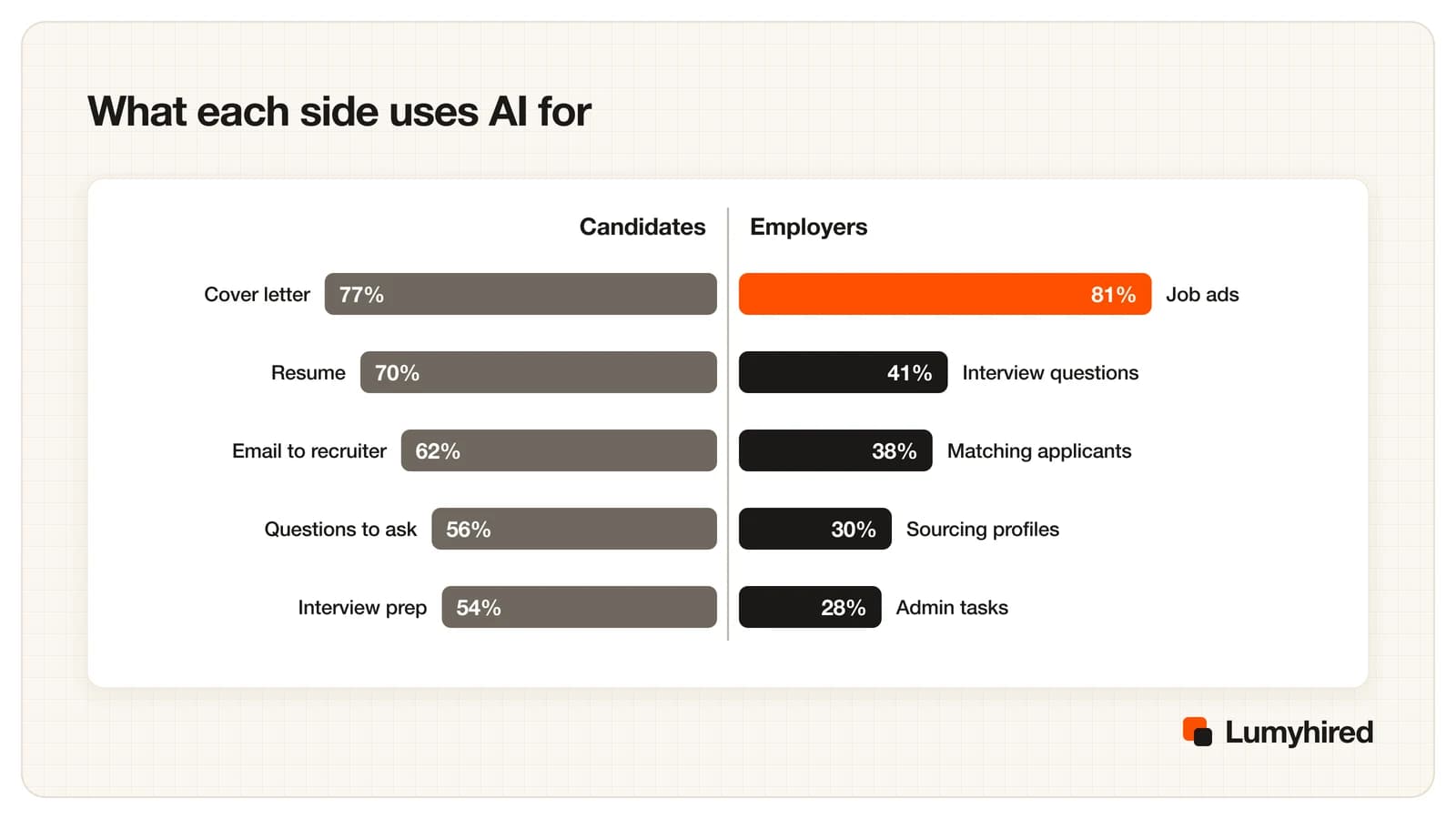
The distribution of tasks is more stable than the headline share. In the APEC data, candidates who used AI used it for cover letters (77%), the CV itself (70%), emails to recruiters (62%), questions to ask a recruiter (56%), anticipating interview questions (54%), company research (53%), salary negotiation (45%) and tests or case studies (44%). Those same respondents put limits on it: 71% say AI cannot fully replace professional advice on a CV or letter, and 80% say it cannot replace mock interviews with a person.
Background context from Pew Research Center: 21% of US workers said they use AI in their job in September 2025, up from 16% a year earlier (n=5,010).
Do employers use AI to screen resumes?
Employer adoption is real and smaller than the candidate side. SHRM put AI use for HR tasks at 43% of organizations in its 2025 Talent Trends survey (n=2,040, February 2025), against 26% in 2024. Its 2026 State of AI in HR survey of 1,900+ HR professionals put implementation at 39%, with recruiting the leading use case at 27%. The two numbers answer slightly different questions, which is why they disagree.
The French data is more precise because it separates the base. 8% of firms with 10+ staff that recruited a cadre used AI for it in 2025 (4% in 2024), rising to 13% among firms with 250+ staff and sitting at 7% among smaller firms. Among the firms using AI, 74% use general tools such as ChatGPT or Mistral and 36% use AI built into their applicant tracking or HR software. What they use it for: writing job descriptions and ads (81%), drafting interview questions (41%), matching applications to required skills (38%), finding profiles to approach (30%), admin tasks (28%), tests (25%), candidate chatbots (8%) and analysing audio or video interviews (7%).
Multiply the two bases and the picture for a French applicant is that roughly 3 firms in 100 are using AI to sort applications, while about 6 in 100 are using it to write the ad you are reading. US figures point the same way: the SHRM 2025 breakdown circulating on secondary sites has 66% of AI-using organizations applying it to job descriptions against 44% to resume screening, though SHRM’s own page confirms only the 43% headline. The screening you actually meet is usually older than that: keyword search and filters inside an applicant tracking system, which is what the guide to getting through ATS filters covers in mechanical detail.
Application volume, fraud and what the numbers really say
The most quoted figure in this field is 11,000 applications per minute on LinkedIn, up 45% year on year. It traces to a single origin: LinkedIn platform data given to the New York Times in June 2025. Every roundup repeating it is repeating that one source, the 45% rise is not measured as caused by AI, and a bigger figure of 14,200 per minute circulates with no traceable origin at all.
Measured volume elsewhere moved less dramatically. APEC found the average number of applications received for the last cadre hire went from 13 to 15, and APEC does not attribute that rise to AI. Greenhouse found 49% of its 1,200 US respondents saying they send more applications than a year ago, which is a vendor survey of self-reported behaviour.
Fraud is the part employers talk about most. Gartner measured 6% of 3,000 candidates admitting to interview fraud, and forecasts that by 2028 one in four candidate profiles worldwide will be fake. That is a prediction about profiles, and it gets misquoted as a measurement about candidates. On the employer side, 65% of 665 US recruiters in the Greenhouse survey said they had caught deceptive AI use, and 86% of 1,002 US hiring managers in an Express Employment Professionals poll conducted by Harris said AI makes it too easy to exaggerate skills. Both are commissioned surveys, and their consequence for you is concrete: verification steps are getting heavier, and 62% of candidates in Gartner’s data say they are more likely to apply when in-person interviews are part of the process.
Volume also has a measured cost. In Huntr’s Q1 2026 dataset of 139,927 applications from 25,635 users, people who sent 11 to 20 applications saw interviews on 9.25% of them, against 2.58% for people who sent 100 or more. Huntr sells an application tracker and the comparison is observational, so treat it as a pattern in user data. It does not prove that sending fewer applications causes interviews. We look at the same question from the other side in how many jobs to apply to and in the review of auto apply tools.
AI interview statistics: how common, and do they work
Greenhouse surveyed 2,950 job seekers across the US, UK, Germany, Australia and Ireland and published the results on 1 May 2026: 63% had faced an AI interview in the previous six months, up 13 points in six months, 70% were not told in advance, 51% never heard back afterwards, and 38% had withdrawn from one. Greenhouse sells applicant tracking software and has a commercial interest in the subject, so the sample is worth naming every time the figure is.
The best evidence on whether AI interviews help or hurt candidates is a randomized field experiment by Jabarian and Henkel covering 70,884 applications for 48 customer-service roles in the Philippines. Applicants assigned to an AI voice interviewer received 12% more offers (9.73% against 8.70%), started 18% more jobs, and were 18% more likely to still be in the job at 30 days (5.89% against 4.98%). Given a choice, 78% picked the AI interviewer.
Three caveats belong with that result. It is a working paper, so it has not been through peer review, though it was pre-registered with the American Economic Association. It covers one job family in one labour market, and entry-level customer service is where structured interviewing tends to look best. And there is a conflict of interest: from 1 August 2025, after data collection ended, one author has been unpaid chief economist at the firm that ran the AI interviews. The result is worth knowing and it is one study.
Candidate sentiment runs colder than those outcomes. Only 26% of 2,918 candidates in Gartner’s first-quarter 2025 survey trust AI to evaluate them fairly. Greenhouse found 70% of hiring managers trusting AI to make faster and better decisions while 8% of job seekers called AI hiring fair. And in a Pew survey from April 2023, 66% of US adults said they would not want to apply to an employer using AI to help make hiring decisions. That last figure is three years old and predates most current tools, which is exactly why it should carry its date.
What the bias evidence actually shows
The study everyone cites is Wilson and Caliskan at the University of Washington, presented at the AIES conference on 22 October 2024. They ran more than three million comparisons using 550+ resumes and 500+ job listings through three text embedding models. The models preferred white-associated names in 85% of comparisons against 9% for Black-associated names, and male-associated names in 52% against 11% for female-associated names. They never preferred Black male names over white male names.
The limit matters as much as the headline. These were general-purpose retrieval models in a controlled setting, so the study shows what embedding-based ranking does with names, and it does not measure any particular commercial applicant tracking system in production. The nearest thing to a test of a real product is litigation. Mobley v. Workday, filed February 2023, has a preliminarily certified collective of applicants aged 40 and over, an opt-in deadline that passed on 7 March 2026, and a June 2026 ruling that let California discrimination claims continue. Discovery is ongoing and no court has ruled on whether the software discriminated.
The rules arriving between now and 2027
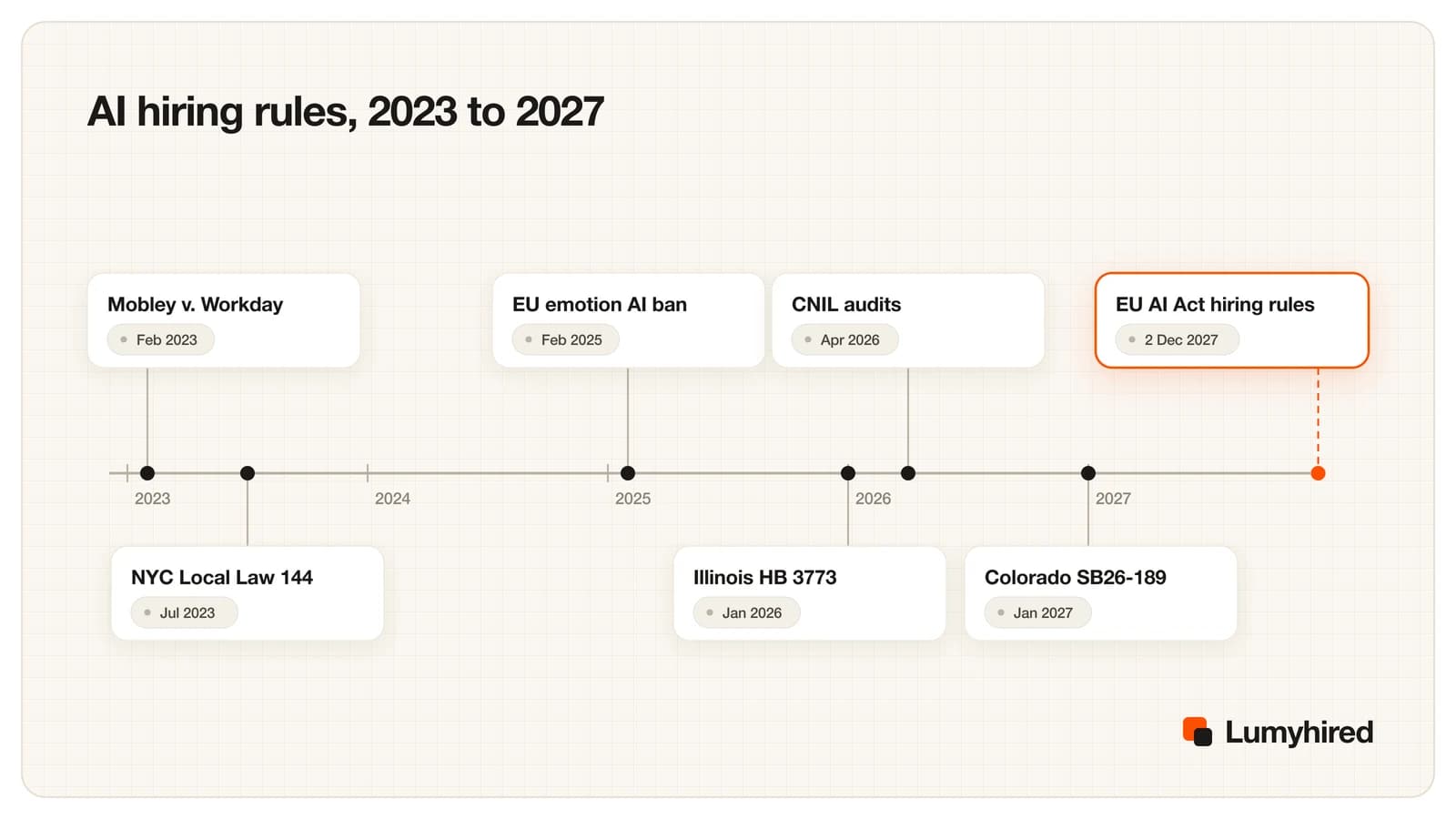
Regulation is where a candidate gets actual rights, and the dates are worth knowing because notice duties are what let you ask a question without sounding difficult.
| Date | What applies |
|---|---|
| 5 July 2023 | New York City Local Law 144 becomes enforceable: an employer using an automated employment decision tool needs a yearly independent bias audit and has to notify candidates. Fines run from $500 to $1,500 per violation. A New York State Comptroller audit published 2 December 2025 called enforcement over the first two years ineffective. |
| 2 February 2025 | The EU AI Act ban on emotion recognition in the workplace applies (Article 5(1)(f) of Regulation 2024/1689), with narrow exceptions for medical and safety reasons. Video interview tools that claim to score a candidate’s emotions are the obvious target. |
| 1 January 2026 | Illinois HB 3773 takes effect: employers may not use AI that discriminates on protected characteristics, may not use zip codes as a proxy for them, and have to notify candidates when AI is used. The Illinois Department of Human Rights proposed implementing rules on 15 May 2026 and then withdrew them temporarily, so the detail is still moving. Law firm summaries disagree on the current status. |
| 3 April 2026 | France’s data protection regulator, the CNIL, names recruitment among its inspection priorities for 2026, listing automated decisions, what candidates are told, and how long applications are kept. |
| 22 June 2026 | In Mobley v. Workday, filed in February 2023 in federal court in California, the judge partly denied Workday’s motion to dismiss and let California discrimination claims continue. A collective of applicants aged 40 and over was preliminarily certified on 16 May 2025, extended to HiredScore users, with an opt-in deadline of 7 March 2026. A May 2026 order also held that some AI bias-testing material can be covered by attorney-client privilege. Discovery is running and nothing has been decided on the merits. |
| 1 January 2027 | Colorado SB26-189, signed 14 May 2026, takes effect. It repeals the broader 2024 Colorado AI Act, whose enforcement a federal magistrate had blocked on 27 April 2026, and replaces it with notice duties plus an explanation within 30 days of an adverse decision, according to law firm McDermott. |
| 2 December 2027 | EU AI Act obligations for Annex III high-risk systems apply, and recruitment, advertising of jobs, filtering of applications and evaluation of candidates sit in that annex. Regulation (EU) 2026/1744, published 24 July 2026, moved this date. Duties fall on the provider and the employer deploying the system, which is what gives candidates something to ask about. |
Two of those dates moved in 2026, which is a reason to check them rather than to trust an article of any age, including this one. The EU high-risk deadline shifted through the Digital Omnibus regulation published on 24 July 2026, and Colorado replaced its 2024 AI Act after a federal magistrate blocked enforcement in April 2026.
What this means if you are the one applying
The original version of this article argued that AI lowered the cost of applying on both sides and pushed the remaining advantage into selection and follow-through. The data supports the first half. It also corrects a claim we made in August: that tailoring had become table stakes with no advantage left in it. In Huntr’s Q1 2026 data, tailored applications produced interviews at 4.23% against 2.07% for untailored ones, so the gap is still roughly double.
- Write with AI, claim only what you can defend. 77% of AI-using cadres draft cover letters with it, so doing the same puts you with the majority. The exposure is the content: with 86% of hiring managers saying exaggeration has become too easy, every line needs to survive two minutes of questions. A bullet like “Responsible for support using AI tools” rewrites better as “Cut first-response time from 9 hours to 4 by routing 1,200 monthly tickets through a triage bot I configured”, and only if that is true.
- Read the ad as a generated document. 81% of AI-using employers write job ads with AI, which means requirement lists are longer and more generic than the job. Match the wording you genuinely meet and ignore the padding. Our comparison of AI cover letter generators covers which tools keep your own detail in the text.
- Check the parse before the volume. Since the common screening layer is still keyword search inside an applicant tracking system, a document that parses badly fails before any model sees it. Run yours through the ATS preview and read what comes back.
- Expect an AI interview, and ask about it. With 63% of job seekers reporting one and 70% getting no warning, asking the recruiter whether any part of the process is automated is a normal question. In New York City and Illinois the employer already owes you notice.
- Follow up, because silence is now the norm. 51% of people who did an AI interview heard nothing afterwards. Tracking what you sent and when is what makes a follow-up possible. If replies have stopped entirely, the diagnostic in why you are not getting interviews separates a parsing problem from a targeting problem.
- Pick fewer roles with more care. The volume curve in the Huntr data and the tailoring gap point the same way. For choosing which tools do the finding and matching, see the best AI tools for finding a job and, if you are weighing automation, the auto apply tools comparison.
Methodology: where each number comes from
Every figure above is listed here with its publisher, sample and fieldwork date, and flagged when the publisher sells hiring or job search software. Figures with no traceable original source were left out, including the widely repeated claims that 77% of French job seekers use AI (France Travail, no named source), that 14,200 applications a minute arrive on LinkedIn, and several vendor blog numbers such as a 96% interview rate attributed to a design tool.
| Study | Publisher | Sample | Fieldwork | Type |
|---|---|---|---|---|
| Les cadres et l’IA 2026 | APEC, French executive employment association | 2,000 cadres, online quota sample | March 2026, published 21 May 2026 | Independent non-profit |
| Pratiques de recrutement de cadres 2026 | APEC | 1,150 private firms with 10+ staff that hired a cadre, phone | 13 January to 12 February 2026 | Independent non-profit |
| Candidate surveys (trust, fraud, AI use) | Gartner | 3,290 (Q4 2024), 2,918 (Q1 2025), 3,000 (Q2 2025) candidates | Reported 31 July 2025 | Analyst firm |
| 2025 Talent Trends | SHRM | 2,040 HR professionals | 3 to 12 February 2025 | HR professional association |
| State of AI in HR 2026 | SHRM Executive Network | 1,900+ HR professionals | Published 3 April 2026 | HR professional association |
| AI trust survey | Greenhouse | 4,136 respondents in the US, UK, Ireland, Germany; US figures from 1,200 job seekers and 665 recruiters | Published 19 November 2025 | Vendor (applicant tracking system) |
| AI interview survey | Greenhouse | 2,950 job seekers, US, UK, Germany, Australia, Ireland | Published 1 May 2026 | Vendor (applicant tracking system) |
| Resume honesty survey | Express Employment Professionals and Harris Poll | 1,002 US hiring managers | 3 to 19 November 2025, released 11 February 2026 | Staffing firm, commissioned poll |
| Job search trends Q1 2026 | Huntr | 139,927 applications from 25,635 users, plus 593 survey answers | First quarter of 2026 | Vendor (application tracker) usage data |
| Applications per minute | LinkedIn, reported by the New York Times | Platform totals, method not published | June 2025 | Platform data, secondary reporting |
| AI voice interviews field experiment | Jabarian and Henkel | 70,884 applications, 48 customer-service roles, Philippines | SSRN August 2025, arXiv version 10 September 2026 | Academic working paper, not peer reviewed |
| Resume screening bias in language models | Wilson and Caliskan, University of Washington | 3M+ comparisons, 550+ resumes, 500+ job listings | AIES conference, 22 October 2024 | Academic conference paper, lab setting |
Three sources carry a conflict worth repeating at the point of use. Greenhouse and Huntr sell software to the people the surveys are about. The Express Employment Professionals poll was commissioned by a staffing firm. The AI interview experiment has an author who took an unpaid role at the partner company after the data was collected.
Frequently asked questions
How many job seekers use AI in their job search?
Do employers use AI to screen resumes?
How many applications does LinkedIn get per minute?
What share of job seekers get interviewed by AI?
Are AI hiring tools biased?
Is it legal for an employer to use AI to reject me?
Will using AI to write my resume get me rejected?
Are AI interviews better or worse for candidates than human ones?
Where Lumyhired fits in this
If the screening layer you will actually meet is a parser and a keyword search, the useful thing is to see your document the way that software sees it before you send it anywhere. Lumyhired renders exactly that in the ATS preview, scores the document against a posting in the ATS resume checker, then tailors it per job, searches 10+ boards and tracks what went where. Plans are weekly from â¬5 on the pricing page, cancel anytime, with a 3-day money-back guarantee and no free plan.
Sources
- APEC, Les cadres et l’IA 2026, published 21 May 2026 (n=2,000 cadres, fielded March 2026)
- APEC, Pratiques de recrutement de cadres 2026, May 2026 (n=1,150 firms, January to February 2026)
- Gartner press release, 31 July 2025: 26% of applicants trust AI to evaluate them fairly
- HR Dive, August 2025, on the Gartner fake candidate profile forecast
- SHRM 2025 Talent Trends
- SHRM Executive Network, State of AI in HR 2026, 3 April 2026
- Greenhouse, AI trust survey, 19 November 2025 (n=4,136)
- Greenhouse, AI interview survey, 1 May 2026 (n=2,950)
- Express Employment Professionals and Harris Poll, 11 February 2026 (n=1,002 US hiring managers)
- Pew Research Center, 6 October 2025: 21% of US workers use AI at work (n=5,010)
- Pew Research Center, 20 April 2023: American views on AI in hiring
- Jabarian and Henkel, AI voice interviews field experiment (arXiv, 10 September 2026)
- University of Washington, 31 October 2024: AI bias in resume screening
- CNIL, 2026 inspection priorities, 3 April 2026
- Hunton, EU Digital Omnibus on AI enters into force (Regulation (EU) 2026/1744)
- NYC Department of Consumer and Worker Protection, automated employment decision tools
- New York State Comptroller, audit of Local Law 144 enforcement, 2 December 2025
- National Law Review, Illinois HB 3773 in force 1 January 2026
- McDermott, Colorado AI law replaced by SB26-189 (effective 1 January 2027)
- Duane Morris, Mobley v. Workday motion to dismiss ruling, 22 June 2026
- Huntr, job search trends Q1 2026 (139,927 applications)
Read next
- How Many Jobs Should You Apply To?
The math behind the number: 0.5% of applications become offers, tailoring roughly doubles interview rates, and a weekly plan for each situation.
- How to Pass ATS Filters in 2026
What Greenhouse, Workday, Teamtailor, Lever and iCIMS say their software does to your resume, the one mechanism that rejects automatically, and where the 75% myth came from.
- Why You're Not Getting Interviews in 2026
Diagnose it by symptom: no replies, rejections within minutes, screens with no interviews, interviews with no offers, or silence. A 10-minute test for each.