
Career Guides
Cold email for a job in 2026: who to write to, email templates, and when to follow up
A cold email for a job asks an employer for something it has not advertised. That makes it harder to write than an application, and easier to get wrong. This guide covers the whole sequence: what the hiring data says about unsolicited applications, how to pick the companies and find the right person without breaking any platform’s terms, four email templates and a cover letter, and a follow-up schedule you can put in a calendar.
How do you write a cold email for a job?
Write to the person who would manage you, or the owner in a small company, in roughly 80 to 150 words: one line on why you are writing to that company now, one or two lines proving a relevant result with a number, one clear question, and your resume attached as a PDF. Follow up twice, about a week and three weeks later, in the same thread. In France, 41.8% of people hired in the previous year said they got the job by approaching the employer directly or applying unsolicited (Insee, 2016 data, includes direct approaches).
Published 14 October 2026. Every figure is sourced at the end, with its date, its sample and what it measures.
What is a cold email for a job?
It is a message to an employer you have no prior contact with, about a job it has not advertised, or not advertised yet. The British call it a speculative application, the French a candidature spontanée, and US career advice usually says cold email or unsolicited application. The idea is the same everywhere: you choose the company first and ask whether it could use someone like you.
In practice it takes four forms:
- A cold email to the hiring manager. Short, personal, resume attached, sent to the person who runs the team you want to join.
- A general application through a careers site. Many larger employers have a form for applications that match no posting. It goes into their applicant tracking system, where a recruiter can find it later.
- A speculative cover letter. The longer, more formal version, which some employers and sectors still expect alongside the resume.
- A message to someone who works there. An employee, a former colleague, an alumnus. You ask how the team hires and who decides, and sometimes that person passes your name on.
They share the same mechanics: the right company, the right person, a short message with a reason to read it, and a follow-up you planned before you pressed send. The rest of this guide takes those in order, starting with whether the effort pays off at all.
Do cold emails for a job actually work?
Yes, as one route among several. Worker surveys credit direct approaches with a large share of hires, while employer surveys about manager-level hiring credit them with a small one. France measures unsolicited applications by name in its national statistics and in employer surveys, so most of the figures below are French.
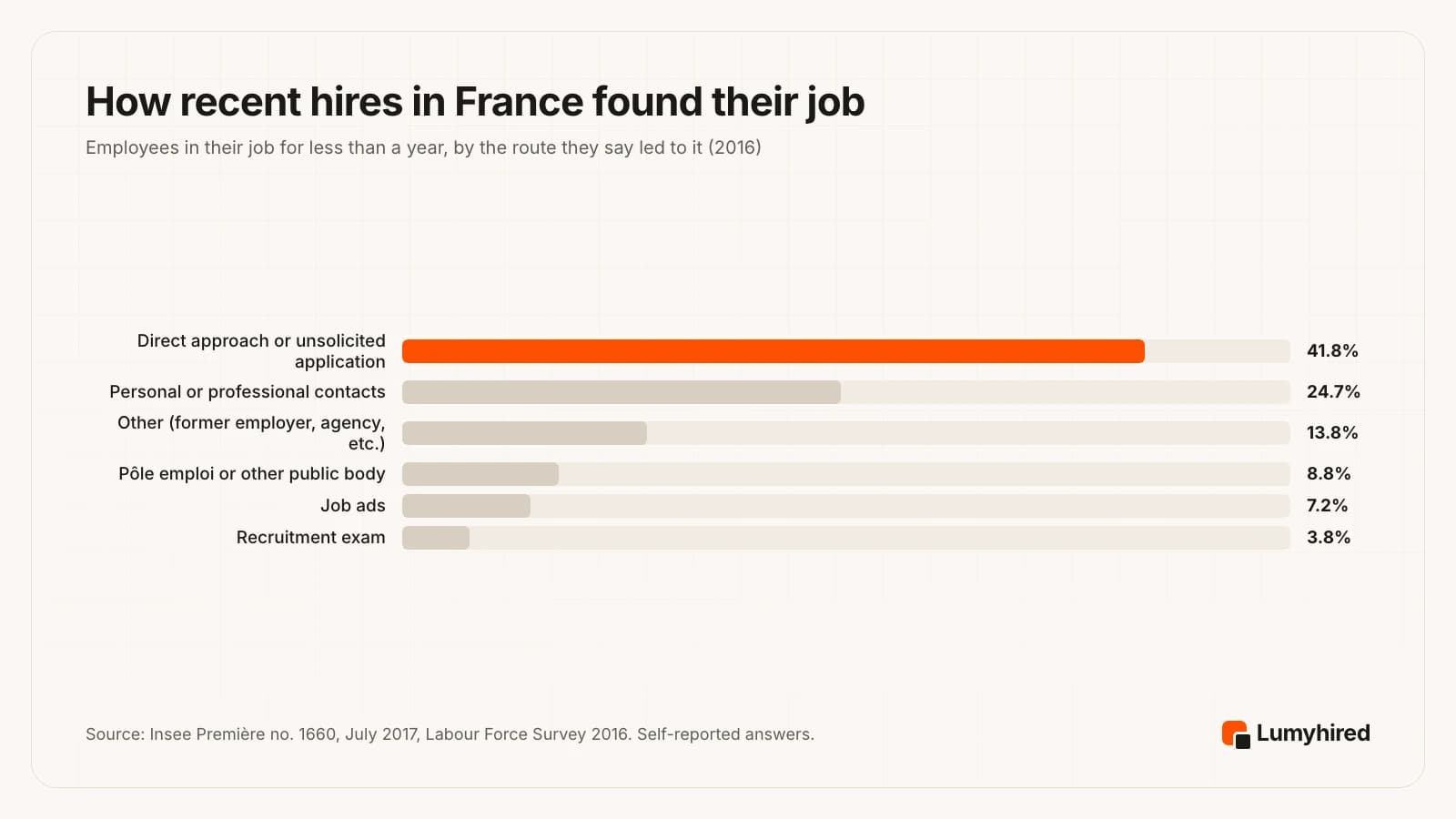
Insee, the French statistics office, asked people who had held their job for less than a year how they got it. 41.8% said through a personal approach to the employer or an unsolicited application, 24.7% through personal or professional contacts, and 7.2% through job ads. Direct contact with the employer and personal contacts together account for seven hires in ten. The same survey found that 62% of people looking for a salaried job had sent an unsolicited application in the previous four weeks.
Two limits matter. The data is from 2016. And Insee’s definition of an unsolicited application is wide: it includes one handed in at a trade fair, in person at the company, by post or email, or on the company’s website. Someone who applied through an employer’s own site may have answered a posting there and still ticked this box.
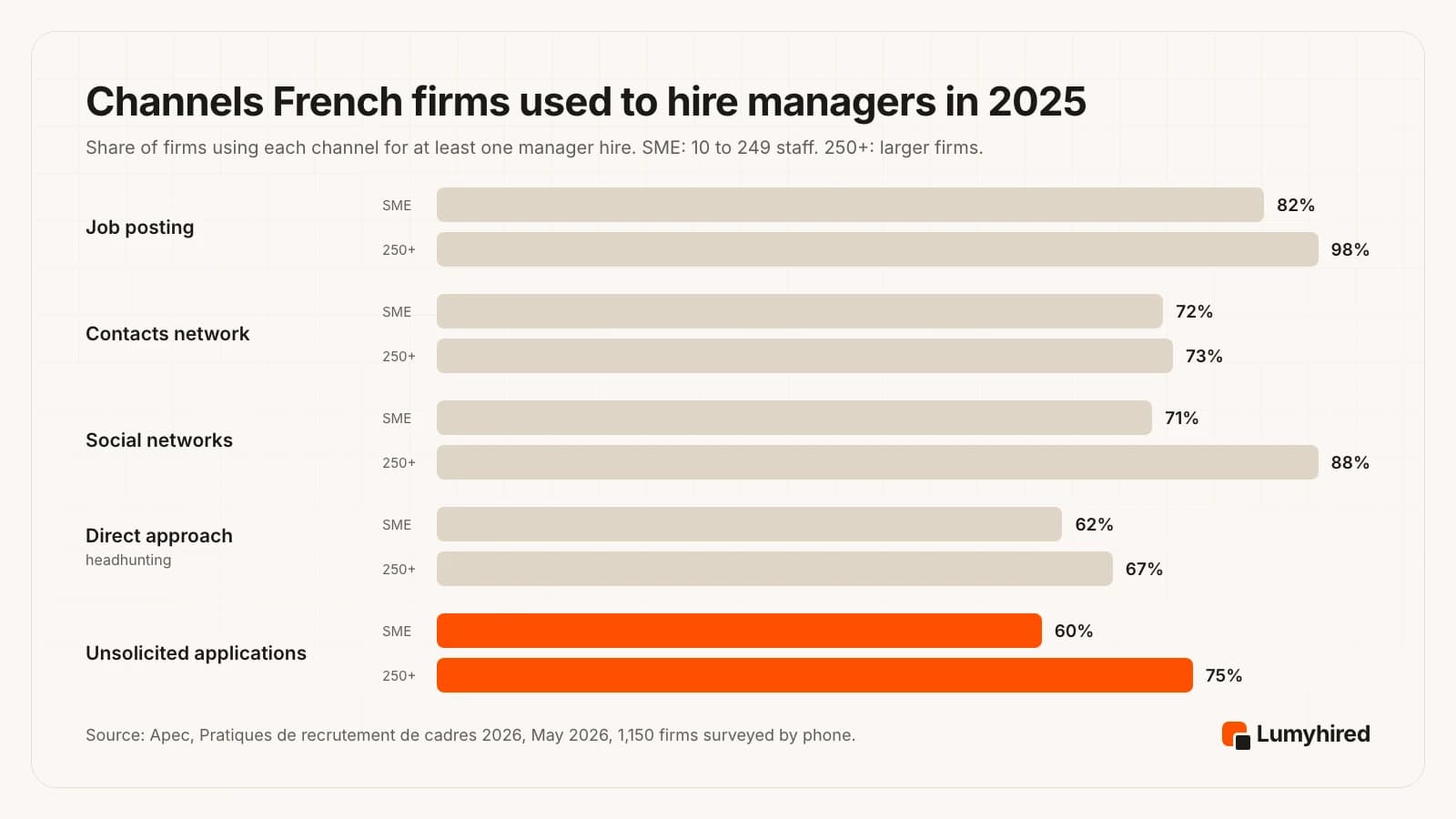
The employer side looks different for managers. Apec, the French agency for managerial employment, surveyed 1,150 firms in early 2026 about their 2025 hiring. Unsolicited applications were a channel for at least one manager hire at 60% of firms with 10 to 249 staff and 75% of larger firms, five points more than a year earlier in the larger group. Apec links the rise to a slower market in which firms receive more applications, unsolicited ones included.
Apec also asked each firm which channel most often found the person it hired: 54% of firms named the job posting. That is a share of firms. Apec also gives shares of hires: among the top five channels that produced manager hires, smaller firms list postings on job sites (35%), their contacts network (22%), postings on social networks (11%), headhunting (11%) and employee referral (6%). Unsolicited applications do not appear in the top five for either size of firm, which puts them at 6% of manager hires or less in smaller firms.
France Travail, the public employment service, gives a third view in its guidance for employers: summarising a study by Dares, the labour ministry’s statistics department, it says unsolicited applications are used in more than six recruitments out of ten. The same page lists the limits the study found for employers: unsolicited applications can be costly in staff time and resources, out of step with what the employer needs, and hard to track internally.
In the US, the Bureau of Labor Statistics does not ask how people got their job, but it does ask unemployed people what they did to look for one. In its 2025 annual averages, 50.8% of the 6.4 million unemployed jobseekers had contacted an employer directly, 56.1% had sent resumes or filled out applications, and 23.7% had contacted friends or relatives. The category covers any direct contact, so it does not isolate cold emails.
Read together, these sources support a modest plan. Cold emails are a common and legitimate way into a job, they are used by most French firms hiring managers at least occasionally, and for manager roles they produce fewer hires than postings and contacts. Run them alongside applications to posted jobs.
Is 70 to 80% of the job market really hidden?
No measured source supports it. The claim that 70 to 80 percent of jobs are never advertised circulates widely in career advice. The UK National Careers Service states that in some industries the hidden job market can be as high as 70% to 85% of all vacancies, without citing a study, and France Travail’s candidate guide says hiring goes “more and more” through the hidden market, without a figure. What research measures is how people were hired. In about 5,000 answers to the New York Fed’s job search surveys between 2013 and 2018, 18.7% of workers in high-skill jobs were hired through a referral from a business contact and 20.4% through a referral from family or friends; in low-skill jobs the figures were 14.0% and 27.4%. A role can be advertised and still go to someone the manager already knew. A separate guide covers how referrals compare with applications to posted jobs. No statistical office publication, government survey or academic paper found for this guide measures the share of jobs that are never advertised.
Who should you send a cold email to?
The person who would manage you, or the owner if the company is small. That person feels the workload, can argue for a new role, and can forward you to HR with a note attached. France Travail’s candidate guide recommends the owner in a small business and the HR department in a larger one, with names found on the company website or on professional networks. The UK National Careers Service lists a supervisor, manager or human resources officer. This guide adds the hiring manager because that person can create the role.
| Company size | Write to | Also do |
|---|---|---|
| Under 50 staff | The owner, founder or managing director | Nothing else; that person decides |
| 50 to 249 staff | The head of the team or department you would join | Copy the HR contact if the website names one |
| 250 staff and more | The hiring manager for that function | Submit a general application on the careers site so you exist in the applicant tracking system |
The size cut-offs are a rule of thumb. A useful test: who would notice if you started on Monday? Write to that person. Large firms used unsolicited applications for manager hires more often (75% against 60% in Apec’s survey), so use the careers portal there as well as the email.
Avoid generic inboxes such as info@ or a contact form when a named person is findable. They work as a last resort, and some small organisations offer nothing else. When that is the case, put the name of the team you are writing about in the subject line so the message can be forwarded.
How do you choose companies and find the right contact?
Work through six steps, in this order, and keep a written record of each. The process uses only public information and normal professional channels, and it never relies on tools that copy data from platforms in bulk.
| Step | What you do | Output |
|---|---|---|
| 1. Define the target | One line: role, level, sector, location or remote | “Payroll specialist, 5 years, logistics or retail, Lyon or remote” |
| 2. Build a long list | Companies that posted similar roles in the past year, recent news, your employer’s clients, suppliers and competitors, trade fair exhibitor lists | 20 to 30 company names |
| 3. Find a reason to write now | One sentence per company tying your skill to something you can see: a new site, a contract, a product launch, a team growing on its careers page | 10 to 15 companies with a reason; drop the rest |
| 4. Name the person | Team pages, press releases, article bylines, conference speaker lists, a LinkedIn search done by hand | One name and title per company |
| 5. Find a legitimate route | An address the company publishes, a call to the switchboard, a LinkedIn message, the careers portal | A way to reach that person, and its source |
| 6. Log and schedule | Company, person, where you found them, date sent, next follow-up date | A tracker you check twice a week |
Steps 2 and 3 do most of the work. A company that posted your role twice last year hires your profile; one that just opened a warehouse in your city will need people to run it. The sentence you write in step 3 becomes the first line of your email, and if you cannot write it, the email will read as generic. Past postings are also a good guide to the vocabulary the company uses, which matters when you tailor your resume to a specific employer.
Step 4 has one firm rule. Search LinkedIn yourself, one profile at a time. LinkedIn’s User Agreement, in section 8.2, forbids scraping or copying profiles and other data from the service, and using bots or other unauthorised automated methods to access it, add or download contacts, or send messages. Browser extensions and services that export profiles or reveal addresses in bulk work by doing those things. LinkedIn can restrict accounts that break these rules (section 3.4 of the same agreement).
Step 5: use the routes the company offers. Many companies publish named addresses on their site, in press releases or in the legal notice. A call to the switchboard works well, especially in smaller firms: “I’d like to send an application to whoever runs your payroll team. Who would that be, and how do they prefer to receive it?” You get a name, a route and sometimes a warm introduction in under two minutes. If the only option is a LinkedIn message, keep it to three sentences and ask where to send your resume.
Keep each send to one personal message to one person. Buying lists of addresses or sending the same email to dozens of people at once is what makes outreach feel like spam to the reader, and it is also the behaviour platform terms target.
How do you write a cold email for a job?
Five parts, in this order, in about 80 to 150 words. That length is a working convention: no study sets it, and it fits on a phone screen without scrolling.
- Subject line. The role plus a detail tied to that company: “Payroll specialist for your new Lyon warehouse”. It tells the reader what you are and why you wrote to them, before they open anything.
- The reason now. The sentence from step 3 of the process: what you saw and why it made you write. One line.
- Proof. What you do and one result with a number, chosen for this company. “I run payroll for 420 staff across three sites and cut correction requests by a third last year.”
- One question. A 15-minute call, whether they expect to hire for this kind of role this year, or who the right person would be. One ask only, easy to answer in a line.
- Signature and attachment. Name, phone, city, LinkedIn URL, and your resume as a PDF named “Firstname-Lastname-Resume.pdf”.
The resume matters more than in an ordinary application, because a manager who likes your email may forward it to HR, and HR may load it into the applicant tracking system. Tailor it to the company the way you would tailor it to a posting, using the terms from its past ads. If you write in a second language, have someone read the email aloud before you send it; awkward phrasing is far more visible in five sentences than in a two-page resume.
What to leave out: your life story, a list of every skill, the phrase “any position”, and anything that reads as a mass mailing.
Cold email templates for a job
Four templates, one per situation. Replace every bracket with something specific to the company. The names and figures are examples.
1. To a hiring manager, no job posted
Subject: Payroll specialist for your new Lyon warehouse

Hi [first name],

I saw that [company] opened its Lyon distribution site in [month], and that the careers page now lists 40 warehouse roles there. Growth like that usually lands on payroll before anyone plans for it.

I run payroll for 420 staff across three sites at [current employer], including shift premiums and temp-to-permanent conversions, and last year I cut correction requests by a third.

Would a 15-minute call in the next two weeks be useful? My resume is attached.

[Full name]
[Phone] · [City] · [LinkedIn URL]
2. To the owner of a small business
Subject: Bookkeeping help as [company] grows

Hello [first name],

Your team has doubled in two years, from what your website shows, and the [award / new contract] in [month] suggests that will continue.

I am a bookkeeper with six years in small firms of 10 to 40 people. I close the books monthly, handle VAT returns and payroll exports, and in my current job I brought the monthly close from twelve days to five.

If you expect to need this in-house this year, full or part time, I would be glad to talk. My resume is attached, and I can send references.

[Full name]
[Phone] · [City]
3. To someone who works there
Subject: Question about the data team at [company]

Hi [first name],

I read your post on [topic] and the way your team moved reporting to [tool]. I am a data analyst at [current employer] working on similar problems, and [company] is high on the list of places I would like to work next.

Could I ask you two questions by email: how the data team usually hires, and who decides? I would be glad to send my resume if that ever seems useful.

Thanks either way,
[Full name] · [LinkedIn URL]
4. Graduate or internship
Subject: Junior marketing analyst, available from [month]

Hello [first name],

I graduate in [month] with a degree in [field] and have followed [company]’s [campaign / product] since [event]. For my final project I built a dashboard from 12 months of a retailer’s sales data in Excel and Power BI, which the store still uses.

I would like to start my career on a team like yours. Do you take on junior analysts or interns, and if so, who should I contact? My resume and a link to the project are below.

[Full name]
[Phone] · [Portfolio URL]
Template 3 asks the reader for the least. The question is easy to answer, it costs the reader nothing, and it matches the referral data above, where a large share of hires came through someone the candidate already knew.
Should you send a cover letter with a cold email?
Put your case in the body of the email, and attach a letter only when the company or the sector expects one. Fewer French firms hiring managers ask for a letter than in 2021. In Apec’s 2026 survey, half of the firms that hired a manager asked at least one candidate for a cover letter in 2025, against nearly 70% up to 2021. In 2025 the share was 62% in services (excluding high value-added services) and 40% in retail.
When you do send one, it follows a three-paragraph shape: why this company, what you bring, and what you propose. Keep it to one page.
[Full name]
[Address or city] · [Phone] · [Email]

[Contact name]
[Title], [Company]
[Date]

Speculative application: [role or field]

Dear [Mr/Ms surname],

[Company] has [specific fact: opened a second plant, won the regional transport contract, launched its own-brand range]. I am writing because that kind of growth calls for [the work you do], and I would like to do it for you.

For the past [number] years I have [your core job in one sentence] at [employer]. Two results are relevant to you: [result one, with a number], and [result two, with a number]. I also [one skill or certificate the company’s past postings ask for].

I am not answering a published vacancy, so I would like to propose a short conversation to see whether my experience matches a need you have now or expect this year. I will call your office in the week of [date] unless you would prefer another time.

Yours sincerely,
[Full name]
Two lines in that letter do the most work. The first sentence proves you chose the company on purpose. The closing line names what happens next, so the follow-up call is expected when it comes.
When and how should you follow up?
Twice: about a week after the first email, then about three weeks after it, both in the same thread. Then stop until you have real news. France Travail’s candidate guide recommends following up by message, by phone, or both, and presents it as a sign of motivation. The exact intervals below are a convention; no study sets them.
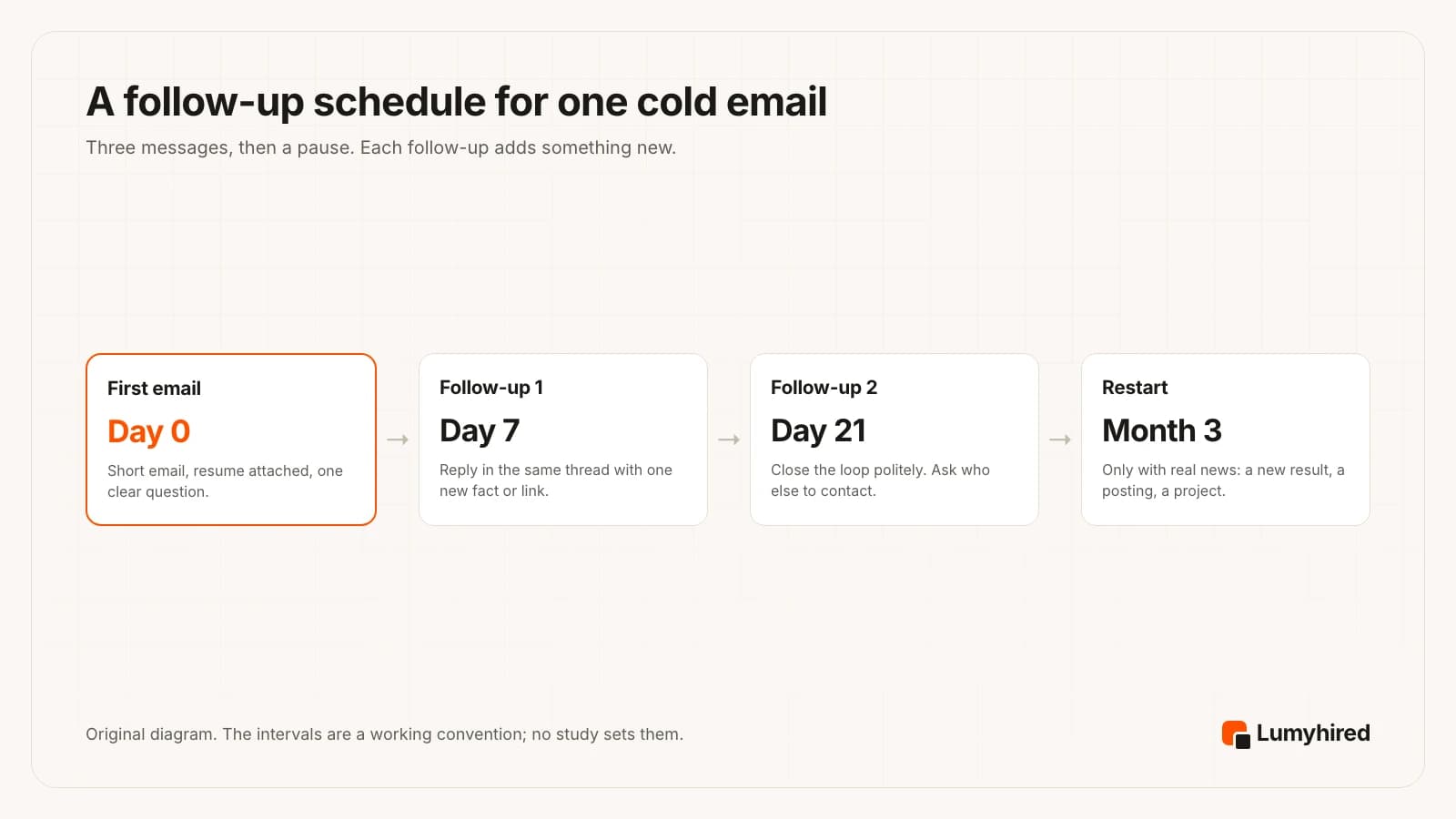
Each follow-up adds one new element. Two examples:
Follow-up 1, day 7
Hi [first name],

A short addition to my note below: I put together a one-page summary of how we handled the shift-premium changes in [month], in case it is useful for the Lyon site. It is attached.

Happy to talk whenever suits you.
[First name]
Follow-up 2, day 21
Hi [first name],

I will not keep filling your inbox. If payroll hiring is not on your plan this year, is there someone in HR or finance who would be the right person to contact? And if the timing changes, my details are below.

Thanks for reading,
[Full name] · [Phone]
The second follow-up asks a question that is easy to answer even when the answer is no, and a name you receive that way is a warm contact. If you call instead, keep it to three sentences: who you are, the email you sent on what date, and whether it reached the right person.
After day 21, move the company to a quarterly check. Restart only when you have something new to say: a posting for a related role, a result in your current job, or company news you can connect to your work.
Is it legal to email a company your resume?
Yes. You are sending your own personal data, by choice, to an employer. Once the employer has it, data protection rules apply to the employer. In the European Union that means the GDPR, and the CNIL, France’s data protection authority, has published plain guidance on what it means for candidates.
- You must be told what happens to your data. During recruitment the employer has to inform you of who holds the file, what it is used for, its legal basis, which answers are optional, who receives the data, how long it is kept, and your rights of access, objection and rectification.
- Your file can be kept after a rejection, within limits. The CNIL’s answer for candidates says a recruiter can keep your data even if you do not get the job, on condition that it informs you and has your agreement, for 2 years after your last contact, or longer if you have formally agreed.
- The 2026 HR retention guide sets two durations. A talent pool of candidates whose profile interests the employer, unless they object or where they consented, can be kept for up to 2 years from the last contact (a CNIL recommendation). Application files of unsuccessful candidates are archived for 5 years from the date the position was filled, as evidence for possible discrimination claims (article L.1134-5 of the French Labour Code, an obligation).
- The two texts frame the talent pool differently. The answer for candidates asks for your agreement; the guide allows it unless you object. In both cases you keep the right to object, which the CNIL lists among the rights you must be told about.
Two practical consequences. First, an unsolicited application can resurface months later when a role opens, which is a reason to make the resume you send a good one. Second, you can ask a company what it holds about you and ask it to delete it. Send only what a first contact needs: no identity document scans, no social security or national insurance number.
These are EU rules applied in France. If you apply to employers in the US, they do not apply in the same way, so ask the company how it handles unsolicited resumes if it matters to you. The LinkedIn rules in section 8.2 of its User Agreement apply wherever you are.
What mistakes get a cold email ignored?
- Visible mass mailing. Several companies in the “To” field, “Dear Sir or Madam”, a body that would fit any employer. Each one tells the reader the message was not written for them.
- Asking for “any position”. It hands the reader the work of figuring out where you fit. Name the role or the problem you solve.
- No reason to write now. Without step 3 of the process, the email gives the reader no reason to read it now.
- A resume behind a link that needs permission. Attach a PDF. A shared-drive link that asks for access gets closed.
- The wrong name or company. A copy-paste error in the first line ends the reading there.
- Following up every two days. Two follow-ups over three weeks are enough. Stop after the second.
- A generic resume. The reader who opens the attachment looks for the terms of their own field. Tailor the resume to the company.
How many cold emails should you send, and how do you track them?
As many as you can personalise properly. No study gives a right number for cold emails. The constraint is the time steps 2 to 4 take for each company, and the follow-ups that pile up behind every send.
The arithmetic of follow-ups is what makes a tracker necessary. Five emails a week, each with two follow-ups, means fifteen messages a week by the third week, each due on a different day. Track at least these columns: company, contact and where you found them, date sent, follow-up 1 date, follow-up 2 date, outcome, and next action. The comparison of job application trackers covers tools that hold this, and a spreadsheet works too.
Balance cold emails against applications to postings, since in the Apec survey postings were the channel firms most often named as finding their hire. How many applications to send overall, and how many it typically takes to reach an interview, is covered in how many jobs to apply for.
Frequently asked questions
Do cold emails for a job actually work?
What should the subject line of a cold email for a job be?
How long should a cold email for a job be?
Should I send a cover letter with a cold email for a job?
How long should I wait to follow up on a cold email?
Is it better to cold email HR or the hiring manager?
How long can a company keep my resume?
Is 80% of the job market hidden?
Make the attached resume count
A cold email gets you one read of your resume, and it may get a second one inside an applicant tracking system if a manager forwards it. Before you send anything, run your resume through the ATS preview, which is free and needs no account, to see exactly what a parser extracts. Lumyhired then tailors your master resume to each job description, ranks open jobs by how well they match you, and keeps every application in a kanban tracker with interview reminders and AI interview preparation. Weekly plans start at €5 on the pricing page, with a 3-day money-back window and no free plan.
Sources
Read 14 October 2026. The Dares study that France Travail summarises (Document d’études no. 259) could not be opened for verification, because its server returned a human-verification page, so its figure is reported as France Travail states it. No primary source was found for the claim that 70 to 80% of jobs are never advertised. The Insee figures date from 2016; no more recent Insee breakdown of how recent hires found their job could be found.
- Insee, Comment recherche-t-on un emploi ?, Insee Première no. 1660, Jorick Guillaneuf, 19 July 2017 (Labour Force Survey 2016, France excluding Mayotte)
- Apec, Pratiques de recrutement de cadres 2026, May 2026 (phone survey of 1,150 private firms with 10 or more staff that hired at least one manager in 2025, 13 January to 12 February 2026; PDF hosted by Banque des Territoires)
- France Travail, Candidatures spontanées : 4 conseils pour bien gérer votre vivier de talents, employer guide summarising a Dares study, read 14 October 2026
- France Travail, La candidature spontanée : mode d’emploi, candidate guide, read 14 October 2026
- US Bureau of Labor Statistics, Current Population Survey, 2025 annual averages, Table 34: Unemployed jobseekers by sex, reason for unemployment, and active job search methods used (6.405 million jobseekers; 11-month average, October 2025 not collected)
- Lester, Rivers and Topa, The Heterogeneous Impact of Referrals on Labor Market Outcomes, Federal Reserve Bank of New York Staff Report no. 987, October 2021 (Survey of Consumer Expectations job search supplements 2013 to 2018, 5,062 observations)
- CNIL, Recrutement : un employeur peut-il conserver mon dossier ?, read 14 October 2026
- CNIL, Recrutement : de quoi dois-je être informé ?, read 14 October 2026
- CNIL, Référentiel : les durées de conservation des données, gestion des ressources humaines, published 2 April 2026, updated 20 May 2026
- National Careers Service (UK government), Where to find job vacancies, read 14 October 2026
- LinkedIn, User Agreement, sections 3.4 and 8.2, effective 3 November 2025
Read next
- Job Search Strategies 2026: Which Channels Get Interviews
Interview rates by job board and career page, referral vs cold application, five message templates and a 10-hour weekly plan built from 2026 data.
- How to Get a Job in 2026: A Data-Backed Guide
The 2026 job market in numbers (11.4 weeks median unemployment, 244 applications per job, 108 days to an offer), an 8-step method and a realistic 30-day plan.
- How to Tailor Your Resume to a Job Description
A 15-minute method with three before and after bullets, an AI prompt that forbids invented facts, and Huntr's data: tailored resumes got interviews at 4.23% vs 2.07% in Q1 2026.
- How Many Jobs Should You Apply To?
The math behind the number: 0.5% of applications become offers, tailoring roughly doubles interview rates, and a weekly plan for each situation.
- Best AI Cover Letter Generator in 2026: 8 Tools Ranked
Eight generators ranked on reading the posting and your resume, keeping claims honest, and cost, with callback data and a prompt that checks every fact.