
Career Guides
How to negotiate salary in 2026, now that the law has moved
Published 27 September 2026. Almost every page ranking for this question was written for the United States and predates the rule that was supposed to land across the European Union this year. That rule changes what you are entitled to know before you speak, and therefore changes what a negotiation is. This page separates what is in force where you apply from what is still a bill, then goes through the published evidence on first offers, on who gets penalised for asking, and on the statistics we threw out.
How do you negotiate salary in 2026?
Start by finding out what the employer is legally required to tell you, because it decides whether you negotiate against a number or against a guess. Directive (EU) 2023/970 gives applicants the right to receive the initial pay or its range before the job interview, and bars the employer from asking your pay history. Member states had until 7 June 2026 to put it into national law. Most missed that date. Where the law has arrived, ask for the range, the typical starting salary and the criteria behind the final offer, then counter with a precise figure. Where it has not, the same three questions still work, just without a right behind them.
Directive text read from the Official Journal (OJ L 132, 17 May 2023) on 27 September 2026. Transposition status read the same day from national sources and law firm trackers, which disagree on the count.
What was supposed to happen on 7 June 2026
Directive (EU) 2023/970 was adopted on 10 May 2023, published in the Official Journal on 17 May 2023 and entered into force twenty days later under Article 36. Article 34 gave member states until 7 June 2026 to bring it into national law. That date has passed. It is the reason this is the year the mechanics of a pay conversation change in Europe, and the reason advice written in 2023 is now wrong in a specific way rather than merely dated.
Article 5 is the part aimed at you rather than at employees. It gives applicants the right to receive, from the prospective employer, information about the initial pay or its range for the position, based on objective and gender-neutral criteria, plus the relevant provisions of any applicable collective agreement. The text says that information shall be provided in a manner such as to ensure an informed and transparent negotiation on pay, such as in a published job vacancy notice, prior to the job interview or otherwise. Article 5(2) says an employer shall not ask applicants about their pay history during their current or previous employment relationships. Article 5(3) requires gender-neutral vacancy notices and job titles.
Two details are worth more than the headline. First, this is a push obligation rather than a request right: unlike Article 7, which lets workers ask for pay data, Article 5 puts the duty on the employer and requires nothing of you. Second, the directive does not require the number to appear in the advert. It requires it to reach you before the interview at the latest, and lets the employer pick the vehicle. A great deal of coverage states the opposite. Individual countries can go further, and France’s draft does.
One sleeper provision deserves a mention because nobody writes about it. Article 18(2) reverses the burden of proof in a pay discrimination case when the employer has not met its transparency obligations under Articles 5, 6, 7, 9 or 10. The employer then has to prove there was no discrimination, unless the breach was manifestly unintentional and minor. An employer who refuses to give you a range is not only declining to answer, it is weakening its own position in any later dispute.
Where that leaves you today
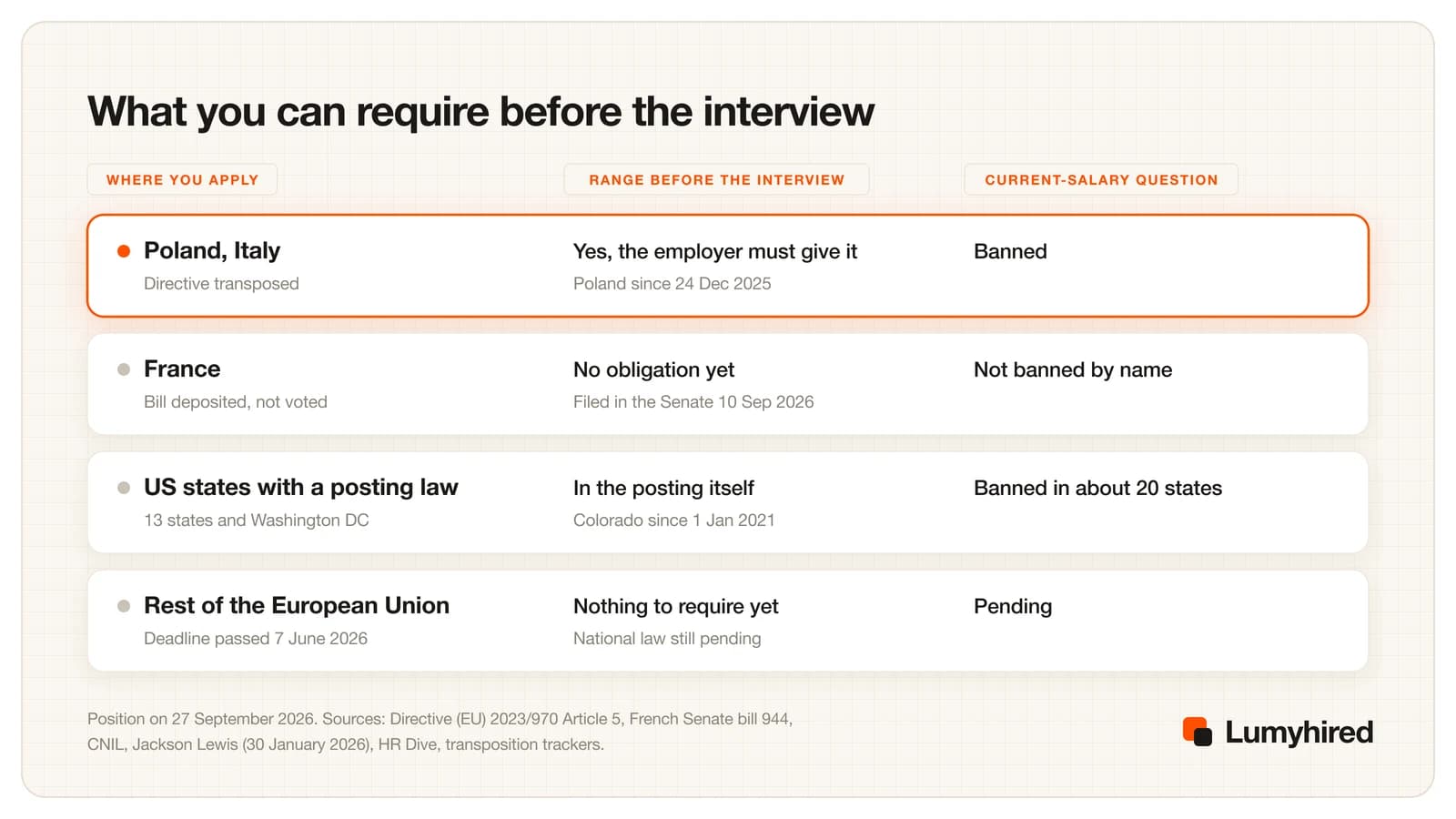
Transposition is patchy and the trackers do not agree with each other. One law firm alliance counted a single member state fully transposed in late September 2026. One specialist tracker counted four in force at the deadline. Both agree on Italy. Rather than print a number, here is what we could verify country by country, and the honest answer is that for most European candidates the directive changes nothing yet.
| Where you apply | Pay range before the interview | Pay history question | Status |
|---|---|---|---|
| Poland | Yes. Starting pay or a range, in the advert or at the latest before the interview. | Banned. Applicants may not be asked about current or previous pay. | In force 24 December 2025, recruitment provisions only |
| Italy | Yes, under the national transposition decree. | Banned. | In force 7 June 2026 |
| France | No obligation yet. The transposition bill would require a range in every advert. | Not banned by name. The CNIL held in 2024 that collecting past salaries is not justified. | Bill 944 filed in the Senate on 10 September 2026, not yet voted |
| Most of the rest of the EU | Nothing to require yet. The 7 June 2026 deadline passed with national law still pending. | Pending. | Sweden paused its transposition on 26 March 2026 |
| United States, 13 states and DC | Yes, in the posting itself. Connecticut joins them on 1 October 2026. | Banned for private employers in about 20 states. | Colorado first, 1 January 2021 |
| United Kingdom | No. The directive was adopted after Brexit and does not apply. | No ban. Equality Act 2010 and UK gender pay gap reporting are unchanged. | Applies to UK employers only for staff based in a member state |
Poland is the clearest working example in the EU. Its labour code amendment took effect on 24 December 2025 and covers exactly the candidate stage: starting pay or a salary range in the advert or at the latest before the interview or the contract, no questions about current or previous pay, and gender-neutral adverts and job titles. The broader employee-facing obligations are still a separate draft there. If you want to see what Article 5 looks like in practice rather than on paper, that is where to look.
France missed the deadline and has not caught up. A standalone transposition bill, number 944, was filed in the Senate on 10 September 2026 under the accelerated procedure, and the Senate dossier recorded no further step as of 18 September. Article 4 of that bill would amend Article L. 1221-6 of the Code du travail to bar questions on a candidate’s current or past pay, create a new L. 1221-9-1 requiring an initial pay range before or during the hiring interview, and add an L. 5332-2-1 making it unlawful to publish a job advert without a pay range. That last one goes beyond what the directive asks. None of it is law yet. The French edition of this article covers what a candidate in France can actually do today.
The United States got there first, state by state
Colorado began requiring pay ranges in job postings on 1 January 2021, five years before the EU deadline. A pay transparency tracker published on 30 January 2026 listed eleven states plus the District of Columbia with posting requirements: California, Colorado, Hawaii, Illinois, Maryland, Massachusetts, Minnesota, New Jersey, New York, Vermont and Washington. Virginia joined on 1 July 2026 and Maine on 29 July 2026. Connecticut moves from disclosure on request to disclosure in the posting on 1 October 2026, four days after this article was published, and its law also requires a general description of benefits in every posting. Delaware follows on 26 September 2027. Nevada and Rhode Island require disclosure on request rather than in the advert, which is why counts of these laws differ so widely.
Those laws have now been running long enough to measure. Arnold, Quach and Taska compared states that adopted posting mandates against states that did not, using three independent datasets: Lightcast job postings, self-reported Glassdoor earnings and QCEW administrative wage records. Employers increased the share of postings carrying salary information by 30 percentage points, and in Colorado the share went from roughly 35% before the law to nearly 70% in the months after. Wages rose between 1.3% and 3.6% depending on the dataset, for people already in post as well as new hires, with no measurable effect on employment, on posting volume or on pay dispersion. Compliance, they note, is still far from complete, and the highest-paying occupations remain the least transparent.
Two other findings are usually reported as if they contradicted that one. Cullen and Pakzad-Hurson found in Econometrica that pay transparency lowered wages by about 2%, but they studied laws protecting workers who ask about a colleague’s pay, which is a different policy with a different mechanism. Bennedsen and colleagues studied Denmark’s 2006 gender pay reporting law across roughly 67,000 employee-firm observations in about 3,900 firms and found the gender gap narrowed by about 13% of its pre-law level, achieved mainly by slowing men’s wage growth rather than by raising women’s. That result is real and it is uncomfortable, and leaving it out would make this page less useful.
A posted range is not an offer, and barely a signal
The most common mistake candidates now make with a transparent posting is treating the band as the answer. It is not even close. Lee, Park and Chang analysed about 10 million US job postings from January 2020 to December 2024 and found the average posted range spanned $38,108, with 43% of postings carrying a single figure and no range at all. A band of that width tells you what the employer is prepared to write down in public, and almost nothing about where your own offer would land.
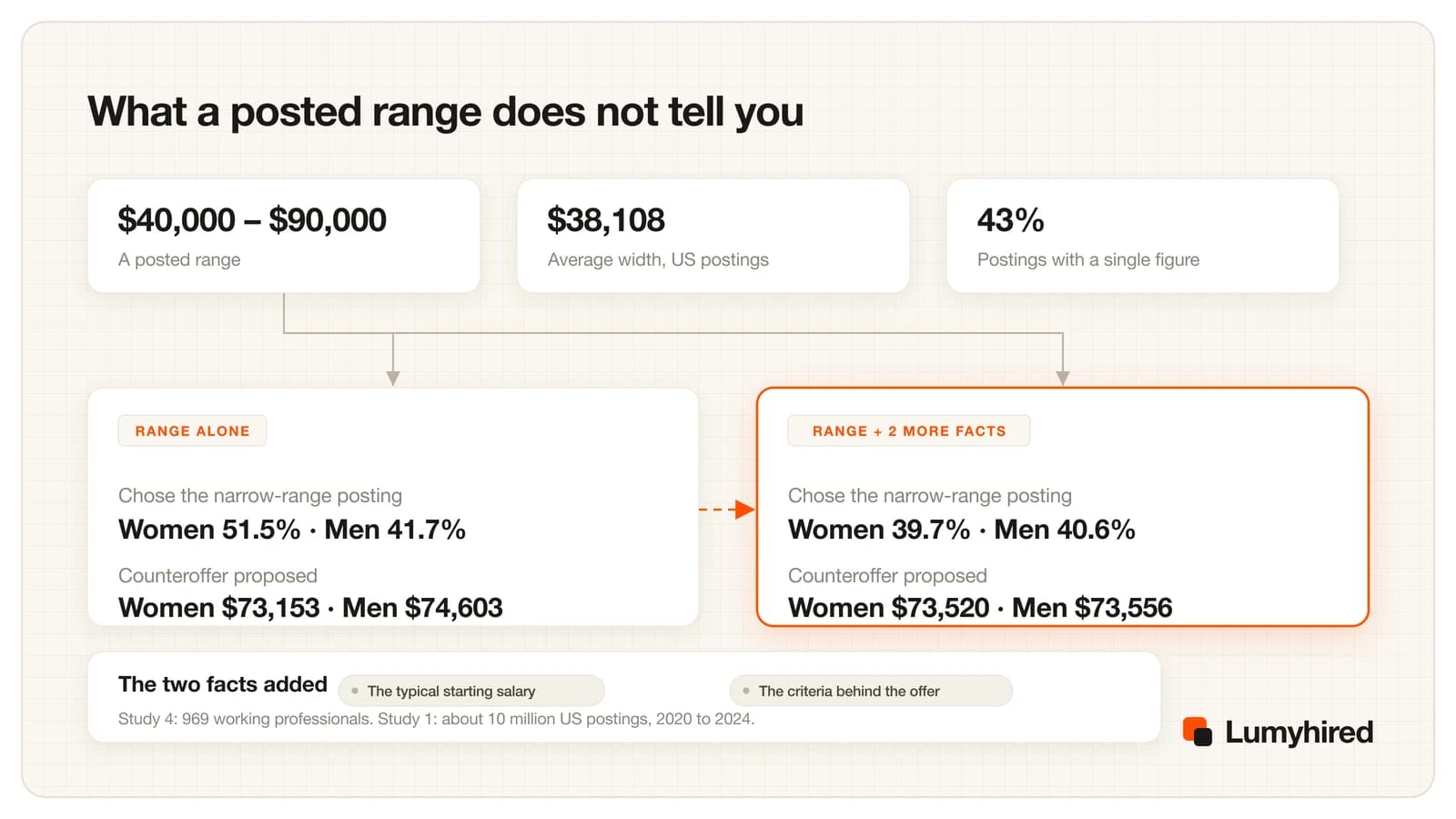
Their fourth study is the practical one. Shown two comparable roles, one advertised at $55,000 to $75,000 and one at $40,000 to $90,000, women chose the narrow band more often than men, 51.5% against 41.7%, and proposed lower counteroffers, $73,153 against $74,603. When the same postings also stated the typical starting salary and the criteria used to set the final offer, both gaps closed: 39.7% against 40.6% on the choice, and $73,520 against $73,556 on the counteroffer. The authors attribute the pattern to differences in risk preference rather than to negotiating skill.
The instruction that follows is short. Once you have the range, ask for the two facts that give it meaning: what someone typically starts on in this role, and what decides where in the band an offer sits. Article 6 of the directive requires employers to make those criteria accessible, though it says workers rather than applicants, so at the candidate stage this is a reasonable question rather than a right. Ask it in writing, before the interview, at the same time as you ask for the range.
And if a recruiter tells you the top of the band is the ceiling, the directive itself disagrees. Recital 32 says the information should let candidates make an informed decision about expected salary without limiting in any way the employer’s or the worker’s bargaining power to negotiate a salary even outside the indicated range.
What the research really says about going first
The advice to anchor high rests on a literature that is thinner and more qualified than its popular version. Galinsky and Mussweiler’s 2001 paper in the Journal of Personality and Social Psychology is the one everyone cites for first-mover advantage, and its actual contribution is the opposite emphasis: the advantage was eliminated when the other side focused on information inconsistent with the anchor, such as their own walkaway or their own target. We could not obtain the full text, so we do not state its sample sizes.
The better-documented finding concerns precision rather than order. Mason, Lee, Wiley and Ames ran six studies in 2013. In the live negotiation between 130 pairs of managers, MBA students and undergraduates, a precise opening offer drew a counteroffer adjustment of $3,197 against $4,235 for a round one, an effect of d = 0.57, and the difference survived into the final settlement gap. Their own footnote is the part worth keeping: the mean final price was lower for precise offers, $12,932 against $13,022, but that difference did not reach significance at p = .34. Precision moved how far the other side pushed back. It did not demonstrably move the money.
Then there is the size question. Li, Weigel, Ferraro and Messer reported in Economic Inquiry in 2025 that anchoring studies routinely run below 30% statistical power, and that a high-powered replication of a study reporting a 31% bid increase produced an effect of 3.4% with a confidence interval from -3.4% to 10%. Anchoring survives as a direction. The magnitudes in circulation are inflated.
One gap is worth naming rather than papering over. We looked for a field experiment isolating first-offer effects in real job negotiations and did not find one. Everything above is laboratory or scenario evidence, plus one real-estate study from 1987 that is often cited as if it were about hiring. Anyone telling you that going first is proven to raise real salaries is going beyond the record.
Who pays a price for asking
Bowles, Babcock and Lai published the study behind every headline on this in 2007, and it is distorted more often than it is read. In their first experiment, with 119 undergraduates, evaluators rated a candidate who asked for more as less hireable, with an effect of d = 0.65 for men and d = 1.44 for women. In their second, with 236 college-educated adults of median age 37, willingness to work with the candidate fell sharply for women, d = 0.95, while for men the effect was statistically indistinguishable from zero.
Their third experiment is the one that gets dropped. With 247 participants watching videotaped candidates, the penalty depended on who was evaluating: with male evaluators, female candidates were penalised and male candidates were not, while female evaluators penalised both. The often-quoted ratio of 5.5 times is a ratio against a baseline that was statistically zero, which is why we quote the effect sizes instead. The authors also flag their first experiment’s manipulation as too strong.
The premise that women simply ask less has also been challenged. Artz, Goodall and Oswald used matched employer and employee data from 2013 and 2014 in Industrial Relations and concluded that women do ask but women do not get: once hours of work are controlled for, men and women request raises and promotions at statistically similar rates, and the difference lies in what is granted. We could not retrieve their exact sample size and do not print one.
Race has its own evidence. Hernandez, Avery, Volpone and Kaiser published three studies in the Journal of Applied Psychology in 2019. In a live negotiation between 109 pairs, every bargaining move a counterpart perceived cost Black job seekers about $314 in final salary, against a statistically null $57 for non-Black job seekers, and counterparts higher in explicit bias perceived Black participants as negotiating harder than they had. The direction replicated across three studies, but the dollar figure rests on 27 Black participants in that cell, so read it as a pattern rather than as a price list.
Does negotiating pay, and by how much
Honest answer: nobody has produced a causal estimate, because you cannot randomise people into negotiating. The strongest employer-side evidence is a 2017 survey by Harris Poll for CareerBuilder, which is unusually well documented for a vendor study: 2,369 full-time employers, fielded between 24 May and 16 June 2017, margin of error 2.01 percentage points. In it, 52% of employers said their first offer is lower than what they are willing to pay, and 26% said the first offer sits at least $5,000 below. A 2019 Robert Half survey of more than 2,800 senior managers found 70% expecting some back and forth on salary, which is a staffing firm surveying its own market and should be read as such.
On the candidate side, Marks and Harold surveyed 149 new hires for the Journal of Organizational Behavior in 2011 and reported roughly $5,000 more in annual pay for those who negotiated rather than accepting the first offer. That is self-reported, cross-sectional and not randomised, so it measures the gap between people who negotiate and people who do not as much as it measures negotiating. Their more durable finding is about strategy: competing and collaborating approaches predicted better outcomes, accommodating and avoiding did not.
| Claim | What the evidence shows | Source and sample |
|---|---|---|
| Posting a range raises pay | Posted wages rose 3.6% and measured earnings 1.3% in two independent datasets, with no effect on employment, on the number of postings or on pay dispersion. | Arnold, Quach and Taska, working paper, 7 November 2025. Lightcast postings, Glassdoor self-reports and QCEW administrative wage data. |
| Ranges got uselessly wide once the laws landed | Not supported. The same study found no increase in posted range width, and concluded the policy did not make postings less informative. | Arnold, Quach and Taska, 2025, minimum and maximum posted salary analysed separately. |
| A precise first number beats a round one | Supported for the size of the counteroffer, d = 0.57 in a live dyadic negotiation. The effect on the final agreed price did not reach significance (p = .34). | Mason, Lee, Wiley and Ames, Journal of Experimental Social Psychology, 2013. Six studies, 130 negotiating pairs in the live study. |
| Anchoring effects are as large as they are usually quoted | Contested. A high-powered replication of an effect published at 31% found 3.4%, 95% CI from -3.4% to 10%, and reported that anchoring studies routinely run below 30% power. | Li, Weigel, Ferraro and Messer, Economic Inquiry, 2025. |
| Women are penalised for negotiating | Supported with conditions. The penalty was large with male evaluators (d = 0.95 against a null for men) and disappeared as an asymmetry with female evaluators, who penalised both genders. | Bowles, Babcock and Lai, OBHDP, 2007. Four experiments, 119 to 341 participants each. |
| Women ask less often than men | Challenged. Matched employer and employee data found women ask at the same rate as men once hours are controlled for, and receive less. | Artz, Goodall and Oswald, Industrial Relations, 2018. Australian workplace survey data, 2013 to 2014. |
| Employers leave room above their first offer | 52% of employers said their first offer is below what they are willing to pay, and 26% said it is at least $5,000 below. | CareerBuilder and Harris Poll, 27 October 2017. 2,369 employers, margin of error 2.01 points. |
The statistics we rejected, and why
Salary negotiation advice runs on numbers that nobody has traced in twenty years. We tried to trace them and could not, so they are absent above and named here instead.
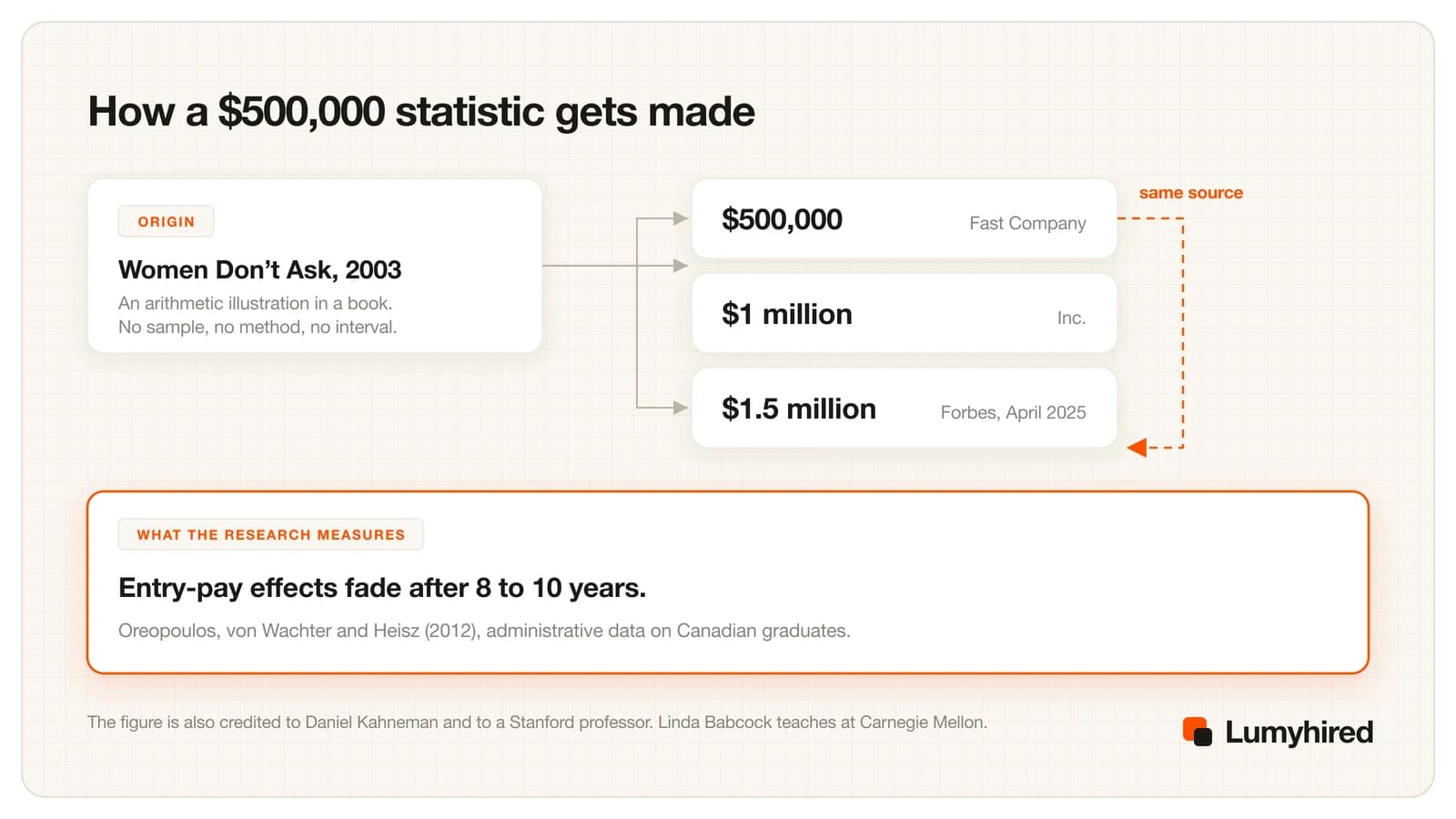
- Failing to negotiate costs you $500,000 over a career. This traces to an arithmetic illustration in Babcock and Laschever’s 2003 trade book Women Don’t Ask, a hypothetical worker projected forward with assumed raises. There is no sample, no method and no interval. It is restated as $500,000 by Fast Company, $1 million by Inc. and $1.5 million by Forbes in April 2025, and variously credited to Daniel Kahneman and to a Stanford professor. Linda Babcock teaches at Carnegie Mellon. It is also contradicted by the evidence on wage persistence: Oreopoulos, von Wachter and Heisz found that the earnings penalty for graduating into a recession fades over eight to ten years as people move to better employers.
- Negotiating raises your salary by 7%. This traces back to the same 2003 book, via the sentence quoted in Bowles and colleagues’ own 2007 paper: graduating professional-school students who negotiated gained on average 7.4% over their initial offers. One cohort, one school type, about twenty-five years ago, and the negotiators were self-selected. One secondary source puts the sample at 37 students; we could not confirm that in a primary document.
- Only 37% of people always negotiate. Traceable to a Salary.com article of 18 January 2012 reporting a poll of nearly 2,000 people with no fielding dates, no sampling frame, no weighting and no margin of error. Fourteen years old and almost never dated when quoted.
- Glassdoor says 70% (or 73%) of employers expect you to negotiate. We could not trace either version to a primary release. The nearest real figure is the 2019 Robert Half survey cited above, which is a different company, a different year and a staffing firm.
- Recruiter surveys on how often offers land below the posted band. One vendor analysis we read reports figures from a survey of 250 or more recruiters without disclosing how they were recruited or how they were weighted, so we left it out. The peer-reviewed alternative on range behaviour is in the section above.
A sequence built on what is actually in force
Five steps, in order, each of which rests on something above rather than on a slogan.
- 1. Establish the regime before you apply. Check the table above for the country or state the role sits in. In Poland, Italy or a US posting state you are asking for something the employer owes you. In France or most of the EU you are asking for a favour, which changes your tone rather than your question.
- 2. Ask for three things in writing, before the first interview. The initial pay or its range, the typical starting salary for the role, and the criteria that decide where in the band an offer lands. The first is an Article 5 right where the directive has arrived. The second and third are what made the gender gap in counteroffers disappear in the 2026 experiment.
- 3. Decline the pay history question without making it a fight. Where it is banned, say so plainly. Where it is not, answer the question they are allowed to ask instead: give your expectation for this role, based on the range they published. The distinction between pay history and pay expectation is the one the law draws, and it is the one that gives you a clean exit.
- 4. Counter with a precise number. Not $75,000. $76,400, with the reason attached. The 2013 evidence is that precise figures draw smaller counter-adjustments. The same evidence is that this may not move the final price, so do not stake the negotiation on it.
- 5. Negotiate the components the band does not cover. Signing bonus, review date, notice period, remote arrangement, training budget. Arnold and colleagues found the highest-paying occupations are still the least transparent, which is the same as saying the further up you go, the more of the package sits outside the published number.
Everything here assumes you have an offer to negotiate. If you do not yet, the stages before this one are covered in why you are not getting interviews and how to target the right postings, and a posted range is one of the better signals for the second of those.
Frequently asked questions
Can an employer still ask what I currently earn in 2026?
Do I have to be given a salary range before the interview?
Is the posted range the most I can get?
Should I give the first number?
How much does negotiating actually add?
Am I risking the offer by asking?
Does a pay transparency law close the gender pay gap?
What if the range is very wide?
Sources
- European Union, Directive (EU) 2023/970 of 10 May 2023 on equal pay through pay transparency and enforcement mechanisms. OJ L 132, 17 May 2023, pp. 21 to 44. Articles 5, 6, 7, 9, 10, 18, 34 and 36 and recitals 32 and 33 read from the Official Journal text on 27 September 2026.
- Sénat, dossier législatif for projet de loi n° 944 and the bill text. Filed 10 September 2026, accelerated procedure, no further step recorded as of 18 September 2026.
- Lewis Silkin, Poland moves ahead with pay transparency, 19 December 2025, on the recruitment-stage rules in force from 24 December 2025.
- Lewis Silkin, Sweden calls for a renegotiation of the Pay Transparency Directive, 27 March 2026, on the pause announced on 26 March 2026.
- Jackson Lewis, 2026 pay transparency laws and employer obligations, 30 January 2026, and HR Dive’s salary history ban tracker.
- Arnold, D., Quach, S. and Taska, B., The Impact of Pay Transparency in Job Postings on the Labor Market, working paper, 7 November 2025. Difference-in-differences across Lightcast postings, Glassdoor self-reports and QCEW administrative data.
- Lee, A. J., Park, T.-Y. and Chang, S., The Implications of Pay Range Transparency on Job Application Preferences and Negotiations, Journal of Applied Psychology, advance online publication 16 February 2026. Four studies, including about 10 million postings and 969 working professionals.
- Mason, M. F., Lee, A. J., Wiley, E. A. and Ames, D. R., Precise offers are potent anchors, Journal of Experimental Social Psychology, 2013. Six studies, 130 negotiating pairs in the live study.
- Li, T., Weigel, C., Ferraro, P. and Messer, K. D., Underpowered studies and exaggerated effects, Economic Inquiry, 2025.
- Bowles, H. R., Babcock, L. and Lai, L., Social incentives for gender differences in the propensity to initiate negotiations, Organizational Behavior and Human Decision Processes, 2007. Four experiments, 119 to 341 participants.
- Artz, B., Goodall, A. H. and Oswald, A. J., Do Women Ask?, Industrial Relations, 2018. Matched employer and employee data, 2013 to 2014.
- Hernandez, M., Avery, D. R., Volpone, S. D. and Kaiser, C. R., Bargaining While Black, Journal of Applied Psychology, 2019. Three studies, 272, 218 and 211 participants.
- Marks, M. and Harold, C., Who asks and who receives in salary negotiation, Journal of Organizational Behavior, 2011. 149 newly hired employees.
- Oreopoulos, P., von Wachter, T. and Heisz, A., The Short- and Long-Term Career Effects of Graduating in a Recession, American Economic Journal: Applied Economics, 2012.
- Bennedsen, M., Simintzi, E., Tsoutsoura, M. and Wolfenzon, D., Do Firms Respond to Gender Pay Gap Transparency?, Journal of Finance, 2022. About 67,000 employee-firm observations in roughly 3,900 Danish firms.
- CareerBuilder and Harris Poll, survey of employers and workers, 27 October 2017. 2,369 employers, margin of error 2.01 points.
- CNIL, mise en demeure on candidate data collection, 25 April 2024, holding that collecting a candidate’s past salaries on the recruiter’s own initiative is not justified.
Where Lumyhired fits, and where it stops
Lumyhired does not negotiate for you and has no salary feature. It works on the stage before the one this article is about: finding postings across job boards, checking what a parser actually extracts from your file with the free ATS extraction preview, scoring that extraction against a specific posting in the ATS resume checker, tailoring the resume per posting and tracking every application. It stops at the offer, which is exactly where this page starts. Weekly plans run from €5 to €13 on the pricing page, with a 3-day money-back window and no free plan.
Read next
- Why You're Not Getting Interviews in 2026
Diagnose it by symptom: no replies, rejections within minutes, screens with no interviews, interviews with no offers, or silence. A 10-minute test for each.
- How to Target the Right Job Postings in 2026
A tailored application costs an hour. The three blocks of a posting, the 60% rule that has no source, and what a posting's age actually changes.
- How to Get a Job in 2026: A Data-Backed Guide
The 2026 job market in numbers (11.4 weeks median unemployment, 244 applications per job, 108 days to an offer), an 8-step method and a realistic 30-day plan.