

Resume & ATS
Best resume builders for career changers in 2026
Seven tools ranked on the one job that decides a switch: turning eight years of real, relevant work into the words the field you are moving into uses for it. Prices read on each vendor’s own page on 25 September 2026, with a section on what a resume parser actually does with a functional layout, in the parser vendor’s own terms.
What is the best resume builder for career changers in 2026?
Lumyhired ranks first on six criteria led by translation: it reads the full target posting and rewrites your existing summary, bullets and skills in its vocabulary, sorts each requirement you do not yet show into a wording gap or a real gap, and copies your employers and dates back from your original resume in code so the chronology cannot drift while the words move. Weekly plans run €5, €8 and €13 with a 3-day money-back guarantee, and there is no free plan. Teal is the strongest free option: unlimited resumes, unlimited job tracking and the top 5 keywords of each posting at no cost. Kickresume’s Career Map is the only feature in this list built for the switch rather than the document.
Lumyhired publishes this page and ranks itself first, so the criteria are stated before the list. Prices and free allowances read on vendor pricing pages on 25 September 2026.
A career change is a translation problem
An operations coordinator moving into product management is not underqualified. They have run processes, coordinated between teams and owned a recurring deliverable for five years. The resume says "stock reconciliation across three warehouses", and the posting asks for process ownership and cross-functional coordination. Same work, different dictionary.
This is why a template library cannot solve a career change. A template has no target posting in front of it, so it has nothing to translate into. The only tools that can attempt the job are the ones that read the specific posting you are answering, which is what per-posting tailoring does.
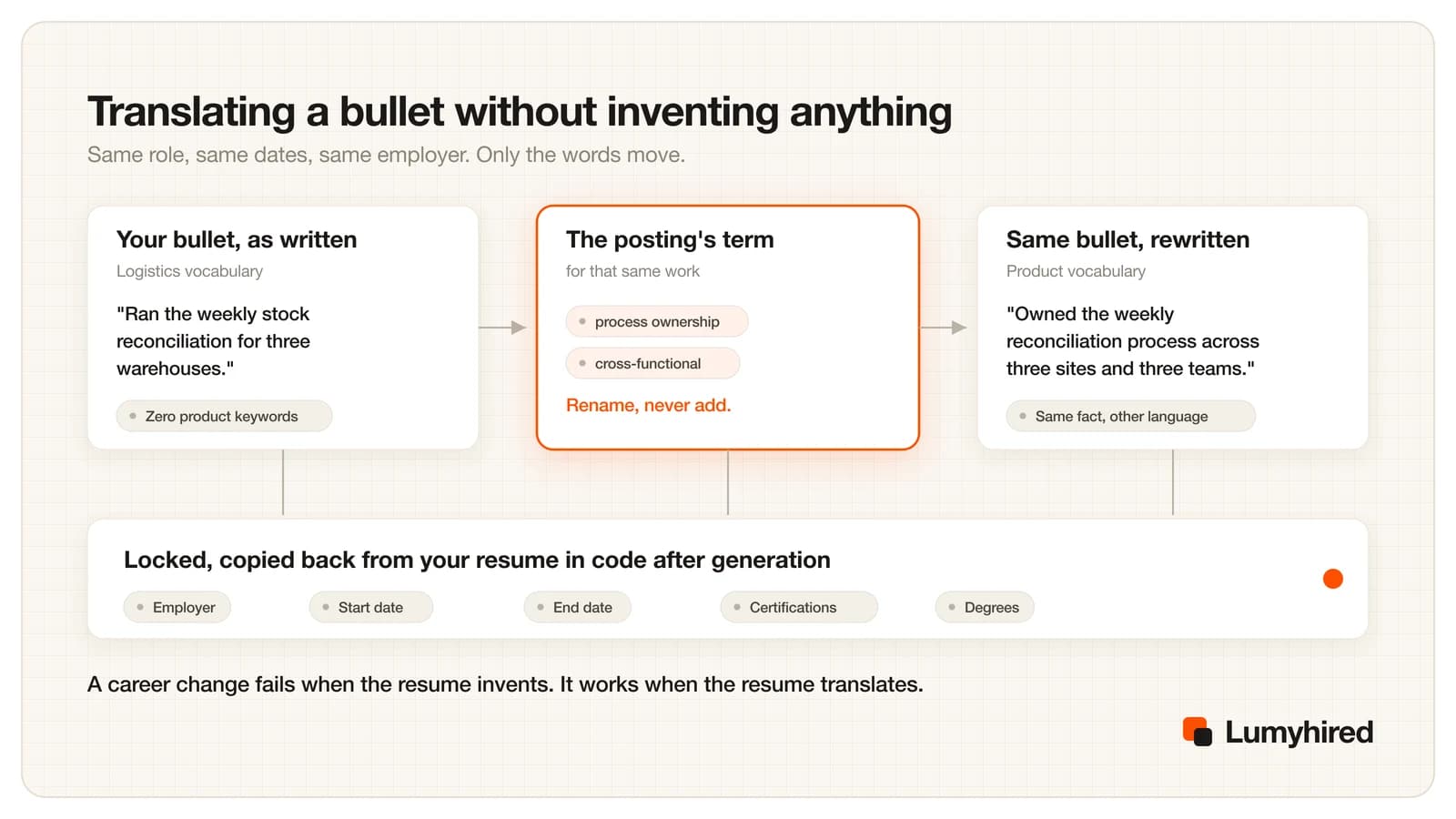
The line between translating and inventing is narrow and it matters more here than in an ordinary application. Renaming work you did in the target field’s term is legitimate. Adopting a term for work you have not done is a claim you will have to defend out loud, in a field whose interview questions you do not know yet.
Functional or reverse chronological, and what a parser does with each
Every career-change guide tells you which format to use. Almost none explains what happens to it inside the software. The usual claim is that a functional resume hides your dates and that recruiters read that as concealment, which is an opinion about readers. The mechanical account is more useful, and it comes from the companies that write the parsers.
Textkernel, whose engine is licensed to other recruiting systems rather than sold to candidates, publishes the data model its parser fills in. A career comes out as an array of employment entries, each with a job title, an organisation, a start date and an end date. Each extracted skill carries a field the documentation describes as a comma-separated list of work history item ids indicating where the skill was found. The schema is built to trace a skill back to the dated job where it was used.
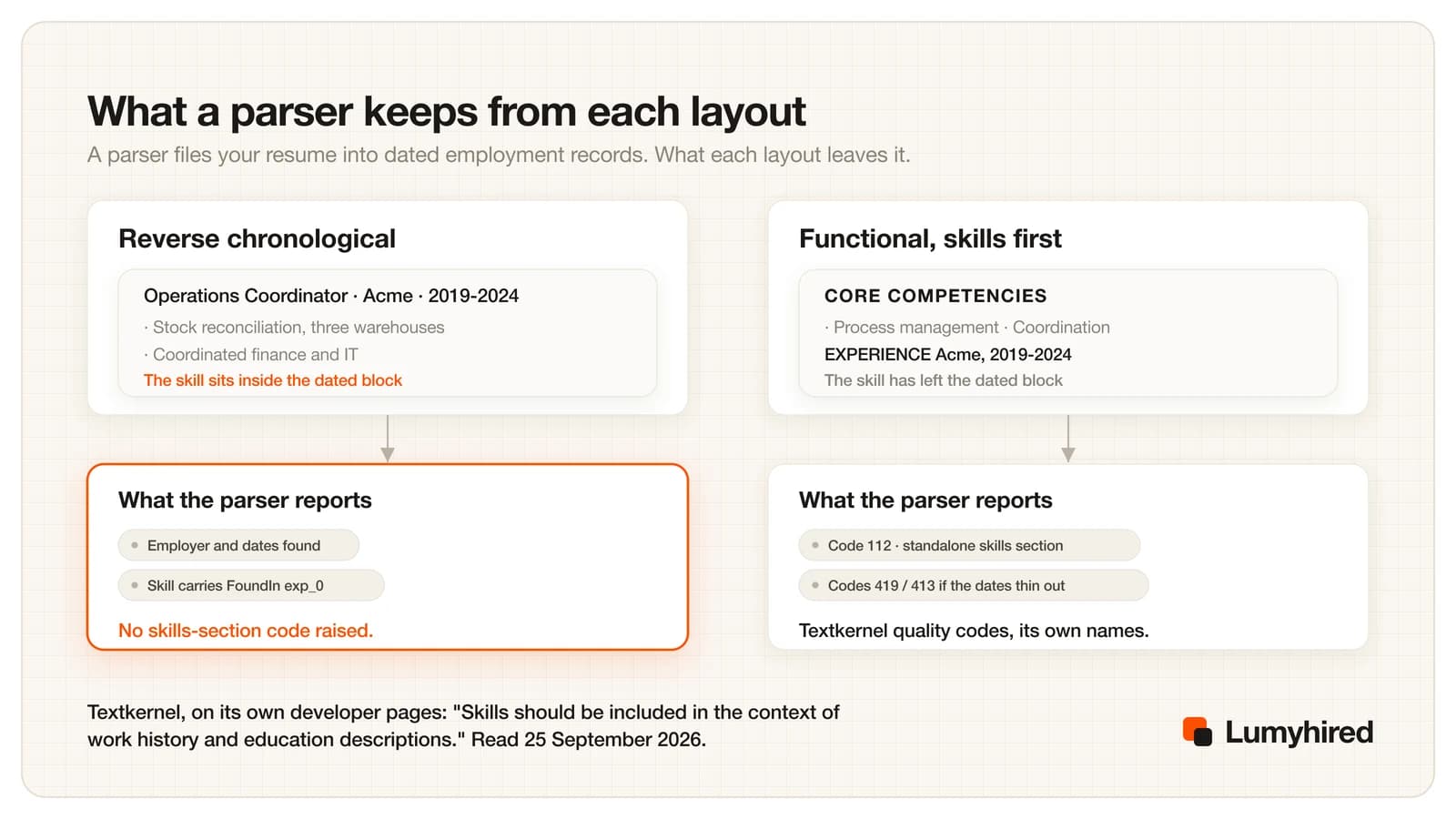
The same documentation ships a set of resume quality codes, and one of them is about this exact decision. Code 112 fires when a separate skills section is found, with the guidance that skills should be included in the context of work history and education descriptions. In the fatal band sit code 413, raised when no work history section is found, code 415, when work history had to be calculated as a section rather than read as one, and code 419, when the employment section did not provide dates for jobs. A functional resume is the document shape most likely to produce that combination.
Two honest limits. Textkernel places code 112 in its lowest severity band, labelled suggested improvements, and says on the same page that the quality output should never be taken as a sign the parser failed. And no published study measures callback rates for functional against chronological resumes. The figures circulating on this topic are frequently attributed to ResumeGo; its research index lists nine studies, on resume length, recruiter reading time, education, virtual interviews, cover letters, employment gaps, LinkedIn, discrimination and page count, and none of them is about resume format. Treat those numbers as unsourced.
Other vendors point the same way without naming the format. Workday's resume parsing page (updated 23 June 2023) states that parsing results can vary based on resume format and order of words, and that Workday does not auto-fill the Languages and Skills fields, which makes a skills-led document the least transferable kind on that system. Greenhouse's unsuccessful parse page (updated 2 March 2026) lists complex layouts, columned designs and unclear section structures among the causes, and says the fallback is a recruiter typing your details in by hand. A 2025 working paper on layout-aware parsing (arXiv 2510.09722, Zhu, Yu, Chen and colleagues, deployed at Alibaba) reports that roughly 20% of resumes use non-linear multi-column layouts that break normal reading order, though it does not separate results by functional against chronological format.
The practical answer for a career changer: stay reverse chronological, keep every employer and every date, and move the emphasis inside each role so the transferable work is the first thing under each job. The full mechanics of what filters do and do not do are in how ATS filters actually screen resumes, and the layout questions in the best resume format for AI screening.
Three things "missing skill" can mean
Every tool here will tell you which of the posting's requirements your resume does not answer. None of that is useful until the list is sorted, because the word covers three situations with three different responses.
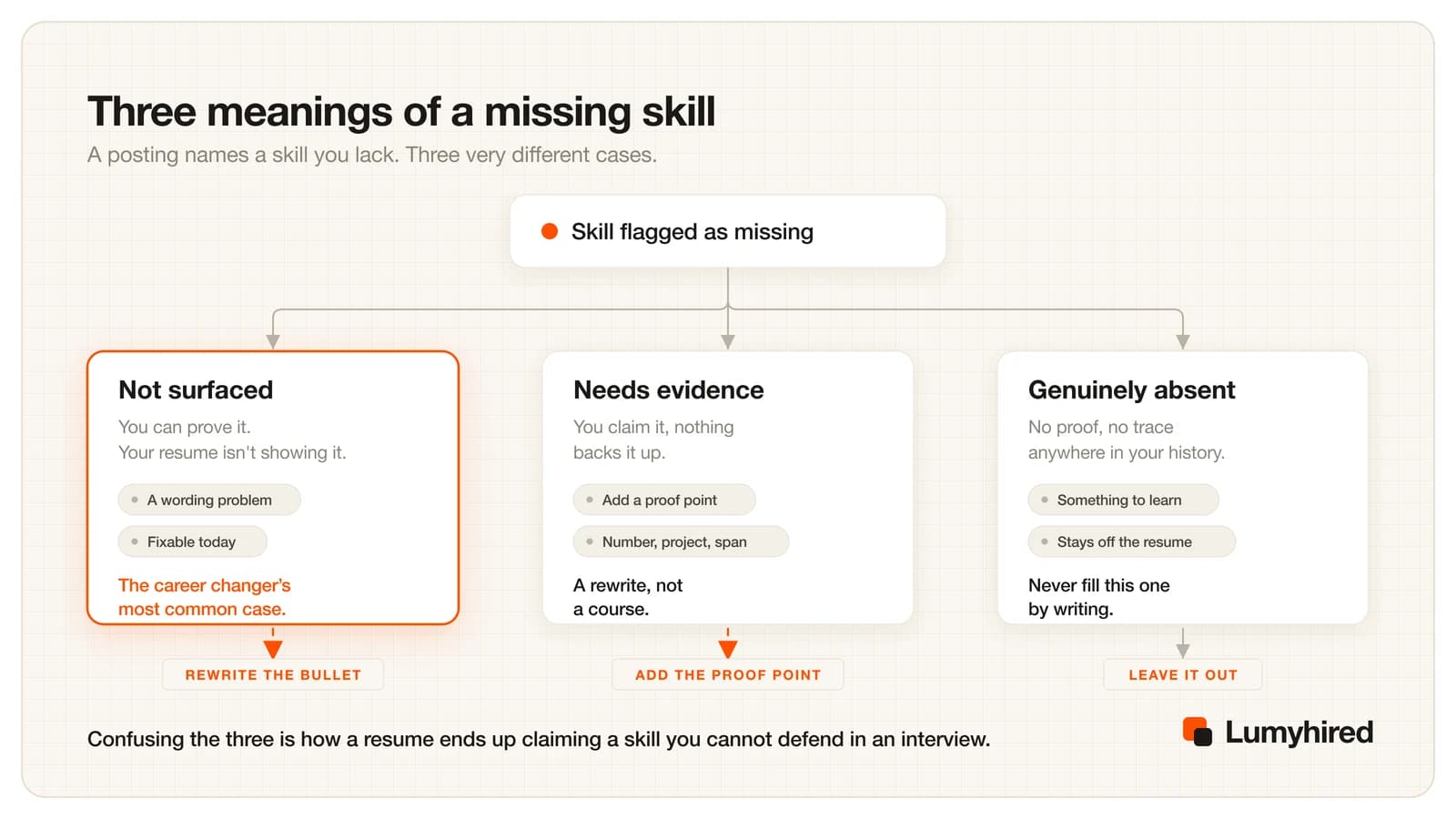
- You can prove it and the resume is not showing it. This is a wording problem and it is most of a career changer's list. Rewrite the bullet that already describes the work, using the posting's term for it.
- You claim it with nothing behind it. The skill is on the page and no line supports it. Add the fact: a number, a project, a duration.
- It is genuinely absent. Leave it off. This is the one a keyword-coverage score will push you to fill, and filling it by writing is how a resume ends up making a claim you cannot defend.
Rezi's keyword targeting offers, for each missing keyword, to write a new bullet containing it and place it under one of your jobs. That is a reasonable feature for someone staying in their field, where most gaps are wording gaps. For a career changer, whose gaps are more often real, it is the most dangerous button in this list.
How we ranked them
We did not run a scored output test. The order rests on what each vendor documents on its own pages, read on 25 September 2026, and for Lumyhired on its source code, checked the same day. Six criteria, in this order of weight:
- Translates against a real posting. Reads the specific job you are answering and re-expresses your existing lines in its vocabulary. A builder with no posting in front of it cannot do this, which is why template quality counts for little here.
- Separates a wording gap from a real gap. Tells you which missing requirements you can already prove and which you cannot, so the rewrite stops where your record stops.
- Protects the employment record. Keeps titles, employers and dates fixed, preferably in code rather than by instruction, because that is the structure a parser is built to extract and the structure a career changer is most tempted to blur.
- Parse-safe output. A single-column, text-based file that keeps each skill inside a dated role.
- Cost over a long search. A switch usually runs longer than a move within a field, so a tool priced well for one month and badly for six is priced wrong for this reader.
- Covers more than the document. Search and tracking matter more when you do not yet know which job titles your background maps to.
Three of the pages ranking for this search today are published by a company that puts its own product first, and two more are paid placements. This page also puts its publisher first, so weigh the criteria above against what you actually need. On criterion five we lose: there is no free plan here, and a switch often means a longer search on less income. Teal's free tier is the honest recommendation in that case.
The 7 best resume builders for career changers in 2026
| Tool | Reads the posting | Handles transferable skills | Protects dates and employers | Free | Paid |
|---|---|---|---|---|---|
| Lumyhired | Yes, full posting | Three-way: provable, unproven, absent | Employer and dates restored in code | None (ATS preview only) | €5 to €13/week |
| Teal | Yes, keyword panel | You judge each term | You edit it yourself | Unlimited resumes and tracking, top 5 keywords | $13/7 days, $29/30 days, $79/90 days |
| Huntr | Yes, full posting | Not addressed | Base resume untouched | 2 job-tailored resumes | $40/mo, or $90/3 mo |
| Kickresume | Premium AI writer | Career Map, before the resume | You edit it yourself | 4 templates, unlimited downloads | $4.50 to $19/mo |
| Claude / ChatGPT | Yes, if you paste it | Best, if you prompt for it | No protection at all | Free tiers | $5.50 to $20/mo |
| Enhancv | Content feedback | Functional template only | You edit it yourself | Plan valid 7 days | Not verifiable on the day |
| Rezi | Keyword targeting | Offers to write the missing keyword in | You edit it yourself | 1 resume, 3 PDF downloads | $29/mo, or $149 lifetime |
1. Lumyhired
Best for: Rewriting the experience you already have in the words of the field you are moving into
Price: No free plan. Weekly plans €5 (Starter), €8 (Pro) or €13 (Hunt), cancel anytime, 3-day money-back guarantee.
What it does well
- Reads the full target posting and rewrites your existing summary, bullets and skills in its terms. That is the whole task in a career change, and a builder with no posting in front of it cannot attempt it.
- Sorts every requirement you do not currently show into three cases: one you can prove but have not written down, one you claim with nothing behind it, and one you genuinely lack. The first is a rewrite, the third stays off the resume. We read the logic in the source on 25 September 2026.
- Protects the employment record in code rather than by instruction. After the model returns a version, the app copies employer, start date and end date back from your original resume by entry id, and passes certifications and degrees through unchanged. Your chronology cannot drift while the wording moves.
- Its rewrite instructions forbid replacing your job title with the posting's title, adding a tool you have not used, inventing a number, and introducing a seniority word your dates do not support. They also tell it to aim for a realistic fit rather than a manufactured full-keyword match.
- Searches more than ten job sources in one query, including Indeed, LinkedIn, Adzuna, France Travail, Remotive, Welcome to the Jungle and hiring.cafe, which helps when you do not yet know which job titles your background maps to. Works in English and French.
Worth knowing
- Smaller brand than Jobscan or Teal, with far less third-party review coverage to read before you commit.
- Built for a considered application, not for firing off 200 a day. There is no auto-apply, and the weekly quotas are sized for tailoring you actually read.
- No free plan and no trial. Weekly plans start at €5 with a 3-day money-back guarantee. The one free tool is the browser-based ATS preview, which needs no account.
- PDF export only. No DOCX, and no large visual template gallery.
2. Teal
Best for: Translating against a posting without paying anything
Price: Free Forever: unlimited resumes, unlimited job tracking, 10 keyword matches, Top 5 Analysis Mode, 10 AI resume-bullet credits, 2 summary credits, 2 cover letter credits, no card to start. Teal+ $13 every 7 days, $29 every 30 days or $79 every 90 days.
What it does well
- Attach the target posting and Teal marks its keywords beside your resume. For a career changer that list is the translation glossary: it names the term the new field uses for work you have already done.
- You write or accept every bullet yourself, so nothing lands on the page that you did not choose. In a field whose conventions you do not know yet, that control is worth more than speed.
- Unlimited resumes and unlimited tracked jobs at no cost, which matters because a career change usually runs long and generates a version per target role.
Worth knowing
- The free tier stops at the top 5 keywords and 10 AI bullet credits, so the deeper matching is a paid feature.
- Paying $13 every 7 days is the most expensive way to buy Teal+, at roughly twice the 90-day rate per week.
- No career-change feature as such. The pages we read frame the rewriter around job-description tailoring, and the career-change material is blog content rather than product.
3. Huntr
Best for: Approving each rewritten line one at a time
Price: Free plan: unlimited base resumes, 2 job-tailored resumes, 2 application packets, tracking for up to 100 jobs. Pro $40/month, $30/month billed $90 every 3 months, or $26.66/month billed $160 every 6 months.
What it does well
- Each suggested change arrives with a short reason, and you accept, edit or ignore it individually. A career changer is rewriting into vocabulary they cannot yet judge by instinct, so reading the reasoning is the check.
- Your base resume stays untouched and each tailored version is tied to a saved job, so the original history survives every experiment.
- Exports as PDF or DOCX.
Worth knowing
- Two job-tailored resumes on the free plan, which is roughly two applications, then $40 a month at the monthly rate.
- Nothing in the product is built around transferable skills. It tailors to a posting well and leaves the question of which of your experience counts entirely to you.
4. Kickresume
Best for: Working out which target roles your background actually maps to
Price: Free: 4 resume templates, 4 matching cover letter templates, 1 website template, 20,000 pre-written phrases, 1,500+ resume examples, unlimited downloads. Premium $19/month, $9/month billed $27 quarterly, or $4.50/month billed $54 yearly, 14-day money-back guarantee.
What it does well
- Career Map is the only feature on any of these products built for the switch itself. Its page says it helps you understand your strengths and highlights the skills you need to develop to transition. That is the step before the resume.
- The free tier allows unlimited downloads, which no other free tier here does.
- $4.50 a month on the yearly plan is the lowest paid price in this list, and there is a 14-day money-back guarantee.
Worth knowing
- Design-led. A career change is decided on which of your facts the reader sees first, and a template cannot make that judgement.
- Full Career Map access needs Premium, and the pre-written phrase library is generic by construction, which is the exact failure mode of a career-change resume.
- No job search and no tracking, so filing the version you sent is yours to do.
5. Claude or ChatGPT with a prompt
Best for: Deciding which of your skills genuinely transfer before any document exists
Price: Free tiers on both. Claude Pro $17/month with the annual discount ($200 up front) or $20 billed monthly. ChatGPT Go $5.50/month, Plus $20/month.
What it does well
- The hardest part of a switch is naming what your old work has in common with the new field, and that is a reasoning task rather than a formatting one. You can keep interrogating it until the mapping is honest.
- Reads a long posting and a long history together, and will tell you which requirements your background does not answer if you ask it to.
- You set the rules, so you can demand a change log and a list of anything it wrote that is not in your original, as in the prompt below.
Worth knowing
- Nothing stops it inventing a plausible achievement unless your prompt forbids it and you check. A career changer is less able to spot an implausible claim in a field they do not know yet.
- Produces plain text with no formatting and no export, and keeps no record of which version went to which employer.
6. Enhancv
Best for: A skills-first layout, if you have decided you want one
Price: Free plan valid for 7 days. Paid Pro billed monthly, quarterly or semiannually. We read different currencies and figures from a browser and a fetcher on the same day, and the page title contradicted the pricing card, so we state no number here.
What it does well
- The only builder here that markets a format for switchers. Its functional templates are described as suiting job seekers changing industries and letting you emphasise transferable skills.
- Gives feedback on content rather than only on formatting, which is the more useful kind when the words are the problem.
Worth knowing
- The functional layout is the thing this article argues against, for the reasons in the parsing section below. Choosing Enhancv for that feature is choosing the risk with it.
- Visually distinctive layouts are the most common cause of broken extraction, and Greenhouse's own help page lists complex layouts and columned designs among the things that make a parse fail.
- We could not state a price with confidence, which is itself a reason to check carefully before paying.
7. Rezi
Best for: A plain document that parses cleanly once you know what to say
Price: Free: 1 resume, 1 AI interview, 3 PDF downloads, standard templates. Pro $29/month, Lifetime $149 one-time, 30-day money-back guarantee.
What it does well
- Conservative single-column layouts that survive extraction without much thought, which removes one variable from a switch that already has several.
- The $149 lifetime plan is cheaper than five months of Pro, and a career change often runs longer than five months.
Worth knowing
- For each missing keyword it offers to write a new bullet containing that keyword. For a career changer that is the most dangerous button in this list, because the missing keyword is usually a real gap rather than a wording gap.
- Almost no help deciding what to emphasise, which is the career changer's actual problem.
- The free tier is 1 resume and 3 PDF downloads, about one application's worth.
Considered and left out
Zety is the biggest brand missing from the seven. Its guided walkthrough suits someone who has not written a resume in years, and its library of pre-written phrasing per role is large. Two facts decided it, both read on its pricing page on 25 September 2026. The free package downloads in TXT format only. The Pro package is sold as a 14-day trial at $1.70 that then auto-renews at $23.95 every 4 weeks, and the page states no money-back guarantee. Its own plan card and comparison table disagreed about the trial price on the day we looked.
Careerflow.ai lists a Skill Gap Analyzer on its plan page, limited on the free tier and fuller on Premium, which is the nearest thing to a transferable-skills feature outside Kickresume. The page does not frame it around career change, so it is adjacent rather than built for this reader. Note that its /pricing URL returns 404 and the live page is /premium.
Jobscan stays out of the ranking for the same reason. Its match report is a good second check on any tool's output, and its free tier gives 5 resume scans a month, but the product scores your resume against a posting rather than helping you decide which of your history belongs on it. Where it fits against this site is covered in the side-by-side with Jobscan.
A prompt that sorts before it writes
This works in ChatGPT, Claude, Gemini or Le Chat, and it is built around the failure mode above. Most tailoring prompts start writing immediately, which is how a career-change resume acquires vocabulary the candidate cannot back up. This one forces the sort first and rewrites only the bucket you can prove.
Copyable prompt: sort, translate, audit
You are helping me move from [current field] into [target field].

TARGET POSTING:
[paste the full posting]

MY RESUME:
[paste it as plain text, phone number and address removed]

PASS 1: SORT, DO NOT WRITE
List every requirement in the posting. Put each into exactly one bucket:
A. I already do this, my resume describes it in my old field's words.
   Quote the line of my resume that proves it.
B. I claim this somewhere but nothing in my resume backs it up.
C. Nothing in my history supports this.
Do not write any resume text yet.

PASS 2: TRANSLATE BUCKET A ONLY
For each bucket A item, rewrite my existing line in the posting's vocabulary.
Keep the same facts, the same scope and the same numbers.
Do not touch bucket B or C. Leave those requirements unanswered.

PASS 3: SELF-AUDIT
Make a table: original line | new line | posting phrase it answers.
Then list every noun in the new version that does not appear in my resume,
and mark each one NOT IN RESUME.
Finally, restate buckets B and C so I can see what I am not claiming.
Then do the part the model cannot. Delete every line marked NOT IN RESUME. Read the change log for scope verbs, because "supported" quietly becoming "owned" is the most common inflation in a career-change rewrite and the easiest to catch. Then read buckets B and C and decide whether to apply anyway, which is a judgement call and frequently a yes. The manual version of this, with before and after bullets, is in how to tailor a resume to a job description, and choosing which terms are worth using is in finding and placing resume keywords.
What costs nothing here
Allowances read on each vendor's pricing page on 25 September 2026, ordered by how much a career changer gets before paying:
- Teal, Free Forever: unlimited resumes, unlimited job tracking, 10 keyword matches, Top 5 Analysis Mode, 10 AI resume-bullet credits, 2 summary credits and 2 cover letter credits, with no card to start.
- Kickresume: 4 resume templates, 4 matching cover letter templates, 20,000 pre-written phrases and unlimited downloads, with partial Career Map access.
- Claude and ChatGPT: free tiers on both, with usage limits, which is enough to run the prompt above.
- Huntr: unlimited base resumes, 2 job-tailored resumes and tracking for up to 100 jobs.
- Rezi: 1 resume and 3 PDF downloads.
- Enhancv: a plan valid for 7 days.
Lumyhired has no free plan and no trial. Its one tool that costs nothing and needs no account is the ATS preview, which runs in your browser, uploads nothing, and shows the text a parser pulls out of your file. Run it on whatever any tool in this list exports, and check that each skill still sits under a dated employer. The fuller ATS resume checker is part of the paid plans.
Which one fits your situation
Your experience genuinely transfers and the resume does not say so. Lumyhired, from €5 a week in English or French, with your employers and dates held fixed while the wording moves.
Budget decides it. Teal's free plan for versions and tracking, with Claude or ChatGPT and the prompt above doing the translation.
You want to approve every edit individually. Huntr, starting with its 2 free job-tailored resumes.
You do not yet know what you are switching into. Kickresume's Career Map, or a conversation with Claude or ChatGPT, before you open any builder. Deciding on a destination comes before writing anything down.
You want the lowest paid price. Kickresume's yearly plan at $4.50 a month, with a 14-day money-back guarantee.
You want a plain file that parses cleanly. Rezi, ignoring its offer to write missing keywords in for you.
If the gap in your history is time away rather than a change of direction, the framing is different and it is covered in how to explain a career gap.
Frequently asked questions
What is the best resume builder for a career change in 2026?
Should a career changer use a chronological or functional resume?
Do ATS parsers actually reject a functional resume?
How do I translate my experience into a new field's vocabulary?
Is a free resume builder enough for a career change?
How much of my old experience should I cut?
Do I need a different resume for every application when changing fields?
Where Lumyhired fits
Lumyhired tailors your resume to one posting at a time. It lists the requirements you already meet and the ones you do not, rewrites the summary, bullets and skills in the posting's vocabulary under rules that forbid a new title, a new tool or a new number, and then restores your employers, dates, certifications and degrees from your original file in code. Job search across more than ten sources, including France Travail and Welcome to the Jungle, sits in the same account, which helps while you are still learning which titles fit you. Weekly plans are €5, €8 and €13 on the pricing page, cancel anytime, with a 3-day money-back guarantee. There is no free plan, no auto-apply and no DOCX export.
Sources
- Textkernel, Tx Platform parser output and Resume Quality codes, read 25 September 2026. No last-updated date published. developer.textkernel.com
- Textkernel, CV/Resume Parsing candidate data model, for the employment entry fields and the skill-to-work-history link, read 25 September 2026. developer.textkernel.com
- Workday, Concept: Resume Parsing, updated 23 June 2023. doc.workday.com
- Greenhouse, Unsuccessful resume parse, updated 2 March 2026. support.greenhouse.io
- Zhu, Yu, Chen and colleagues, Layout-Aware Parsing Meets Efficient LLMs, arXiv 2510.09722, submitted 10 October 2025. Not peer reviewed; does not separate results by resume format. arxiv.org
- ResumeGo, research index, checked 25 September 2026 to confirm that no study on resume format exists there. resumego.net
- Teal, pricing page, read 25 September 2026. tealhq.com
- Huntr, pricing page, read 25 September 2026. huntr.co
- Kickresume, pricing page and Career Map page, read 25 September 2026. kickresume.com
- Rezi, pricing page, read 25 September 2026. rezi.ai
- Enhancv, pricing page and functional template pages, read 25 September 2026. Prices differed between a browser and a fetcher on the same day, so none is quoted here. enhancv.com
- Zety, pricing page, read 25 September 2026. zety.com
- Careerflow.ai, plan page, read 25 September 2026. careerflow.ai
- Anthropic, Claude pricing, and OpenAI, ChatGPT pricing, both read 25 September 2026. claude.com, chatgpt.com
Read next
- Explaining a Career Gap
What field experiments show about gaps, the resume line and interview answer for each reason, what you never have to disclose, and the LinkedIn career break section.
- How to Tailor Your Resume to a Job Description
A 15-minute method with three before and after bullets, an AI prompt that forbids invented facts, and Huntr's data: tailored resumes got interviews at 4.23% vs 2.07% in Q1 2026.
- Best Resume Format for AI Screening
Which format rules vendors actually document, a two-minute copy-paste parse test, and how to build and check an ATS-safe template in Word or Google Docs.