
Career Guides
The best job boards in 2026: 8 sites ranked, and where their listings come from
Eight job boards ranked on five stated criteria, plus the country boards that matter in the US and in France. Every price and every figure was read on the board’s own pages on 15 October 2026. The question that decides how many boards you need: where does each site get its listings, and how many of them are copies of the same job?
What is the best job board in 2026?
Lumyhired ranks first: it searches Indeed, LinkedIn, Glassdoor, France Travail, Welcome to the Jungle and employer career sites, among other sources, in one feed, with postings older than 3 days hidden by default. It costs €5 a week and up, with no free plan. If you want a free board, pick LinkedIn to reach recruiters or Indeed for the widest reach, and in France add France Travail and, for cadre roles, APEC.
Lumyhired publishes this page and ranks itself first, and its own feed includes HiringCafe listings among its sources, so weigh the criteria against what you need. Published 15 October 2026.
Why does your choice of job board matter more in 2026?
Because there are more applicants per opening and fewer openings: the days between a job going live and you seeing it count for more. Both halves of that are on the record this year, on both sides of the Atlantic.
On the applicant side, LinkedIn’s CEO, Dan Shapero, says job seekers are sending 30% more applications than they did before the pandemic. Fortune reported it on 30 September 2026, alongside his remark to the Wall Street Journal that employers find it harder to tell who can actually do the job. The same article puts US job openings at a five-month low of 7.08 million in August.
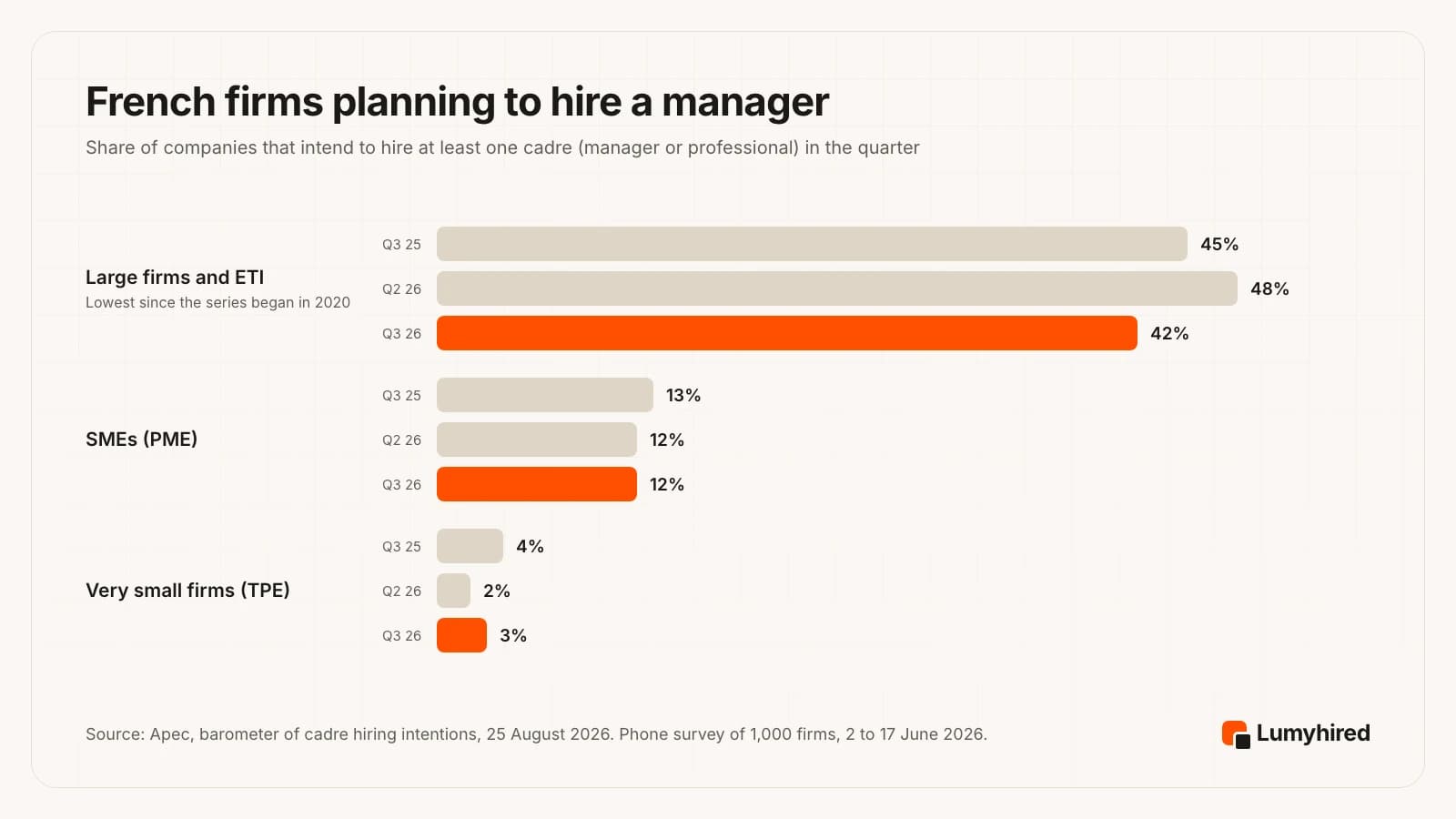
On the hiring side in France, Apec’s barometer for the third quarter of 2026, published on 25 August, found cadre hiring intentions at the lowest level seen in recent years. Among large firms and mid-sized groups (ETI), 42% planned to hire at least one cadre, down from 48% the quarter before and 45% a year earlier: the lowest reading since the indicator began in 2020. Among SMEs the share held at 12%. The survey covered 1,000 firms and 2,000 cadres, questioned between 2 and 17 June 2026.
When fewer jobs draw more applications, a posting you find on day six joins a pile that was already large on day two. That is why freshness is one of the five criteria behind the ranking below.
Where do job board listings actually come from?
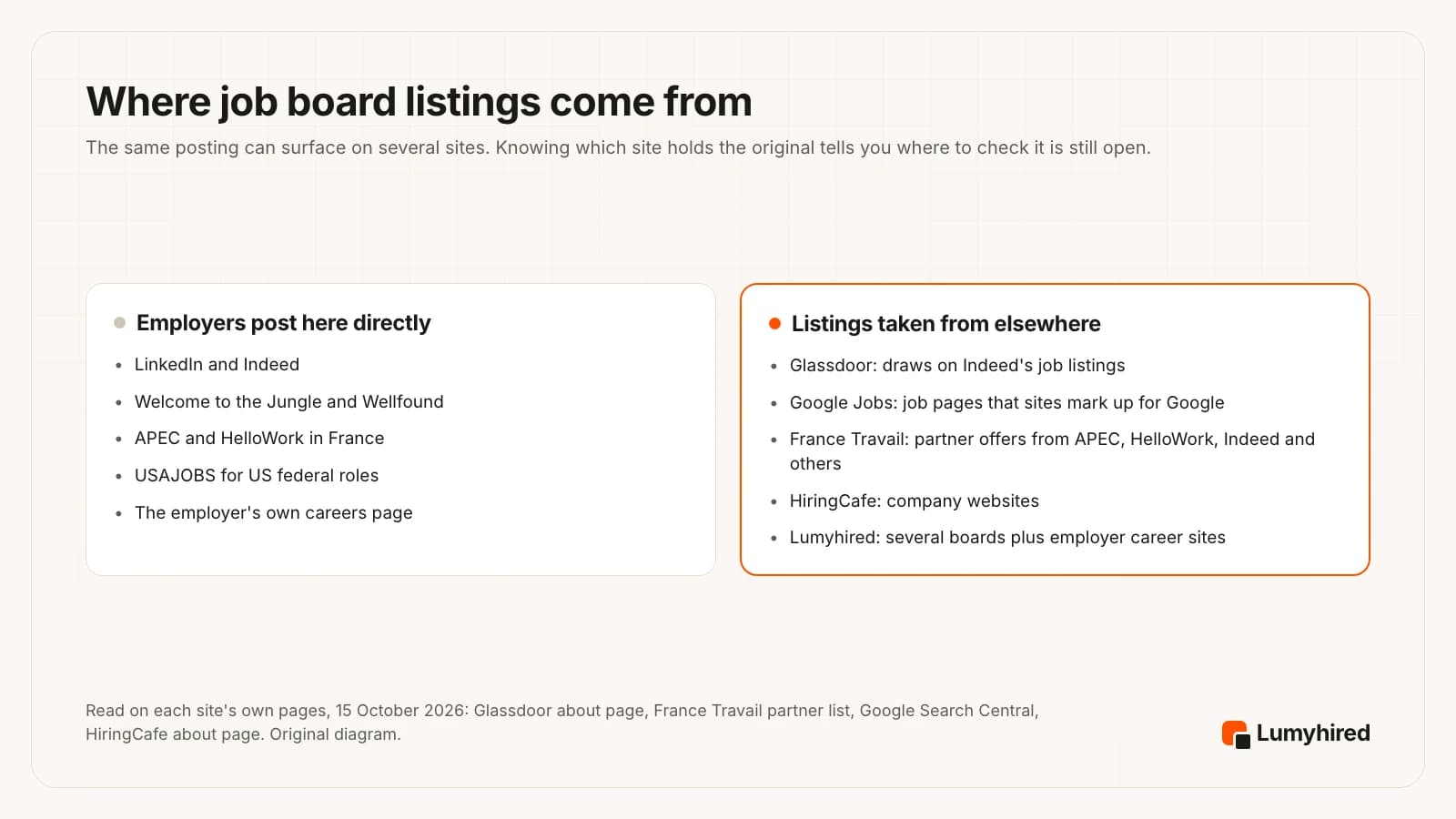
From three places: employers posting on the board, the board copying postings from other boards, and the board reading employers’ own career pages. Here is what the boards in this ranking state about themselves.
- Glassdoor says it taps into Indeed’s job listings. Glassdoor and Indeed belong to the same group, and the copyright line on Glassdoor’s about page names Indeed, Inc.
- France Travail shows “partner offers” that come from other sites. Its published partner list includes APEC, HelloWork, Indeed, Cadremploi, Jobijoba and Talent.com, among many others, and partner offers carry the partner’s logo in the results.
- Google Jobs holds no listings of its own. It shows job pages that boards and employers mark up with Google’s job posting format.
- HiringCafe says it collects jobs directly from company websites and filters out recruiting agencies.
- LinkedIn, Indeed, Welcome to the Jungle, Wellfound, APEC, HelloWork and USAJOBS all take postings directly from employers.
This matters for two reasons. First, coverage: searching Glassdoor after Indeed adds reviews and salaries to the jobs you already saw, and searching France Travail after HelloWork and APEC will show you some of the same offers again. Second, freshness. A copy depends on the board that made it noticing when the original closes, which is where the next section starts.
How many job postings are ghost jobs?
Nobody knows the true share, and the estimates you will read come from companies with a product to sell. The Congressional Research Service, which briefs the US Congress, put it plainly in April 2025: there are no official statistics on the magnitude of ghost jobs. It defines them as online postings for positions that do not exist or that employers are not planning to fill soon.
One private figure comes from Greenhouse, which sells hiring software. In its 2024 State of Job Hunting report it said that in any given quarter, 18 to 22% of the jobs posted on the Greenhouse platform are classified as ghost jobs, and that three in five of the 2,500 workers it surveyed in the US, the UK and Germany suspected they had come across one. That is one platform’s data, and the report does not publish how a posting gets classified.
The CRS note gives the reason that matters most for choosing a board. Some ghost postings are not deliberate: job boards automatically copy postings from other websites, and when the employer fills the job and takes down its own posting, it may not realise the copy lives on elsewhere.
Two rules point the other way. Google’s job posting guidelines, updated on 8 September 2026, say Google does not allow expired job postings, and that a site should remove a posting once the job is filled or mark its expiry date in the past; the original posting date is a required field. And Ontario has enacted rules, which the CRS reported as scheduled to take effect in 2026, that require most employers to say whether a posting is for an existing vacancy. Neither helps you on a board that ignores them, so the checks below are still yours to run.
How did we rank the job boards?
We did not run a controlled test of response rates, so nothing here claims one board gets you more interviews than another. The order rests on what each board publishes about itself, read on 15 October 2026, weighed on five criteria in this order:
- Where the listings come from. Postings from the employer, or from its own careers page, rank above copies of copies.
- Freshness. Does the site show the posting date, let you filter on it, or drop old postings for you?
- Coverage. Volume, sectors, and whether it works in the US, in France, or both.
- Cost to job seekers, stated in public. Free is best. A paid tier is fine if its price is on a page you can read before signing up.
- Does something the others do not. Reviews, referrals, startup equity, company videos: a reason to keep the tab open.
Lumyhired wins on freshness (postings older than 3 days hidden by default) and on the fifth criterion. On origin it mixes employer ATS pages with board copies, Glassdoor’s copies of Indeed among them, so check the original posting for its listings too. It loses on cost: it is the only site in the ranking with no free plan. The criteria are stated so you can weigh them differently and reorder the list yourself.
What are the 8 best job boards in 2026?
| Board | What it does | What it doesn’t do | Listings come from | Free for job seekers | Paid option | Where it works |
|---|---|---|---|---|---|---|
| Lumyhired | One feed with a match score, resume tailoring and a tracker | Apply for you; no free plan, extension or mobile app | Several boards plus employer career sites | No free plan | €5, €8 or €13 a week | US and French boards among its sources |
| Jobs next to the people who work there; messages to recruiters | Search other boards | Employers and recruiters post directly | Yes, search and apply | Premium Career from US$39.99/month or US$239.88/year (€29.98 or €179.88) | 200+ countries and territories | |
| Indeed | The largest audience by its own Comscore claim, 60+ countries | Keep sponsored posts out of the results | Employers post directly | Yes | None listed on the pages read | 60+ countries |
| Google Jobs | Searches many sites at once and links to the original | Host applications or track them | Sites that mark up their postings | Yes | None | North America and listed countries, France and UK included |
| Glassdoor | Reviews and salaries beside the job | Add listings beyond Indeed's | Indeed's job listings | Yes | None, per Glassdoor | Follows Indeed's listings |
| Welcome to the Jungle | Company profiles with photos and videos | Cover countries beyond France, the UK and the US | Employers post directly | Yes, no candidate price published | None published | France, UK, US |
| HiringCafe | Reads company websites; detailed filters | List agency roles | Company websites | Yes, core search | None for job seekers | Location filter; US and French jobs listed |
| Wellfound | Startup jobs with direct lines to founders | Cover established employers or the public sector | Startups post directly | Yes, always, per Wellfound | None | Wherever its 27,000+ startups hire |
1. Lumyhired
Best for: Searching several boards and employer career sites in one feed, with postings older than 3 days hidden by default
Listings: Several job boards plus employer career sites.
Price: No free plan. Weekly plans €5 (Starter), €8 (Pro) and €13 (Hunt), cancel anytime, 3-day money-back guarantee.
What it does well
- One feed draws on Indeed, LinkedIn and Glassdoor, on employer career sites hosted on Greenhouse, Lever, Ashby, Workable and Workday, and on France Travail and Welcome to the Jungle, among other sources.
- Postings older than 3 days are hidden by default. A switch shows them again, and any job you saved stays visible whatever its age.
- Every posting carries a match score against your resume. A contract filter (permanent, fixed-term, freelance, apprenticeship, internship) leaves internships and apprenticeships off until you turn them on.
- From a posting you keep, the same account tailors your master resume to it, checks that an applicant tracking system can read the file, and files the application in a kanban tracker with interview reminders and interview preparation.
Worth knowing
- A newer and much smaller brand than every board below it, with far less third-party review coverage to read before you decide.
- No free plan, no browser extension and no mobile app. Every other board in this ranking is free to search.
- Built for one well-aimed application at a time. It does not apply for you, and it is the wrong tool for sending hundreds of applications a day.
2. LinkedIn
Best for: Reaching recruiters and seeing who you already know at a company
Listings: Employers and recruiters post directly.
Price: Free to search and apply. Premium Career starts at US$39.99 a month or US$239.88 a year (€29.98 a month or €179.88 a year in euros), on LinkedIn's Premium Career page last updated 20 April 2026, which says prices may exclude VAT and that a free trial may be available.
What it does well
- LinkedIn says it has more than 1 billion members in more than 200 countries and territories, so the recruiter, the hiring manager and your former colleagues are often on the same site as the job.
- A posting sits next to the company page and the people who work there, which is the quickest route to a referral or a name to write to.
- Employers post on LinkedIn directly, so the listing you open is usually the original.
Worth knowing
- LinkedIn's CEO, Dan Shapero, says job seekers send 30% more applications than before the pandemic (Fortune, 30 September 2026), and a one-click application to a popular posting joins a long queue.
- Premium Career costs US$39.99 a month billed monthly. The lower rate, US$239.88 a year (about US$20 a month), means paying for twelve months up front.
Source: https://about.linkedin.com/
3. Indeed
Best for: The biggest audience, across every sector and more than 60 countries
Listings: Employers post directly.
Price: Free: Indeed says job seekers can search, create an account and apply for free.
What it does well
- Indeed calls itself the world's #1 job site on Comscore total visits for March 2026, and reports 685 million job seeker profiles and more than 3.5 million employers hiring through it.
- It operates in over 60 countries, which makes it the one board in this ranking that works much the same way in the US and in France.
- It reports 31 hires a minute made on Indeed in March 2026, a hiring figure it publishes alongside its traffic claims.
Worth knowing
- Employers can pay to sponsor listings, and sponsored posts sit among the results. Sort by date when you want the newest postings first.
- Its listings travel. Glassdoor draws on them and France Travail shows Indeed offers as partner listings, so the same job can reach you three times.
Source: https://www.indeed.com/about
4. Google Jobs
Best for: Searching many job sites at once for free, then opening the original posting
Listings: Job pages that boards and employers mark up for Google.
Price: Free, part of Google Search.
What it does well
- Search for a role on Google and, in the countries covered, a job panel gathers postings from any site that marks them up for Google, boards and employer career pages alike.
- Google's rules ban expired postings: sites must remove a filled job or set its expiry date in the past, and the original posting date is a required field.
- Google's documentation, updated 8 September 2026, lists North America in full and named European countries, France and the United Kingdom included.
Worth knowing
- It is a search feature with no profile, no application and no tracking. Every click leaves Google for the site that holds the job.
- It sees only the sites that add the job markup, and a board's copy of a posting can sit beside the employer's original.
Source: https://developers.google.com/search/docs/appearance/structured-data/job-posting
5. Glassdoor
Best for: Reading employee reviews and salaries before you apply
Listings: Indeed's job listings.
Price: Free: Glassdoor says job seekers never pay for job matching, company reviews, salary information or its community.
What it does well
- Reviews and salary figures sit beside the job, so you can judge an employer before you write a single line of a cover letter.
- Glassdoor says it taps into Indeed's job listings, so its coverage follows the largest board in this list.
- Its anonymous community is where employees talk about pay, interviews and how a team runs.
Worth knowing
- Because the listings come from Indeed, searching both mostly shows you the same jobs twice. Use Glassdoor for the research and Indeed for the search.
- Reviews are written by the people who chose to write them. Read the recent ones and the spread, and treat any single review as one person's account.
Source: https://www.glassdoor.com/about/
6. Welcome to the Jungle
Best for: Seeing the team and the office behind a job, in France, the UK and the US
Listings: Employers post directly.
Price: No candidate price published. The only pricing page on the site is in its recruiter section.
What it does well
- Company profiles with photos, videos and figures, on more than 6,000 companies, let you judge the place as well as the role.
- It says 4,500 companies across France, the UK and the US use it to hire, and that a job post goes up every minute.
- A short profile drives job recommendations, and recruiters can contact you once your profile is complete.
Worth knowing
- Its home page gives company counts but no figure for live jobs, so its volume is hard to compare with Indeed or LinkedIn.
- Three countries only. Outside France, the UK and the US it is not the board to start with.
7. HiringCafe
Best for: A free search of listings collected straight from company websites
Listings: Company websites.
Price: Free: its FAQ says job seekers can search, filter, save searches and build boards without paying.
What it does well
- HiringCafe says it collects jobs directly from company websites in real time and filters out external recruiting agencies and fake consulting firms.
- Filters go well past title and location. Its search page on 15 October 2026 offered date posted, apply process, salary, experience, company size and funding stage, among others.
- It says it keeps improving the systems that detect stale postings and duplicate roles, and it lets you hide companies.
Worth knowing
- Agencies are filtered out by design, so staffing roles and employers with no careers page of their own are missing.
- Its Date Posted filter defaults to 3 months (read 15 October 2026), so older postings stay in the results until you narrow the date.
Source: https://hiringcafe.com/about
8. Wellfound
Best for: Startup jobs, with direct lines to founders and hiring managers
Listings: Startups post directly.
Price: Free: Wellfound says creating a profile and applying are always free for candidates.
What it does well
- Wellfound says more than 27,000 startups hire on it, with direct lines to founders and hiring managers and no third-party recruiters.
- Listings can show the salary range and equity next to the title, as its own sample listing does.
- One profile serves every application you send on the site.
Worth knowing
- Startups only, so established employers and the public sector are outside its scope.
- Early-stage companies change plans quickly. Check the posting date and the company's own site before you put an evening into an application.
Source: https://wellfound.com/
Which job boards matter most in France and in the US?
Four national boards belong next to the ranking above. They are listed apart because each one serves a single country, and this page is written for people searching in either.
If you search in France
France Travail. Best for: every contract type in France, through the public employment service.
The public service’s job site carries the offers employers file with France Travail and a large set of partner offers from other sites. Partners are bound by an agreement that, in France Travail’s words, guarantees the offers are free, legal and fresh, and each partner offer shows its source’s logo. The catch is the overlap: APEC, HelloWork and Indeed are all on the partner list, so you will meet some offers twice. When you do, apply through the original source.
APEC. Best for: cadre roles and graduates with at least three years of higher education (Bac+3) in France.
Apec is the association for cadre employment, and it is the body behind the barometer quoted at the top of this page. It says apec.fr is one of the main job boards for cadre roles, with 2 million offers published in 2025, and that it supported close to 230,000 people in 2025. If your role is a cadre position, this is the specialist board to keep. Our fetcher could not open apec.fr itself on 15 October 2026, so these figures come from Apec’s press release of 25 August 2026.
HelloWork. Best for: regional, temporary (intérim) and apprenticeship jobs in France, with status updates on your application.
HelloWork displayed 817,217 offers on its home page on 15 October 2026 and describes itself as France’s leading job site, its own claim. It says listings show salary and remote work up front, that 155,000 CVs are read on the site each day on average, and that you are told as your application moves forward. Like APEC, it is a France Travail partner, so its offers also appear there.
If you search in the US
USAJOBS. Best for: US federal government jobs.
Run by the US Office of Personnel Management, USAJOBS calls itself the federal government’s official employment site and says more than 16 million job seekers have created accounts on it. Federal roles go through its five-step application process, so if you want to work for a federal agency this is the board to use, and the one source to trust over copies elsewhere. It lists federal jobs only.
For the general boards, the ranking holds in both countries. LinkedIn, Indeed, Google Jobs and Welcome to the Jungle all operate in the US and in France, and HiringCafe listed French jobs as well as US ones on 15 October 2026. If you are searching for remote roles specifically, the boards built for that, such as We Work Remotely and Working Nomads, are ranked separately in the best remote job search tools.
How many job boards should you use at once?
Two or three, plus the careers pages of the employers you most want. Past that, the overlap grows: Glassdoor repeats Indeed, France Travail repeats several French boards, and every alert you set up is one more inbox to read.
A setup that covers most searches without duplication looks like this:
- One general board for reach. LinkedIn for professional roles, Indeed for everything else. Both if your field straddles the two.
- One board for your niche or your country. Wellfound for startups, Welcome to the Jungle for company culture in France, the UK or the US, APEC for cadre roles in France, USAJOBS for federal roles.
- The careers pages of a short list of target employers, checked weekly or read through a search that indexes them, such as HiringCafe.
- Glassdoor when you research an employer. Open it when a job is worth applying to, to read reviews and salaries. Its listings come from Indeed.
The list of target employers is the part that does the most work. How to build one, and how to judge whether a posting is worth an application at all, is in how to target the right job postings.
How do you tell whether a posting is still open?
Check the employer’s own careers page. If the job is there with the same title and location, it is live. If it has gone from the employer’s site but still shows on a board, you are looking at a copy. That one check covers the case the Congressional Research Service describes, and it takes under a minute.
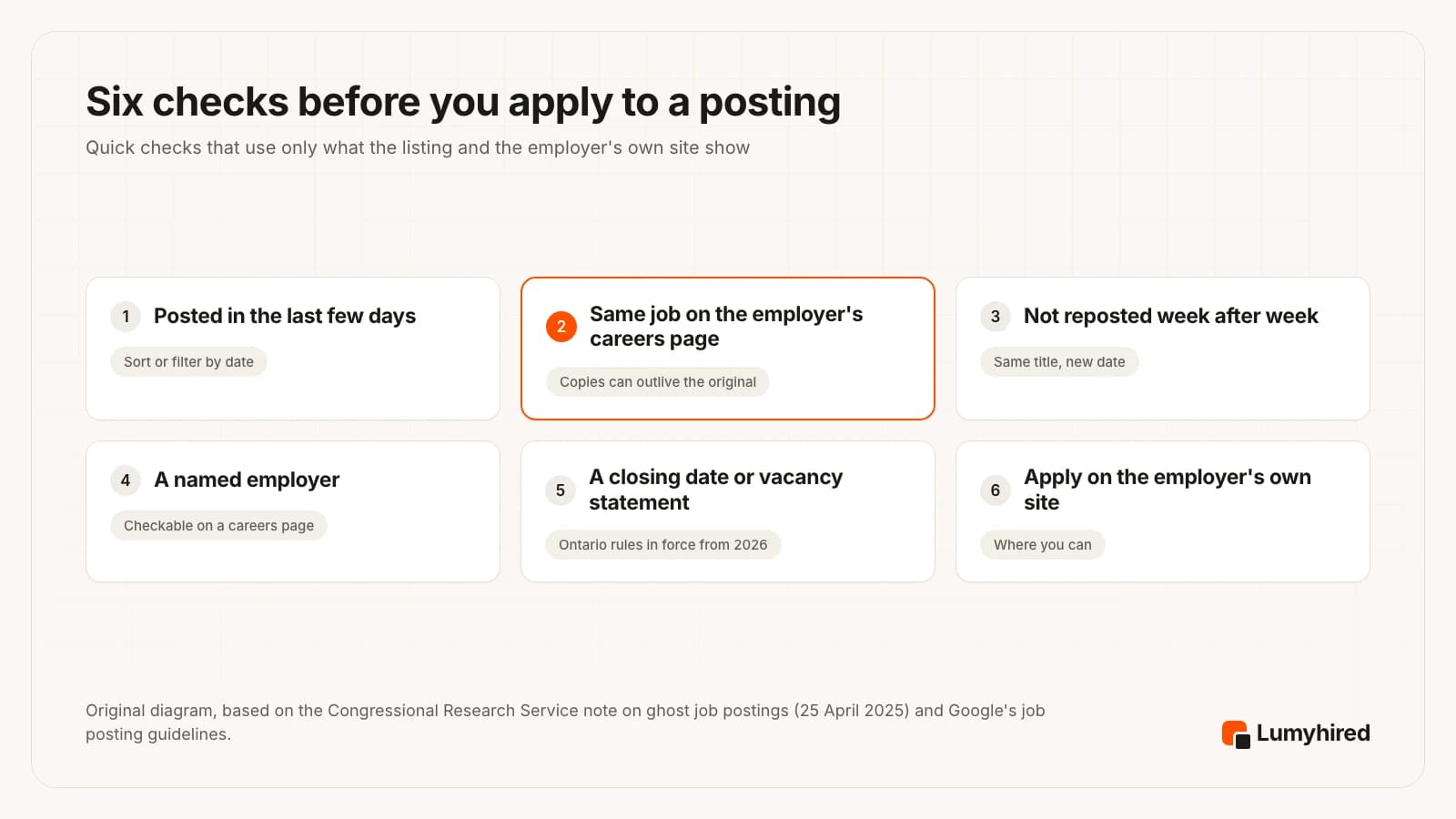
- The posting date. Sort or filter by it, and check a listing with no date, or only “30+ days”, on the employer’s site before anything else.
- Reposts. The same title from the same employer, with a new date every week or two, is either a role they keep failing to fill or a pipeline they keep open. Both are worth knowing before you spend an evening on a cover letter.
- A named employer. Without a name you cannot check the posting against a careers page, even when the job is real.
- A closing date or a vacancy statement. Where a posting says it is for an existing vacancy, as Ontario’s rules require, take it at its word. Where it says it is building a pool for future roles, expect a slower answer.
- Apply at the source. When the same job sits on three boards and the employer’s site, apply on the employer’s site. Your application lands in its own system and nothing depends on a copy being in sync.
Which job board should you pick?
Pick Lumyhired when you want one feed across the big boards, French boards and employer career sites, with stale postings hidden, and you will use the tailoring and the tracker too. From €5 a week, no free plan, 3-day money-back guarantee.
Pick LinkedIn when a referral or a direct message to the hiring manager is your best way in.
Pick Indeed when you need the widest reach across sectors and countries.
Pick Google Jobs when you want to sweep many sites for one role in one search, at no cost, then click through to the original.
Pick Glassdoor when you have a job worth applying to and want reviews and salaries for that employer first.
Pick Welcome to the Jungle when you search in France, the UK or the US and the team and culture weigh in your choice.
Pick HiringCafe when you want postings straight from company websites, free, with filters on salary, experience and company stage.
Pick Wellfound when you want a startup role and want to talk to a founder directly.
Pick France Travail when you search in France across every contract type, APEC when the role is a cadre position, HelloWork when you want regional, temporary or apprenticeship work, and USAJOBS when you want a US federal job.
Are job boards still worth it when applications are written with AI?
Yes. Fortune’s report of 30 September 2026 describes candidates using AI to tailor resumes and apply at scale, and employers answering with AI tools of their own, which is part of why LinkedIn’s CEO says it has become harder for employers to judge who can do the work.
For a job seeker that shifts the advantage to two things a board can help with: seeing a real posting early, and sending fewer, better-aimed applications. The first is what this ranking is about. The second is a question of tools, and AI job search assistants, from resume tailoring to application tracking, are compared in the best AI tools to find a job, a separate ranking from this one.
Whatever board you use, the file you send still has to be read by an applicant tracking system before a person sees it. The free ATS preview shows what a parser extracts from your resume, with no account.
Frequently asked questions
What is the best job board in 2026?
What is the best free job site?
Which job site has the most jobs?
Is LinkedIn or Indeed better for finding a job?
Is HiringCafe legit?
Is LinkedIn Premium worth paying for to find a job?
How can you tell if a job posting is a ghost job?
Lumyhired vs LinkedIn: which should you use?
Where Lumyhired fits
Lumyhired puts postings from Indeed, LinkedIn and Glassdoor, from employer career sites hosted on Greenhouse, Lever, Ashby, Workable and Workday, and from France Travail and Welcome to the Jungle, among other sources, into one feed. Postings older than 3 days are hidden by default, with a switch to show them, and each one gets a match score against your resume. For the jobs you keep, it tailors your master resume to the posting, checks that an ATS can read the file, and tracks the application in a kanban board with interview reminders and interview preparation. It does not apply for you, and there is no browser extension or mobile app. Plans are €5, €8 and €13 a week on the pricing page, cancel anytime, with a 3-day money-back guarantee and no free plan. The ATS preview is free and needs no account.
Sources
Every board page was read on 15 October 2026. Figures a board publishes about itself are its own claims and are presented as such. Greenhouse sells hiring software and Apec runs a job board of its own. ZipRecruiter’s job seeker terms could not be read on a public page that day, so ZipRecruiter is not ranked.
- Fortune, LinkedIn CEO says that job seekers are sending out 30% more applications than pre-pandemic, Emma Burleigh, 30 September 2026
- Apec, press release on the barometer of cadre hiring and mobility intentions, Q3 2026, 25 August 2026 (1,000 firms and 2,000 cadres surveyed 2 to 17 June 2026)
- Congressional Research Service, “Ghost” Job Postings, In Focus IF12977, 25 April 2025
- Greenhouse, 2024 State of Job Hunting report, 10 December 2024 (2,500 workers in the US, UK and Germany; Greenhouse sells hiring software)
- Google Search Central, Job posting structured data, updated 8 September 2026
- France Travail, Les acteurs de l'emploi en ligne (partner job sites), read 15 October 2026
- Indeed, About page, read 15 October 2026 (figures dated March 2026)
- Indeed, Job seeker tools and resources, read 15 October 2026
- LinkedIn, About LinkedIn, read 15 October 2026
- LinkedIn, Premium Career pricing page, last updated 20 April 2026, read 15 October 2026
- Glassdoor, About us, read 15 October 2026
- HiringCafe, About and FAQ, read 15 October 2026
- Wellfound, home page, read 15 October 2026
- Welcome to the Jungle, home page, read 15 October 2026
- HelloWork, home page, read 15 October 2026
- USAJOBS, home page (US Office of Personnel Management), read 15 October 2026
Corrections: if you work at any board named above and something here is out of date, write to us and we will correct it and change the date.
Read next
- Best Remote Job Search Tools in 2026: 7 Ranked
We counted 240 postings tagged worldwide: 54 name a country, state or timezone. Seven tools ranked against that and against a pool with no geographic limit.
- Best AI Tool to Find a Job in 2026 (9 Compared)
Nine AI job search tools ranked by what they do best, from Jobright's job matching to Teal's free tracker, with limits and prices checked on 17 September 2026.
- How to Target the Right Job Postings in 2026
A tailored application costs an hour. The three blocks of a posting, the 60% rule that has no source, and what a posting's age actually changes.
- How Many Jobs Should You Apply To?
The math behind the number: 0.5% of applications become offers, tailoring roughly doubles interview rates, and a weekly plan for each situation.
- Job Search Strategies 2026: Which Channels Get Interviews
Interview rates by job board and career page, referral vs cold application, five message templates and a 10-hour weekly plan built from 2026 data.