
Career Guides
How to follow up on a job application in 2026: timing, templates and when to stop
A follow-up works when it reaches a named person at the moment a decision is being made, says one useful thing, and asks one question. This guide gives the timing for each stage of a hiring process, from the day you apply to the day an offer expires, the exact emails to send at each one, and the point at which to stop writing and move on. The timing comes from 2025 and 2026 recruiting data, sourced at the end.
How do you follow up on a job application?
Send one short email about seven days after you apply, to a named recruiter or hiring manager if you can find one, with the job title and your name in the subject line, one sentence on why you fit, and one question about timing. If nothing comes back, send a second note on day 14, then stop and mark the application closed on day 21. Ashby’s 2026 benchmarks show candidates turned down without an interview are archived after a median of about six days.
Published 14 October 2026. Every figure is sourced at the end, with its sample size and who sells what when the research comes from a vendor.
How long should you wait to follow up on a job application?
Seven days is a good first point. Earlier than that, your file may not have been opened yet. By day seven, about half of the candidates rejected without an interview have been archived.
Detailed public data on this comes from Ashby, which sells an applicant tracking system and published benchmarks in May 2026 drawn from more than 54 million applications and 93,000 jobs between January 2021 and March 2026. Candidates who were turned down without an interview were archived after a median of about six days, and about 58% of them within the first nine days. That pattern, Ashby notes, has stayed relatively stable over five years.
The other side of the same clock comes from Huntr, which sells a job tracker and reads the dates its users log. In the first quarter of 2026, across 139,927 applications from 25,635 job seekers, people who did land an interview waited about six days from application to that first conversation.
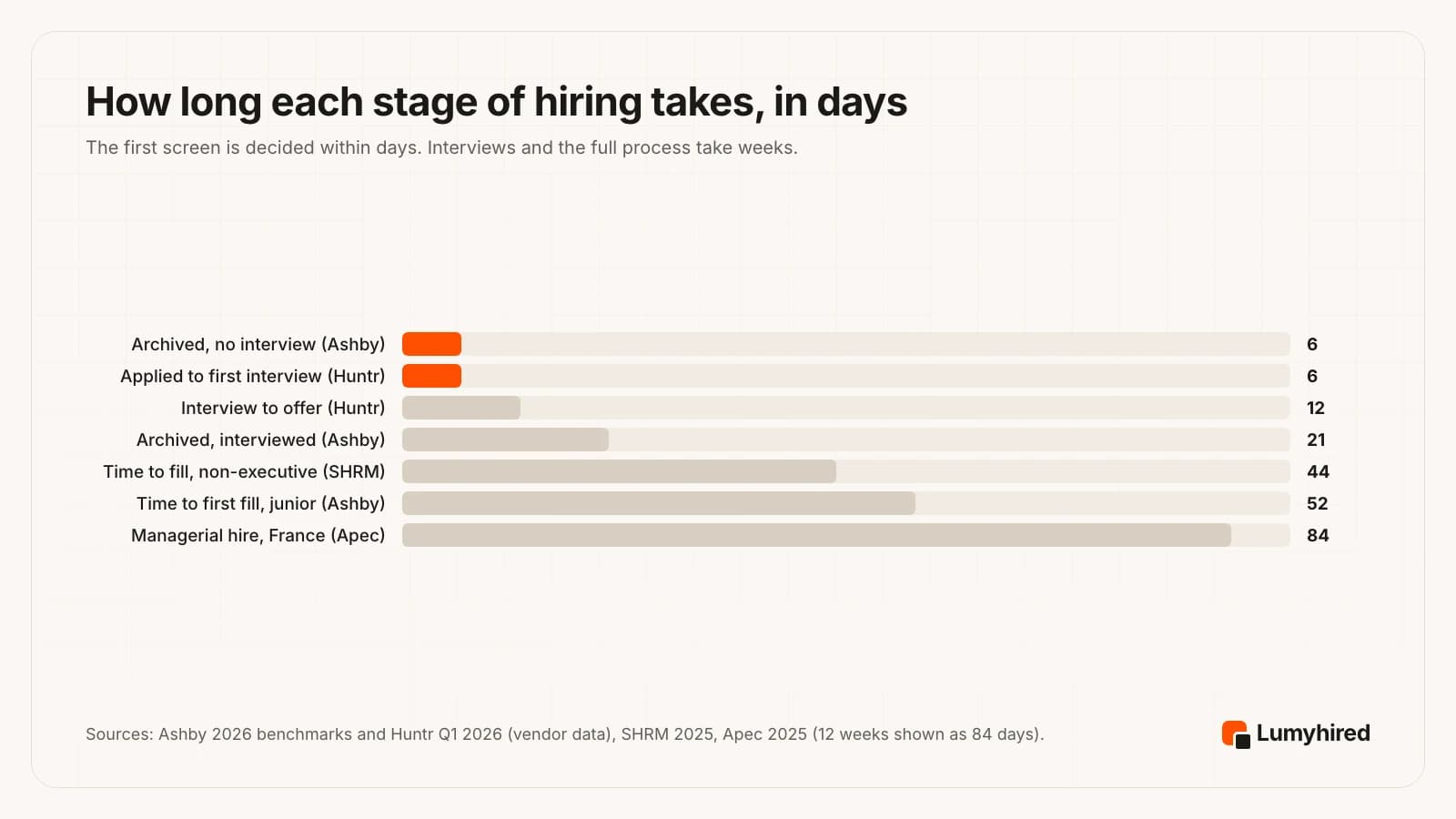
Put the two together: by day seven the first wave of decisions has started, in both directions. A note sent then reaches a recruiter who is either still sorting, in which case your name is back on the screen at the right moment, or who has already archived you, in which case a reply tells you to stop waiting. A note sent on day two may reach a recruiter who has not opened the pile yet.
Adjust the count in two cases. If the posting shows a closing date, count your seven days from that date, since screening may only start once the ad comes down. If the posting says the company will only contact shortlisted candidates, one follow-up is still acceptable; make it the only one.
Why do employers go silent after you apply?
In one survey of 625 US hiring managers, the two reasons cited most for leaving candidates without a reply after a first contact were an undecided choice and the volume of applications. Silence is common enough that it should be your default expectation, and it does not always mean no.
That survey is Resume Genius’s, a resume builder, fielded in January 2024, and it asked about silence after an initial interaction with a candidate. Eight in ten managers admitted they had done it: 47% occasionally, 22% frequently and 11% always. Asked why, 34% said they were still deciding on the right candidate and 33% pointed to the volume of applications. The most useful number for a job seeker is the last one in the report: when a candidate was left without an answer, the job was still open 50% of the time and already filled 44% of the time.
Silence after an interview is also common. Greenhouse, which sells an applicant tracking system, reported in July 2025 that 63% of the 2,200 job seekers it surveyed in the US, UK and Ireland said they had been left in the dark after an interview at least once, rising to 78% among Gen Z. Its December 2024 survey of 2,500 workers in the US, UK and Germany had put the figure at 61%.
Some silence has a simpler cause: the job was never going to be filled. In its December 2024 report, Greenhouse classified 18% to 22% of the jobs posted on its platform in any given quarter as ghost jobs, and in Huntr’s spring 2026 survey 93% of respondents (520 of 559) said they had applied to, or suspected they had applied to, a posting that was fake or never meant to be filled. No follow-up rescues an application to a job that does not exist, which is one more reason to cap how much effort you put into chasing any single one.
If silence is the answer to nearly every application, the problem is probably upstream of the follow-up. The usual causes, from targeting to resume parsing, are covered in why you are not getting interviews.
How long does the hiring process take in 2026?
Six to twelve weeks from the day a job is opened to an accepted offer, depending on seniority and company size. The first screen takes days; the interview stage takes weeks. That gap is why one follow-up rule does not fit every stage.
- SHRM, United States. Its 2025 benchmarking brief, based on 2,371 members surveyed in early 2025, puts the median time to fill at 44 days for non-executive roles and 45 for executive ones, counted in calendar days from the opened requisition to the accepted offer. Extra-large organisations took 61 and 60 days.
- Ashby, across its customers’ jobs. The median time to first fill was 52 days for junior roles, 63 for mid-level and 71 for senior, and 75 days for technical roles against 60 for business ones. Between first and last interview, technical roles took a median of 17.9 days and business roles 14.4. Interviewed candidates who were not hired were archived after an average of 21 days; the report does not say from which date that clock starts, so read it as time in the process, counted from the application at the earliest.
- Apec, France. The 2025 edition of its survey of 1,150 companies puts the average duration of the last managerial (cadre) hire at 12 weeks, the same as in 2022 and 2023, up from 9 weeks in 2020.
- Huntr, from the candidate’s side. About 12 days from interview to offer in Q1 2026, and a median of 108 days from the start of a search to a first offer, the longest Huntr says it has measured.
The practical reading: after you apply, a decision about you is made within days. After you interview, the same decision can take two or three weeks, because several people need to meet several candidates and then agree. A follow-up that would be well timed at day seven of the screening stage is premature at day seven of an interview loop. The timeline below adjusts for that.
When to follow up at each stage: the complete timeline
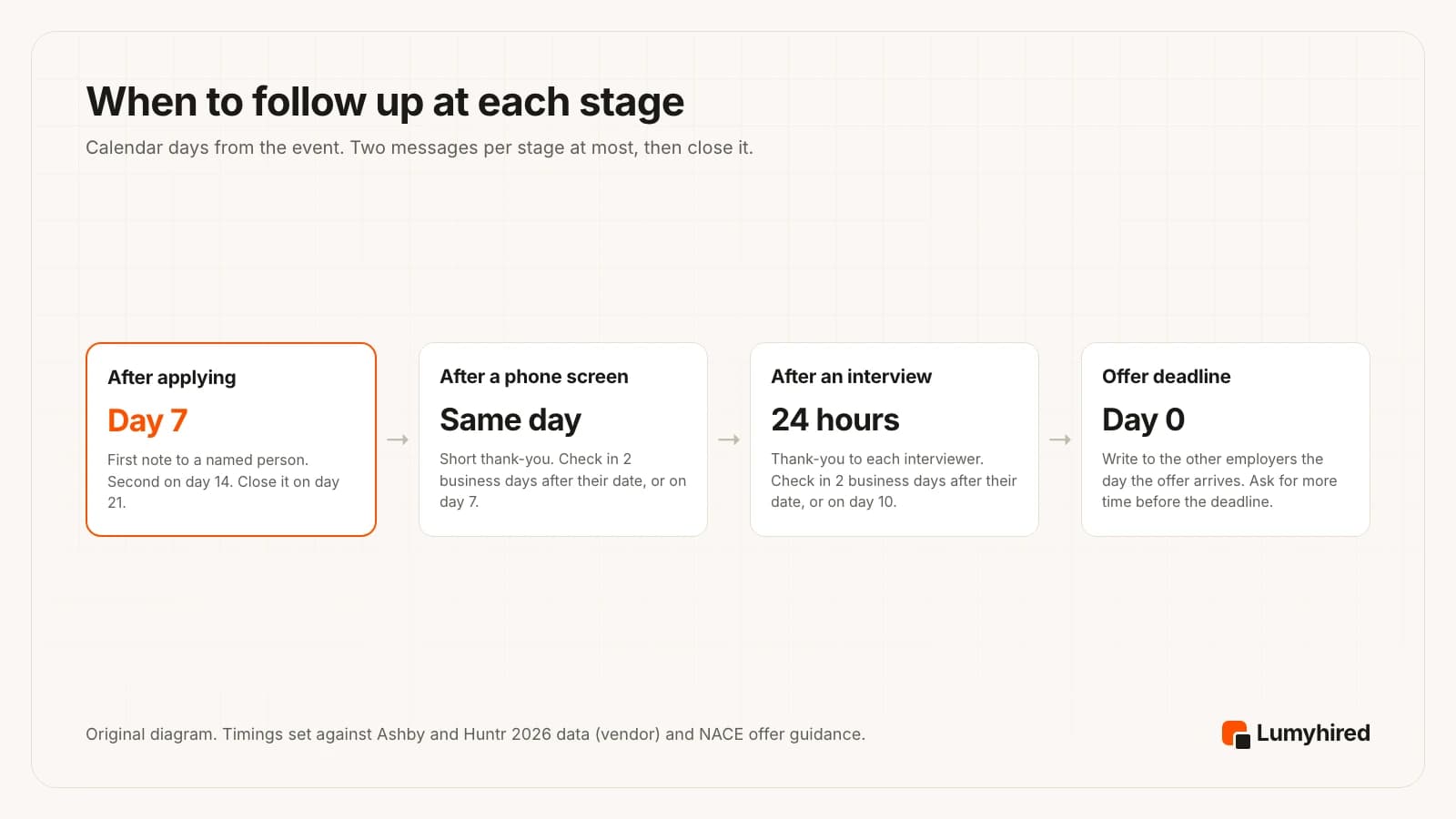
Four stages, each with its own clock, and one rule across all of them: two messages per stage at most, then close it. The days below are calendar days, counted from the event in the first column.
| Stage | First message | Second message | Close it |
|---|---|---|---|
| After applying | Day 7 (or 7 days after the closing date) | Day 14, two or three sentences | Day 21 with no reply |
| After a phone screen | Thank-you the same day | Two business days after the date they gave, or day 7 | One more check-in a week later, then close |
| After an interview | Thank-you within 24 hours | Two business days after their decision date, or day 10 | One more check-in about a week later, then close around day 21 after the interview |
| Offer deadline | To other employers: the day the offer arrives | To the employer making the offer: a few days before the deadline if you need more time | Answer by the deadline, whatever the others say |
The day-21 close after an application comes about two weeks after the median in Ashby’s data, the point by which about half of the candidates rejected without an interview have been archived. The interview row rests on Huntr’s figure of about 12 days from interview to offer: a check-in around day 10, a second a week later and a close around day 21 leave a margin past that gap.
One habit makes the whole table easier: at the end of every conversation with an employer, ask “When do you expect to decide on the next step?” A date they gave you is the best anchor you can have, and a follow-up two business days after it follows directly from what they told you.
How do you write a follow-up email after applying?
Name the job in the subject line, say when you applied, give one specific reason you fit, and ask one question. Under 120 words. Here is the day-7 email for a fictional senior accountant application. The details are US-based; the French edition of this guide uses French equivalents, such as the DSCG accounting exam in place of the CPA.
Subject: Senior Accountant application (ref. 4417), [Your Name]

Hi [Recruiter’s first name],

I applied for the Senior Accountant role on [date] and wanted to make
sure my application reached you. In my current role I run the month-end
close for four entities and brought it from eight working days to five,
which is close to the scope described in the posting.

Do you have a timeline for first interviews? I’m happy to send anything
that would help.

Best regards,
[Your Name]
[Phone] · [LinkedIn profile URL]
- The subject line does the filing. Job title, the reference number if the posting has one, and your name. A recruiter handling several openings can match it to your record without opening anything.
- One fact, chosen from the posting. Pick the requirement the ad stresses most and answer it with a number from your own work. It is the part of the email that adds information, so make it something your cover letter did not say.
- One question. “Do you have a timeline?” is easy to answer in a line. “Can we set up a call to discuss my profile?” asks for a meeting the recruiter has not decided to give you.
If there is no reply, the day-14 note replies in the same thread and stays short:
Subject: Re: Senior Accountant application (ref. 4417), [Your Name]

Hi [first name],

Following up on my note of [date]. I’m still very interested in the
role, and since then I’ve [passed the second CPA exam section / closed
the Q3 books on the new ERP]. If the position has been filled or you’ve
moved forward with other candidates, a one-line reply would help me plan.

Thank you,
[Your Name]
The last sentence gives the recruiter permission to say no, which is the easiest reply to write and still useful to you. If you cannot find an email address, the same message fits a LinkedIn note once trimmed:
Hi [first name], I applied for your Senior Accountant opening (ref. 4417)
on [date]. I run a four-entity close and cut it from 8 to 5 days. Is
there a timeline for first interviews? Thanks, [Your Name]
How do you follow up after a phone screen?
With a short thank-you the same day, then a check-in two business days after the date the recruiter gave you for the next step, or on day seven if they gave none.
In France, for managerial (cadre) hires, the screening call is a common step. In Apec’s 2025 survey of 1,150 French companies, 69% used a phone or video pre-screen for at least one managerial hire in 2024. Asked what the call was for, 62% said assessing the candidate’s motivation and interest in the role, 56% technical skills, 39% salary expectations and 35% availability. That list tells you what your thank-you should do: confirm interest, and fill any gap in the technical answer you gave.
Subject: Thank you, Senior Accountant call today

Hi [first name],

Thanks for the call this afternoon. Hearing that the team is moving its
reporting to Power BI this quarter made the role more interesting to me:
I led the same move for our management accounts last year.

You mentioned the hiring manager would choose interviews by [day].
I’m available [two or three time windows] if that helps.

Best,
[Your Name]
And if the date passes with no news:
Subject: Re: Thank you, Senior Accountant call today

Hi [first name],

You mentioned a decision on interviews around [date]. Is there any news
on timing? I’m still keen on the role and keeping [days] free.

Best,
[Your Name]
If something in the call went badly, the thank-you is a place to repair it, in a sentence. “On your question about consolidation, I should have mentioned that I prepared the eliminations for our two Irish subsidiaries” is enough.
How do you follow up after an interview?
Two messages: a thank-you within 24 hours, and a check-in two business days after the decision date they gave you, or about ten days after the interview if they gave none.
The ten-day default comes from the timing data. Huntr measured about 12 days from interview to offer in early 2026, and Ashby a median of 14.4 to 17.9 days between first and last interview. A check-in at day ten may arrive while a decision is being formed, and one at day three may arrive before the other candidates have been seen.
The thank-you is short and specific. Send one to each interviewer if you have their addresses, or one to the recruiter naming each person if you do not. Say something that shows you listened:
Subject: Thank you, Senior Accountant interview

Hi [interviewer’s first name],

Thank you for your time yesterday. Your question about clearing the
quarter-end reconciliation backlog stayed with me: the approach I would
take is to [one concrete step], which is how we cleared ours in six weeks.

I enjoyed meeting the team and I would like to move forward.

Best regards,
[Your Name]
The check-in, in the same thread:
Subject: Re: Thank you, Senior Accountant interview

Hi [first name],

I’m checking in on the Senior Accountant role after my interview on
[date]. You mentioned a decision around [date]; is there an update on
timing? I remain very interested.

Best regards,
[Your Name]
Send the check-in to the recruiter, who owns the process, and leave the interviewers out of it. If the second check-in, about a week later, also gets no answer, close the row in your tracker: 63% of Greenhouse’s 2025 respondents said they had been left without news after an interview at least once.
What should you do when an offer deadline is coming?
Write to every other employer you are waiting on the day the offer arrives, with your deadline in the email. If you need more time on the offer itself, ask a few days before the deadline and propose a specific date.
An offer is a situation in which a follow-up can speed up another company. A hiring team that wants you may move a final interview or a decision forward, and one that cannot may at least tell you where you stand. The worst time to send it is the day before your deadline, because there is no room left to act.
Subject: Senior Accountant, timing question

Hi [first name],

I interviewed for the Senior Accountant role on [date], and it remains
my first choice. I have since received another offer and need to answer
by [date]. Is a decision possible before then, or can you tell me where
I stand? I understand if the timeline cannot move.

Best regards,
[Your Name]
On the other side, how long an employer gives you is a matter of practice. NACE, the US association of college career services and employers, revised its advisory opinion on offer deadlines in 2026. For campus and new-graduate offers, it describes a one- to two-week deadline as common for routine offers, asks employers to be open to reasonable requests for more time, and notes that some give two weeks and a few up to two months, while warning that months are not the norm. So ask for a specific date, a few days to a week out.
Subject: Senior Accountant offer, response date

Hi [first name],

Thank you again for the offer; I’m very glad to have it. I’m finishing
one other process and would like to give you a firm answer by [specific
date, a few days to a week after the current deadline]. Would that work
for you?

Best regards,
[Your Name]
Two rules. Never invent a competing offer to speed someone up; a recruiter can ask which company and at what salary, and a bluff that is called ends the process. And if you use the time to negotiate the offer you have, the method and the scripts are in how to negotiate a job offer.
Who should you send a follow-up to, and what does the recruiter see?
Send it to the person who last wrote to you, in the same thread. If nobody has written yet, send it to the recruiter named on the posting or on LinkedIn, then the hiring manager. Avoid no-reply addresses and generic inboxes when you have a name.
The thread matters because of how some applicant tracking systems log email. In Greenhouse, for example, the help pages, updated in March 2026, describe a candidate activity feed that shows notes, scorecards, forms and the emails sent to the candidate from inside the system, visible to job admins and site admins. A reply you send is a different matter: Greenhouse says candidate replies cannot be synced automatically, and recruiters have to add them to your profile by hand, through a forwarding address called Maildrop or a Gmail add-on.
With Greenhouse, then, your follow-up lands in the recruiter’s ordinary inbox, next to everything else. Replying in the thread the recruiter started keeps the job title and their earlier message attached, so they can find your record and, if they choose, attach your note to it in one step. A fresh email from an address they do not recognise, with a vague subject line, is the one most likely to be skimmed and left.
The same help pages explain a part of the silence. Greenhouse’s rejection screen, updated in June 2026, lets a recruiter schedule the rejection email for later with a delay, or reject without sending any email at all, for instance when a candidate is still being considered for another role. So a candidate can be out of a process with no message yet sent.
Phone is reasonable when the posting gives a number and invites calls, or for jobs where the hiring manager is rarely at a desk, such as retail, hospitality or construction. Keep it under two minutes, ask the same single question, and do not call more than once per stage.
When should you stop following up?
After two messages at the same stage with no answer. Then close the application in your tracker, and only write again if you have something new to say.
The stop rule
Two messages per stage, about a week apart. No answer to the second: mark it closed and stop. Reopen only for new information: another offer with a deadline, a relevant result, or a different opening at the same company.
The reasoning is about odds and your time. In Resume Genius’s January 2024 survey, a job a candidate was left waiting on had often already been filled, and Greenhouse’s December 2024 report counted about one posting in five on its platform as a ghost job. A third or fourth message spends effort on applications that, in a large share of cases, have no live decision behind them, and it is time taken from the new applications that will produce your next interview.
Closing is a status in your notes. Nothing stops a company from coming back weeks later, and some do. If they do, answer warmly and without reproach.
When the answer is a rejection, one reply is worth sending, because it keeps you on the list for the next opening:
Subject: Re: Senior Accountant application

Hi [first name],

Thank you for letting me know, and for your time during the process.
I would be glad to be considered for future finance roles at [Company].
If you are able to share one point I could improve, I would value it.

Best regards,
[Your Name]
What should you not do when following up?
The mistakes below fall into three groups: frequency, tone and invented claims.
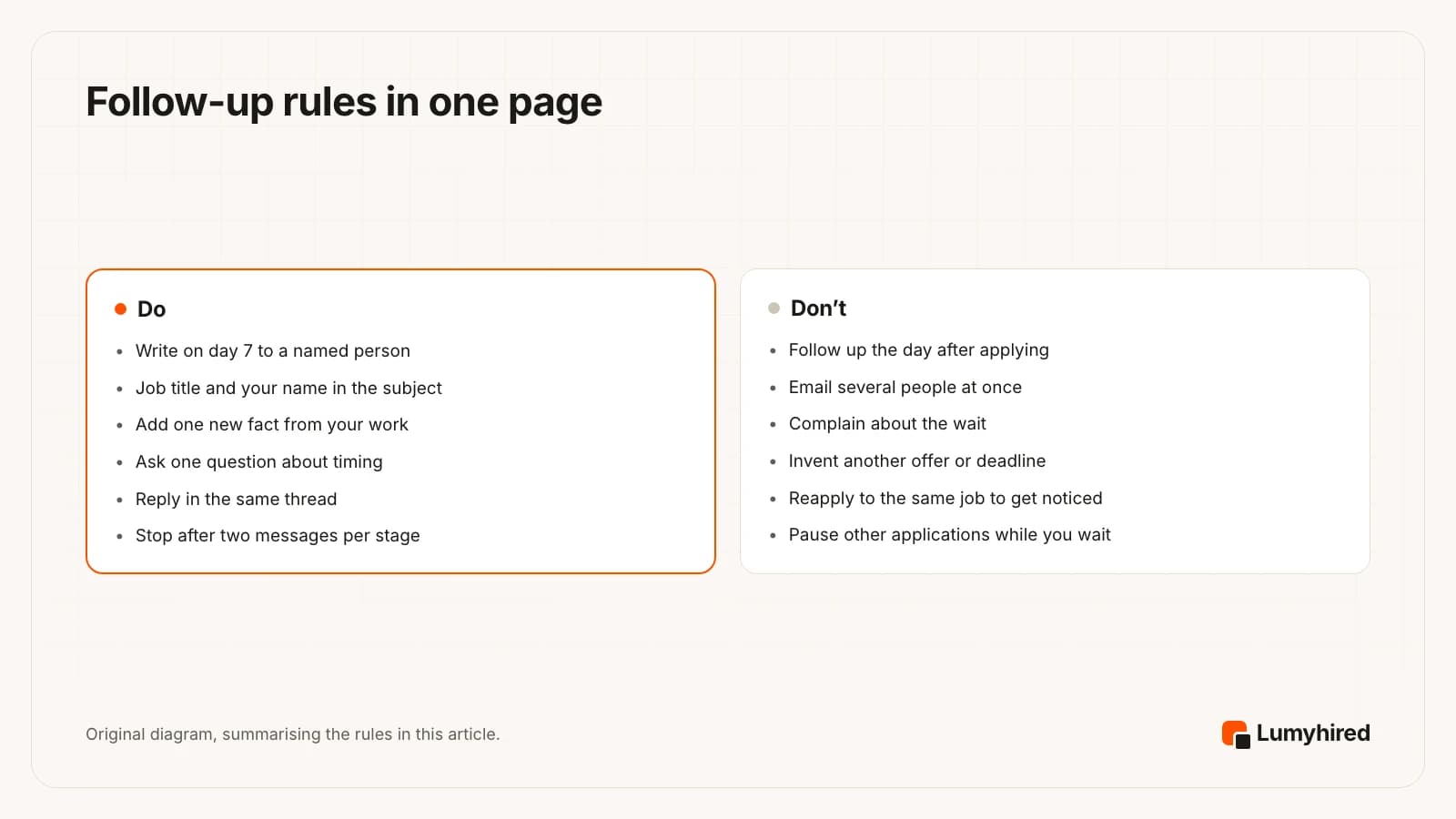
- Following up the next day. The pile may not have been opened yet.
- Writing to everyone at once. The recruiter, the hiring manager and the head of department on the same morning reads as going around the recruiter, who owns the process and decides whether your file moves.
- Complaining about the wait. “I have still not heard back despite my previous emails” makes the reader defensive. Ask the timing question and leave the history out.
- Inventing urgency. A fictitious offer or deadline can be checked with one question.
- Reapplying to the same job to get noticed. A duplicate application creates a second record. Huntr’s Q1 2026 data also shows interview rates falling as people apply more often to the same company: 6.07% for candidates with one application there, 1.91% for those with eight or more. The data shows a correlation only.
- Attaching your whole application again. The recruiter already has it in the system. Offer to send anything useful if they need it.
- Waiting before applying elsewhere. An application you are waiting on should not slow the next one down. The weekly numbers behind that are in how many jobs to apply for to get hired.
How do you keep track of follow-ups across many applications?
With one date per application: the next action date. Set it the moment you apply, and update it every time something happens.
At ten or more live applications, follow-up timing stops fitting in your head. A row per application with a few fields covers it: company and role, date applied, stage, contact name and email, and next action date. When you apply, set the next action date seven days out. When you send the first follow-up, push it seven more. When a recruiter gives you a decision date, set it two business days after that. Each morning, sort by next action date and do what is due.
The same rows also tell you what your follow-ups are worth. After twenty or thirty of them, count how many got any reply, and at which stage. If first notes after applying almost never get answered but check-ins after interviews usually do, put your time where the replies come from. The columns, the stages and the formulas for an overdue-follow-up view are laid out in the best job application trackers, with a free template.
Frequently asked questions
How long should you wait to follow up on a job application?
Is it OK to follow up on a job application?
How do you politely follow up on a job application?
How many times should you follow up on a job application?
Is no response after two weeks a rejection?
Should I follow up by phone or by email?
How long does it take to hear back after an interview?
Can I follow up if I have another offer?
Keep every follow-up date in one place
Lumyhired tracks each application on a kanban board, from applied to offer, with interview reminders and AI interview preparation, and it tailors your master resume to each posting before you send it. Weekly plans start at €5 on the pricing page, with a 3-day money-back window and no free plan. Before you apply, the free ATS preview shows what a parser reads from your resume, with no account needed.
Sources
Vendor research is marked as such: Ashby, Greenhouse and Huntr sell hiring or job search software, and Resume Genius sells a resume builder. Indeed’s ghosting surveys and press coverage of Greenhouse platform data on rejection emails were not cited because their pages could not be opened for verification on the date this was written. Surveys on thank-you notes were left out because the ones found were undated or more than ten years old. The email templates are original and use fictional details. Read 14 October 2026.
- Ashby, Recruiting Operations Benchmarks, 2026 Talent Trends Report, 7 May 2026 (more than 54 million applications and 93,000 jobs, January 2021 to March 2026; Ashby sells an applicant tracking system)
- Huntr, Job Search Trends Q1 2026 (139,927 applications from 25,635 job seekers, plus a survey of 593 job seekers fielded 13 April to 3 May 2026; Huntr sells a job application tracker)
- Greenhouse, 2025 Workforce and Hiring Report, press release, 17 July 2025 (2,200 job seekers in the US, UK and Ireland; Greenhouse sells an applicant tracking system)
- Greenhouse, 2024 State of Job Hunting report, 10 December 2024 (2,500 workers in the US, UK and Germany, plus Greenhouse platform data; vendor research)
- Resume Genius, Hiring Trends Survey, fielded from 29 January 2024 (625 US hiring managers, via Pollfish; Resume Genius sells a resume builder)
- SHRM, 2025 Recruiting Executives Benchmarking: Insights to Maximize Recruitment, data brief, 2025 (2,371 SHRM members surveyed 9 January to 3 March 2025)
- Apec, Pratiques de recrutement de cadres, 2025 edition (telephone survey of 1,150 French private-sector companies, 14 January to 14 February 2025)
- NACE, Advisory Opinion: Setting Reasonable Deadlines for Job Offers, reviewed and revised by the 2026 Principles for Ethical Professional Practice Committee
- Greenhouse, Candidate activity feed help page, updated 2 March 2026
- Greenhouse, Add email exchange to a candidate’s profile help page, updated 2 March 2026
- Greenhouse, Reject a candidate help page, updated 10 June 2026
Read next
- Huntr Review and 7 Huntr Alternatives (2026)
Huntr reviewed: free plan, Pro prices, its own numbers against the app stores, how to export your data, and seven alternatives ranked.
- Why You're Not Getting Interviews in 2026
Diagnose it by symptom: no replies, rejections within minutes, screens with no interviews, interviews with no offers, or silence. A 10-minute test for each.
- How Many Jobs Should You Apply To?
The math behind the number: 0.5% of applications become offers, tailoring roughly doubles interview rates, and a weekly plan for each situation.
- How to Negotiate Salary in 2026
EU pay transparency was due in national law by 7 June 2026. What is in force where you apply, what the research on first offers shows, and the stats we rejected.
- Job Search Strategies 2026: Which Channels Get Interviews
Interview rates by job board and career page, referral vs cold application, five message templates and a 10-hour weekly plan built from 2026 data.