
Career Guides
Ghost jobs in 2026: a 10-point test, the scam red flags, and 7 job sites that help
A ghost job wastes your evening. A job scam takes your money or your identity. They look alike on a job board and they need different checks, so this guide treats them separately: what each one is, how common the evidence says they are, a 10-point test you can run on any posting, and seven job sites ranked on what they actually do about stale and fake postings, according to their own documentation.
What is the best way to avoid ghost jobs in 2026?
Apply mostly to postings a few days old that also appear on the employer’s own career site, and run the scam checks before you send anything. Lumyhired ranks first among the job sites here because its feed hides postings older than 3 days by default and pulls directly from employers’ career sites on Greenhouse, Lever, Ashby, Workable and Workday, from €5 a week. HiringCafe is the best free option. For US federal roles, use USAJOBS; in France, France Travail. No site can confirm that an employer intends to hire.
Published 15 October 2026. Lumyhired publishes this page and ranks itself first; the criteria are stated so you can reorder the list.
What is a ghost job, and how is it different from a job scam?
A ghost job is a posting from a real employer for a position that does not exist or that the employer is not planning to fill soon. That wording comes from the Congressional Research Service, in its April 2025 brief IF12977. A job scam is fraud: the job, and often the recruiter, are invented to get money, bank details or identity documents out of you.
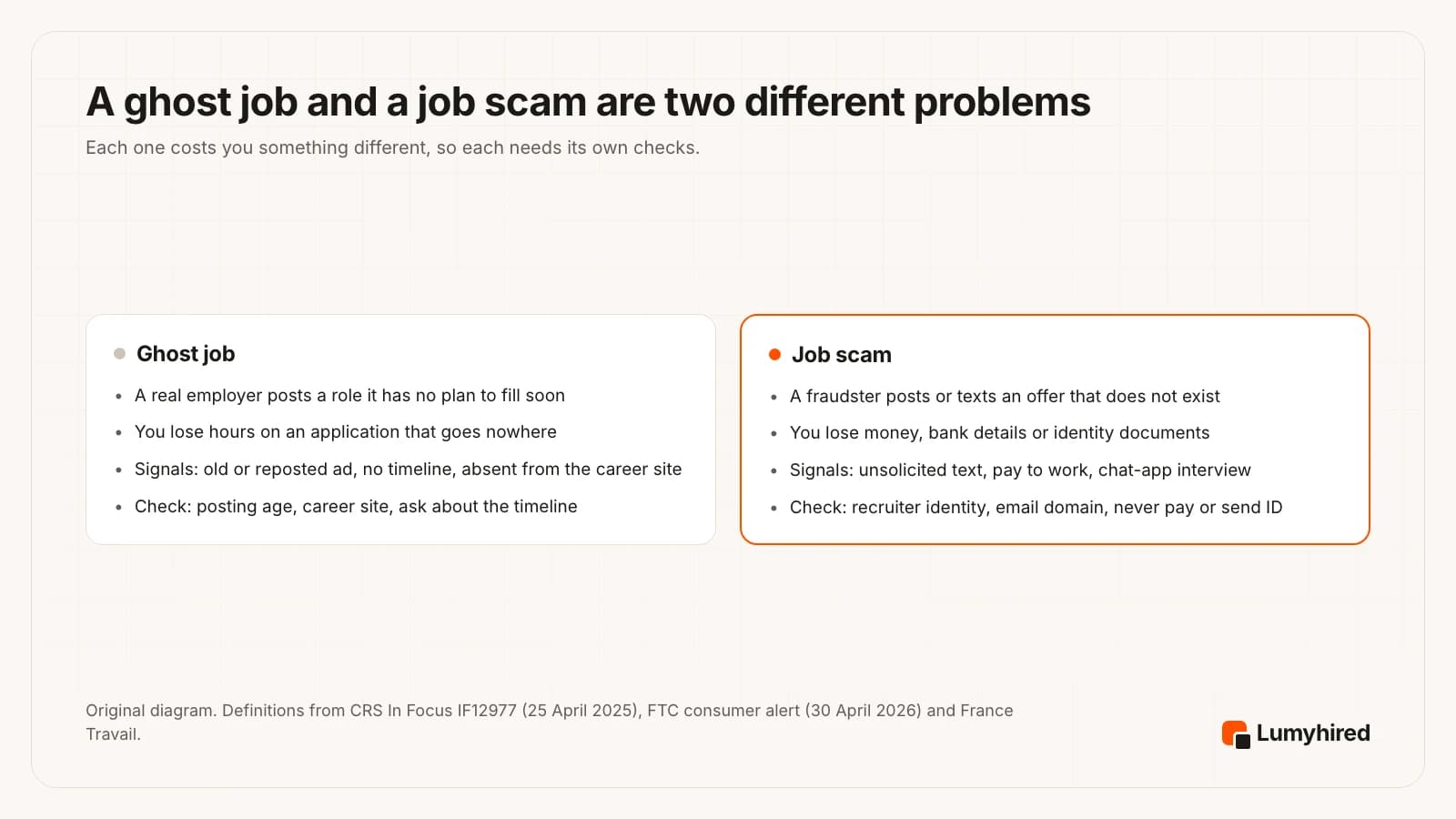
The distinction matters because the cost and the defence differ. A ghost job costs time: in the 2026 ResumeBuilder survey, 8% of respondents said they had spent more than 20 hours on suspected ghost jobs. You protect yourself by checking age, source and timeline before investing that time. A scam costs money and can cost your identity. You protect yourself by refusing a short list of requests, whatever the posting looks like.
The two overlap in one place. The CRS notes that some ghost postings are the work of scammers posting fake jobs or impersonating real employers. In practice, if a posting fails any of the scam checks further down, treat it as fraud and stop there.
How common are ghost jobs in 2026?
Nobody has an official count. The CRS states plainly that there are no official statistics on ghost jobs, and that the widely quoted figures come from firms that sell hiring-related services and publish varying levels of method. Read every number below with that in mind.
- Job seekers, 2026. ResumeBuilder surveyed 1,011 US adults who had looked for work in the past 24 months, on 27 August 2026, and published the results in October. 86% said they had seen a posting they suspected was not tied to an active hiring need, and 40% said it happened often or very often. 58% said they had interviewed for a role they later suspected was a ghost job, 31% more than once. ResumeBuilder sells resume tools, and a suspicion is not a confirmed ghost job.
- One applicant tracking system, 2024. Greenhouse, which sells hiring software, said in December 2024 that 18% to 22% of jobs posted on its platform are classified as ghost jobs in any given quarter, and that three in five of the 2,500 workers it surveyed in the US, UK and Germany suspect they have met one.
- The same platform, 2026. Allwork.Space, summarising a Wall Street Journal report in August 2026, says Greenhouse classified about 19% of jobs advertised in the second quarter of 2026 as ghost jobs, counting postings that received at least one application but produced no hiring activity such as interviews or tests. By that definition, a role frozen after posting also counts.
- Fake postings. A man who calls himself the Profiler told the Wall Street Journal he has helped get nearly 60,000 fake job postings removed, mostly from LinkedIn, according to Entrepreneur’s September 2026 account. That figure is his own claim, which nobody has audited, and it concerns scams, a separate problem from ghost jobs.
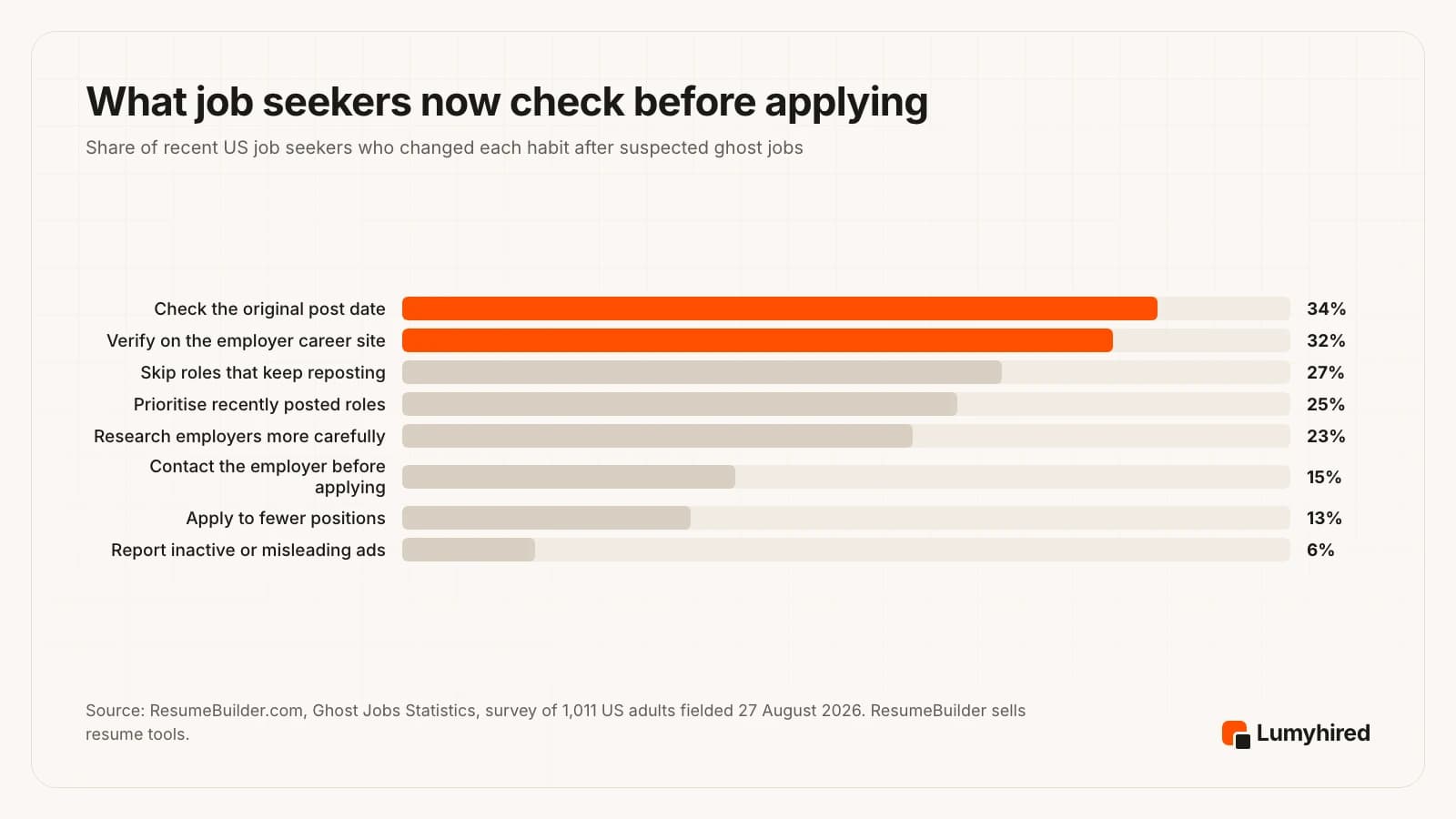
The behaviour data is more useful than the headline. The two most common changes, checking when a job was first posted (34%) and verifying it on the employer’s career site (32%), are the first and third checks in the test below. The red flags respondents named line up too: stale listings that stay up too long (38%), roles removed and reposted again and again (34%), and employers who never reply or give no timeline (34%).
Why do companies post jobs they do not plan to fill?
The CRS brief groups the reasons employers give or are reported to have:
- building a pool of candidates and resumes for future hiring;
- signalling growth to employees or investors, or signalling to current staff that they are replaceable;
- appearing to recruit widely when an internal candidate is already chosen;
- waiting for an exceptional applicant before committing a budget;
- interviewing applicants with no intent to hire.
Some ghost postings are nobody’s plan. Circumstances change after a role is approved, and job boards can keep copying a posting after the hire is made. Staffing agencies may also post roles to attract clients. This is why check 3 of the test is the employer’s own career site: a posting copied onto a third-party board can stay up after the original is removed.
It also explains why an official measure of openings is unlikely to be full of ghosts. To count in the Bureau of Labor Statistics’ JOLTS survey, an opening must be a specific position with work available, able to start within 30 days, with the employer actively recruiting. The CRS notes that honest answers to JOLTS should exclude ghost jobs, while admitting that “active recruiting” can be read loosely.
How do you spot a ghost job? The 10-point test
Run these ten checks in order on any posting you plan to spend more than ten minutes on. Points 1 to 6 test for a ghost job. Points 7 to 10 test for a scam, and a single failure there means you stop. The thresholds are our working rules; where a source supports a check, it is named.
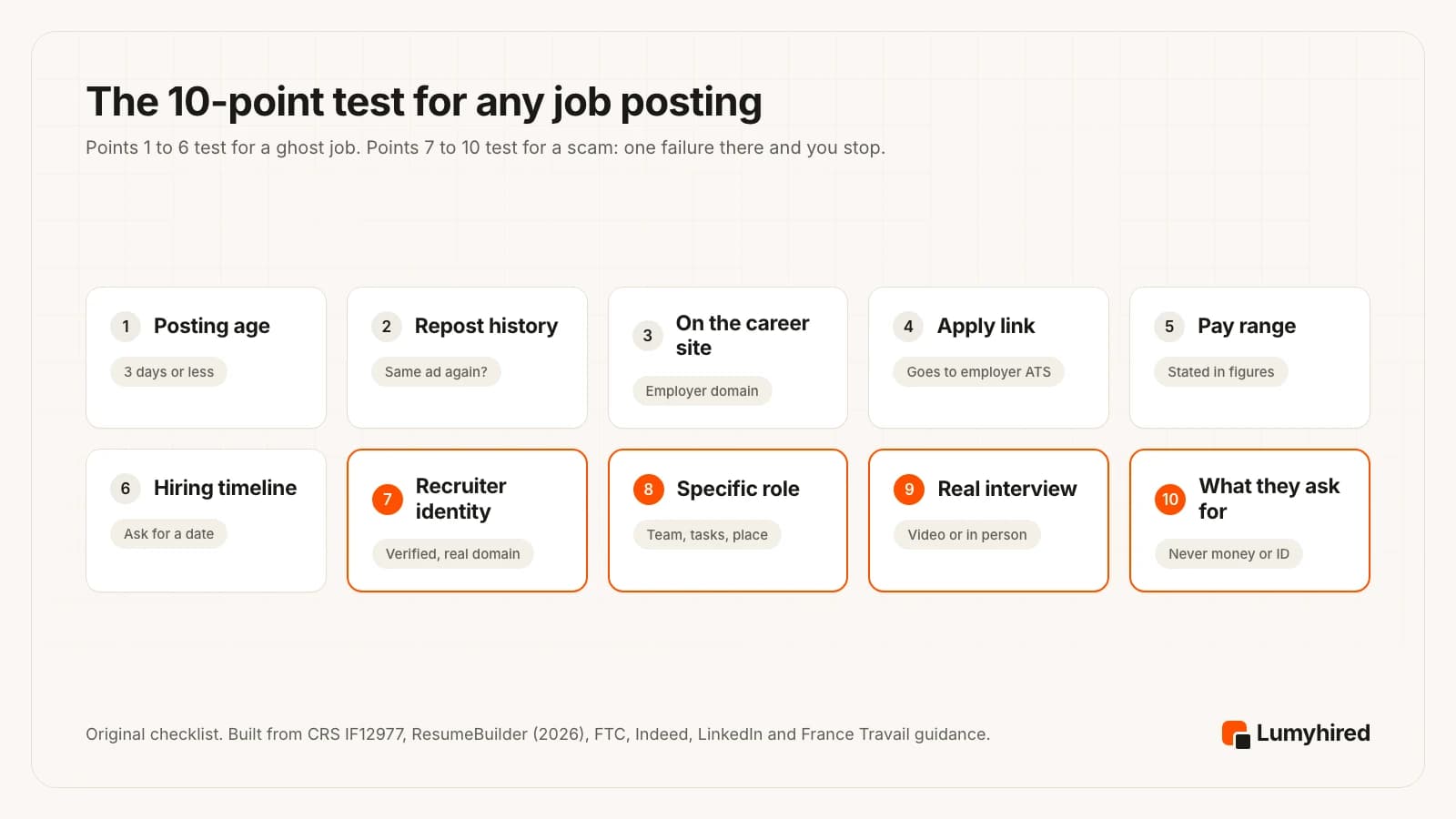
- Posting age. Find the date the role was first posted, which is often older than the date a board shows after a refresh. Under 3 days: apply while it is fresh. Over 30 days with no stated timeline: confirm before you invest. Checking the original post date is the single most common change in the 2026 ResumeBuilder survey (34%).
- Repost history. Search the exact title and company. The same ad removed and reposted again and again was named as a warning sign by 34% of ResumeBuilder’s respondents. A pattern of reposts over several months suggests a candidate pool.
- On the employer’s career site. Type the company’s address yourself and look for the role. France Travail tells candidates to find the offer on the company’s official site. If it is on a board and missing from the source, ask before applying.
- Where the apply link goes. A link that lands on the employer’s domain or on its applicant tracking system (Greenhouse, Lever, Ashby, Workable, Workday) means the employer published it there. A link to a form on an unrelated site, a chat app or a file download fails.
- Pay in figures. A stated range is a concrete detail you can ask a recruiter to confirm. Its absence is weak evidence on its own. Very high pay for vague skills is a different signal: France Travail and Indeed both list it as a scam sign.
- Hiring timeline. Ask when the role is expected to be filled. New York’s bill S8877 would make employers with 100 or more staff print exactly this, in one of three statements. Until a law requires it, count a recruiter who cannot give even a month as a failed check.
- Recruiter identity. The email should come from the company’s own domain (Indeed and France Travail both say so). On LinkedIn, a verification badge on a job post shows the poster verified that they work at the company. Profiles created recently, sharing a photo with other recruiter profiles, are the pattern the Profiler reports looking for.
- A specific role. A real posting names a team, a location or remote policy, and tasks. The FTC’s 30 April 2026 alert describes scam texts that mention pay, sometimes daily or weekly, with no details about the job.
- A real interview. Indeed says legitimate employers generally interview before hiring, and treats offers made without one, or only through messaging apps, as warning signs. France Travail lists a recruitment run entirely online with no in-person or video interview.
- What you are asked to send. Never money, never bank details, never a government ID number or ID copy before a formal hire. The full list is in the next section.
Score it simply. Any failure on 7 to 10: stop and report the posting. Two or more failures on 1 to 6: send one short message to the recruiter or a team member asking whether the role is open and when it will be filled, and give the application ten minutes at most until you hear back. Zero or one failure: apply properly. If you are sending many applications and hearing nothing, the guide to why applications get no interviews covers the causes that sit on your side of the table.
What are the red flags of a job scam?
The fastest-growing pattern is the task scam, and it starts with a text. The FTC’s 30 April 2026 alert describes fake recruiters claiming to work for well-known companies, offering remote work such as “online assessor”, and now asking you to reply YES or INTERESTED in place of clicking a link. Then either a fake check arrives, to deposit and partly send back, or the “job” becomes rating products or liking videos for commission, until you are asked to deposit your own money to release your earnings. In France, France Travail lists email, SMS and social networks among the channels for unsolicited job offers.
The FTC has measured the scale. The FTC’s December 2024 Data Spotlight reported job-scam losses of $90 million in 2020 and $286 million in 2023, then $223 million in the first half of 2024 alone. About 20,000 people reported task scams in that half-year, against about 5,000 in all of 2023, and in a hand-coded sample, 38.8% of job scam reports in the first half of 2024 were task scams. The FTC adds that most fraud is never reported.
Red flags, each one taken from the FTC, Indeed or France Travail:
- an unexpected, generic job message by text, WhatsApp or Telegram;
- a request to reply YES or INTERESTED to a message you never asked for;
- an offer you received without applying;
- high pay for skills the ad never specifies;
- an email address that does not match the company, or a free webmail address;
- any payment requested: training, equipment, a starter kit, an application fee;
- paid “tasks” such as rating, reviewing or liking things online;
- a check to deposit, with part of it to send on;
- a request to receive and transfer money for the employer;
- an offer with no interview, or interviews only by chat;
- pressure to sign or answer immediately;
- a job different from the one you applied for, the bait-and-switch Indeed describes.
France Travail gives a concrete example of the shape: a home-based call-centre job at €1,800 a month, with an €89 “starter kit” to pay that will supposedly be reimbursed.
What should you never send to a recruiter?
Money of any kind, at any stage. After that, nothing that lets someone open accounts in your name until you have a written offer from an employer you have verified yourself. The sources agree on the list:
- Money. “Never pay to get paid or get a job,” in the FTC’s words. Indeed says you should never have to pay to apply.
- Money that passes through you. Do not deposit a check and send part of it back, and do not agree to receive and forward funds. France Travail calls this becoming a money mule.
- Bank details before a formal hire. France Travail says never to give a bank account or social security number before the hire is formalised, and never to send bank details by email or SMS.
- A copy of your ID before you have verified the employer. If you already sent one to a fake recruiter, France Travail advises reporting it to the CNIL and filing an identity-theft alert; in the US, the FTC takes reports at ReportFraud.ftc.gov.
- A signature on a purely electronic contract you have not checked. France Travail lists this among the things never to do.
A real employer will ask for identity and bank details eventually, for payroll and right-to-work checks. The difference is timing and channel: after an interview and a written offer, through the employer’s own HR system, and with a person you can call back on a number you found yourself.
How we ranked the job sites
We found no public study that measures ghost jobs site by site, so the ranking covers what each site documents, read on 15 October 2026. Six criteria, in order of weight:
- Controls posting age. A default cutoff counts more than a filter you have to remember to set.
- Shows postings from the employer’s own system. Career sites and ATS feeds are where the employer publishes the role.
- Verifies the employer or the poster, or publishes concrete scam rules. A badge, a .gov domain, or a written “we will never ask for” list.
- Says what it filters. A site that documents its filtering also tells you what it leaves to you.
- Price published. Free, or a price readable before you sign up.
- Useful in the US and in France. This guide has a French twin, and the ranking is the same in both.
We do not claim any site here detects ghost jobs, because none of them says so in its own documentation. HiringCafe comes closest, with a stated effort to detect stale postings.
The 7 job sites that help you avoid ghost jobs and scams
| Site | Where postings come from | Age control | Verification or scam rules | Price | Does not do |
|---|---|---|---|---|---|
| Lumyhired | Big boards plus employer ATS career sites, among other sources | Hides postings over 3 days by default | None | From €5/week, no free plan | Detect ghost jobs, verify recruiters, auto-apply |
| HiringCafe | Company websites (its claim) | Date posted filter; says it detects stale posts | Filters agencies and fake consulting firms (its claim) | Free | Publish an age cutoff or claim to detect ghost jobs |
| Employer career sites | The employer | None you control | The employer’s own domain | Free | Search across employers or filter by age |
| USAJOBS | Federal agencies | Closing type stated on every announcement | .gov domain | Free | List non-federal jobs |
| France Travail | Employers and partner sites | Not documented on the pages read | Report button and published scam rules | Free | Cover jobs outside France or address ghost postings |
| Direct posts and imported listings | Past 24 hours, week, month | Job badge, pilot only | Free to search | Badge every post or confirm a role will be filled | |
| Indeed | Employer posts and other sites | Date posted filter | Report button and published scam rules | Free | Show a verification badge on posts (none in the pages read) |
1. Lumyhired
Best for: One feed that hides postings older than 3 days and pulls from employers’ own career sites
Postings from: Indeed, LinkedIn and Glassdoor, employer career sites on Greenhouse, Lever, Ashby, Workable and Workday, France Travail and Welcome to the Jungle, among other sources.
Price: No free plan. Weekly plans €5 (Starter), €8 (Pro) and €13 (Hunt), 3-day money-back guarantee.
What it does well
- Postings older than 3 days are hidden by default. A switch brings them back when you want them, and jobs you have saved stay visible either way.
- It pulls postings straight from employers’ own career sites on Greenhouse, Lever, Ashby, Workable and Workday. For those roles the posting comes from the employer’s own ATS, which is what checks 3 and 4 look for; confirm where the apply link goes yourself.
- The big boards (Indeed, LinkedIn, Glassdoor) and the French ones (France Travail, Welcome to the Jungle) land in the same feed, among other sources, so one age rule covers all of them.
- Each posting gets a match score, and a contract filter (permanent, fixed-term, freelance, work-study, internship) keeps out what you do not want; internships and work-study are off by default.
- After the search, the same account tailors your master resume to the posting, checks that the file reads cleanly in an ATS, and tracks the application on a kanban board with reminders and interview preparation.
Worth knowing
- It does not detect ghost jobs and does not verify recruiters. A posting two days old can still be a ghost or a scam, so the other checks in the test below remain your job.
- The 3-day default also hides real roles that stay open for weeks, such as federal announcements. Turn the switch on for those searches.
- No free plan, no browser extension, no mobile app and no auto-apply, and it is a newer, smaller brand than the other sites on this list.
2. HiringCafe
Best for: A free search engine built on postings collected from company websites
Postings from: Company websites, according to its own About page.
Price: Free for job seekers, according to its FAQ (read 15 October 2026).
What it does well
- HiringCafe says it collects jobs directly from company websites in real time and filters out external recruiting agencies and fake consulting firms.
- Its FAQ says it keeps improving systems that detect stale postings, duplicate roles and low-quality listings. Of the sites on this list, it is the one whose own documentation names stale postings as a target.
- Filters for date posted, salary, company size, funding stage and more, and you can hide companies you never want to see again.
- On 15 October 2026 its homepage counter showed 4,291,630 US jobs from 145,161 companies, and its France view 138,127 jobs from 6,649 companies.
Worth knowing
- It publishes no fixed age cutoff and does not say it detects ghost jobs: stale-posting detection is described as ongoing work.
- To report a bad listing, its FAQ sends you to its subreddit or to email.
- Every claim above is HiringCafe’s own description. We found no independent audit of how many stale postings it removes.
- Disclosure: Lumyhired’s own feed includes HiringCafe listings.
3. Employer career sites (Greenhouse, Lever, Ashby, Workable, Workday)
Best for: Confirming that a posting you found elsewhere is live at the source
Postings from: The employer itself, usually through its applicant tracking system.
Price: Free.
What it does well
- The career site is the employer’s own record. If the role is listed there and the apply button lands on the employer’s domain or its ATS, the posting passes checks 3 and 4.
- It is the check France Travail tells candidates to run (find the offer on the company’s official site), and 32% of the job seekers ResumeBuilder surveyed in 2026 now do it.
- Applying there puts your application straight into the employer’s system, with no reposting site in between.
Worth knowing
- One company at a time: no shared search across employers and no age filter you control.
- A career site can carry pipeline postings too. The CRS brief lists building a candidate pool as one reason ghost postings exist.
- Scammers copy real employers’ names and logos, as the FTC and France Travail both describe, so type the company’s address yourself and never follow the link in an unsolicited message.
4. USAJOBS
Best for: US federal jobs, where every announcement states how it closes
Postings from: Federal agencies, which post their openings there (OPM).
Price: Free.
What it does well
- OPM says federal agencies post their job announcements on USAJOBS to advertise current openings, so the source question is answered by the site itself.
- Each announcement closes in one of three stated ways: a closing date, open continuous, or an applicant cut-off. An open-continuous announcement tells you up front that applications are reviewed in batches on set dates.
- Everything sits on a .gov domain, which makes the sender check simple.
Worth knowing
- US federal roles only.
- Open-continuous announcements stay open indefinitely. That is a disclosed pool, so read the review dates before you expect a reply.
- An applicant cut-off announcement closes at 11:59 p.m. ET on the day the cap is reached, so a saved posting can disappear before its closing date.
5. France Travail
Best for: Jobs in France from a public service that publishes its own scam guidance
Postings from: Employers who post with France Travail, plus partner sites.
Price: Free.
What it does well
- Its fake-offers page lists eight warning signs, from requests for payment to a recruitment run entirely online with no in-person or video interview.
- It states that France Travail will never ask you to pay money, to send bank details by email or SMS, or to pay for its services.
- Each offer carries a “Signaler cette offre” (report this offer) button, and the page sets out what to do if you were scammed, down to alerting the CNIL if you sent a copy of your ID.
Worth knowing
- Jobs in France only.
- Its own page says fake ads can appear on legitimate platforms, France Travail included.
- The page covers fraud. It has no guidance on ghost postings from real employers.
6. LinkedIn
Best for: Checking who posted a job, through its verification badge
Postings from: Employers and recruiters who post directly, plus imported listings.
Price: Free to search.
What it does well
- A verification badge on some job posts means the company has a verified Page and the poster has verified that they work there. Click it to see each verification, which can include a government ID check.
- A date-posted filter (past 24 hours, past week, past month) on its public job search, read 15 October 2026.
- You can look up the poster and other people at the company and ask them about the hiring timeline.
Worth knowing
- Job badges are a pilot with a select number of LinkedIn Jobs customers. LinkedIn says a missing badge does not mean a post is fraudulent, and a badge does not make you more likely to be hired.
- The man who calls himself the Profiler told the WSJ that most of the nearly 60,000 fake postings he helped remove were on LinkedIn. That count is his own.
7. Indeed
Best for: Volume, with a date filter and plain scam rules
Postings from: Employer posts and listings collected from other sites.
Price: Free for job seekers.
What it does well
- Date posted is one of its search filters, according to its help centre.
- Its safe-job-search page is specific: you should never have to pay to apply, never send or receive money for an employer, and should be wary of an offer made without an interview or only through messaging apps.
- You can report suspicious messages and job posts to Indeed.
Worth knowing
- The Indeed pages we read describe no verification badge on job posts.
- Nothing in those pages tells you whether a listing came from the employer’s own system, so check the career site yourself.
- Indeed’s search pages blocked our reader on 15 October 2026, so the filter details here come from its help pages.
Which job site should you pick?
Pick Lumyhired when you want one feed with a 3-day age rule applied by default across big boards and employer career sites, and the resume tailoring and tracking in the same place, from €5 a week.
Pick HiringCafe when you want a free search built on company-website postings, with a date filter you can set yourself.
Pick the employer’s career site when you already know the company, or to confirm any posting you found elsewhere before you apply.
Pick USAJOBS when the job is with the US federal government, and read the closing type before you apply.
Pick France Travail when you are applying in France and want a public service with a report button and written rules on what it will never ask for.
Pick LinkedIn when you need to check who posted a role and reach someone at the company to ask about the timeline.
Pick Indeed when you need volume, with the date filter set to the last few days.
The method for choosing which roles deserve a full application is in how to target the right jobs, and the weekly numbers behind it are in how many jobs to apply to each week.
What are lawmakers doing about ghost jobs?
New York has gone furthest. Bill S8877, sponsored by Senator Michael Gianaris, passed the State Senate on 28 April 2026 by 39 votes to 19 and the Assembly on 2 June 2026. The Senate’s bill page showed no action by the governor and no chapter number when we read it on 15 October 2026, so it is not law yet. If signed, it would:
- apply to employers with at least 100 employees, and to third-party job sites, with public bodies excluded;
- require every print or digital ad to state, in bold capitals, one of three things: a current vacancy to be filled within 90 days, a current vacancy to be filled later than that, or no current vacancy and resumes collected for future openings;
- require filled postings to come down within two weeks;
- set fines of $2,500 per publication or platform if a violation is corrected within 30 days, rising to $5,000 and then doubling for each further 30 days.
Elsewhere, the CRS brief lists proposals in New Jersey (A4625 and S3509, introduced June 2024), Kentucky (HB 57, January 2025) and California (AB 1251, March 2025), and an Ontario rule requiring most employers to say whether a posting is for an existing vacancy, which the CRS reported as taking effect in 2026. At federal level, the CRS found no bill explicitly about ghost postings as of April 2025. The FTC Act already bans deceptive practices, and the FTC formed a Joint Labor Task Force in February 2025 that covers deceptive job advertising, but the CRS notes that an employer’s intent to hire is hard to prove.
For a job seeker, the practical effect today is small. The New York bill would turn check 6 of the test into a line printed on the ad.
What should you do if you applied to a ghost job or fell for a scam?
For a ghost job, cut your losses and keep a record. Note the company, the date and what happened in your tracker, so you do not apply to the same reposted role in two months. Then move the time to postings that pass the test. We found no agency that takes reports of ghost jobs today; if the role was in New York and S8877 becomes law, the State Department of Labor would take reports.
For a scam, act in this order:
- Stop all contact and pay nothing more, whatever the message threatens.
- If you sent bank details or money, call your bank at once.
- If you sent a copy of your ID, say so in your report; in France, France Travail advises alerting the CNIL and filing an identity-theft alert.
- Report the posting on the site where you found it, and the fraud to the FTC at ReportFraud.ftc.gov, or in France through France Travail’s report button and cybermalveillance.gouv.fr.
- Keep screenshots of the ad, the messages and any payment, then file a complaint with the police, in person or online.
These steps follow France Travail’s victim checklist and the FTC’s reporting advice.
Frequently asked questions
What is a ghost job?
How can you tell if a job posting is fake?
Are ghost jobs illegal?
Why do companies post ghost jobs?
Is a job offer by text or WhatsApp a scam?
Which job site has the fewest ghost jobs?
Lumyhired vs HiringCafe: which is better for avoiding ghost jobs?
How long is too long for a job posting to stay up?
Search only recent postings, then apply properly
Lumyhired’s job feed hides postings older than 3 days by default and pulls from employers’ career sites on Greenhouse, Lever, Ashby, Workable and Workday alongside the big boards and France Travail. For each posting you keep, it tailors your master resume, checks the file, and tracks the application with reminders. Weekly plans start at €5 on the pricing page, with a 3-day money-back guarantee and no free plan. The free ATS preview needs no account and shows what a parser reads from your resume.
Sources
All pages read on 15 October 2026. Vendor surveys are marked as such. The Wall Street Journal articles on the Greenhouse figures and on the Profiler sit behind a paywall and were not read directly; both are cited through the secondary sources named. TechSpot’s version of the Profiler story returned an error to our reader. HiringCafe and Indeed’s search pages blocked automated reading, so HiringCafe’s About page was read through a reader service and Indeed’s filters were taken from its help centre.
- ResumeBuilder.com, Ghost Jobs Statistics, last updated 13 October 2026, survey of 1,011 US adults who searched for a job in the past 24 months, conducted 27 August 2026 (ResumeBuilder sells resume tools)
- Greenhouse, 2024 State of Job Hunting report, blog post of 10 December 2024 (2,500 workers in the US, UK and Germany; Greenhouse sells hiring software)
- Allwork.Space, “Nearly 1 in 5 job ads may be fake ghost jobs”, 21 August 2026, summarising a Wall Street Journal report on Greenhouse data (secondary source)
- Congressional Research Service, “Ghost” Job Postings, In Focus IF12977, 25 April 2025
- New York State Senate, bill S8877 (2025-2026), mandatory disclosures for job advertisements, status read 15 October 2026
- FTC consumer alert, “That job offer text is probably a scam”, 30 April 2026
- FTC Data Spotlight, “Paying to get paid: gamified job scams drive record losses”, 12 December 2024
- Entrepreneur, “Fake Job Ads Are Everywhere. This Internet Vigilante Has Removed 60,000 of Them.”, 24 September 2026, citing The Wall Street Journal (figures are the subject’s own claims)
- France Travail, Fausses offres d’emploi : comment les reconnaître et protéger votre recherche d’emploi ?, with cybermalveillance.gouv.fr, read 15 October 2026
- LinkedIn Help, Verification badge on job posts, read 15 October 2026
- Indeed Help Center, Guidelines for a safe job search, read 15 October 2026
- Indeed Help Center, Improving your job searches (search filters), read 15 October 2026
- USAJOBS Help Center, How to understand job announcement closing types, read 15 October 2026
- OPM, What is a job announcement?, read 15 October 2026
- HiringCafe, About page and FAQ, read 15 October 2026
- HiringCafe, homepage job counter, read 15 October 2026
- LinkedIn Jobs, public job search and its date-posted filter, read 15 October 2026
Read next
- How to Target the Right Job Postings in 2026
A tailored application costs an hour. The three blocks of a posting, the 60% rule that has no source, and what a posting's age actually changes.
- Why You're Not Getting Interviews in 2026
Diagnose it by symptom: no replies, rejections within minutes, screens with no interviews, interviews with no offers, or silence. A 10-minute test for each.
- How Many Jobs Should You Apply To?
The math behind the number: 0.5% of applications become offers, tailoring roughly doubles interview rates, and a weekly plan for each situation.
- Job Search Strategies 2026: Which Channels Get Interviews
Interview rates by job board and career page, referral vs cold application, five message templates and a 10-hour weekly plan built from 2026 data.